Share this link via:

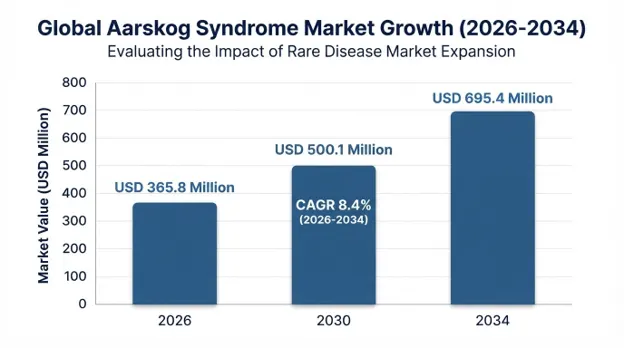
The global Aarskog syndrome market size was valued at USD 335.2 million in 2025 and is projected to reach USD 365.8 million in 2026, expanding to USD 695.4 million by 2034, growing at a CAGR of 8.4% during the forecast period (2026-2034).
Aarskog syndrome (also referred to as Aarskog-Scott syndrome or faciogenital dysplasia) is a rare X-linked genetic disorder that is the result of mutations in the FGD1 gene on the X chromosome, at position p11.21. The FGD1 gene encodes a guanine nucleotide exchange factor that plays an important role in cytoskeletal organization, cellular morphogenesis and embryonic development through its involvement in Rho GTPase signaling pathways. It mainly affects boys and is estimated to occur in 1 in 25,000 to 1 in 100,000 of all male births, but underdiagnosis likely means this is an underestimate. Normally a female carrier will have a mild or no clinical expression because of the X-inactivation patterns, although some may show subtle facial features or mild growth retardation.
The clinical syndrome is characterized by a triad of of craniofacial dysmorphism, skeletal abnormalities and urogenital malformations that was first described by Dagfinn Aarskog, a Norwegian pediatrician in 1970. Craniofacial characteristics are hypertelorism with widely set eyes, ptosis, short, upturned nose with anteverted nares, a broad philtrum, widow's peak hairline and low set ears. The bony features include Brachydactyly (Short broad hands and feet), interdigital webbing (especially fingers), clinodactyly (5th finger) and hypermobility of several joints. Other unique genital findings along with cryptorchidism (in about 50% of affected males) and hypospadias (occurring in a subset of patients) include a pathognomonic shawl scrotum in which scrotal tissue surrounds the base of the penis.
Growth hormone deficiency or insufficiency has been reported in 40–55% of Aarskog syndrome patients and requires formal provocative testing and possibly recombinant human growth hormone therapy, which is the main pharmacological treatment in the current treatment paradigm. These cognitive and behavioral issues are observed in about 30% of those affected and involve mild learning difficulties, attention deficit hyperactivity disorder and social communication difficulties that necessitate appropriate developmental and educational support programs in both childhood and adolescence.
The therapeutic market includes diverse multi-disciplinary therapies, rather than a single high-value therapy directed at the underlying dysfunction of the FGD1 pathway. Revenue includes growth hormone products for documented growth hormone deficiency, surgical correction of cryptorchidism, hypospadias and skeletal deformities, physical, occupational, speech therapy and developmental interventions, and full genetic testing and counselling for affected families and at-risk family members.
The commercial impact extends beyond therapeutic product sales to include but is also being broadened by the increasing infrastructure of next-generation sequencing diagnostic panels, patient registry development and rare disease drug development programs that are increasingly targeting the FGD1-Rho GTPase signaling axis involved in multiple developmental conditions. The market benefits from favorable regulatory frameworks for the development of rare disease drugs, such as the designation of rare disease programs, which offer commercial incentives for pharmaceutical investment in this historically underdeveloped ultra-rare disease space through market exclusivity, waivers of development fees, and increased regulatory support.
| Report Coverage | Details |
|---|---|
| Base Year | 2025 |
| Base Year Value | USD 335.2 Million |
| Forecast Value | USD 695.4 Million |
| CAGR | 8.4% |
| Forecast Period | 2025-2034 |
| Historical Data | 2022-2025 |
| Largest Market | North America |
| Fastest Growing Market | Asia Pacific |
| Segments Covered | By Treatment Type, Diagnosis Type, End-User, Region |
| Region Covered | North America, Europe, Asia Pacific, Middle East & Africa, Latin America |
| Countries Covered | US, Canada, UK, Germany, France, Italy, Spain, Japan, China, India, Australia, Brazil, UAE, Saudi Arabia, South Africa |
| Key Market Playes | Novo Nordisk A/S, Pfizer Inc., Ipsen S.A., Sandoz International GmbH, Ferring Pharmaceuticals, Ascendis Pharma A/S |
Get more details on this report - Request Free Sample
The primary driver of Aarskog syndrome market expansion is the revolutionary improvement in diagnostic identification rates enabled by widespread adoption of next-generation sequencing technologies, comprehensive genetic panel testing, and whole exome sequencing in clinical practice. These advances have transformed diagnosis from a predominantly clinical exercise dependent on expert dysmorphology recognition to a molecularly confirmed process accessible across diverse healthcare settings. Historically, Aarskog syndrome was substantially underdiagnosed due to phenotypic overlap with other conditions including Noonan syndrome, Robinow syndrome, and various skeletal dysplasias, combined with relatively mild presentations that often did not prompt specialist referral.
The global rare disease genetic testing market has witnessed significant growth as the cost of next-generation sequencing reduced from around USD 5,000 for each whole exome sequencing test in 2015 to less than USD 800 in 2025. This reduction in testing costs has greatly raised the percentage of patients with suspected genetic disorders who get genetically confirmed, with the identification of mutations in the FGD1 gene being an integral part of comprehensive X-linked intellectual disability gene panels, RASopathy panels, and skeletal dysplasia gene panels. As such, the improved success rate has translated into market expansion as new patients get diagnosed and require growth hormone therapy, urological care, developmental screening, and genetic counseling.
Patient registries and natural history studies have improved understanding of the true prevalence of Aarskog syndrome., although there is a suspicion that many cases go undiagnosed. More referrals of patients to the clinical genetic service have been achieved through better knowledge about Aarskog syndrome among pediatricians and other specialists through rare disease education programs and online diagnostic tools.
Deficiency and insufficiency of growth hormones constitute the two most medically treatable forms of Aarskog syndrome where treatment with recombinant human growth hormone becomes the dominant category of cost in the treatment market. Studies indicate that 40–55% of patients of Aarskog syndrome cases with growth hormone deficiency or sub-normal secretion of growth hormone or inability to produce IGF-1 hormone which provides an indication for the use of growth hormone replacement therapy for improving final height by 4-8 cm.
Commercial growth hormone therapy market can gain from already existing insurance reimbursement process for confirmed cases of growth hormone deficiency in major countries such as the USA, EU, and Japan where the approval process includes the diagnosis of short stature with genetic causes. Studies have shown that there is significant increase in height velocity among children with Aarskog syndrome under treatment with growth hormone. Insurance coverage decisions for growth hormone therapy are based on scientific evidence, which is reflected in pediatric endocrinology guidelines. Long-acting growth hormones with weekly administration represent an advance in the field of endocrinology.
The average annual cost for the administration of growth hormones per patient is between USD 10,000 and USD 35,000, which varies according to dosage based on body weights and drug choice. Long-acting growth hormone formulations have experienced rapid market adoption has seen an increase in their market share of about 28%, annually.
Regulatory and commercial incentives established under orphan drug legislation have completely transformed the attractiveness of rare disease drug development, including disorders related to the FGD1-Rho GTPase signaling pathway associated with Aarskog syndrome. Under the Orphan Drug Act there is an offer for seven years of market exclusivity, waiver of development fees, tax credit for qualifying expenses on clinical trials, and enhanced access to regulatory guidance; all these elements decrease the risk of developing such a program and improving its ROI.
The increasing recognition of Rho GTPase signaling dysfunction in Aarskog syndrome is fueling scientific research on the targeted treatment options of the pathway by academics and emerging biotech companies. There are several projects and initiatives involving pre-clinical and investigational approaches in the pharmacological modulation of downstream effectors, which can help to alleviate the developmental defects or prevent further complications. There is no specific treatment developed for the disease, but due to the growing environment of rare disease drug development there are promising opportunities for pipeline developments.
The primary constraint on market growth of the Aarskog syndrome is the intrinsic constraint posed by its ultra rare occurrence where the global affected population in males is projected to be around 85,000-340,000, based on different diagnostic ascertainment assumptions. The small patient population makes it commercially challenging to develop drugs that cater to the syndrome and hence creates difficulty in justifying the costs of developing these drugs.
Geographical spread of the disease among global markets further makes it difficult to conduct commercialization efforts as the patient base in a particular nation is often insufficient to form the critical mass required to conduct clinical trials. For the development of a specific intervention, multi-nation clinical trials will have to be conducted as per different regulations.
A significant opportunity lies in the development of therapies that would address the actual mutation in the FGD1 gene leading to Aarskog syndrome using cutting-edge technologies such as adeno-associated virus vectors, gene editing techniques based on CRISPR technology, and RNA drugs that proved their efficiency in treatment of other X-linked diseases. The relatively small size of the FGD1 gene coding region at around 3.4 kb fits into the limitations of adeno-associated virus vectors, and pre-clinical experiments show the possibility of achieving partial phenotypic correction.
Gene therapies for X-linked disorders have already set some precedents for regulations and manufacturing processes that can be utilized in gene therapy treatment for Aarskog syndrome patients. In several academic research centers where there is experience with gene therapies for rare diseases, pre-clinical trials to replace the FGD1 gene have been undertaken with promising results.
Structural change is taking place in the Aarskog syndrome market because of the development of specific rare disease centers of excellence, as well as multidisciplinary care programs that bring together expertise in clinical genetics, pediatric endocrinology, developmental pediatrics, urology, orthopedics, and psychology under one roof. Specialized centers of excellence offer much more advanced diagnostics, coordinated treatment plans, and follow-up care that can be achieved through fragmented specialist treatment provided separately from each other.
The development of centers of excellence leads to the creation of significant dynamics in the market, since these facilities concentrate several patients to enable the use of new diagnostic tools and techniques, involvement in clinical trials, and new approaches to therapy. The concentration of patients facilitates commercial development, as it enables us to identify sites of high-volume treatment that allow efficient education and launch of pharmaceutical products.
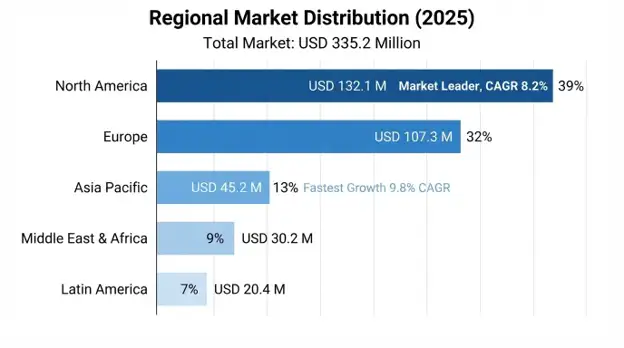
North America held the largest market share in 2025 at USD 132.1 million and is expected to retain the same CAGR of 8.2% until 2034. This is because of the availability of the complete rare disease healthcare framework ranging from genetics clinics in academic medical centers, existing reimbursement pathway for orphan drugs through Medicare and commercial insurance, high prevalence of genetic testing, and pharmaceutical development for rare diseases. In North America, the USA accounts for 84% of market value thanks to the Orphan Drug Program offered by the FDA and strong patient advocacy groups.
Regulatory policy acts as a big source of business opportunities due to the availability of orphan drug designations offering seven years of exclusivity, breakthrough therapy designations, and rare disease programs offering regulatory expertise. Growth hormone therapy is covered by Medicare when there are deficiency states gives the reimbursement base for the primary treatment, while the availability of genetic tests by commercial insurances makes diagnosis possible.
The Asia Pacific region is the fastest-growing regional market with a CAGR of 9.8% to 2034 and a value of USD 45.2 million in 2025. Key factors driving the regional growth include fast growth in the infrastructure of genetic tests, increased awareness of rare genetic diseases among pediatric experts, increased healthcare spending for sophisticated diagnostic facilities, and government initiatives in favor of precision medicine programs, which include rare disease diagnostics.
China’s national genomics projects and rare disease registry programs of Japan are some public sector investments aimed at improving the diagnostic facility and patient detection rates. The Japanese market shows high development in the region because of its well-developed regulation for rare diseases, reimbursement of growth hormone therapy via the national health insurance system, and high rates of genetic testing among pediatric experts.
Hormonal Therapies lead the way in the treatment sector by accounting for 44% market share worth USD 147.5 million in 2025 and a 9.1% CAGR during 2025 to 2034. Growth hormone replacement is the major product type offered in the hormonal therapies segment, which includes treatment of growth hormone deficiency among affected individuals. This is a well-proven pharmacological therapy for the indication, as there exist well-defined reimbursement avenues for the treatment.
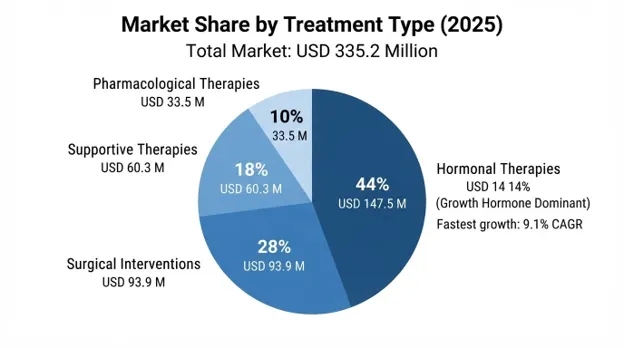
Surgical Interventions are responsible for 28% market share of USD 93.9 million in 2025, which includes orchidopexy for cryptorchidism, hypospadias surgery, orthopedics for skeletal deformities, and dentistry treatments. This is the steady income-generating segment because of the high prevalence of surgical conditions among patients, with the condition of cryptorchidism correction being required in about 50% of affected males.
Genetic Testing controls the largest share in the diagnosis market with 52% share valued at USD 174.3 million in 2025 with 11.2% CAGR till 2034. Genetic Testing includes Next Generation Sequencing Panels, Whole Exome Sequencing, and Targeted FGD1 Mutation Analysis providing molecular confirmation for the condition. Factors driving growth in this market include reduced cost of sequencing, increased coverage by insurance companies, and adoption by physicians.
Specialty Genetic Centers account for the largest end-user segment, contributing to 38% of the market share that amounts to USD 127.4 million in 2025 due to high levels of clinical expertise related to diagnostics and management present in genetics departments in academic medical centers. This type of center provides full diagnostics through molecular diagnosis and clinical evaluation including genetic counseling.
The global Aarskog syndrome market is highly fragmented because the lack of treatment drugs for Aarskog Syndrome and hence, an addressable market comprising players involved in the production of growth hormones, genetic test kits, and rare disease specialist companies. Some of the key players present in the relevant market segments hold 45-55% of the addressable market share owing to their growth hormone therapy offerings, genetic diagnostics, and rare disease treatment capabilities.
March 2026: Novo Nordisk presented additional clinical data on the efficacy of somapacitan as a long-acting growth hormone therapy in syndromic forms of short stature, including Aarskog syndrome, for future label expansion discussions with regulatory bodies.
February 2026: Invitae Corporation introduced an X-linked developmental disorders genetic test with increased sensitivity to detect mutations in the FGD1 gene, increasing the diagnostic rate for Aarskog syndrome by 12-18%.
December 2025: Aarskog Syndrome Foundation initiated a research funding program of USD 2.8 million to support academic research groups studying the FGD1 pathway and possible therapeutic targets.
You'll get the sample you asked for by email. Remember to check your spam folder as well. If you have any further questions or require additional assistance, feel free to let us know via-
+1 724 648 0810 +91 976 407 9503 sales@intellectualmarketinsights.com
22 Jul 2026
Intellectual Market Insights Research © 2026. All rights reserved.


