Share this link via:

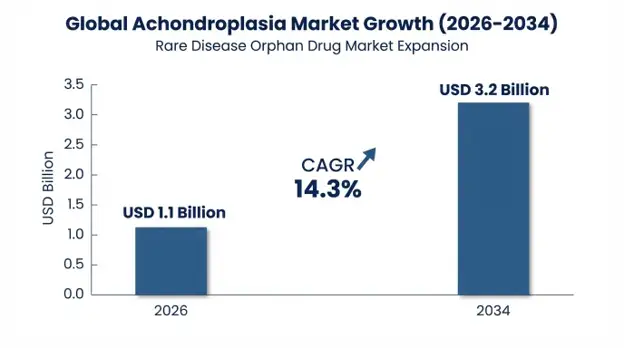
The global achondroplasia market size was valued at USD 890 million in 2025 and is projected to reach USD 1.1 billion in 2026, expanding to USD 3.2 billion by 2034, growing at a CAGR of 14.3% during the forecast period (2026-2034).
Achondroplasia is the most frequent type of disproportionate short stature and skeletal dysplasia, caused by a gain of function of the gene encoding fibroblast growth factor receptor 3 (FGFR3), mostly because of the G380R point mutation in the receptor gene, which occurs in about 97% of cases. This genetic change alters the function of FGFR3 signaling pathways, which causes defects in endochondral ossification, affects the growth of long bones, contributes to characteristic craniofacial abnormalities such as macrocephaly and midface hypoplasia, and results in abnormalities of the spine, as well as potentially life-threatening abnormalities like foramen magnum stenosis and cervicomedullary compression. It occurs in about 1 in 15,000 to 40,000 live births worldwide, and about 80% of cases occur as new mutations in families who do not have a history of skeletal dysplasia.
Over the last decade, the therapeutic approach to achondroplasia has been revolutionized., moving from purely symptomatic management by orthopedic surgery, respiratory support and psychosocial care to targeted molecular therapies directly targeting the underlying dysfunction of the FGFR3 pathway. In 2021, BioMarin Pharmaceutical's vosoritide (Voxzogo) was FDA approved as a disease-modifying pharmacological treatment that specifically targets achondroplasia, and demonstrating that the CNP-cGMP signaling cascade is an effective therapeutic target. that could overcome the overactive FGFR3 signaling in growth plate chondrocytes.
As part of modern achondroplasia management, multidisciplinary, targeted use of biologic therapy, combined with specific surgical procedures (such as limb lengthening, spinal decompression and foramen magnum decompression as needed), coupled with management of obstructive sleep apnea, which occurs in up to 96% of young children with achondroplasia, and audiological intervention for conductive hearing loss due to recurrent otitis media, and psychological support for quality of life issues related to visible physical differences and functional limitations. These treatments are increasingly delivered in dedicated skeletal dysplasia centers, providing optimal age-specific functional outcomes. with a minimum of disease-related complications.
| Report Coverage | Details |
|---|---|
| Base Year | 2025 |
| Base Year Value | USD 890 Million |
| Forecast Value | USD 3.2 Billion |
| CAGR | 14.3% |
| Forecast Period | 2025-2034 |
| Historical Data | 2022-2025 |
| Largest Market | North America |
| Fastest Growing Market | Europe |
| Segments Covered | By Treatment Type, Drug Class, Age Group, Route of Administration, End-User |
| Region Covered | North America, Europe, Asia Pacific, Middle East & Africa, Latin America |
| Countries Covered | US, Canada, Mexico, UK, Germany, France, Italy, Spain, Netherlands, China, Japan, India, Australia, South Korea, Brazil, Argentina, UAE, Saudi Arabia, South Africa |
| Key Market Playes | BioMarin Pharmaceutical Inc., Ascendis Pharma A/S, QED Therapeutics Inc., Sanofi SA, Pfizer Inc., Biomea Fusion Inc., Ribomic Inc. |
Get more details on this report - Request Free Sample
The most significant driver of the achondroplasia market is the transformation of the science of FGFR3 pathway biology into clinically beneficial drugs through the successful development of vosoritide which has set a milestone in the development of drugs for targeted treatment of skeletal dysplasias, thus attracting unprecedented investment in development of the next generation treatments. Vosoritide has shown statistically significant increases in yearly height velocity in Phase III clinical trials by 1.57 cm/year when compared to placebo and became the first drug to affect the basic pathology of the condition rather than just the symptoms.
The increasing therapeutic pipeline includes a variety of mechanistic approaches like TransCon CNP (navepegritide) by Ascendis Pharma, which is a long-acting analog of CNP, providing long-term stimulation of growth through weekly instead of daily subcutaneous administration; infigratinib by QED Therapeutics, an oral selective FGFR3 tyrosine kinase inhibitor that offers the benefit of oral dosing, and SAR442501, a soluble FGFR3 decoy receptor by Sanofi, which competes with fibroblast growth factors, limiting their action on the receptor.
Commercial impact extends beyond drug revenues from the sales of new drugs and include the creation of special facilities, development of growth monitoring protocols for children, and establishing registries, which contribute to clinical practice and further research initiatives. Vosoritide real-world evidence proves the penetration of therapy at the level of 25-40% of all eligible pediatric patients in early adopting markets; Treatment adoption is higher where families actively engage with patient advocacy groups and specialty centers.
Key Performance Metrics:
The achondroplasia market has benefited from significant improvements in diagnostic recognition. in the fields of neonatology, pediatrics, and medical genetics. This has enabled earlier diagnosis and treatment during the period when therapy is most effective. In the past, diagnosis was missed in poor and developing countries.
In prenatal diagnosis, the diagnosis by ultrasound for characteristic skeletal features, such as the short femoral length, macrocephaly, and the trident hand shape, has been greatly improved with the second trimester anomaly scan detecting around 65-70% of all cases of achondroplasia before birth in developed countries that offer screening for all pregnancies. The molecular genetic test confirming the presence of the FGFR3 G380R mutation is 100% accurate for the diagnosis of this condition, allowing better planning of the treatment from birth.
Patient registries and natural history studies specific to the achondroplasia patient group have been created to provide solid epidemiological information regarding the disease burden, growth rate, and complications frequency which is useful for drug approval applications, clinical trials, and post-marketing surveillance. Advocacy organizations such as the Little People of America and the Restricted Growth Association UK have raised awareness of this condition greatly among both patients and doctors.
Diagnostic Infrastructure Metrics:
The most significant constraint on achondroplasia market growth is the extremely high cost of treatment. is the prohibitively expensive cost of FDA-approved drugs, where a single-year course of treatment using vosoritide alone amounts to around USD 320,000 per patient and creates considerable reimbursement problems for healthcare systems across the board and, in effect, completely rules out the use of the drug for patients from middle- and low-income countries unless there are managed access programs for such patients. Lifetime treatment of a child diagnosed with achondroplasia and started treatment from the age of three until the growth plates close, around age 13-15, result in a treatment cost of USD 3.2-4.8 million.
Insurance coverage has proven to be inconsistent depending on payers and geography where commercial payers require heavy prior authorization documentation, attestations from specialists regarding the medical necessity of the drug, and re-assessment of benefit on an ongoing basis for the continued coverage. Medicaid programs in various states of the US have set quantity limitations, age limitations for covering the indication, or disease severity criteria which might not be consistent with the FDA approval labels. The European market access has been complicated by the health technology assessment processes which initially resulted in unfavorable reimbursement decisions in several countries. based on cost-effectiveness analysis using quality-adjusted life years thresholds inappropriate for the pediatrics rare disease.
The high cost of treatment has led to the establishment of patient assistance programs, compassionate use programs, and international managed access agreements; however, these programs cover only a small percentage of eligible patients around the world. Patients are also faced with huge out-of-pocket payments despite having insurance coverage.
Cost Barrier Impact Metrics:
A significant untapped market opportunity exists that exists in terms of the development of treatment modalities for the progressive musculoskeletal conditions, neurologic consequences, and quality-of-life issues facing adult patients with achondroplasia, who account for roughly 70% of all patients suffering from achondroplasia worldwide but for whom no disease-modifying drugs exist yet. Adults with achondroplasia experience from progressive spinal stenosis leading to neurogenic claudication and disability in as many as 85% of people aged 40 years or older, chronic pain due to joint deterioration and malalignment of the spine, obstructive sleep apnea needing continuous positive airway pressure, and cardiovascular diseases linked to obesity and metabolic problems.
Achondroplasia in adults constitutes about 175,000 patients who require treatment for conditions resulting from their disease, indicating that therapies targeting adult complications would have a significantly greater market than the pediatric population suffering from growth disorders. There is an array of potential treatments such as FGFR3 signaling pathway modulation in order to achieve neuroprotection in patients suffering from spinal stenosis, anti-inflammatories to deal with degenerative joint disease, respiration optimization, and complete pain management.
Adult Treatment Opportunity Metrics:
Current achondroplasia treatment research focuses on, the current focus is to employ combination therapies by using drugs that target more than one node of the signaling pathway of FGFR3, thereby allowing additive or synergistic effects of growth beyond single-target drugs. The basis of combining drug treatment lies in the various downstream pathways that are affected by the activation of FGFR3 and include MAPK/ERK, STAT1, and PI3K/AKT signaling pathways, which each have independent functions in preventing proliferation of chondrocytes and causing their early differentiation. One promising combination involves CNP-mediated cGMP signaling (vosoritide) with MEK inhibitors targeting the MAPK pathway.
Oncological precedents, in which activation of FGFR3 in bladder carcinoma and multiple myeloma through mutations is treated via combination treatment regimens that produce better results than those observed with monotherapy using an FGFR3 inhibitor, offer the mechanistic basis for combining therapies for achondroplasia. Nonetheless, safety issues related to children will play an important role in designing such combination treatments due to the necessity to account for toxicities and effects of simultaneous modulation of two pathways in organ growth stages.
Various research programs that target combination therapy focus on the use of CNP analogs along with FGFR3 tyrosine kinase inhibitors, decoys in combination with MEK signaling pathway inhibitors, and growth hormone therapy in addition to other targeted FGFR3 inhibitors.
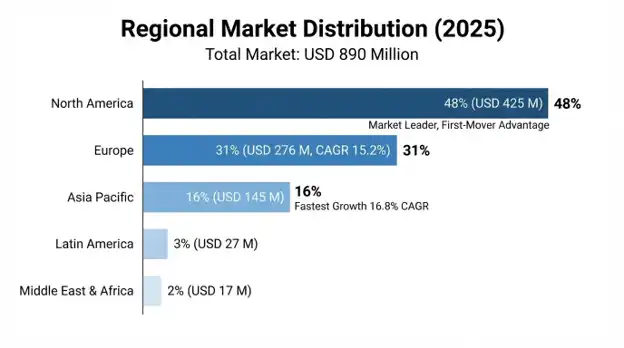
North America held the largest share of the achondroplasia market in 2025, holding a market share worth USD 425 million with a CAGR of 13.8% throughout the forecast period till 2034. The US accounted for 87% of the total market share in the region due to the early availability of the vosoritide drug after FDA approval in August 2021, established rare disease reimbursement policy under the Medicare and insurance schemes, presence of advanced skeletal dysplasia centers and high healthcare costs in the country.
The U.S. market enjoys a strong patient advocacy infrastructure, and patient advocacy groups like Little People of America actively participate in ensuring faster diagnosis, patient participation in clinical trials, and insurance coverage of approved treatment modalities. The presence of an extensive body of expertise in achondroplasia in academic medical centers such as Boston Children’s Hospital, Nemours Children’s Health, and Shriners Hospitals for Children enables referral pathways that facilitate enrolling of eligible patients in both approved treatment and ongoing clinical trials.
The regulatory framework fosters innovation with the help of FDA initiatives like breakthrough therapy designation, rare pediatric disease designation, and priority reviews, which speed up the development process of therapies treating serious diseases with significant unmet medical need, while post-market surveillance systems provide safety and efficacy data collection.
Key Performance Indicators:
Europe was the second-largest regional market in the year 2025, recording a CAGR of 15.2% from 2026 to 2034. In August 2021, the European Medicines Agency approved the vosoritide for sale in EU member states simultaneously with FDA. Nevertheless, the time to reimbursement was not uniform because of the health technology assessments conducted independently in each country. Germany attained early access due to the availability of the AMNOG system while other countries such as France, Italy, Spain, and UK had further economic negotiations which delayed access for 12-24 months.
The European Rare Bone Disease Network (ERN BOND) is an organization that coordinates expertise among member countries to have standard diagnosis and treatment which help in proper use of the drug and facilitates research activities. There are several European markets that have adopted new systems of reimbursement such as risk sharing, outcome-based contracts, and managed entry schemes.
Asia Pacific is projected to register the fastest regional growth of 16.8% CAGR until 2034 with a value of USD 145 million in 2025. Japan was the first region to gain access to vosoritide after its approval in 2022 from the Pharmaceuticals and Medical Devices Agency owing to the presence of a well-established rare disease reimbursement policy and a robust health insurance program in Japan. China, on the other hand, approved vosoritide in 2023, gaining access to the world’s largest population.
Regional Growth Drivers:
Targeted Biologic Drugs hold the highest market share of 74% worth USD 658 million in 2025, exhibiting a CAGR of 15.1% up to 2034. The Targeted Biologic Therapies segment includes drugs based on C-type natriuretic peptide analogs, FGFR3 signaling pathway inhibitors, and novel molecular drugs which target the basic underlying pathology of FGFR3 overactivation. These drugs enjoy the advantage of premium prices, proven clinical efficacy, and a diverse pipeline with different mechanisms of action and modes of administration.
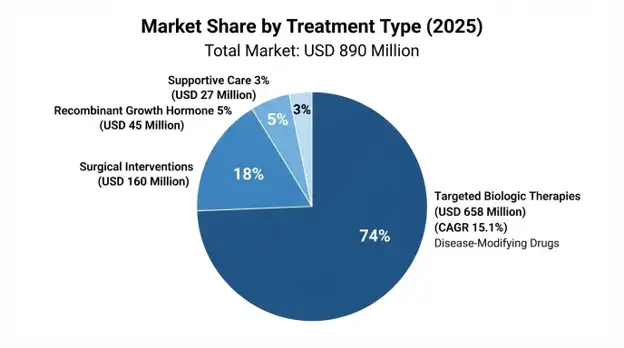
Surgical Approaches include 18% market share, valued at USD 160 million in 2025. These surgical approaches include limb-lengthening surgery, spine decompression surgery, and orthopedic correction surgeries.
C-Type Natriuretic Peptide (CNP) analogues account for the largest market share of the market at 68% worth USD 605 million in 2025 driven by the presence of vosoritide along with the development of next generation analogs of CNP with extended half-life.
The fastest growing drug class segment is FGFR3 Inhibitors, which accounts for 22.4% CAGR between 2025-2034. This class comprises orally administered tyrosine kinase inhibitors, decoy receptors, and monoclonal antibodies.
The pediatric segment accounts for the largest market share (89%) at USD 792 million in 2025, because growth-modifying therapies are effective only while growth plates remain open. for treatment that makes use of pharmacological treatment only in those people who have open growth plates. Adult segment, although having just 11% share of the existing market share, will register an 18.7% CAGR from 2025-2034.
The global achondroplasia market demonstrates moderate concentration with the leading presence of the incumbent, BioMarin Pharmaceutical, via its product vosoritide. The competitive landscape is evolving rapidly. as the late-stage pipelines of other companies like Ascendis Pharma with its TransCon CNP, QED Therapeutics with infigratinib, and Sanofi with SAR442501 are with several candidates expected to reach commercialization between 2028 and 2030.
March 2026: Ascendis Pharma filed a New Drug Application at the FDA for TransCon CNP (navepegritide) after positive results from a Phase III trial showing an average increase in height velocity by 2.0 cm per year versus placebo when administered once per week, becoming the first extended-interval CNP analog approved for achondroplasia.
February 2026: BioMarin Pharmaceuticals announced positive results from a 5-year long-term extension study on vosoritide with a mean final height gain of 8.2 cm compared to natural history controls.
January 2026: Interim results of QED Therapeutics Phase III trials of infigratinib showed dose-response improvement of height velocity with oral dosing, which supported further progress towards a regulatory filing planned for late 2026.
November 2025: Sanofi commenced the Phase II clinical trial of SAR442501 for treating pediatric achondroplasia via soluble FGFR3 decoy receptor with quarterly subcutaneous dosing.
You'll get the sample you asked for by email. Remember to check your spam folder as well. If you have any further questions or require additional assistance, feel free to let us know via-
+1 724 648 0810 +91 976 407 9503 sales@intellectualmarketinsights.com
22 Jul 2026
Intellectual Market Insights Research © 2026. All rights reserved.