Share this link via:

The global acromegaly market size was valued at USD 1.95 billion in 2025 and is projected to reach USD 2.15 billion in 2026, expanding to USD 3.75 billion by 2034, growing at a CAGR of 7.0% during the forecast period (2026-2034).
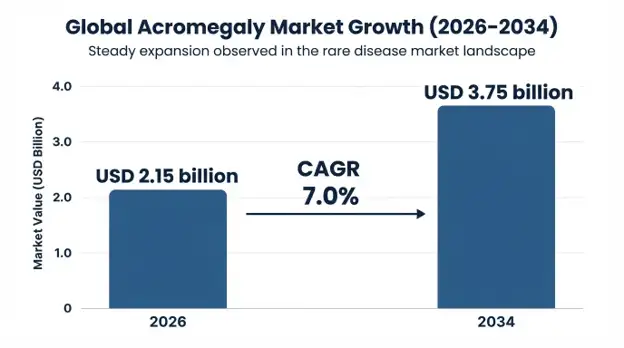
Acromegaly is a rare, chronic endocrine disorder, which is primarily related to growth hormone-secreting pituitary adenomas and results in chronic excessive GH and its downstream hormone, insulin-like growth factor-1 (IGF-1), production. This hormonal excess leads to typical somatic changes (acral enlargement, coarsening of facial features, soft tissue overgrowth, visceromegaly) and to severe systemic complications such as cardiovascular disease, type 2 diabetes mellitus, sleep apnea, arthropathy, and increased risk of colorectal neoplasia. The slow progression of the disease means that the diagnosis is delayed by an average period of 7-10 years from the onset of symptoms, by which time the structural and metabolic complications have developed and treatment for the disease requires a broad range of long-term approaches beyond primary surgical treatment.
There are three cornerstones of therapy for acromegaly: transsphenoidal surgical resection (the first-line curative option); pharmacological therapy (for patients with residual or postoperative disease); and stereotactic radiotherapy (as adjunctive or alternative therapy). Depending on tumor characteristics, the surgical cure rate is significantly different; biochemical remission is obtained in about 55-60% of cases of microadenoma, and 40-50% of macroadenomas. This is an inherent limitation of surgical treatment and, because a significant number of patients do not achieve adequate surgical results, a significant number of patients will remain on pharmacological therapy to manage their biochemical control and prevent disease related morbidity and mortality.
Pharmacological management is mainly based on long-acting somatostatin analogues (octreotide and lanreotide) that inhibit the production of growth hormone at the pituitary level and are used as routine first-line medical therapy. Growth hormone receptor antagonists, such as pegvisomant, are peripheral growth hormone inhibitors and result in the superior insulin-like growth factor-1 normalisation in patients non-responsive to somatostatin analogues. Cabergoline is a dopamine agonist that is administered orally and is used as a treatment in selected patients who have mixed-secreting adenomas, either as a secondary agent or as a primary agent. Combination regimens with several drugs acting at different sites of action are an emerging approach. to achieve biochemical control, with the potential of also lowering the doses of individual drugs and costs.
| Report Coverage | Details |
|---|---|
| Base Year | 2025 |
| Base Year Value | USD 1.95 Billion |
| Forecast Value | USD 3.75 Billion |
| CAGR | 7.0% |
| Forecast Period | 2025-2034 |
| Historical Data | 2022-2025 |
| Largest Market | North America |
| Fastest Growing Market | Asia Pacific |
| Segments Covered | By Drug Class, Treatment Type, Route of Administration, End-User |
| Region Covered | North America, Europe, Asia Pacific, Middle East & Africa, Latin America |
| Countries Covered | US, Canada, Mexico, UK, Germany, France, Italy, Spain, Netherlands, China, Japan, India, Australia, South Korea, Brazil, Argentina, UAE, Saudi Arabia, South Africa |
| Key Market Playes | Novartis AG, Ipsen SA, Pfizer Inc., Amryt Pharma, Recordati Rare Diseases, Camurus AB, Crinetics Pharmaceuticals |
Get more details on this report - Request Free Sample
Enhanced endocrinologist awareness of the subtle clinical features of acromegaly and the growing availability and accessibility of insulin-like growth factor-1 assays as reliable biochemical screening tools across all global healthcare systems are key structural drivers that will continue to fuel market expansion for acromegaly. Also, as more pituitary magnetic resonance imaging (MRI) protocols become standardized and sensitive enough to detect smaller adenomas that may have previously gone undetected, the number of diagnosed patients will continue to rise. There are estimated to be approximately 60 cases of acromegaly for every million people and 3-4 new cases for every million people per year worldwide, which works out to approximately 480,000-500,000 people diagnosed with acromegaly worldwide. Epidemiological studies have consistently shown that the real prevalence is 50-70% higher than the registered prevalence due to the persistent underdiagnosis implying that the number of people that can be reached with treatment is more than 750,000 people worldwide.
The diagnostic delay of 7–10 years creates a large population of patients who remain undiagnosed for years before receiving treatment. This growing diagnostic reservoir is becoming a growing treatment reservoir as providers in diverse specialties begin to recognize systemic effects of acromegaly, especially when patients develop resistant hypertension, poorly controlled diabetes, unexplained carpal tunnel syndrome, or sleep apnea. Each newly diagnosed patient typically requires lifelong treatment, resulting in significant cumulative pharmaceutical expenditure., often over decades, of an average medically managed patient with a total of significant cumulative pharmaceutical consumption per patient.
Transsphenoidal surgery, although considered the favored approach for most patients with acromegaly, yields biochemical remission, defined as normalization of insulin-like growth factor-1 levels and adequate suppression of growth hormone on an oral glucose tolerance test, in only 55-60% of microadenomas and 40-50% of macroadenomas. Because macroadenomas comprise around 70-75% of cases, most patients would require additional pharmacotherapy to achieve biochemical control after surgery. This inherent deficiency of the surgical cure guarantees a robust pharmacological market that would not be displaced by future advancements in surgery alone.
Patients who do not achieve biochemical remission after surgery, usually start somatostatin analogs within 3–6 months after surgery. Around 35–40% of patients would require growth hormone receptor antagonist therapy after inadequate effect of somatostatin analogs. The stepwise and combination pharmacologic approach results in the sequential use of multiple therapies and, therefore, in compound pharmaceutical income per patient. Moreover, 5-10% of patients achieving surgical remission have disease recurrence after 10 years, and thus, become pharmacologically managed again.
The most significant structural constraint limiting the acromegaly market share is the small patient population due to the nature of orphan diseases that are estimated at around 480,000 to 500,000 patients globally, thus providing an upper limit to the potential market size irrespective of any pricing strategies and innovations in treatment. Though being an orphan drug can facilitate premium prices with somatostatin analogs costing between USD 3,500-USD 8,000 per month and pegvisomant costing more than USD 15,000-USD 20,000 per month, still the small patient size limits its market value compared to common diseases.
Reimbursement challenges further compound the limitations imposed by the small patient population. because payors whether government-funded or privately run have become keener on evaluating expensive drugs for rare diseases using thorough budget impact analysis and cost-effectiveness studies. Pegvisomant therapy costs USD 180,000–240,000 per year and is subject to strict formulary management through prior authorization procedures, step therapy protocols where the drug will be considered only after failing to use analogs of somatostatin, and dose management. Reimbursement difficulties lead to delay in marketing of such expensive drugs and low pricing.
A promising pipeline of next-generation somatostatin receptor modulators is emerging with the ability to bind to receptors of types 1, 2, 3, and 5 to have a better effect on growth hormone suppression than previous generation analogs which only targeted receptor type 2. Pasireotide, a multiligand somatostatin analog that binds to different receptor types with high affinity was shown to have better biochemical response than octreotide and lanreotide in patients who were refractory to these drugs and achieved normalization of IGF-1 in 25-35%.
Innovations in somatostatin analogue scaffold chemistry to produce compounds with good affinity towards receptors, longer half-life to enable dosing at intervals of three months or six months, and higher bioavailability could translate into valuable business opportunities for companies able to offer unique clinical advantages. In the case of about 35% - 40% of patients not gaining biochemical control through current somatostatin analogs, there is a clearly identifiable market opportunity that could amount to about 100,000-130,000 patients in total.
Management of acromegaly increasingly favors treat-to-target strategies based on the regular measurement of insulin-like growth factor-1, with targets for biochemical remission set using age-adjusted normal values rather than mere upper limits of normal in the population. The trend towards personalized biochemical target setting is backed by studies showing that targeting normalization of the hormone to the lower limit of the age-adjusted normal range is associated with better cardiovascular and metabolic profiles when compared to normalization to any value within the normal range, thus prompting therapy escalation in patients whose disease was deemed under control.
Molecular characterization of pituitary adenomas through the discovery of mutations in aryl hydrocarbon receptor interacting protein genes as well as expression profiling of somatostatin receptor subtypes obtained through surgery will facilitate personalized therapy choice by allowing the prediction of drug response before the commencement of treatment. Adenomas that have high expressions of somatostatin subtype receptor 2 respond well to somatostatin analogs of the first generation, whereas Adenomas with high somatostatin receptor subtype 5 expression respond better to pasireotide.
North America accounted for the highest market share at about USD 780 million in 2025, with a forecasted CAGR of 7.0% over 2034. This is driven by the availability of specialists in pituitary diseases in academic medical centers and specialized pituitary centers, comprehensive insurance cover for costly orphan diseases via commercial and Medicare insurance companies, high awareness levels of endocrinologists on the present biochemistry control and pharmacological options, and efficient patient advocacy organizations.
The United States accounts for 85% of the total North American market revenue due to high prices of medicines, high diagnosis rate compared to worldwide standards, and the availability of a payment mechanism for somatostatin analogs and pegvisomant via specialty pharmacies. With FDA approval of oral octreotide, competition was created within the US market as the oral form took a share of patients who wished to evade the monthly injections yet remain in control of their biochemistry.
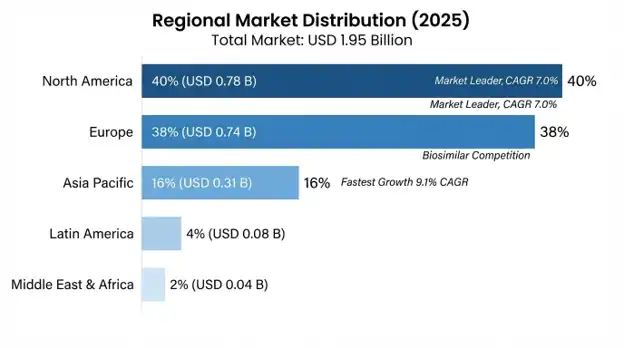
Asia Pacific is expected to be the fastest-growing region with a CAGR of 9.1% between 2023-2034, accounting for about USD 310 million in 2025. Expansion of the region is fueled by increased subspecialization and infrastructural development for endocrinology in China, Japan, India, and South Korea; increased availability of insulin-like growth factor-1 testing assays allowing biochemical diagnoses for acromegaly where only clinical assessments were feasible before; and growing awareness among endocrinologists regarding systemic symptoms of acromegaly.
Japan leads all other countries in terms of the level of maturity within the Asia Pacific due to the availability of reimbursement for somatostatin analogs and pegvisomant within the national health insurance, while China demonstrates the highest country-specific growth rate thanks to the ongoing process of healthcare modernization, establishment of new tertiary pituitary surgery centers, and pharmaceutical market entry opportunities for endocrine specialty treatments. India witnesses increasing incidence due to the growing endocrinology training and insulin-like growth factor-1 testing availability.
Acromegaly drugs market share is dominated by somatostatin analogues which make up for 65% market share worth USD 1.27 billion in 2025 and have a CAGR of 6.8% through 2034. The segment includes the use of long-acting injectables of octreotide and lanreotide as standard first-line pharmacotherapy for the disease with the addition of the oral octreotide preparation, which has become a source of new growth dynamics through increasing the potential pool of the addressed patients to include patients favoring or necessitating oral administration.
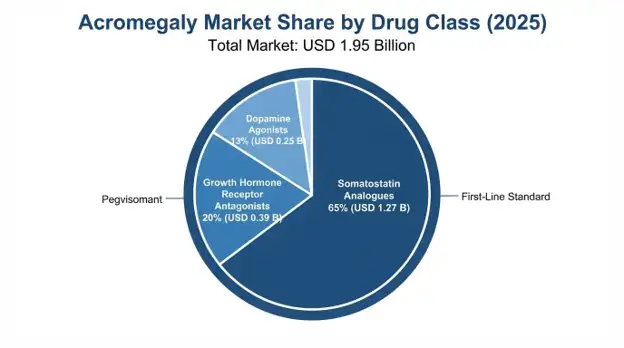
The share of growth hormone receptor antagonists, primarily pegvisomant, makes up for about 20% market share worth USD 390 million in 2025, and commands the leading per-patient revenue thanks to high prices. Pegvisomant is the only drug that normalizes insulin-like growth factor-1 through the peripheral blockade of the action of growth hormone in patients resistant to somatostatin analogues irrespective of their receptor profile.
Dopamine agonists, primarily cabergoline, make up for about 15% market share worth USD 293 million in 2025, due to their oral delivery, good tolerability, low cost, and use in mixed growth hormone and prolactin-secreting adenomas.
Injectables lead with a 78% share of the market, worth USD 1.52 billion in 2025, including monthly depot administration of Octreotide LAR and Lanreotide Autogel, as well as weekly subcutaneous administrations of pegvisomant. The injectable segment benefits from well-established clinical use and proven efficacy and proven efficacy but is threatened by competition from oral formulations.
The oral segment accounts for approximately 22% of the market valued at USD 428 million in 2025 and is expected to increase with a CAGR of 10.8% till 2034 due to being the fastest-growing route of administration segment. Currently, the segment includes oral octreotide capsules and cabergoline tablets; oral octreotide leads to segment growth owing to novel oral administration technology.
The global acromegaly market is dominated by Novartis AG, Ipsen SA, Pfizer Inc., and Amryt Pharma, Ipsen SA, Pfizer Inc., and Amryt Pharma hold around 72-78% of global pharmaceutical sales share through somatostatin analogue franchise and pegvisomant market dominance. Competitive advantage is based on formulation innovations in lowering the frequency of injections, superiority in biochemical control in treatment-resistant patients supported by clinical data, access support programs, and pipeline innovations to meet unmet needs in about 35-40% of patients suffering from insufficient control with current medicines.
The acromegaly market is highly protected from competitors due to complex management of pituitary diseases, need for long-term clinical trials, well-established connections between doctors and companies already active on the market, and the necessity to provide clinical differentiation in the market that uses established algorithms for the treatment. Biosimilar rivalry is arising in European markets in connection with somatostatin analogues.
March 2026: Ipsen SA reported successful Phase III trials for its new subcutaneous form of lanreotide that allows for quarterly dosing, which showed non-inferiority of its effectiveness for the control of insulin-like growth factor-1 levels compared to the monthly administration of lanreotide Autogel in chemically stable patients. Applications have been submitted to the EMA and FDA, and the decision is expected in the first quarter of 2027.
February 2026: FDA approved Camurus AB’s CAM2029, a ready-to-use form of subcutaneous octreotide that uses FluidCrystal injection depot technology to allow for once-a-month administration without reconstitution.
January 2026: Novartis AG conducted a Phase II study testing pasireotide LAR along with oral octreotide in those patients whose somatostatin analogue monotherapy was not working due to the presence of resistance and were making up about 35% of all medically treated patients.
December 2025: The promising Phase II data on paltusotine, an oral somatostatin type 2 receptor agonist, revealed maintenance of biochemical control with once-daily dosing in treatment-naïve acromegaly patients. that could provide a novel treatment route for them as oral only treatment.
You'll get the sample you asked for by email. Remember to check your spam folder as well. If you have any further questions or require additional assistance, feel free to let us know via-
+1 724 648 0810 +91 976 407 9503 sales@intellectualmarketinsights.com
22 Jul 2026
Intellectual Market Insights Research © 2026. All rights reserved.