Share this link via:
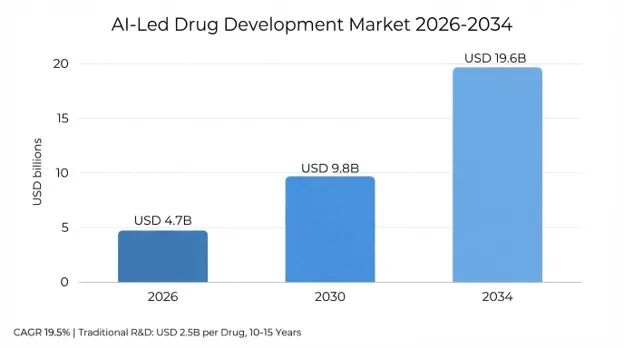
The global AI-led drug development market size was valued at USD 3.9 billion in 2025 and is projected to reach USD 4.7 billion in 2026, expanding to USD 19.6 billion by 2034, growing at a CAGR of 19.5% during the forecast period (2026-2034).
AI-driven drug development is the use of machine learning (ML), deep learning, generative AI, natural language processing (NLP), and other advanced computational techniques throughout the entire pharmaceutical research and development (R&D) process, ranging from target identification to post-market monitoring. Traditional drug development involves long timescales of around 10–15 years, research costs more than USD 2.5 billion per approved drug, and has a clinical success rate of less than 10% of compounds that enter Phase I trials. Investment in research is on the rise, scientific complexity is growing, regulatory demands are becoming more stringent, and patent expiration dates are coming soon, making it more critical than ever to have technologies that improve development efficiency, decrease failure rates, and accelerate innovation.
From drug discovery to manufacturing, AI's impact is becoming apparent in almost every phase of pharmaceutical drug development, making it a powerful tool for decision-making in a data-driven era. AI algorithms utilize genomic, transcriptomic, proteomic, and clinical data during the target identification phase to determine the disease-associated markers and prioritize the relevant therapeutic targets with greater accuracy, thus elucidating the biological targets. Generative AI models, such as transformer-based architectures and deep neural networks, can be used in drug discovery to create new chemical entities optimized for efficacy, selectivity, pharmacokinetic, and manufacturability parameters, drastically minimizing hit-to-lead and lead optimization timelines. The progress at protein structure prediction driven by the tools like AlphaFold has opened new avenues for structure-based drug design by uncovering the 3D structure of difficult targets in the biological world. AI's contribution to preclinical research relates to advanced analysis of drug safety, predictive toxicology, pharmacokinetic models, and virtual screening, which all can narrow down the pool of potential candidates before costly lab and animal trials are conducted.
AI helps with trial design, patient recruitment, biomarker identification, protocol optimization, and the analysis of real-world evidence within clinical development. Machine learning models can be used to identify eligible patient cohorts, predict enrollee numbers, optimize study endpoints, and adapt the study design to minimize wasted efforts. AI is also being used more in drug repurposing, testing existing drugs for new use. AI is increasingly being used in drug repurposing, where existing drugs are tested for new therapeutic purposes based on huge amounts of biological and clinical data.
The AI-enabled biotech start-up sector has emerged as an essential component of the commercialization ecosystem in addition to cloud computing solutions, CROs, and the technology sector, which form an integral part of the commercialization process. The business model has moved on to focus on strategic partnerships, milestone-based partnerships, and co-development partnerships, thus bringing AI platform players in line with the innovation happening in the pharmaceutical industry. While the application of AI in early discovery is the most common, other applications like clinical development, precision medicine, and drug repositioning have the potential for the most growth due to increasing acceptance of technology among regulators, availability of real-world data, and enhanced computing power.
| Report Coverage | Details |
|---|---|
| Base Year | 2025 |
| Base Year Value | USD 3.9 billion |
| Forecast Value | USD 19.6 Billion |
| CAGR | 19.5% |
| Forecast Period | 2025-2034 |
| Historical Data | 2022-2025 |
| Largest Market | North America |
| Fastest Growing Market | Asia Pacific |
| Segments Covered | By Component, Technology, Application, Therapeutic Area, End-User, Region |
| Region Covered | North America, Europe, Asia Pacific, Middle East & Africa, Latin America |
| Countries Covered | US, Canada, Mexico, UK, Germany, France, Switzerland, China, Japan, India, South Korea, Australia, Brazil, UAE, Saudi Arabia |
| Key Market Playes | Recursion Pharmaceuticals, Exscientia, Insilico Medicine, Schrödinger, Isomorphic Labs, NVIDIA, BenevolentAI |
Get more details on this report - Request Free Sample
The growing cost of drug development and the continued problem of attrition during the late stage of development have forced companies to think about re-engineering their discovery processes using AI to validate targets, optimize leads, and conduct early-stage toxicity screening.
The rapid advancement of genomics sequencing, single-cell multi-omics, high-content imaging, and digitized medical records has resulted in massive training datasets that surpass previous limits of analytics capabilities, but transformers adapted to chemistry, protein sequences, and clinical texts have been able to generalize across discovery tasks with little fine-tuning.
The key limitation to market expansion stems from the difficulties associated with the inconsistency and fragmentation of training data used by pharma companies, universities, and clinics, which is further exacerbated by the rarity of published negative trial outcomes, which are needed to train algorithms how to avoid something. Regulatory organizations, such as the FDA and the EMA, expect proof of interpretability and reproducibility in using AI in the decision-making process, thus contradicting the intrinsic opacity of high-performing neural network structures.
The most appealing aspect of all is when the AI-developed or optimized compounds gain approval thanks to the partnership models that include up-front and milestone payments as well as royalties, making it possible for the platform firms to engage in value creation in the long term. The convergence of this process with the precision medicine model is natural because the AI models involving genomics and clinical outcomes help determine responsive patient subsets and reduce costs of developing treatments for orphan diseases.
A revolutionary trend that is taking place is the convergence of AI-based software and automated laboratory robotics to develop "closed-loop" or self-driving discovery tools whereby an algorithm designs a new molecule, robotically synthesizes it, conducts HTS experiments on it, and uses the feedback loop from results back to the model, thus creating a closed circuit. Such convergence between in silico design and in vitro testing creates rapid iterations and minimizes human errors in the process of candidate optimization.
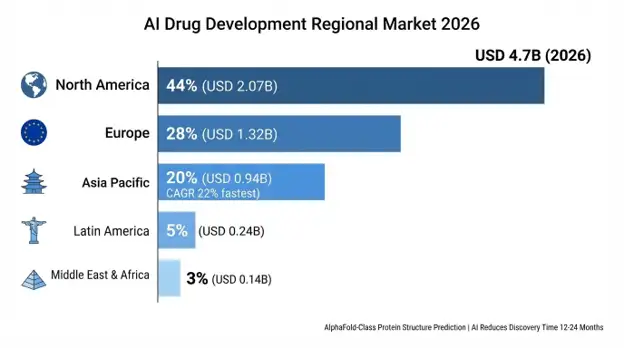
North America holds the largest market share owing to the United States, owing to the presence of leading AI discovery firms, significant pharmaceutical research and development firms, hyperscale cloud services, venture capital funding, and the FDA’s proactiveness regarding AI and ML in drugs.
The European market is the second-biggest market, due to the presence of prestigious academic computational biology research centers and consortia, as well as EMA reflections that provide regulatory clarity, although national heterogeneity and tough data-protection laws slow down the process in some countries.
The Asia Pacific is the most rapidly growing area due to AI-driven national strategy in China, Japan, South Korea, and India; a large, digitized patient population; a booming biotech sector; and increasing collaboration between local technology companies and international pharmaceutical companies.
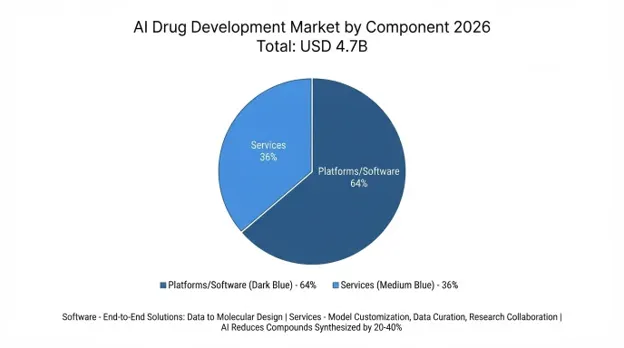
Software/platforms are the key segment, accounting for about 64% market share, valued at nearly USD 2.5 billion by 2025, which offer end-to-end solutions covering data ingestion to molecular design to predictive modeling. The remaining share is accounted for by the Services segment, which includes model customization, data curation, and research collaborations and is the fastest-growing segment in the market space.
Machine learning and deep learning together have the largest share in terms of technology, owing to the vital importance of these in the analysis of genomics, structure, and image data, whereas generative AI is the fastest-growing sub-segment due to the maturation of de novo molecule design from experimentations into actual use. Target Identification and Validation are the applications that generate the highest revenue, whereas Clinical Trial Design and Patient Stratification are the fastest-growing ones.
Pharmaceutical and biotech companies form the largest end-user category, constituting about 59%, owing to the development of their own internal AI capabilities as well as partnering with other organizations, whereas contract research organizations have emerged as the fastest-growing market segment due to the integration of patient selection and analytics using artificial intelligence.
The global AI-based drug discovery market is moderately fragmented but very cooperative, including specialty AI-enabled platform companies, cloud computing and computational platform vendors, mature pharma companies developing AI capacities within their organizations, and contract research organizations that integrate AI into their service offerings. The distinction between the competitors will be based on unique data access, clinical validation of candidates from AI, scope of processes involved, and partnership arrangements economics.
March 2026: Isomorphic Labs unveiled a new multi-target strategic partnership with a leading pharmaceutical organization that utilizes advanced structural prediction tools to develop small molecule drugs for hard-to-treat oncology targets.
February 2026: Insilico Medicine provided encouraging interim results from Phase II studies for its fully AI-designed and -developed drug for fibrosis.
January 2026: NVIDIA began a pharmaceutical-specific AI research program, which provided favored access to new computing architectures and biomolecule foundation models to certain drug discovery collaborators.
December 2025: A large pharmaceutical company and an AI platform company entered an extended cancer treatment partnership, including AI-enabled discovery of novel synthetic lethality targets, where milestone payments could be in the billions.
November 2025: Exscientia revealed successful safety and pharmacokinetic Phase I results of their second AI-enabled clinical candidate compound.
You'll get the sample you asked for by email. Remember to check your spam folder as well. If you have any further questions or require additional assistance, feel free to let us know via-
+1 724 648 0810 +91 976 407 9503 sales@intellectualmarketinsights.com
10 Aug 2026
Intellectual Market Insights Research © 2026. All rights reserved.