Share this link via:

The global AI-powered logistics and supply chain optimization market size was valued at USD 15.2 billion in 2025 and is projected to reach USD 18.4 billion in 2026, expanding to USD 68.5 billion by 2034, growing at a CAGR of 17.8% during the forecast period (2026-2034).
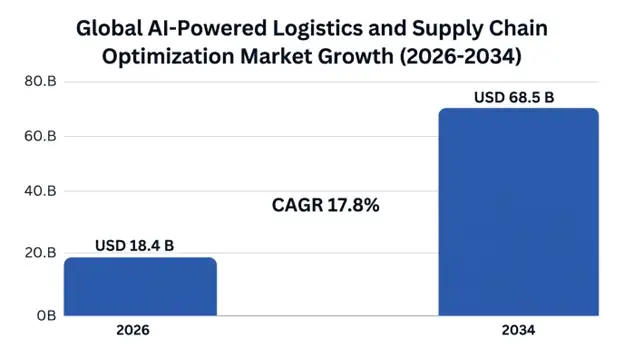
AI-enabled logistics and supply chain optimization constitutes a revolutionary technology paradigm that combines advanced artificial intelligence (AI), machine learning (ML), predictive analytics, and autonomous systems to support decision-making across complex global logistics ecosystems. This innovation overcomes inherent challenges associated with conventional supply chain operations by analyzing massive volumes of real-time data from sources such as Internet-of-Things (IoT) sensors, transportation networks, supplier systems, weather reports, and market intelligence platforms.
Modern supply chains are characterized by complexities that were not common before because of factors such as globalization, the need to support omnichannel commerce, volatile demands, political instability, and tough environmental standards. In this regard, Conventional enterprise resource planning systems and human-led decision-making processes cannot cope with the complexity of supply chain operations involving thousands of variables. Artificial intelligence provides an effective platform for identifying trends from historical and real-time data feeds, generating accurate forecasts, and executing decisions efficiently.
These technologies support a wide range of applications, including demand prediction systems that utilize consumer behavior patterns, weather correlations, social media sentiment, and macroeconomic indicators to generate forecasts that are estimated to be 20–35% more accurate than traditional statistical methods. They also enable autonomous fulfillment centers that use computer vision, robotics, and reinforcement learning to manage operations with minimal human intervention. Route planning and optimization algorithms consider live traffic conditions, vehicle capacity, delivery time windows, and dynamic change requests to create the most efficient delivery sequences, outperforming human planners by 15–25%.
The commercial importance extends beyond cost reduction to include competitiveness, supply chain resilience, and improvements in sustainability performance. Companies using AI-driven supply chain optimization outperform organizations that rely on traditional management practices. The ongoing pandemic due to the virus COVID-19 and the resulting geopolitical instability highlighted major weaknesses in global supply chains, prompting companies to develop resilience capabilities enabled by AI that would help identify potential risks, scenario modeling, and network realignment.
| Report Coverage | Details |
|---|---|
| Base Year | 2025 |
| Base Year Value | USD 15.2 Billion |
| Forecast Value | USD 68.5 Billion |
| CAGR | 17.8% |
| Forecast Period | 2025-2034 |
| Historical Data | 2022-2025 |
| Largest Market | North America |
| Fastest Growing Market | Asia Pacific |
| Segments Covered | By Component, Technology, Application, Deployment Mode, Enterprise Size, End-User Industry |
| Region Covered | North America, Europe, Asia Pacific, Middle East & Africa, Latin America |
| Countries Covered | US, Canada, Mexico, UK, Germany, France, Italy, Spain, Netherlands, China, Japan, India, Australia, South Korea, Singapore, Brazil, Argentina, UAE, Saudi Arabia, South Africa |
| Key Market Playes | Microsoft Corporation, IBM Corporation, SAP SE, Oracle Corporation, Amazon Web Services, Blue Yonder Group, Manhattan Associates |
Get more details on this report - Request Free Sample
The key factor driving the development of the AI-driven logistics market is the rapid rise of e-commerce, whose value increased to USD 6.8 trillion in 2025 and is expected to reach USD 11.4 trillion by 2030, thereby revolutionizing consumer demands for delivery time, visibility, and flexibility. The shift from conventional distribution systems designed for large cargo volumes to single-parcel delivery has made operations increasingly complicated, demanding the optimization of inventory placement and deliveries beyond human capacity for analysis.
Artificial intelligence helps address operational complexity through dynamic micro-fulfillment optimization, whereby machine learning algorithms analyze millions of transaction patterns, localized demand signals, seasonality, and promotions to determine optimal inventory positioning prior to order fulfillment. In the vital last mile delivery phase, which accounts for 40-50% of the total cost of logistics, AI route optimization algorithms factor in real-time traffic information, delivery time windows, vehicle capacity, driver availability, and dynamic order additions to generate routes at costs 15–25% lower than traditional planning methods.
The omnichannel retail environment requires integration across online, mobile, and in-store channels, the mobile channel, and the store channel, where customers expect consistency in inventory management, flexibility in fulfillment modes, such as pick up in store, ship from store, and same day delivery. Artificial intelligence platforms manage this complicated fulfillment network through optimal inventory allocation between channels, forecast demand at very small location and temporal intervals, and adapt the fulfillment strategy accordingly.
COVID-19 and other geopolitical events such as the Ukraine-Russia situation, shortage of semiconductors, and the clogging of the Suez Canal resulted in over USD 4 trillion disruption costs in the supply chain, thus shifting organizational focus regarding enterprise risk management from cost-effectiveness to resilience. Companies realized that their supply chain systems, which relied on efficiency via just-in-time inventory systems, single-source suppliers, and concentrated manufacturing systems, were extremely vulnerable in the current business environment full of disruptions.
AI-based supply chain solutions solve resilience needs by using an ongoing process of multi-level supplier risk management that combines information from financial health, geopolitical risks, weather trends, sentiment from news articles, and satellite images from supplier’s sites to detect warning signs of possible disruptions well before they affect business weeks or months in advance. Machine-learning algorithms based on historic disruption data learn key predictors that humans are usually not able to notice due to their limited cognitive capacity and difficulty managing hundreds of data points at once.
The use of advanced AI-based systems allows for the development of “self-healing” capabilities in the supply chain whereby disruptions can be detected and resolved using pre-designed protocols for activating alternate suppliers, release of safety stocks, shifting of modes of transport, and communicating with customers without any human intervention. The use of digital twin technology involves creating virtual models of the whole supply chain network, allowing one to run simulations on possible courses of action.
The most significant constraint facing the implementation of an AI-driven supply chain is the problem of aligning the advanced AI technologies with the legacy technology ecosystem, which is typical of any enterprise setup. For AI systems to operate effectively, organizations must establish clean and accurate data environments, which consists of data collected by many different systems inside the company such as ERP, WMS, TMS, supplier portal, CRM, along with data from external sources like market analysts and weather channels.
Enterprise data environments typically face several quality issues, including inconsistencies in master data definitions in business divisions and geographically spread locations, incomplete history because of the migration or acquisition of data systems, data latency in real time due to legacy systems unable to support streaming architecture, and data absence in tiered supply chain systems due to poor connectivity with second or third level suppliers. It takes around 18-36 months for organizations to cleanse data, develop an integration architecture, and improve master data management for AI models to work properly.
The challenge is further exacerbated by the need to develop change management programs that address resistance from experienced supply chain personnel of the supply chain, who perceive the use of automation through AI technology as a threat to their expertise and job security. Change efforts shall involve comprehensive training programs, role creation, and culture change initiatives, which may constitute up to 40-60% of the total project cost.
The shortage of professionals with expertise in both supply chain management and artificial intelligence/data science is a serious limitation on the growth of the markets, given that it becomes very hard for businesses to acquire, train, and retain such highly specialized staff. It should be mentioned that the combination of knowledge on supply chains and artificial intelligence is an incredibly rare combination, which receives additional 45-65% pay compared to regular jobs in the field of supply chains.
A significant market opportunity exists in the development of digital twin technologies that generate virtual copies of the complete supply chain, thereby allowing for simulation of different scenarios and their impact without any disruptions to actual operations. The concept of the supply chain digital twin is one that utilizes live feeds from various processes within the chain such as the Internet of Things sensors, logistics, warehousing, suppliers, and customers to develop virtual models that can aid decision-making.
The use of digital twin allows “what-if” analysis capabilities that were unattainable with traditional simulation methods, providing businesses with the ability to concurrently analyze many different possible combinations of their supply chain setups, procurement processes, inventory placements, and more, to find the best course of action for each situation. Digital twins allow for decision making in strategy, such as finding optimal facility locations, developing diversity plans, and planning sustainability efforts.
The increased pressure on organizations for greater commitment to sustainability, the need for carbon accounting due to new regulations, and increasing consumer pressures for sustainable supply chains make an attractive market opportunity for platforms using AI technology that can help reduce carbon footprints, conduct sustainable sourcing, and implement circular economies. New regulations by the European Union Corporate Sustainability Reporting Directive and others around the world require organizations to track emissions throughout their supply chains, which presents opportunities for AI-based systems.
Sustainability platforms that are driven by artificial intelligence technology balance cost, service, and carbon variables, and thus make it possible for companies to realize carbon emission reductions without impacting competitiveness, hence establishing the fact that efficiency and sustainability goals go together.
Technology related to the supply chain industry is moving towards developing autonomous capabilities where AI-driven models not only provide recommendations on decision-making based on certain scenarios but can implement their own solutions after receiving permission without having to seek human permission, thus allowing them to respond at the same speed as today’s supply chains operate. Supply chain systems with autonomous capabilities have decision-making frameworks which have been designed through collaboration between humans and AI models, thus allowing them to make decisions regarding order placements, transportation carriers, inventory balancing, etc.
Supply chain self-healing initiatives, which involve having the AI systems automatically identify disruptions and initiate a set of predefined actions such as activating other suppliers and releasing the safety stock, are at the cutting edge of autonomous supply chains with early adopters reporting disruption response time reductions of up to 65%.
Environmental sustainability is evolving from being a voluntary exercise undertaken by companies through corporate social responsibility to an operational constraint due to regulatory requirements, pressure from investors and customers for real emission cuts and disclosures. Logistics planning software that utilizes artificial intelligence technology now takes carbon intensity considerations into account to select the optimal means of transport and route while designing the network layout.
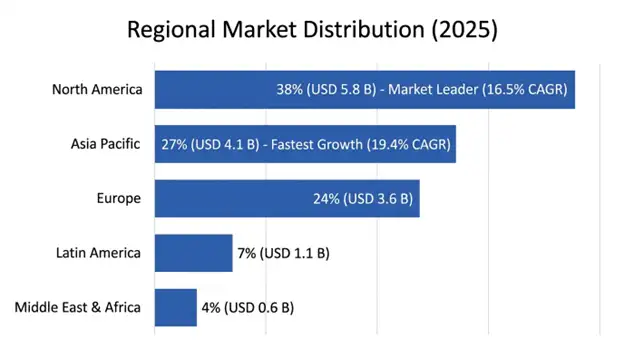
North America has the highest market share for AI-enabled supply chain worth USD 5.8 billion in 2025 and expected to grow at a CAGR of 16.5% until 2034. It is due to the availability of technology hubs, capabilities of enterprises to adopt new technologies, and involvement of key e-commerce/retail players in the region that help implement innovations. The U.S. comprises around 82% of the regional market and backs up the spending on venture capital funding for supply chain technology start-ups at USD 8.4 billion in 2025.
The regional market is favored by an advanced cloud network, data connectivity throughout supply chain ecosystem, and available AI talent base located in tech hubs. Big retail and manufacturing firms like Amazon, Walmart, Procter & Gamble, and General Electric have invested billions in AI for their supply chains and created standards that affect others.
The Asia-Pacific region proves to be the fastest-growing one, with the forecasted CAGR of 19.4% until 2034 and the value forecast of USD 4.1 billion by 2025. The drivers of regional growth include the need for advanced supply chain management related to production in China and Southeast Asia; the fast development of e-commerce that calls for last mile optimization; and the involvement of governments in digital transformations by allocating considerable investments into supply chain management solutions. The market share of China in the region amounts to 45%.
Japan and South Korea exhibit advanced levels of adoption in auto manufacturing and electronics where high complexity and quality needs result in attractive propositions for optimizing AI. The Indian national market presents the highest annual rate of growth at 24.2% due to development in the manufacturing industry and e-commerce, among others.
Europe is a developed market, with USD 3.6 billion revenue generation forecasted in 2025 and 15.8% CAGR until 2034, marked by high sustainability demands, complicated inter-country logistics chains, and regulatory constraints, which prompt the use of AI systems to facilitate compliance and efficiency. The EU Green Deal and Corporate Sustainability Reporting Directive mandate the use of artificial intelligence in terms of greenhouse gas emission reduction.
Regional adoption focuses on transportation multimodality, sustainable supplier evaluation, and circular economy considerations, where companies focus on artificial intelligence (AI) solutions that concurrently address cost, service, and environmental performance criteria.
The software category occupies more than half the market at 58%, representing a valuation of USD 8.8 billion by 2025 and a CAGR of 18.2% till 2034. The software category includes cloud-based optimization platforms, advanced analytical systems, and decision-making software. The services segment holds 28% market share, representing a valuation of USD 4.3 billion by 2025 and includes services such as system implementation, system integration, and optimization services needed for a successful deployment of AI. The hardware category represents a market share of 14%.
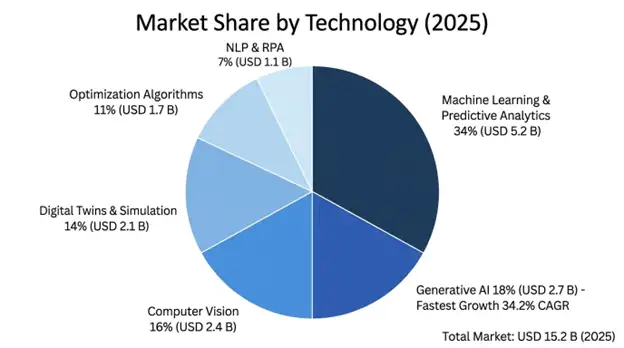
Machine Learning and Predictive Analytics are the major players in the AI Technology Segment, accounting for a market size of USD 5.2 billion and holding 34% market share in 2025. Generative AI holds 18% market share and is the fastest growing segment with 34.2% CAGR until 2034, owing to high enterprise uptake of natural language interface applications and automatic content generation applications. Computer Vision holds a share of 16%, and this technology plays a vital role in warehouse automation and autonomous vehicles.
Application Segments with Dominant Share of Demand Forecasting & Planning include Market Share of 31% worth USD 4.7 Billion by 2025 due to high reliance on effective demand forecasting. Application Segment of Transportation & Route Optimization is having market share of 26%, witnessing a surge in demand due to growing e-commerce and rising fuel costs. The market segment of Warehouse Automation holds a Market Share of 19% and exhibits fastest CAGR of 21.4%.
The end-user vertical that holds the greatest market share is Retail & E-commerce, which constitutes 31% of the market share worth USD 4.7 billion in 2025 owing to challenges faced during multichannel fulfillment and competitive service level considerations. The Manufacturing industry contributes 26% towards the market share and leverages AI to plan production, manage suppliers, and optimize inbound logistics.
The global market for logistics and supply chain optimization services based on artificial intelligence technology is moderately concentrated, with the leading eight players having around 48 to 55 percent market share through their platform features, customer base strength, and constant technological innovation. The areas of competition include accuracy, integration, industrial specialization, and the generation of return on investment.
Major software vendors like SAP, Oracle, and Microsoft can use their customer base and ERP platforms to incorporate the capability of AI, while niche players such as Blue Yonder and Manhattan Associates can rely on their industry knowledge and optimization algorithms. Cloud computing companies such as Amazon Web Services and Google Cloud Platform can provide core capabilities and pretrained models to allow quick deployment in the mid-market space.
April 2026: Microsoft Corporation unveiled its Supply Chain Intelligence solution featuring an AI-enabled platform with the use of foundation models that can facilitate natural language supply chain management in 14 languages, as well as disruptive autonomy across 85% of exceptions.
March 2026: SAP SE integrated generative AI functions in its entire suite of supply chain management solutions to support conversational procurement, automate supplier risk assessments, and produce AI-powered demand plan narratives accepted by 94% of analysts during beta trials.
February 2026: Amazon Web Services unveiled AI-powered infrastructure services to provide network optimization solutions that can make up to 10 million real-time decisions per day in consumption-based pricing models for third-party logistics providers and retailers.
January 2026: IBM Corporation concluded its acquisition of a digital twin platform in the domain of supply chain for USD 890 million to integrate its digital twin technology into the company's Sterling Supply Chain solutions.
December 2025: Blue Yonder Group deployed its autonomous supply chain solution at a major global retailer with 34% inventory reduction and 28% increase in on-shelf availability through AI-powered replenishment optimization.
You'll get the sample you asked for by email. Remember to check your spam folder as well. If you have any further questions or require additional assistance, feel free to let us know via-
+1 724 648 0810 +91 976 407 9503 sales@intellectualmarketinsights.com
27 May 2026
Intellectual Market Insights Research © 2026. All rights reserved.