Share this link via:

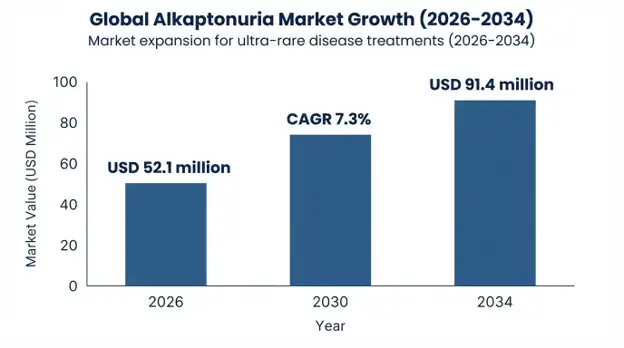
The global alkaptonuria market size was valued at USD 48.5 million in 2025 and is projected to reach USD 52.1 million in 2026, expanding to USD 91.4 million by 2034, growing at a CAGR of 7.3% during the forecast period (2026-2034).
Alkaptonuria is one of the best understood ultra-rare, autosomal recessive metabolic diseases caused by a defect in homogentisate 1,2-dioxygenase enzyme that allows homogentisic acid to build up in the body, oxidize and polymerize to condense ochronotic pigment within connective tissues, cartilage, heart valves, and other tissues. It is a progressive deposition process (ochronosis) that clinically presents as characteristic darkening of urine on exposure to air from birth, followed by bluish-black pigmentation of ear cartilage and sclerae visible from the 3rd decade and most importantly, severe premature osteoarthritis affecting the spine and large weight-bearing joints, which is usually debilitating by 4th-5th decade.
Pathophysiology is due to a complete enzymatic block in the tyrosine degradation pathway resulting in 1,000-fold increased plasma homogentisic acid levels that lead to irreversible tissue damage by oxidative stress, inflammatory responses and mechanical disruption of cartilage matrix integrity. The disease occurs in about 1/250,000 to 1 million people worldwide, with a high prevalence in Slovakia where a combination of founder events has resulted in 1/19,000 people, as well as in the Dominican Republic and Jordan, where patient numbers are concentrated in defined locations and historically have contributed disproportionately to clinical research and natural history.
A therapeutic paradigm shift occurred since 2020, when the nitisinone drug received clearance from the European Medicines Agency as the first intervention that targets the disease metabolism of alkaptonuria, transforming the treatment from merely symptomatic with analgesics, anti-inflammatory drugs, dietary protein restriction and ultimately joint replacement surgery to an intervention targeting the disease metabolism. By blocking 4-hydroxyphenylpyruvate dioxygenase upstream in the tyrosine pathway, Nitisinone significantly decreases production of homogentisic acid by more than 95%, thus effectively stopping any further ochronotic pigment deposition, without being able to undo any tissue damage that can occur before treatment is begun.
The commercial ecosystem includes specialized orphan drug companies that are building ultra-rare disease treatments, diagnostic laboratories that are sequencing genes and analyzing biochemical properties, orthopedic device firms that are supplying joint replacement devices in high-risk cases, and patient advocacy groups that are helping patients take part in clinical research and access treatment. Strong regulatory mechanism for orphan drugs, offering potential market exclusivity and priority review pathways plus development incentives that enable premium pricing that are justifiable in the very small number of patients, This enables sustainable long-term revenue streams despite the small patient population.
| Report Coverage | Details |
|---|---|
| Base Year | 2025 |
| Base Year Value | USD 48.5 Million |
| Forecast Value | USD 91.4 Million |
| CAGR | 7.3% |
| Forecast Period | 2025-2034 |
| Historical Data | 2022-2025 |
| Largest Market | Europe |
| Fastest Growing Market | North America |
| Segments Covered | By Treatment Type, Drug Class, Route of Administration, Diagnosis Method, End-User |
| Region Covered | North America, Europe, Asia Pacific, Middle East & Africa, Latin America |
| Countries Covered | US, Canada, UK, Germany, France, Italy, Spain, Slovakia, Czech Republic, Netherlands, Japan, Australia, Jordan, Dominican Republic, Brazil, UAE |
| Key Market Playes | Swedish Orphan Biovitrum AB, Cycle Pharmaceuticals Ltd., Recordati Rare Diseases, Sanofi Genzyme, Pfizer Inc. |
Get more details on this report - Request Free Sample
The key factor behind the growth of the alkaptonuria market is the EMA approval of nitisinone for the treatment of alkaptonuria in 2020 on the basis of strong results shown by the DevelopAKU study and the SONIA-2 randomized controlled trial where administration of nitisinone at 10 mg once daily reduced urinary homogentisic acid secretion by about 99% relative to the placebo, resulting in a slower development of ochronosis within four years. This event changed the approach to treating alkaptonuria, which before the approval was possible only through symptomatic treatment, into evidence-based therapy of the disease, providing significant financial value for the product owing to its orphan drug status.
The clinical treatment paradigm has shifted toward early intervention before there is any joint damage has broadened the pool of patients from symptomatic adult patients to younger patients detected through family screening or accidental detection, with treatment guidelines now advocating for earlier intervention with treatment initiated on biochemical evidence of disease and not on symptoms. The shift provides ongoing growth in the market through early detection of patients, increased duration of treatment for each patient with treatment started at an early age, and better results ensuring that treatment continues.
Patient adoption has been slow but steady, with an estimated 15–22% adoption rate of nitisinone in diagnosed alkaptonuria patients by 2025, indicating huge scope for growth with rising awareness about this drug amongst healthcare professionals, greater availability of the drug across more healthcare facilities due to increasing reimbursements and favorable outcomes from this drug which have included delaying the need for joint replacement surgery, maintaining functional ability, and improving quality of life.
A major growth driver is the significant advancement in diagnostic capabilities due to the growing number of genes tested, the use of advanced mass spectrometry-based biochemical tests and knowledge of the disease, which has shortened the diagnostic delay for the diagnosis of alkaptonuria from 8-12 years in a typical clinic to 2-4 years at a specialist centre. Next generation sequencing has become incorporated into routine clinical care, allowing for the identification of affected individuals following the diagnosis of a proband, through family cascade screening, and the hallmark biochemical evidence of elevated urinary homogentisic acid is a definitive diagnostic marker and can be readily detected by common analytical methods.
In limited areas there are pilot programmes introducing newborn screening for AK, such as the National Alkaptonuria Centre programmes in the United Kingdom, which have proven feasible for population screening with existing platforms for expanded metabolic disorder screening, offering the potential for pre-symptomatic diagnosis and initiation of treatment before the onset of ochronotic damage. The clinical need for early intervention is apparent because ochronosis requires decades of exposure to homogentisic acid, and joint damage is radiologically detectable by the 4th decade, and by the 5th to 6th decade in untreated patients.
The cost savings from preventing joint replacement surgeries of USD 35,000-55,000 per surgery, avoiding chronic pain management including the cost of drug treatment, avoiding loss of workforce productivity, and avoiding loss of QALYs all make the economic case to invest in screening systems, infrastructure and lifetime cost of therapy a compelling one. The population of people diagnosed with Alkaptonuria. is estimated to be 12,000-18,000 worldwide, with that figure likely to increase significantly as more individuals are diagnosed in the future due to expanded screening and increased awareness by primary care physicians, rheumatologists, and orthopedic surgeons.
The fundamental constraint in the market growth of Alkaptonuria is the presence of an extremely small global population affected by the disease, where the total number of patients affected is less than 50,000 globally. This limitation of addressable market will exist despite whatever the pricing structure is for the drug or however far its geographical reach may extend. Given the fact that the market is ultra rare, full market coverage will still result in a much smaller market than specialty pharmaceutical markets, making it not very attractive to the major pharma companies.
The clustering of higher prevalence populations in certain regions such as Slovakia, Dominican Republic, and Jordan will pose even more challenges in the context of market development on the international level as there may be not enough healthcare infrastructure, regulatory and reimbursement system developed in order to provide access to premium-priced commercial therapy of rare diseases. In turn, North American and Western European markets with their large healthcare systems will have smaller alkaptonuria populations spread across a wide geographical area, which will require building networks of specialists.
The reimbursement processes associated with ultra-orphan drugs in the healthcare systems have come under greater scrutiny from payers who assess cost-effectiveness through established frameworks of health technology assessment which may fail to recognize the societal value derived from preventing disability in rare disease patients, especially in the case of a disease like alkaptonuria, in which there are long-term benefits from treatment and the alternative is disability rather than death. Several health technology assessment agencies from Europe have granted restrictive reimbursement status to nitisinone.
The emergence of Gene therapy represents a promising future treatment opportunity in the development of therapies for restoring the function of the enzyme homogentisate 1,2-dioxygenase via gene transfer in the liver cells, which will result in curative or nearly curative one-shot therapies that will make continued treatments with nitisinone and diet unnecessary. The homogentisate 1,2-dioxygenase enzyme is active in the liver for the metabolism of tyrosine and therefore genes could be transferred into the hepatocytes through adeno-associated viral vectors or lipid nanoparticles, as done in other liver metabolic disorders such as hemophilia and transthyretin amyloidosis.
Regulatory precedents from approvals for gene therapies in inherited metabolic diseases suggest that the pathway to success is feasible and commercially viable for one-time therapies with lifetime value that will command high prices as such therapies. For alkaptonuria, the successful gene therapy for permanent normalization of homogentisic acid would mean that there would be no progression of ochronosis, and patients would never develop arthropathy, as well as possibly revert existing ochronotic lesions, providing far more treatment value than current chronic management of the disease.
Clear targets and validated biomarkers from straightforward pathogenesis of alkaptonuria (single enzyme defect leading to known biochemical alterations) provide a good foundation for efficient proof-of-concept work. There have been academic-industry collaborations that started preclinical gene therapy projects for alkaptonuria, at least one of which received orphan drug designation from regulatory bodies, providing incentives for development and pathway definition for moving forward with clinical trials.
The alkaptonuria treatment landscape is increasingly supported by comprehensive patient registry systems providing real world evidence that helps make regulatory and reimbursement decisions and create guidelines which cannot be fulfilled by traditional clinical trials because of the limited number of patients. The DevelopAKU network created the biggest multinational natural history study and registry including patients from several centers of Europe providing long-term data about disease progression, results of treatment and quality of life which became the basis for the regulatory approval of nitisinone.
The registry data have shown that the effects of nitisinone seen in clinical studies can be translated into practice successfully, as treated patients had considerably slower progression of ochronosis and improved functional preservation as compared to untreated patients of comparable cohorts with similar natural history. This information is extremely important due to the long natural history of alkaptonuria and impossibility to perform long-term randomized controlled trials in this ultra-rare group of patients.
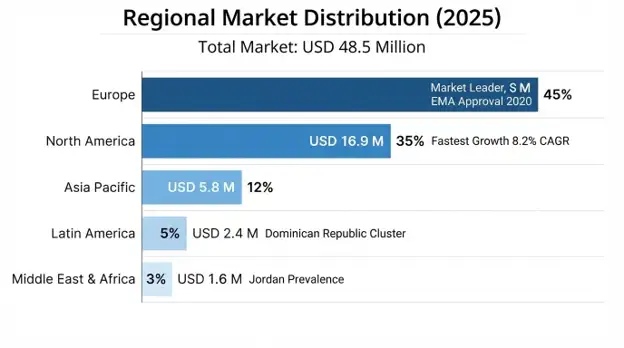
Europe accounted for the largest share of USD 21.8 million in 2025, with a share of 45% of global revenue, and is expected to achieve a CAGR of 6.8% till 2034. Regional dominance indicates the EMA's leadership role as the first health authority to approve nitisinone as a dedicated drug for the treatment of alkaptonuria in 2020, setting the groundwork for the first commercial market for disease-modifying therapy, compared to other jurisdictions around the world. The region has established specialist metabolic disease centre networks, DevelopAKU research consortium infrastructure and organised patient advocacy through AKU Society that contribute to the diagnosis, access to treatment and continued clinical research programs.
The prevalence of alkaptonuria in Slovakia is exceptionally high (1/19,000 people), which makes the country an exceptional market in Europe with a large concentration of patients, playing a disproportionate role in clinical research and natural history. Slovak healthcare system developed separate pathway for the care of alkaptonuria, including a reimbursement system, which reflected the importance of this condition in the public health system of this high prevalence country and showed the feasibility of systematic care delivery also for ultra-rare conditions in smaller healthcare systems.
Reimbursement for nitisinone in the United Kingdom has been granted under the Highly Specialised Technologies program, and access to treatment is centralised at the National Alkaptonuria Centre, which has established treatment protocols for patient selection, monitoring and collection of outcome data, all of which will contribute to the generation of evidence. Such a centralised model maximises the efficiency of the use of resources and guarantees treatment quality and security standards critical to the management of ultra-rare diseases.
North America is expected to be the fastest-growing regional market with the highest expected CAGR of 8.2% during 2022–2034, with an anticipated valuation of USD 16.9 million by 2025. The rapid growth is attributed to the move towards the FDA clearance of nitisinone for alkaptonuria as a result of regulatory submissions based on European clinical evidence and post-marketing studies proving safety and efficacy. The FDA clearance will provide access to the US market, where the prices on orphan drugs are higher compared to Europe, and the market is well-developed with the infrastructure for treatment distribution of rare diseases.
The US has well-developed schemes for orphan drugs that include market exclusivity, incentives, tax credits, and accelerated approval processes to decrease the risks associated with development and improve the commercial attractiveness of the treatment. The incentives have stimulated interest from various pharmaceutical companies in developing new therapies for the treatment of alkaptonuria in addition to nitisinone.
The Disease-Modifying Therapies segment holds a 68% market share with a value of USD 33.0 million in 2025, exhibiting an 8.1% CAGR until 2034, mainly due to the widespread adoption of nitisinone in the available markets and new markets. Orphan drug premium pricing based on its cost of development, small patient population, and unavailability of any other alternative treatment helps the segment generate high revenue per patient through an annual cost of USD 85,000 – USD 125,000 per year.
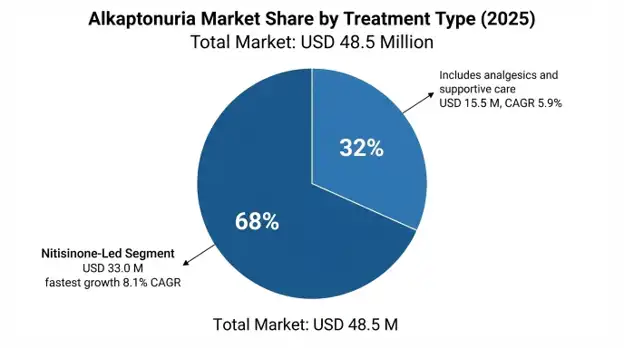
The Symptomatic Management segment accounts for 32% of the market with a value of USD 15.5 million in 2025 and includes analgesics, anti-inflammatory drugs, and supportive therapies for patients who have not received any disease-modifying treatments or residual ochronotic symptoms. Though the market grows at a slower pace than the former market, i.e., 5.9% CAGR, the market remains important due to many patients around the world not receiving nitisinone treatment.
Nitisinone is the leading drug type with a 68% market share of USD 33.0 million in 2025 that will grow at an 8.1% CAGR till 2034. Being the sole disease-modifying treatment currently available, nitisinone enjoys high pricing typical of orphan drugs having proven effectiveness and lacking any therapeutic substitutes. The advantage of the drug type in question lies in its strong clinical evidence, effective safety tracking, and increased awareness among doctors via specialized centers.
Analgesics & Anti-inflammatory Agents represent 22% market share, which include patients treated with nitisinone and experiencing any persistent symptoms as well as patients not receiving treatment but needing symptomatic relief due to progressive ochronotic arthropathy. This category consists of prescribed drugs as well as over-the-counter formulations.
The Specialty rare disease centers account for the largest end-user share in the market, comprising 54% of the total market, which is estimated to be worth USD 26.2 million by 2025. This is because these centers specialize in the diagnosis and treatment of rare metabolic disorders such as alkaptonuria. that requires treatment in the metabolic medicine centers.
In addition, the hospitals and clinics constitute 31% market share and include cardiology departments handling heart-related issues, rheumatology and orthopedic departments treating bone problems, and surgical departments undertaking joint replacements in case of severe cases.
The alkaptonuria market is highly concentrated owing to the nature of ultra-rare disease, where Swedish Orphan Biovitrum has a leading market share on account of nitisinone owing to its acquisition from its earlier competitors. Effective monopoly conditions exist during the orphan drug exclusivity period, competition is minimal in disease-modifying category, and the generics compete mostly in symptom-alleviating category.
Pipeline competition is emerging through modified-release formulations of nitisinone from Cycle Pharmaceuticals, partnerships between academia and industry in the form of gene therapies, and biotech companies that are developing RNA-based therapies.
March 2026: Swedish Orphan Biovitrum disclosed expanded access to nitisinone for treatment of alkaptonuria patients in an additional three countries in the Middle East and Latin America, before making any formal regulatory filings in areas where there is a concentration of patients.
January 2026: Cycle Pharmaceuticals conducted the Phase II study on nitisinone modified release formulation and showed a 34% decrease in peak plasma tyrosine levels, along with equal suppression of homogentisic acid; this paved the way for moving onto Phase III development.
November 2025: Alkaptonuria Management Guidelines from the European Reference Network for Hereditary Metabolic Disorders have been revised and now reflect five years of follow-up of patients under the use of nitisinone after its approval.
September 2025: AKU Society and DevelopAKU have announced the expansion of the patient registry internationally to cover North American and Asia-Pacific centers, with a goal of recruiting an additional 300 patients.
You'll get the sample you asked for by email. Remember to check your spam folder as well. If you have any further questions or require additional assistance, feel free to let us know via-
+1 724 648 0810 +91 976 407 9503 sales@intellectualmarketinsights.com
22 Jul 2026
Intellectual Market Insights Research © 2026. All rights reserved.