Share this link via:

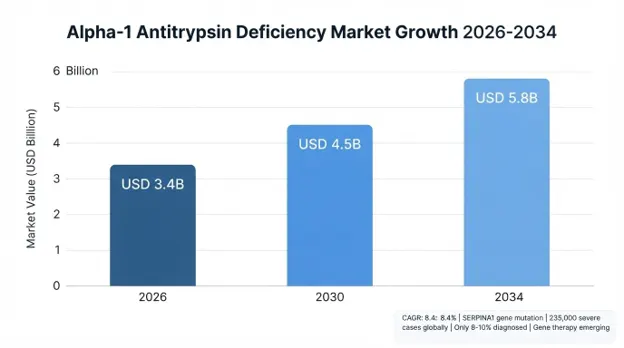
The global alpha-1 antitrypsin deficiency market was valued at USD 3.1 billion in 2025 and is projected to reach USD 3.4 billion in 2026, expanding to USD 5.8 billion by 2034, growing at a CAGR of 8.4% during the forecast period (2026-2034).
The deficiency in alpha-1 antitrypsin is a relatively rare disorder that is marked by low amounts of alpha-1 antitrypsin, a protein that acts as an important inhibitor to serine proteases to protect the lungs and liver from degradation and inflammation. This disease results from mutations in the SERPINA1 gene and is inherited in an autosomal codominant pattern; 235,000 people around the world are known to have the condition in its severe form, more specifically the PI*ZZ type, accounting for 50% of cases among people living in Europe (37%), the Americas (9%), Asia (9%), Australasia (3%), and Africa (1%). The mechanism of the disease includes uncontrolled action of neutrophil elastase in respiratory epithelial tissues leading to emphysema, bronchiectasis, and early development of chronic obstructive pulmonary disease, and aggregation of mutant proteins in liver cells leading to fibrosis and cirrhosis of the liver.
Treatment options for alpha-1 antitrypsin deficiency in the modern era involve intravenous plasma-derived alpha-1 antitrypsin augmentation therapies such as Prolastin C, Glassia, Zemaira, and Respreeza that involve providing systemic augmentation of AAT via weekly or biweekly infusions at sufficient serum concentrations to overcome the deficient level of 57 micromoles per liter; new recombinant alpha-1 antitrypsin treatments involving provision of synthetic proteins, thereby limiting the need for human plasma donations; novel inhaled alpha-1 antitrypsin augmentation therapies that involve delivering the protein directly to the pulmonary epithelium without systemic absorption; groundbreaking gene therapy treatment options such as BEAM-302 that involves using CRISPR base-editing technology to provide a genetic cure of the PiZ mutation and allow production of functional AAT in the hepatocytes; and RNA interference therapy treatment options such as fazirsiran that involves degradation of misfolded Z-AAT mRNA in hepatocytes.
Clinical importance goes beyond augmentation therapy to include complete disease management involving disease diagnosis via serum AAT levels, phenotyping through isoelectric focusing or genetic testing for precise genotype determination, lung evaluation via spirometry for the measurement of FEV decrease rate and high-resolution computed tomography for identification of emphysema pattern and severity, liver monitoring using ultrasonographic elastography for determining the extent of liver fibrosis development and hepatocellular carcinoma risk stratification, genetic counseling of relatives of patients suffering from the condition, smoking cessation counseling to prevent the worsening of the disease, and individualized treatment protocols to enhance the quality of life and prevent organ damage. The market fills essential unmet needs among about 3.4 million people worldwide with AATD, which includes between 70,000 and 100,000 severely affected individuals in the United States, with less than 10 percent receiving a correct diagnosis even though the disease affects one out of 1500-3500 people with European ancestry around the globe.
| Report Coverage | Details |
|---|---|
| Base Year | 2025 |
| Base Year Value | USD 3.1 billion |
| Forecast Value | USD 5.8 Billion |
| CAGR | 8.4% |
| Forecast Period | 2025-2034 |
| Historical Data | 2022-2025 |
| Largest Market | North America |
| Fastest Growing Market | Asia Pacific |
| Segments Covered | By Product Type, Treatment Type, Disease Manifestation, Diagnostic Testing, Route of Administration, End-User |
| Region Covered | North America, Europe, Asia Pacific, Middle East & Africa, Latin America |
| Countries Covered | US, Canada, Mexico, UK, Germany, France, Italy, Spain, Netherlands, China, Japan, India, Australia, South Korea, Brazil, Argentina, UAE, Saudi Arabia, South Africa |
| Key Market Playes | Grifols International, Takeda Pharmaceutical, CSL Behring, Novo Nordisk, Roche (Genentech), Beam Therapeutics, Arrowhead Pharmaceuticals, Kamada Pharmaceuticals |
Get more details on this report - Request Free Sample
The key factor that drives the global AATD market is the lack of early detection and delay in diagnosing the condition, which is experienced by most patients worldwide. Only about 10% of those who have a severe form of the disease get an accurate diagnosis, while others have to wait 5-8 years before being diagnosed with AATD, since the symptoms are often confused with those of asthma or COPD. Factors such as low awareness among clinicians, lack of adherence to the diagnostic guidelines, limited availability of genetic testing, and poor healthcare infrastructure contribute to the delayed diagnosis as well. More efforts aimed at increasing awareness, educating physicians', improving the availability of genetic and serum AAT tests, conducting workplace screening, and identifying the disease through electronic health records help in making the diagnosis earlier.
The growing incidence of early-onset emphysema and obstructive lung diseases due to the undiagnosed alpha-1 antitrypsin deficiency (AATD) has been a key factor responsible for the growth of the market. The occurrence of AATD is estimated to be 2-3% of cases of emphysema globally and about 1% of COPD cases. Most patients have symptoms between 20 and 50 years, have a fast decline of lung function, and are at high risk for developing bronchiectasis and respiratory infections. Apart from the respiratory problems, 15-20% of adult patients develop liver disease, such as cirrhosis and hepatocellular carcinoma. Due to the progressive nature of AATD, which needs decades of treatment, the demand for therapy will continue to grow, leading to market expansion and investment in disease-modifying therapeutics.
The major factor that impedes the expansion of the AATD market is the extremely high price of AAT augmentation therapy and the stringent reimbursement practices. Treatment with AAT via the intravenous route costs around USD 150,000 to 200,000 per year per patient, making the treatment a burden to pay for healthcare organizations and insurers. Reimbursement limitations, along with prior authorization and the threshold of pulmonary function, make access to therapy more difficult for patients. Such access problems are noticeable in countries with smaller budgets for healthcare or strict reimbursement practices, in which patients cannot access the approved treatment regardless of the clinical needs. The significant geographical price differences and uneven insurance coverage become additional barriers to treatment uptake.
One of the main opportunities of the alpha-1 antitrypsin deficiency (AATD) market is the use of gene therapies providing an option for permanent treatment of the mutation of SERPINA1 by using one single administration of the drug. Gene editing represents the possibility to treat the root causes of the disease instead of lifelong treatments. Clinical studies of the BEAM-302 drug have confirmed the proof of concept with higher levels of functional alpha-1 antitrypsin and a decreased amount of misfolded protein with a promising safety profile. The successful launch of curative drugs can help achieve premium pricing and save healthcare costs related to long-term treatment. Other possible opportunities are in vivo and ex vivo gene editing and viral vectors. Regulatory progress expected in the coming years provides the opportunity for developers of gene therapies to achieve first-move advantages in this market.
A major opportunity that can be identified within the AATD market is the development of non-invasive biomarkers and imaging techniques for monitoring progression of liver disease and the effectiveness of treatment. Blood-based biomarkers such as hyaluronic acid, procollagen type III amino-terminal propertied (PIIINP), matrix metalloproteinase-2, and tissue inhibitor of metalloproteinases-1 are increasingly being used as non-invasive methods for determining fibrosis in the liver. Other technologies that are complementing the biomarkers in non-invasively measuring the severity of liver fibrosis include transient elastography and shear wave elastography. These innovations allow for early diagnosis, stratification of patients, and monitoring of treatment response. Non-invasive monitoring allows for initiating therapy when the patients have just begun experiencing fibrosis rather than irreversible cirrhosis, thus expanding the target population significantly.
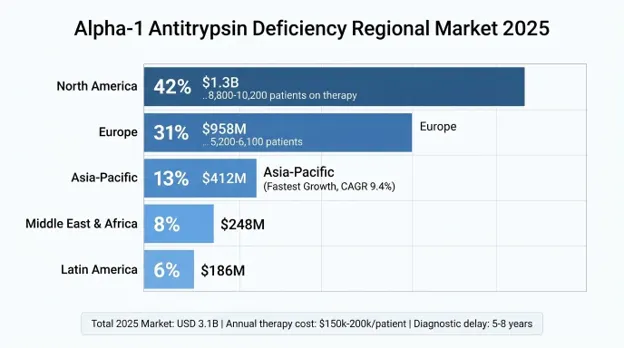
The North American market accounted for 42% market share, with an estimated market value of USD 1.3 billion in 2025, and is expected to experience a CAGR of 8.6% over the next decade till 2034. The United States contributes 88% of the regional market and is backed by advanced respiratory care programs, pulmonary specialty centers, and effective reimbursement frameworks that help patients gain access to expensive augmenting drugs. The presence of effective patient advocacy groups, increased awareness amongst physicians, and advancements in clinical research infrastructure promoting innovations in gene therapy and RNA-based therapeutics also favor growth in the region. More than 450 dedicated diagnostic centers and screening programs have helped increase diagnosis rates, whereas favorable regulatory policies and Medicare reimbursement have enabled adoption of existing treatment solutions and furthered development of innovative disease-modifying therapies.
The European region held 31% of the global AATD market, worth USD 958 million in 2025, and the market in Europe will be expanding at a CAGR of 8.1% until 2034. This growth is attributed to the advanced respiratory care system in place, comprehensive coverage through national health care systems, and higher incidence rate of AATD in some Northern and Western European countries. Germany, France, Italy, and Spain form the largest markets in the region on account of established pulmonology centers, patient advocacy groups, and proper diagnostic processes in place. Diagnosis of patients is easier in Europe owing to the recommendations from the European Respiratory Society for the screening of the condition. Europe also forms one of the major centers for conducting clinical research for AATD.
Asia-Pacific emerges as the most rapidly growing region for the global AATD market and is estimated to exhibit a CAGR of 9.4% from 2025 to 2034, with revenues rising from USD 412 million in 2025 to nearly USD 1.1 billion in 2034. The reasons behind growth include advancements in respiratory care facilities, improvements in availability of genetic and serum AAT testing, and increased awareness regarding rare respiratory diseases among China, India, Japan, and South Korea. China represents the greatest growth potential owing to the presence of a large undiagnosed population. However, countries such as Japan and South Korea have an advantage owing to their highly developed health care system and high levels of diagnosis. Increased spending on health care, insurance coverage, and enhanced diagnostic facilities is encouraging uptake of AATD drugs.
Augmentation therapies have captured 68% market share, worth USD 2.1 billion, in the year 2025. This market category is inclusive of plasma-based intravenous augmentation therapies, namely Prolastin C, Glassia, Zemaira, and Respreeza, which are used for reversing the loss of protective AAT levels and for slowing lung function deterioration. There is high demand due to established clinical benefits, whereas the recombinant AAT drugs have emerged as potential competitors owing to better manufacturing stability. The remaining 32% market share belongs to supportive care medications, worth USD 988 million, which include bronchodilators, corticosteroids, and mucolytics for treating the symptoms of AATD-induced lung diseases.
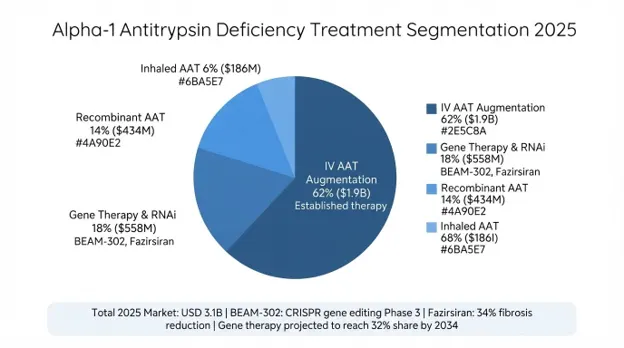
Intravenous AAT augmentation therapy accounts for 62% of the market share in the AAT deficiency therapeutics market, worth USD 1.9 billion by 2025. The gene therapy and RNA interference therapies capture 18% of the market and are projected to grow up to 32% by 2034 as the disease-modifying therapies are commercialized. Recombinant AAT holds 14% of the market share and is aided by increasing capacity in the manufacturing process and less dependence on plasma. Inhaled AAT therapies account for 6% of the market.
Indications for pulmonary disease manifestations constitute the major share in the indications market of alpha-1 antitrypsin deficiency (AATD), representing a valuation of USD 2.0 billion in 2025 and forecasted to reach a CAGR of 8.2% till 2034. This segment is characterized by a large patient base of emphysema, bronchiectasis, and AATD associated with COPD with the help of augmentation therapy. Hepatic disease manifestations are worth USD 648 million and are likely to witness the highest growth rate of 9.8%, owing to the advancement in RNA interference and gene therapy for liver disorders. Pulmonary & hepatic disease manifestations constitute 22% of the market.
IV Delivery is expected to have a 64% market share of USD 1.98 billion in 2025 due to their existing domination of augmentation therapy and clinical trial evidence. Subcutaneous delivery systems continue to be under investigation due to new recombinant AAT delivery forms, which would allow patients to take weekly doses of medication themselves after being granted regulatory approval. Gene delivery vector administration is an innovative method that will be used in BEAM-302 as well as other gene therapy programs through vector administration to liver cells.
Hospitals and clinics have a 45% market share of USD 1.4 billion in 2025, which includes departments for pulmonary care, respiratory clinics, and tertiary hospitals offering intravenous augmentation therapy and handling AATD complications. Home infusion services have a 32% market share of USD 990 million in 2025, which include facilities offering infrastructure for AAT via intravenous augmentation therapy to facilitate convenient treatment of patients at home. Specialized respiratory centers have an 18% market share of USD 558 million in 2025.
The global alpha-1 antitrypsin deficiency (AATD) market exhibits moderate concentration levels, where the top six companies generate roughly 72-78% share of total market revenue. The market leader will be determined based on the availability of proven augmentation treatment options, superior production capabilities, good connections with respiratory specialists, and the pipeline strength in the development of gene therapy and RNA interference techniques. Competition within the market is centered on developing disease-modifying drugs and even cures, bettering products, improving the convenience and efficiency of treatment, and offering effective support to patients. Top firms in the global alpha-1 antitrypsin deficiency market are Grifols, Takeda Pharmaceutical, CSL Behring, Novo Nordisk, Roche/Genentech, Beam Therapeutics, Arrowhead Pharmaceuticals, and Kamada Pharmaceuticals.
July 2026: Beam Therapeutics has announced positive data in the BEAM-302 Part B study in liver fibrosis in AATD that has shown reduction in hepatic biomarkers and stabilization of fibrosis progression with the 60-milligram dose of CRISPR-corrected gene therapy, with a favorable safety profile to initiate the Phase 3 trial. The product is expected to be commercialized in 2027-2028 with regulatory approval.
June 2026: Arrowhead Pharmaceuticals finished enrolling patients in the fazirsiran Phase 3 METAVIR stage F2-F4 fibrosis trial based on preliminary evidence of 34% fibrosis inhibition from placebo at the 48-week point, making for a stronger regulatory filing to be submitted in Q4 2026 with a view to FDA approval in 2027.
May 2026: Takeda Pharmaceutical has announced a regulatory approval extension in the European Union of Glassia (alpha-1 proteinase inhibitor [human]) in hepatic AATD (METAVIR F1) for treatment initiation in early stages before developing cirrhosis.
You'll get the sample you asked for by email. Remember to check your spam folder as well. If you have any further questions or require additional assistance, feel free to let us know via-
+1 724 648 0810 +91 976 407 9503 sales@intellectualmarketinsights.com
22 Aug 2026
Intellectual Market Insights Research © 2026. All rights reserved.


