Share this link via:

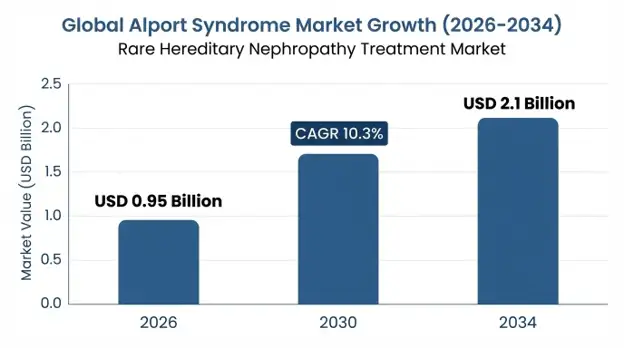
The global Alport syndrome market size was valued at USD 0.85 billion in 2025 and is projected to reach USD 0.95 billion in 2026, expanding to USD 2.1 billion by 2034, growing at a CAGR of 10.3% during the forecast period (2026-2034).
Alport syndrome is a rare, progressive hereditary nephropathy that is caused by mutations in the genes (COL4A3, COL4A4, COL4A5) that code for the alpha chains of type IV collagen, a basic structural component of the glomerular basement membranes, cochlear basement membranes, and the lens capsules of the eye. The features of the disease include chronic kidney disease with chronic microscopic haematuria, sensorineural hearing loss typically in adolescence or early adulthood and some eye abnormalities, including anterior lenticonus. The X-linked phenotype (mutations in the gene COL4A5) is the most severe and, in hemizygous males, occurs in approximately 80% of patients, with a median age-of-onset end stage renal disease (ESRD) of 25 years without nephroprotective treatment.
Current treatment includes established nephroprotective therapies as well as new disease modifying treatments that target specific molecular pathways that cause injury to the GBM. There is a current focus on early starting of renin-angiotensin-aldosterone system (RAAS) inhibition with angiotensin-converting enzyme (ACE) inhibitors and angiotensin II receptor blockers (ARBs) plus sodium-glucose cotransporter-2 (SGLT2) inhibitors, which have significant nephroprotective effects in chronic kidney disease (CKD) populations and have considerable nephro- and podo-protective potential in Alport syndrome through tubuloglomerular feedback (TGF) restoration and direct protection of podocytes.
The commercial opportunity extends beyond the traditional drug market to include the traditional drug market; the disease management systems that will include genetic testing and counselling, care coordination for nephrology patients, innovative biomarker development for disease monitoring, and new gene therapy platforms directed at the underlying collagen defects. Affecting an estimated 150,000–300,000 people worldwide, the market meets an important unmet medical need, with an economic impact of lifetime healthcare costs of more than USD 1.8 million per patient by the time they reach end-stage kidney disease, providing strong health economic justification for disease-modifying therapies that delay or prevent progression to dialysis and transplantation.
| Report Coverage | Details |
|---|---|
| Base Year | 2025 |
| Base Year Value | USD 0.85 Billion |
| Forecast Value | USD 2.1 Billion |
| CAGR | 10.3% |
| Forecast Period | 2025-2034 |
| Historical Data | 2022-2025 |
| Largest Market | North America |
| Fastest Growing Market | Asia Pacific |
| Segments Covered | By Disease Type, Treatment Class, Disease Stage, Route of Administration, End-User |
| Region Covered | North America, Europe, Asia Pacific, Middle East & Africa, Latin America |
| Countries Covered | US, Canada, Mexico, UK, Germany, France, Italy, Spain, Netherlands, China, Japan, India, Australia, South Korea, Brazil, Argentina, UAE, Saudi Arabia, South Africa |
| Key Market Playes | Travere Therapeutics, Chinook Therapeutics (Novartis), Calliditas Therapeutics, Vertex Pharmaceuticals, Regulus Therapeutics |
Get more details on this report - Request Free Sample
The main driving factor for the growth of the Alport syndrome market is the introduction of next-generation sequencing panels and awareness of the nephrology community, which has significantly shortened the time needed to confirm a diagnosis of Alport syndrome, cutting the time from symptom onset to genetic diagnosis from an average of 9-12 years to around 4-5 years in developed health systems. This addresses a long-standing diagnostic gap in which children with isolated microscopic hematuria were often misdiagnosed as having either benign familial hematuria or thin basement membrane nephropathy, and were not offered definitive genetic testing, delaying nephroprotective therapy until the critical disease window when therapeutic interventions have their greatest effect.
The increasing availability of comprehensive gene panels targeting COL4A3, COL4A4, and COL4A5 at prices that have dropped from USD 3,000-5,000 ten years ago to less than USD 500 in many developed markets has revolutionized diagnostic workflow. Genetic testing can lead to definitive diagnosis in many instances without a kidney biopsy and can also allow for cascade family screening of at-risk family members before clinical signs and symptoms appear. International patient registries, such as the European Alport Registry (with > 1200 patients enrolled) and Alport Syndrome Foundation registry in North America, have provided natural history data that have supported clinical trial design and regulatory submissions.
The Alport syndrome treatment paradigm has evolved significantly through the transition from an approach based solely on generic antihypertensive drugs to a competitive field where several mechanism-specific investigational treatments are being pursued for treating different disease mechanisms including endothelin receptor agonism, transforming growth factor beta signaling, and microRNA regulation. Among the investigational treatments in this category, sparsentan, a dual endothelin receptor and angiotensin receptor antagonist manufactured by Travere Therapeutics, is the most promising compound with proven efficacy in decreasing proteinuria by going beyond traditional renin-angiotensin-aldosterone system blockade in phase III clinical trials.
The introduction of sodium-glucose cotransporter-2 inhibitors into the standard of care treatment has laid the new foundations as per retrospective studies from European registries showing 25-35% decrease in proteinuria progression and glomerular filtration rate decline delay after renin-angiotensin-aldosterone system blockade. Combination therapy has emerged as a promising approach to addressing the key problem associated with the inability of any one therapy to be effective for the complicated nature of glomerular basement membrane injury in the disease.
The primary commercial limitation of the Alport syndrome market is the fact that rare genetic diseases have, by definition, very small patient populations, thus posing major challenges in balancing high prices to recover R&D costs and patient access through sustainable reimbursement systems. According to the current estimates, the global prevalence of the condition varies from 150,000 to 300,000, but the number of diagnosed patients is even smaller, restricting commercial opportunities compared to frequent chronic diseases.
Disease heterogeneity in terms of genetic subtypes makes it difficult to conduct clinical trials, which need a relatively large number of patients to prove statistically significant effect on the endpoint such as estimated glomerular filtration rate change and time to end-stage kidney disease. Phase III trials usually involve 200-400 patients recruited in 3-5 years, which constitutes 25-50% of the treated population in large markets.
The most transformative long-term opportunity lies in gene therapies that introduce functional copies of COL4A3, COL4A4, and COL4A5 into the kidney cells, thereby preventing or reversing the breakdown of the glomerular basement membrane due to restoring the normal assembly of type IV collagen. Proof-of-concept studies in mice lacking Col4a3 have confirmed that adeno-associated viral vector-based gene therapy results in the preservation of glomerular structure, reduction in proteinuria, and increased longevity compared to untreated controls.
The development of kidney-targeted adeno-associated viral vectors with improved podocyte targeting, scalable production, and optimization of the immunosuppression regimens is an active area moving towards first-in-human trials. Curative one-time gene therapies with the price tag of up to 2-4 million dollars per patient can provide decent revenues, albeit low patient numbers.
The incorporation of SGLT2 inhibitors into treatment regimens of patients with Alport syndrome is a promising area of advancement in the short term, based on solid mechanistic foundations, such as glomerular hyperfiltration prevention via restoration of tubuloglomerular feedback, and direct anti-inflammatory properties.
Several studies from European nephrology centers reported a 31% reduction in the rate of glomerular filtration decline by 31% within 24 months using sodium-glucose cotransporter-2 inhibitors in addition to renin-angiotensin-aldosterone system inhibitors. Randomized prospective studies dedicated to Alport syndrome are planned for the period of 2027-2029.
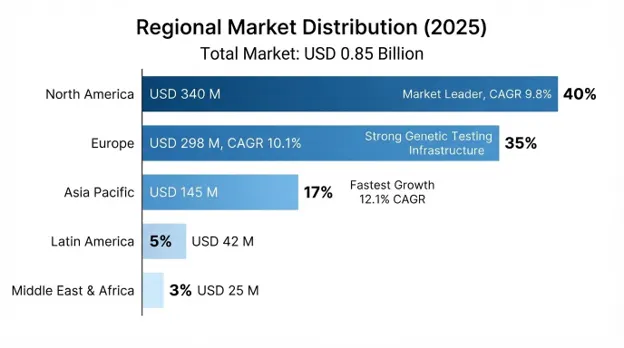
The North America region held the highest regional market share at USD 340 million in 2025 and continued to grow at 9.8% CAGR over 2034. Market dominance was attributed to the existence of a complex rare disease ecosystem characterized by nephrology clinics specialized in Alport syndrome, advanced genetic testing facilities, patient support for clinical trials, and regulation of orphan drugs with 7 years of market exclusivity among other priorities.
FDA acceptance of proteinuria reduction as a surrogate endpoint for expedited approvals for treatments for rare nephropathies in the US has helped develop new drug compounds. Coverage of genetic testing, specialist consultations, and orphan therapies by Medicare and commercial insurers has provided an insurance coverage base that sustains adoption at high prices.
Asia-Pacific showed the highest growth rate with forecasted CAGR of 12.1% from 2020 to 2034, growing up to USD 145 million in 2025. Growth is attributed to the large patient population where Alport syndrome cases are similar globally but have lower diagnostic rates due to limited genetic testing infrastructure.
Japan dominates the region in terms of development as it has well-developed rare disease programs supported by the government and has nephrologist experts along with participation in international clinical trials. China presents the biggest growth opportunity as it has about 140,000-280,000 Alport syndrome cases but fewer than 8,000 currently diagnosed.
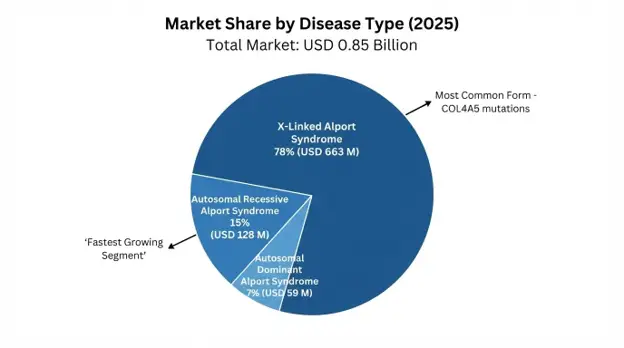
X-linked Alport Syndrome is the dominant segment, accounting for 78% of the total market with USD 663 million value in 2025 and is expected to grow at 10.1% CAGR from 2026 to 2034. The dominance is attributed to high prevalence rates, more predictable disease severity in males, thereby enabling clearer clinical endpoints, and increased investments in research. The X-linked Alport Syndrome segment includes hemizygous males with progressive disease course and heterozygous females with variable penetrance.
The Autosomal Recessive Alport Syndrome holds 15% market share worth USD 128 million in 2025 and is the fastest-growing segment at a rate of 11.2% CAGR due to increasing diagnosis of such cases using genetic tests. Autosomal Dominant Alport Syndrome is a 7% market share segment.
ACE Inhibitors and ARBs form the leading segment with 48% market share worth USD 408 million in 2025, including the current gold standard care for nephroprotection. SGLT2 Inhibitors constitute the fastest growing segment with 22% market share and USD 187 million in 2025, witnessing growth at a CAGR of 18.7% through 2034 due to increasing adoption globally.
Novel pipeline therapeutics, including sparsentan and endothelin receptor antagonists form 12% of the market share worth USD 102 million in 2025, which is estimated to rise to 28% market share by 2034 due to the approval of experimental therapeutics. Gene therapy forms an upcoming segment with 2% market share, expected to reach 8% market share by 2034.
Hospitals & Specialty Clinics form the largest segment with 52% market share accounting for USD 442 million in 2025, including academic medical centers with programs for rare kidney diseases and pediatric nephrology clinics. Nephrology Clinics contribute to 31% market share, accounting for USD 264 million in 2025 with 11.4% CAGR up until 2034 and forms the fastest growing segment.
The global Alport syndrome market is moderately concentrated with companies adopting different therapeutic strategies based on the pathophysiological mechanism of the diseases and the patient pool. The competitive advantage for companies lies in mechanism-specific therapies targeting Alport syndrome pathology, quality of clinical trial evidence specific to the disease, orphan drug designation and patient identification ability via registries.
March 2026: Sparsentan showed promising Phase III data for treating Alport syndrome with 38% reduction in proteinuria and the time taken to achieve a 40% estimated glomerular filtration rate reduction prolonged by 2.1 years compared with standard-of-care treatment.
February 2026: Chinook Therapeutics enrolled patients for ALIGN trial to evaluate atrasentan specifically for treating Alport syndrome using a selective endothelin receptor A antagonist approach.
January 2026: Vertex Pharmaceuticals announced successful COL4A3 delivery using adeno-associated virus in preclinical studies, resulting in 72% decrease in proteinuria and maintaining glomerular ultrastructural integrity, supporting an Investigational New Drug (IND) application.
December 2025: Orphan designation of anti-microRNA-21 therapy was awarded by European Medicines Agency on account of its crucial involvement in pathways of renal fibrosis.
You'll get the sample you asked for by email. Remember to check your spam folder as well. If you have any further questions or require additional assistance, feel free to let us know via-
+1 724 648 0810 +91 976 407 9503 sales@intellectualmarketinsights.com
22 Jul 2026
Intellectual Market Insights Research © 2026. All rights reserved.