Share this link via:

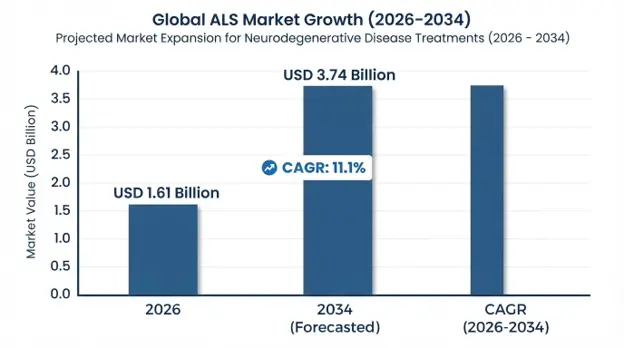
The global amyotrophic lateral sclerosis (ALS) market was valued at USD 1.42 billion in 2025 and is projected to reach USD 1.61 billion in 2026, expanding to USD 3.74 billion by 2034, growing at a CAGR of 11.1% during the forecast period (2026-2034).
Amyotrophic lateral sclerosis (ALS) is one of the most devastating neurodegenerative diseases, characterized by the progressive and selective degeneration of upper and lower motor neurons in the brain (including the brainstem) and spinal cord, which eventually causes progressive muscle weakness and paralysis with a mean life expectancy of 2-5 years from onset of symptoms. The disease affects approximately 5–7 people per 100,000 population worldwide, with an estimated 450,000 patients worldwide in 2025, of which 5-10% (or about 25,000) could have identifiable genetic mutations in genes such as SOD1, C9orf72, FUS and TARDBP, which encode TDP-43 protein.
The therapeutic landscape has evolved significantly from offering few treatment options, with only riluzole available for treatment for more than 20 years, to one that has become more sophisticated, with a growing number of disease-modifying drugs, precision medicine strategies aiming at certain genetic subtypes, and comprehensive multidisciplinary treatment models, including pharmacotherapy, respiratory support, nutritional management and assistive technologies. Tofersen, the first antisense oligonucleotide targeting SOD1 mRNA, was recently approved, establishing the genetically stratified treatment paradigm and setting a precedent for regulatory approval of biomarker-driven drug development, thus changing the commercial landscape of ALS therapeutics.
The market’s commercial importance extends beyond pharmaceutical revenues to cover the entire therapeutic ecosystem that includes the average annual treatment cost (AATC) per ALS patient, which is greater than USD 250,000, including the cost of multidisciplinary clinic visits, respiratory support equipment, nutrition support, assistive communication technology, and palliative care. Despite the relatively small patient base, the strong commercial potential of this high-value therapeutic setting, coupled with orphan drug status and longer market exclusivity and higher price premiums, offers ample opportunities for novel precision therapies with annual treatment costs of USD 150,000-250,000 per patient.
| Report Coverage | Details |
|---|---|
| Base Year | 2025 |
| Base Year Value | USD 1.42 Billion |
| Forecast Value | USD 3.74 Billion |
| CAGR | 11.1% |
| Forecast Period | 2026-2034 |
| Historical Data | 2022-2025 |
| Segments Covered | By Drug Class, Route of Administration, Disease Type, Mutation Type, End-User |
| Region Covered | North America, Europe, Asia Pacific, Middle East & Africa, Latin America |
| Countries Covered | US, Canada, UK, Germany, France, Italy, Spain, Japan, China, Australia, South Korea, Brazil, UAE, Saudi Arabia, South Africa |
| Key Market Playes | Biogen Inc., Mitsubishi Tanabe Pharma, Novartis AG, Sanofi, Ionis Pharmaceuticals, Wave Life Sciences, UCB S.A., Amylyx Pharmaceuticals |
Get more details on this report - Request Free Sample
The ALS market is experiencing steady growth due to improved disease awareness, faster diagnosis, and expanding genetic testing. that include better disease identification, faster diagnostics, and the systematic incorporation of genetic testing that helps identify patient subgroups for targeted treatment. In the past, patients who had symptoms of ALS were diagnosed on average within 12-18 months after showing their first symptoms because they resembled those of other more common neurological diseases like cervical spondylotic myelopathy, multifocal motor neuropathy, and Kennedy disease. Modern ALS multidisciplinary clinics managed to lower median diagnostic delay time to less than 9 months.
The global trend of aging demographics will fuel steady baseline growth in demand due to the sharp increase in ALS risk starting at the age of 50, with the peak incidence rate among the population aged 60-75. The growing share of elderly population in North America, Europe, Japan and increasingly China results in higher absolute number of new ALS cases despite stable age-specific incidence rates, ensuring continued market growth throughout the forecast period.
The introduction of genetic testing into clinical practice for ALS has been transformative for the disease, with the detection of 10-15% of patients carrying treatable genetic mutations that can be addressed by personalized therapies through genetic testing performed on approximately 78% of all newly diagnosed patients in specialized ALS centers in 2025 compared to 34% in 2018. Detection of SOD1 mutations in approximately 2% of patients enabled the development and approval of tofersen., while C9orf72 hexanucleotide repeat expansion in 5-7% of all cases is the most promising target for antisense oligonucleotides programs, providing significant commercial opportunities.
The ALS drug discovery and development pipeline is one of the most cutting-edge and lucrative development portfolios in rare neurology, comprising more than 60 active clinical programs in 2025 based on diverse mechanisms of action, which include gene silencing via antisense oligonucleotides, gene replacement via adeno-associated viral vectors, modulation of neuroinflammation, mitochondrial preservation, and neuroprotection by stem cells. FDA’s approval of tofersen through the accelerated approval process highlighted the utility of the antisense oligonucleotide modality in motor neuron diseases and showed that biomarker-based surrogate endpoints, like neurofilament light chain suppression, can facilitate regulatory approvals and thereby shorten the timeframes for future pipelines.
The commercial opportunity is further accentuated by the existence of orphan drug schemes that provide market exclusivity of 7 years in the US and 10 years in Europe, priority reviews, and significant tax credits on clinical development expenses, making development efforts economically viable not only for big pharma but also for specialized biotech companies. The premium pricing conditions associated with the approved treatments for ALS can be viewed in the light of orphan drug economics, with tofersen’s annual cost of about USD 176,000 per year being illustrative of this point.
High Clinical Trial Failure Rates and Complex Endpoint Challenges:
The primary factor restricting ALS market growth is the high clinical trial failure rate. due to the failure of more than 50 molecules that were effective in preclinical studies but failed to demonstrate efficacy in humans over the last three decades. The failure of preclinical research is due to intrinsic weaknesses of currently existing models of ALS in animals, especially transgenic mice with elevated expression of mutant human SOD1.
Clinical endpoint selection remains a major scientific and regulatory challenge. because well-validated endpoints of survival and ALSFRS-R functional rating scale changes involve a lot of patients observed for 12-18 months to show statistically significant differences. This makes clinical trials costly and complex. ALS as a heterogeneous disease with various genetic forms, different rates of progression, various sites of onset, and presence of frontotemporal involvement causes difficulties in statistical proving of drug efficacy in realistic trial conditions.
Development Challenge Metrics:
Antisense Oligonucleotide and Gene Therapy Platforms for Genetically Defined ALS Subtypes:
The approval of tofersen has created significant opportunities for genetically targeted ALS therapies. for the firms that are involved in antisense oligonucleotide and gene therapy programs focused on the rest major genetic subtypes of ALS that affect around 15-20% of the total cases of ALS. The most important unmet need in genetically defined ALS includes C9orf72 repeat expansions affecting around 25,000-35,000 people in the U.S. and Europe, with multiple antisense oligonucleotide programs under clinical development from Biogen and Wave Life Sciences.
Gene therapies based on adeno-associated viral (AAV) vectors offer significant advantages for SOD1 silencing than antisense oligonucleotide, due to the single-administration of the silencing and no need for repetitive intrathecal administration, which has been successfully achieved by Novartis and academia in non-human primates to reduce the SOD1 protein expression.
Gene Therapy Opportunity Metrics:
Neurofilament Light Chain as Transformative Biomarker Enabling Accelerated Drug Development:
The development of neurofilament light chain as a pharmacodynamic and prognostic biomarker in ALS is the most significant advance in ALS drug development in terms of impact on study design, because of making possible small-term studies to show target engagement, prior to moving on to larger survival-based clinical trials. Levels of neurofilament light chain in blood and cerebrospinal fluid correlate very strongly with ALS disease progression, survival, and functional worsening, and predict 12-month survival with area under the curve above 0.80.
The tofersen study represented the first regulatory validation of neurofilament light chain as a surrogate endpoint, when FDA approved the drug since its significant reduction of plasma neurofilament light chain concentration in SOD1-ALS patients. This regulatory experience has been adopted by most ALS Phase II trials that started after 2023, including neurofilament light chain reduction as a primary or secondary endpoint.
Biomarker Adoption Metrics:
North America: Market Leadership Through Regulatory Innovation and Specialized Care Infrastructure:
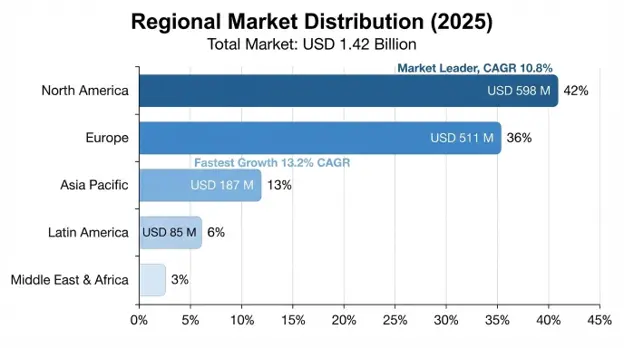
North America led the ALS market, accounting for USD 598 million in 2025. in 2025 and will also maintain the expected CAGR of 10.8% till 2034. The dominance of this region in the market can be attributed to the presence of the highest number of ALS specialized clinics in the world, effective coverage by Medicare and Medicaid of FDA-approved medications for ALS patients, and the ALS Association’s research funding efforts.
The U.S. accounts for 87% of regional revenue, supported by approximately 32,000 ALS patients. and USD 280 million annual expenditure on riluzole and edaravone drugs. Medicare coverage for riluzole and Part B coverage for IV edaravone and intrathecal tofersen ensures total reimbursement framework, while tofersen penetrates 68% of the eligible SOD1-ALS patients in just 12 months after its approval.
Key Performance Indicators:
Asia Pacific: Fastest Growth Through Population Scale and Expanding Neurological Care Access:
The Asia Pacific is set to be the fastest-growing ALS market region with a CAGR forecast of 13.2% until 2034 and market size expected to reach USD 187 million in 2025. In the Asia Pacific region, Japan has the highest ALS incidence rate in Asia at 11.3 cases per 100,000 population., which is about 2.5 times higher than the world average owing to the genetic predisposition and advanced diagnostics systems. Edaravone became the first drug approved for treatment of ALS in Japan in 2015.
China is the most promising ALS market with an estimated number of 60,000-80,000 patients, although the number of patients who received a diagnosis is far smaller. Healthcare system development in the framework of Healthy China 2030 initiative will contribute to market development.
Drug Class Insights:
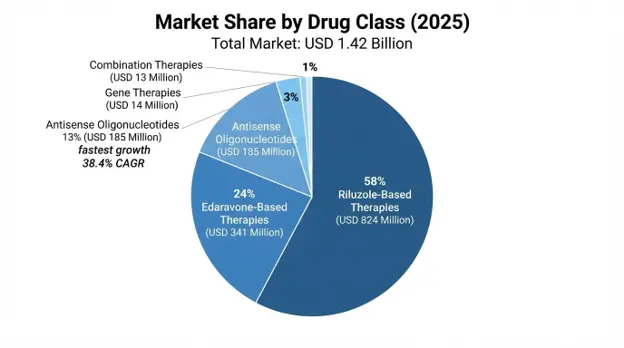
Riluzole-Based Therapies continue to have the highest market share of 58%, translating to sales worth USD 312 million by 2025 amid competition from generics that lowers costs per patient per year to USD 8,000-12,000. Glutamate modulation by Riluzole has resulted in mild yet significant survival gain of 2-3 months for the ALS patients.
Antisense Oligonucleotide Therapies are projected to be the fastest-growing class with a 38.4% CAGR until 2034 and a value of USD 187 million in 2025 thanks to tofersen sales. Antisense oligonucleotides target genetic origins via mRNA degradation and are thus not symptomatic therapies, but disease modifying ones whose commercialization depends on clinical results and pipeline development.
Disease Type Insights:
Sporadic ALS accounts for 90–95% of cases and is primarily treated with non-specific therapies. like Riluzole and Edaravone, at an average annual cost of treatment of USD 14,000 per patient. However, familial ALS comprises only 5-10% of cases, holds disproportionate pharma market share due to specific treatments available, at an average annual cost of treatment of USD 198,000 per patient.
End-User Insights:
Hospitals & Neurology Centers have a market share of 52%, which is valued at USD 738 million by the year 2025, which includes academic hospitals having multidisciplinary centers for the management of ALS.
The highest CAGR of 14.2% is observed in Home Healthcare through 2034, due to the transition of patients from hospital care to home care, owing to the requirement for respiratory and nutritional management and use of assistive technologies.
Competitive Landscape:
The global ALS market is moderately concentrated. where major players command 65-70% of total value in the pharmaceutical market by virtue of their generic riluzole sales, their branded edaravone offerings, and their precision medicines segments. The competitive landscape is shifting toward precision medicine, favoring companies developing antisense oligonucleotide therapies. and rare diseases commercialization capability can generate outsized value in genetically defined patient segments.
Biogen generated its position in precision medicines through tofersen launch and antisense oligonucleotide pipeline programs. Novartis benefits from its expertise in gene therapy gained from Zolgensma to explore the SOD1-ALS opportunity. Mitsubishi Tanabe sustains its position with edaravone sales and oral formulation of edaravone.
April 2026: Positive interim data was revealed by Biogen on their ATLAS presymptomatic SOD1-ALS prevention study using tofersen, showing that tofersen delays clinical onset in presymptomatic SOD1 mutation carriers.
March 2026: Wave Life Sciences released Phase Ib study results for WVE-004 targeting C9orf72 repeat expansions, showing dose-dependent reduction in poly-GP dipeptide repeat proteins, moving to Phase II/III efficacy studies.
February 2026: Sanofi finalized its acquisition of Inhibrx and launched its new rare neurology strategy including ALS gene therapy development with an USD 450 million pipeline investment promise.
January 2026: Novartis provided 18 months’ data on AAV-mediated SOD1 gene silencing showing sustained 78% reduction in SOD1 protein levels in non-human primates.
List of Key Players in Global ALS Market:
By Drug Class:
By Route of Administration:
By Disease Type:
By Mutation Type:
By End-User:
By Region:
You'll get the sample you asked for by email. Remember to check your spam folder as well. If you have any further questions or require additional assistance, feel free to let us know via-
+1 724 648 0810 +91 976 407 9503 sales@intellectualmarketinsights.com
Intellectual Market Insights Research © 2026. All rights reserved.