Share this link via:

The global Alström syndrome market size was valued at USD 142.8 million in 2025 and is projected to reach USD 156.4 million in 2026, expanding to USD 298.7 million by 2034, growing at a CAGR of 8.3% during the forecast period (2026-2034).
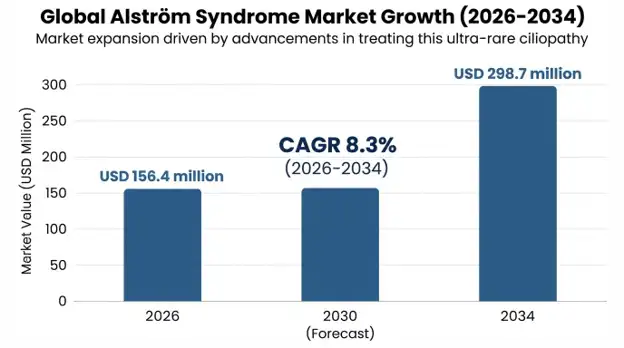
Alström syndrome is one of the most complex and rare genetic syndromes that results from mutations in the ALMS1 gene on chromosome 2p13, which encodes a large centrosomal and ciliary protein that is vital for the correct functioning of cells in several organ systems. The number of people with a confirmed diagnosis of this autosomal recessive ciliopathy is estimated to be approximately 1,000-1,200 people worldwide, with epidemiological studies suggesting there may be up to 2,500-3,000 people worldwide with the disorder but not yet diagnosed or misdiagnosed. The syndrome has an overwhelming multi-system phenotype, typically apparent in early childhood, which includes progressive cone-rod dystrophy, which is the primary cause of legal blindness by the 2nd decade of life, and bilateral, sensorineural, hearing loss in > 90% of patients, severe childhood-onset obesity and profound insulin resistance, early-onset type 2 diabetes, and life-threatening complications such as dilated cardiomyopathy, progressive hepatic and pulmonary fibrosis and chronic kidney disease.
ALMS1 protein is a key component of the centrosome and primary cilium, which are organizing centers for microtubules and sensory organelles, respectively. Primary cilia are found on almost all human cell types and serve as antennae for detecting physical, chemical and electrical stimuli from the extracellular environment and transmitting them to the cell to control basic cellular events such as proliferation, differentiation and apoptosis. This loss of function of ALMS1 protein is associated with impaired function and structure of the cilia in many tissues, which underlies the multi-organ clinical features of the syndrome and progressive nature of the course. The diagnosis of Alström syndrome is complex and high value because it involves multiple medical disciplines such as ophthalmology, cardiology, endocrinology, nephrology, hepatology and audiology and treatment needs are long term.
There are no disease-modifying treatments to date that target the underlying ALMS1 defect, and the current treatment paradigm for Alström syndrome is largely symptomatic and organ-specific. Therapy is targeted at individual manifestations based on known pharmacological therapy outlined below: angiotensin-converting enzyme inhibitors and beta-blockers for cardiac dysfunction, insulin sensitizers and advanced antidiabetic therapy for metabolic complications, assistive devices for sensory impairments, and novel anti-fibrotic medication for progressive organ fibrosis. Gene therapy platforms continue to see a dramatic evolution in the market with several investigational programs emerging around adeno-associated virus-mediated gene replacement of ALMS1, antisense oligonucleotides targeting specific splice variants and base editing approaches aimed at correcting point mutations.
The commercial value of the Alström syndrome market is not limited to therapeutic revenues, but has the potential to include full diagnostic care, specialist medical devices, and integrated care delivery systems. The rarity of the condition gives rise to some distinct market dynamics, including high prices for niche therapies, vast regulatory benefits such as orphan drug designations and concentrated patient bases at specialized centers of excellence. The costs of health care services to individual patients range from USD 85,000 to USD 150,000 per year, depending on the complexity of multi-organ management, and on the need for ongoing monitoring and intervention to prevent life-threatening complications.
| Report Coverage | Details |
|---|---|
| Base Year | 2025 |
| Base Year Value | USD 142.8 Million |
| Forecast Value | USD 298.7 Million |
| CAGR | 8.3% |
| Forecast Period | 2025-2034 |
| Historical Data | 2022-2025 |
| Largest Market | North America |
| Fastest Growing Market | Europe |
| Segments Covered | By Treatment Type, Clinical Manifestation, Diagnostic Approach, End-User |
| Region Covered | North America, Europe, Asia Pacific, Middle East & Africa, Latin America |
| Countries Covered | US, Canada, UK, Germany, France, Italy, Spain, Netherlands, Japan, China, India, Australia, Brazil, UAE, Saudi Arabia, South Africa |
| Key Market Playes | Rhythm Pharmaceuticals, ProQR Therapeutics, Editas Medicine, Boehringer Ingelheim, Sanofi (Genzyme), Applied Therapeutics |
Get more details on this report - Request Free Sample
The key factor driving changes in the Alström syndrome market is the groundbreaking enhancement of the diagnosis precision and efficiency gained by the implementation of the next-generation sequencing technique in the clinical setting. Previously, the average diagnostic delay, which was on average 7-9 years from the onset of symptoms, has been significantly shortened to 2-4 years in many medical care facilities, thus allowing earlier diagnosis and treatment of the disease. The use of gene panels for the diagnosis of ciliopathies, as well as whole-exome and whole-genome sequencing, has completely changed the diagnosis of the disease.
Clinical significance of early genetic diagnosis goes much further than administrative convenience as early detection of ALMS1 gene abnormalities allows the introduction of cardiac monitoring aimed at detecting life-threatening heart complications that could occur suddenly even during childhood or in adolescents. Early surveillance enables the timely initiation of cardioprotective therapy before irreparable myocardial damage takes place, allowing for increased life expectancy and prevention of a sudden cardiac death. Also, early metabolic treatment using dietary regimens and insulin sensitizers could postpone diabetes diagnosis and lessen the complications like diabetic nephropathy and atherosclerosis.
Decreasing the cost of sequencing has greatly contributed to widespread use of genetic testing as currently the cost of exome sequencing is below USD 500 per case as compared to approximately USD 10,000 per patient in 2015, thus making the genetic screening affordable for patients with clinical characteristics of ALMS1-related conditions. Insurance coverage for genetic testing has increased significantly. due to their proven clinical significance and cost-efficiency.
The strong orphan drug regulatory framework existing in key markets creates powerful economic incentives which have brought considerable biotech investment into the development of treatments for Alström syndrome, despite its limited number of patients. The unique market exclusivity period, fast-track pathway, cost reductions during the development process and priority review voucher programs offers an attractive economic environment for substantial investments in ultra-rare diseases. The US orphan drug status grants seven years of market exclusivity, 25% tax credits for qualifying clinical trials, exemption from the FDA fees of USD 3.2 million and a possibility to get priority review vouchers worth between USD 100 and 350 million in the secondary market.
The incentives offered by the European regulatory system via ten-year market exclusivity, protocol assistance programs, and reduced fees that together lower development costs by 35-50% when compared with non-orphan programs have played a key role in increasing the Alström syndrome development pipeline, which expanded from less than 5 investigational therapies in 2020 to more than 15 different development programs in 2025.
The regulatory pathway for the development of Alström syndrome therapeutics is facilitated by the guidance from FDA and EMA on the use of natural history data as an alternative to placebo controls, thereby minimizing the ethical issues associated with placebo trials within ultra-rare disease populations. The use of composite endpoints that demonstrate multi-organ benefit and the availability of accelerated approval mechanisms based on surrogate endpoints are additional facilitators to development.
The primary limitation restricting growth of the Alström syndrome market is the extremely low number of patients who are spread over a vast geographical location, numbering around 1,000-1,200 worldwide and are spread out among more than two dozen countries without any geographical concentration. This scarcity of patients poses major problems for conducting clinical trials because these would need multi-national protocols and extended period of 3-5 years of recruitment to attain statistical significance in terms of numbers.
Revenue potential is limited due to the small size of the patient population, as it poses a dilemma between needing high prices to cover research costs and payer unwillingness to provide very expensive treatments for ultra-rare disorders. Research programs in case of Alström syndrome usually include 25-80 patients at several sites around different countries as opposed to other rare diseases which have 200-500 patients in their clinical trials.
The most significant potential in the treatment market for Alström syndrome comes from the gene therapy strategies that would lead to restoring normal expression of ALMS1 protein, which can have a disease modifying effect on several organ systems using single intervention. The feasibility and regulatory framework for ALMS1-related gene therapy have been already confirmed by adeno-associated virus gene therapy success in related inherited retinal disorders, including Luxturna approval and several other clinical trials.
There is only one significant obstacle that prevents successful use of ALMS1 gene therapy, and it is the very large size of the ALMS1 protein-encoding region, estimated to be around 12.8 kilobases long, which is larger than usual adeno-associated virus packaging capacity. Potential approaches to overcome this challenge include two-vector delivery using protein splicing through intein, shortened but still functional ALMS1 protein, as well as non-viral delivery methods such as lentivirus or lipid nanoparticles. Initial results from the dual AAV system in animals show some success in ALMS1 protein restoration.
Significant advances have been made within the area of natural history data collection in Alström syndrome via an expanding set of international patient registries like the International Alström Syndrome Registry run by the Jackson Laboratory and the European Alström Syndrome Registry. Data on the rate of progression of the condition, genotype-phenotype associations, biomarker trends, and quality of life metrics is collected in the registries, which form the basis for the natural history needed for accelerated drug approval.
To accept natural history data as external control data in rare disease studies greatly decreases the burden of conducting such clinical trials since no placebo arms need to be conducted for ethical reasons due to the difficulty of randomization in small sample sizes.
In North America, North America accounted for USD 56.8 million in 2025, representing the largest regional market. in 2025, accounting for 40% of the worldwide market value, with a forecasted growth rate of 8.5% CAGR over the period of 2026-2034. The reason behind regional dominance is the availability of specialized rare disease research infrastructures such as the NIH Undiagnosed Diseases Program, Jackson Laboratory, and orphan drugs' regulatory incentives for research in Alström syndrome. There are around 285-320 diagnosed cases of Alström syndrome in the United States, the largest country patient population worldwide.
The US market also enjoys rare disease centers network, full coverage for the genetic tests and specialized treatments by Medicare and Medicaid coverage for eligible rare disease services, and patient advocacy by organizations such as Alström Syndrome International. Regulatory landscape encourages innovations using breakthrough therapy designation and regenerative medicine advanced therapy designation.
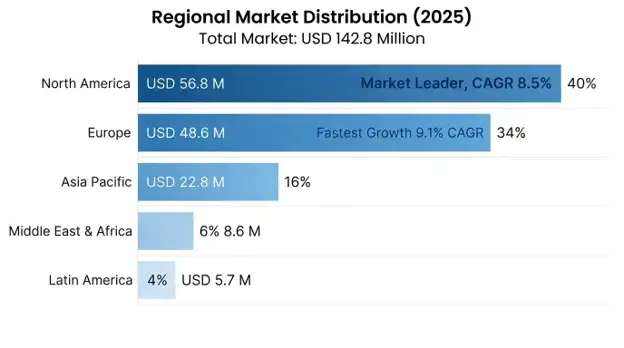
With an estimated CAGR of 9.1% during the forecast period (2026–2034).. The reason behind this is European Reference Networks for rare diseases. These networks have improved diagnosis and care coordination across the region. The establishment of ERN-EYE and ERN-ITHACA consortia has helped in diagnosing and providing standard treatments to the patients in the region.
Newborn screening programs in Germany, France, and Netherlands, which involve genetic screening for ciliopathies, can also play a pivotal role in managing patients in this region. In addition, regulatory support from the European Medicines Agency with respect to orphan designation and development of European Alström Syndrome Registry will facilitate the conduct of clinical trials in the region.
Symptomatic Management is the leading treatment category accounting for 58% market share worth USD 82.8 million in 2025, which includes cardiologic drugs, antidiabetics, devices that help individuals with sensory organ defects, and support treatments. This category illustrates the current lack of disease modification treatment and the emphasis on management of the respective organ symptoms with existing treatment methods.
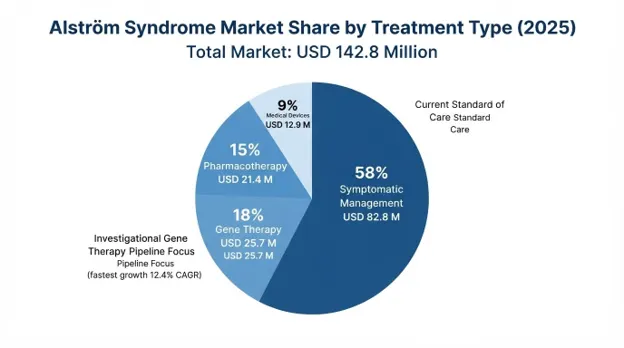
Investigational Gene Therapy has a market share of 18% worth USD 25.7 million in 2025, which includes the cost incurred in developing gene therapy programs and conducting early-stage clinical trials before their implementation in commercialization process. The category is expected to have the highest growth rate of 12.4% CAGR till 2034 due to development of several gene therapy programs into clinical stage.
Cardiac Complications is the biggest clinical application segment with a market share of 32%, accounting for USD 45.7 million in 2025. This includes drugs used to treat dilated cardiomyopathy, heart failure, and cardiac devices. It also receives an impetus from established treatment procedures and life-threatening nature of cardiac conditions that require aggressive measures.
The Metabolic Disorders category holds a market share of 28%, estimated to be worth USD 40.0 million in 2025. It covers insulin resistance, diabetes, obesity, and related disorders with the help of antidiabetics and nutritional solutions.
Specialized Rare Disease Centers are expected to be the major end user group, accounting for 52% market share worth USD 74.3 million in 2025 due to high prevalence of Alström syndrome patients at such centers. Such centers offer integrated diagnostic services, care delivery services, and clinical trials for increased healthcare utilization by patients.
Academic Medical Centers will hold 26% market share worth USD 37.1 million in 2025 due to their role in conducting natural history studies, biomarker identification, and clinical trials.
Competitive environment of the worldwide market of Alström syndrome remains highly fragmented owing to the absence of any company controlling more than 15% market share since it is an early stage of development of therapeutics specifically aimed at treatment of the disease in question. There are three segments where competition takes place, including well-established pharmaceutical companies selling their approved drugs which bring profits from the sales to Alström syndrome patients among others; special biotech companies developing orphan drugs targeting ciliopathies; and finally, companies producing medical devices for sensory restoration.
The competitive landscape is expected to consolidate up to 2034 due to the development of gene therapy programs and launch of approved therapies for the treatment of Alström syndrome.
March 2026: Rhythm Pharmaceuticals reported interim data from a Phase II trial of setmelanotide in genetically diagnosed cases of Alström syndrome, showing significant weight loss and increased insulin sensitivity after 24 weeks of administration of the drug.
January 2026: The Jackson Laboratory was awarded a USD 15.2 million NIH grant to build the International Alström Syndrome Registry and undertake thorough natural history research involving 200 patients within a period of five years.
November 2025: ProQR Therapeutics revealed preclinical data from an antisense oligonucleotide that targeted specific ALMS1 splice variants and restored functional protein expression in cell models derived from the patients.
September 2025: The European Medicines Agency awarded orphan designation for a dual adeno-associated virus ALMS1 gene therapy program, granting ten years of market exclusivity along with protocol support for future clinical research programs.
By Clinical Manifestation:
You'll get the sample you asked for by email. Remember to check your spam folder as well. If you have any further questions or require additional assistance, feel free to let us know via-
+1 724 648 0810 +91 976 407 9503 sales@intellectualmarketinsights.com
22 Jul 2026
Intellectual Market Insights Research © 2026. All rights reserved.