Share this link via:

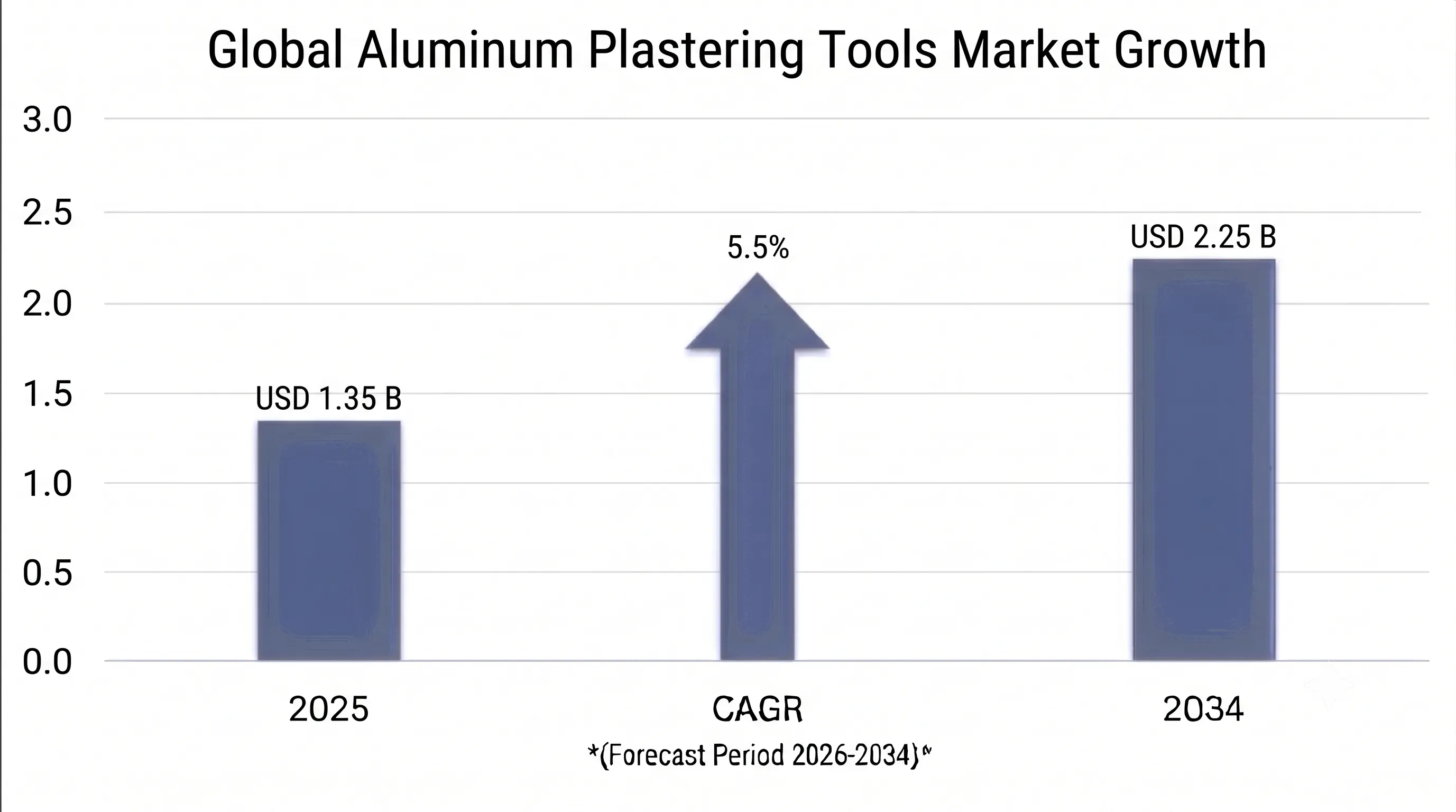
The global aluminum plastering tools market size was valued at USD 1.35 billion in 2025 and is projected to reach USD 1.46 billion in 2026, expanding to USD 2.25 billion by 2034, growing at a CAGR of 5.5% during the forecast period (2026-2034).
Aluminum plastering tools are a specialized area of construction hand tools designed to provide high performance, durability, and ergonomic benefits for masonry, drywall, and surface finishing applications. in residential, commercial and industrial construction. They consist of multiple implements such as trowels, hawks, darbies, straightedges, floats, screeds, corner tools and mixing accessories made from a wide variety of aluminum alloys., including an impressive assortment of aluminum alloys that offer excellent strength-to-weight ratio, inherent resistance to corrosion, and dimensional stability across a wide range of environmental conditions.
These basic benefits of aluminum construction for plastering tools are due to the special characteristics of the material that directly meet the physical needs and quality demands of professional finishing trades. The lightweight nature of aluminum helps reduce operator fatigue during prolonged overhead and repetitive use. yet enables the operator to generate flat and smooth surfaces over wide wall and ceiling areas. Aluminum is also very corrosion-resistant, so it will not stain rust on light-colored plasters and will not degrade as steel tools commonly do. in a moisture-wet construction site.
They combine the latest in manufacturing, such as precision extrusion processes that produce hollow profiles with their associated high strength to weight ratio, computer-controlled machining to ensure dimensional accuracy that is critical in screeds and straightedges and specialized surface treatments such as anodizing and powder coating. to achieve increased durability and improve friction during application. The trend toward ergonomic handle designs with thermoplastic rubber grips and vibration dampening features help improve tool control and surface finish. while alleviating occupational health concerns.
Beyond the individual tool sale, this market is important to the overall construction industry's focus on productivity, quality, and workers' safety. Aluminum tools are a necessity in today's construction specifications and are becoming a standard tool for professional contractors to achieve the precise flatness tolerances required by these specs, to decrease rework costs, and to keep up competitive labor productivity. The market supports plasterers worldwide., drywall finishers and masonry professionals, and to meet the needs of the growing DIY home improvement market which is drawn to the performance of professional grade tools.
| Report Coverage | Details |
|---|---|
| Base Year | 2025 |
| Base Year Value | USD 1.35 Billion |
| Forecast Value | USD 2.25 Billion |
| CAGR | 5.5% |
| Forecast Period | 2025-2034 |
| Historical Data | 2022-2025 |
| Largest Market | Asia Pacific |
| Fastest Growing Market | Asia Pacific |
| Segments Covered | By Product Type, Application, Construction Type, End-User, Distribution Channel |
| Region Covered | North America, Europe, Asia Pacific, Middle East & Africa, Latin America |
| Countries Covered | US, Canada, Mexico, UK, Germany, France, Italy, Spain, Netherlands, China, Japan, India, Australia, South Korea, Brazil, Argentina, UAE, Saudi Arabia, South Africa |
| Key Market Playes | Marshalltown Company, OX Tools, Kraft Tool Co., NELA Tools, Refina Ltd., DEWALT, Goldblatt Tool Company |
Get more details on this report - Request Free Sample
The unprecedented volume of construction activity due to rapid urbanization, infrastructure modernization initiatives and the continued demand for residential housing across developed and emerging economies are the key structural factors propelling aluminum plastering tools market growth. In 2025, global construction output is estimated at USD 13.5 trillion and is expected to grow at a rate of about 3.6% per year, fueled by urbanization, which is adding more than 60 million people to urban areas each year., demanding huge investments in housing, commercial real estate, and infrastructure, with all three sectors creating constant demand for professional finishing tools.
Plastering and drywall finishing are critical trades for every building type in all construction markets around the world, where Residential is the largest demand generator. As the industry moves towards higher quality finishes on the interior of buildings, the building envelope standard is for energy efficiency, and the architecture specifications are for tight flatness tolerances, there is continuous demand for accuracy in aluminum tools that allows the contractor to keep up with the higher interior finishes, energy efficient building envelope, and flatness tolerance requirements while maintaining a competitive productivity.
Commercial and infrastructure construction has made significant contributions. in large-scale construction projects in which the lightweight feature of aluminum tools and their dimensional stability are very advantageous. The surface quality requirements in sensitive environments such as hospitals, data centers and institutional facilities, where sensitive equipment and finishes must be installed on properly leveled surfaces., require the use of extended aluminum screeds and straightedges.
A transformational factor is the growing concern of the construction industry regarding worker health and safety, especially the prevention of musculoskeletal disorders among plasterers and drywall finishers due to overhead movements, prolonged awkward positions, and lifting of heavy loads during their long hours of work. The use of aluminum tools is instrumental in alleviating these health issues as they significantly decrease the tool’s weight by 35%-45% when compared to similar steel tools.
The ergonomics improvements go well beyond merely lightening the load and involve better balanced tools, lower vibration, and greater comfort in the form of incorporated rubber handles, which make the tools easier on the hands for sustained work. This translates into tangible productivity gains, as professional plasterers can increase their coverage rates by 12-18% per day when using ergonomic aluminum tool kits versus traditional steel tools.
Tools are selected not only based on their quality and performance but also as part of regulatory compliance with such laws as those promulgated by OSHA in North America or the EU Workplace Safety Directives, since companies are mindful of the financial implications of keeping down their insurance and other liabilities in view of the skill trade shortages.
Aluminum-based plastering tooling equipment is susceptible to major difficulties in terms of volatility associated with aluminum prices, since the cost of materials accounts for 40%-55% of the overall cost of manufacture for aluminum-based tools. The aluminum sector is therefore particularly vulnerable to changes in international aluminum prices, which have been affected during the period of 2020-2025 due to variations in energy prices and geopolitical conditions. The price volatility associated with aluminum has fluctuated from as low as USD 1,480/metric ton to USD 3,380/metric ton.
Precision manufacturing constraints for tools intended to be used for plastering by professionals make it difficult to substitute or reduce material content while retaining the same performance capabilities necessary for professional use. Aluminum extrusion and machining require specific alloy compositions. that makes it impossible to use scrap material.
A significant growth potential exists within the flourishing DIY home improvement industry due to the increase in ownership, higher home equity allowing renovations, work-from-home culture focusing on improving homes, and the rise of digital content to guide through complicated tasks. In 2025, the worldwide home improvement market surpassed the value of more than USD 850 billion, creating massive demand potential for professional-grade equipment from consumers quality tools.
The prosumer movement reflects a growing tendency among DIY experts to purchase premium-quality aluminum tools instead of cheaper alternatives., as they understand the impact of quality tools on the outcome of their projects. There is substantial business opportunity for companies investing in the right product development for such a market sector.
The aluminum plastering tool industry has been undergoing innovations based on surface modifications such as hard anodizing, fluoropolymer coatings, and custom-designed non-stick surfaces that enhance performance while ensuring a long-life span for the tools. Such innovations are aimed at solving issues such as aluminum oxidation stains on light plaster materials, adhesion problems, and cleaning processes after application.
The combination of aluminum components with new materials. such as thermoplastic rubber, silicon-based products, and anti-vibration polymers offers an ergonomic edge without sacrificing any of the properties that made aluminum such a popular material to begin with. Combination of modular tools with aluminum blades and universal ergonomic handles allows users to switch between applications quickly.
The Asia Pacific region has the largest share in the global aluminum plastering tools market valued at USD 0.51 billion in 2025 and growing at a CAGR of 6.2% during the forecast period from 2025 to 2034 due to the sheer volume of construction taking place in China, India, Southeast Asia, and Australia where various programs for housing in urban areas have contributed significantly to the demand for construction finishing tools.
The regional market benefits from extensive aluminum fabrication capabilities. that cater to both domestic use and export requirements, with notable extruding factories located in China, India, and the countries in the Southeast Asia region offering cost-effective sources of materials. Improving construction quality standards and rising labor costs. have contributed to the move towards aluminum products by contractors.
India offers significant growth potential. based on its government housing program which seeks to build 20 million housing units in urban areas.
North America is one of the developed regions that offer huge potential for the aluminum tool market. It generates a revenue of USD 0.41 billion in 2025, and there will be a continuous growth of 5.1% CAGR until 2034. This is attributed to the high cost of manpower, strict quality standards, and stringent occupational health and safety laws. The United States dominates the region due to strong commercial construction and renovation activity.
The regional market benefits from an efficient distribution network. via well-established contractor supplies networks, big box home improvement stores, and specialized tool distributors who effectively cover the market region. The adoption of ergonomically sound equipment to avoid injuries according to OSHA standards indirectly favors the use of aluminum tools.
Spending in the renovation and remodeling sector exceeded USD 485 billion in 2025 within the region, thus creating strong demand for professional and consumer-grade aluminum tools within the retail market due to their high disposable income level compared to other regions globally.
In Europe, the region enjoys a considerable market share worth USD 0.32 billion in 2025 growing at a CAGR of 5.3% from 2025-2034 due to vigorous renovations, stringent building regulations, and an existing culture of plastering trade in Western and Central Europe. The European Renovation Wave program, which aims to renovate 35 million buildings by 2030, is a major factor ensuring constant demand for plastering equipment.
Quality standards for regional craftsmanship and the training programs employed highlight appropriate selection and maintenance of tools, contributing to the use of high-quality aluminum tools by professional plasterers who understand long-term benefits through increased efficiency and longer lifespans. The four countries of Germany, France, Italy, and the United Kingdom constitute approximately 65% of Europe’s market value.
The product segments of Darbies and Straightedges contribute the biggest share of 32% to the global market at USD 0.43 billion in 2025, with a CAGR of 5.8% recorded till 2034. These products demonstrate aluminum’s primary advantages. by allowing manufacturers to produce long-lasting leveling tools that cannot be made with the same length in steel due to their weight without sacrificing their rigidity to achieve levelness.
Trowels take up 28% market share worth USD 0.38 billion in 2025, which includes the various trowels like finishing trowels, plastering trowels, and skimming blades, which require aluminum backing as it allows the perfect weight balance and eliminates wrist strains caused due to repeated usage. Hawks constitute an 18% market share due to aluminum outshining its wooden and steel counterparts with regards to corrosion resistance and weight efficiency.
Wall Plastering is the leading application segment with a 42% market share worth USD 0.57 billion in 2025, given the universal need for plastered walls in construction activities. The application segment of ceiling plastering holds a 24% market share, wherein aluminum tools prove to be very helpful due to their light weight while doing overhead plastering, where using heavy tools places significant physical strain on workers.
Floor Screeding & Leveling holds 19% market share, and there is an increasing demand for precise aluminum floor screeding from commercial and industrial building projects.
Professional Contractors form the main source of revenues accounting for 74% market share worth USD 1.00 billion by 2025, which is mainly derived from continuous tool replacement, preference for high-quality products, and bulk purchase via contractor supplies. On the other hand, Small Trades and Artisan Plasterers make up 16% of the market share, looking for an ideal balance between professional quality and reasonable price range.
The DIY/Homeowners segment has a smaller share of 10%, but they have shown tremendous growth in the past few years at the rate of 7.1% CAGR until 2034.
The aluminum plastering tools market is moderately fragmented., with well-known players like the Marshalltown Company, OX Tools, Kraft Tool Co., NELA Tools, Refina Ltd., DEWALT, and Goldblatt Tool Company controlling around 52-58% of the market, on account of brand image among tradesmen, wide-ranging product ranges, existing networks, and development of ergonomics.
Competition is based on product durability, dimensional accuracy, their ergonomics and weight, the breadth of their distribution network through professional and retail outlets, and reputation among the professional plasterer community. Local companies enjoy strong market positions due to cost and relationship advantages.
March 2026: The Marshalltown Company introduced a new range of high-end aluminum concrete trowels, with unique honeycomb extrusion technology that offers 20% more stiffness while being 15% lighter than earlier models.
February 2026: OX Tools introduced an innovative range of aluminum plasterer hawks., equipped with an anti-fatigue silicone handle system created with occupational therapists.
January 2026: The premium line of NELA Tools was enhanced through the introduction of a new aluminum trowel made from 78% post-industrial recycled materials.
December 2025: Kraft Tool Co. upgraded its aluminum extrusion facilities, enhancing its production capacity by 30%, thus meeting North America and export market demands.
November 2025: Refina Ltd. strengthened its ties with the Asia Pacific distributors targeting the markets of Australia, New Zealand, and Southeast Asia focusing on professional contractors.
You'll get the sample you asked for by email. Remember to check your spam folder as well. If you have any further questions or require additional assistance, feel free to let us know via-
+1 724 648 0810 +91 976 407 9503 sales@intellectualmarketinsights.com
01 Jul 2026
Intellectual Market Insights Research © 2026. All rights reserved.


