Share this link via:

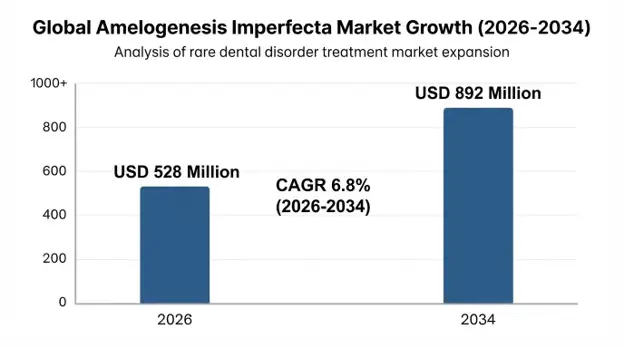
The global amelogenesis imperfecta market size was valued at USD 485 million in 2025 and is projected to reach USD 528 million in 2026, expanding to USD 892 million by 2034, growing at a CAGR of 6.8% during the forecast period (2026-2034).
Amelogenesis imperfecta is a group of rare inherited disorders in which there is a defect in dental enamel formation affecting both primary and permanent dentitions. that are clinically and genetically heterogeneous. The disease is caused by mutations in genes involved in the crucial process of enamel matrix secretion, organization and mineralization during tooth formation, such as genes encoding AMELX, ENAM, MMP20, KLK4, FAM20A and WDR72. The clinical manifestations have been found to be very different according to the four main phenotypic groups, namely: hypoplastic forms with quantitatively less but normally mineralized enamel, hypomaturation variants with defective enamel maturation and less mineral content, hypocalcified forms with soft and easily abraded enamel and normal thickness, and combined hypomaturation-hypoplastic forms with enlarged pulp chambers and mixed defects.
It is not merely an esthetic problem, as many patients with some clinical subtypes have severe thermal and tactile hypersensitivity with a significant impact on oral function and dietary intake, Split into separate sentences for clarity. due to dentoalveolar compensatory mechanisms, and with high caries susceptibility because of compromised enamel integrity, with the majority of these problems occurring after eruption. The psychosocial consequences are significant, especially for adolescents during a sensitive developmental phase where the appearance of their teeth has significant social and psychological impact on the process of peer acceptance, social identity formation and academic engagement. A consistent pattern of studies has shown that children and adolescents with AI experience significantly more oral health-related quality-of-life (OHRQOL) impairments than children with other dental conditions.
The therapeutic spectrum encompasses multidisciplinary treatment with the use of the latest developments in restorative dentistry using high-strength ceramic materials and nano-hybrid composite restorations, the use of CAD/CAM (Computer-Aided Design/Computer-Aided Manufacturing) technologies for the precision fabrication of restorations, orthodontic treatment for situations of malocclusion and spacing irregularities, prosthodontic rehabilitation including implant-supported prostheses for severely compromised cases, and preventive approaches with the use of desensitizing agents, applications of high concentrations of fluoride and remineralizing compounds containing casein phosphopeptide-amorphous calcium phosphate. The complexity of the treatment depends on the severity of enamel defect, age and developmental stage of the patient, the genetic subtype affecting the prognosis of long-term success of the restorative material, and the occlusal relationships needing correction before definitive rehabilitation can be provided.
| Report Coverage | Details |
|---|---|
| Base Year | 2025 |
| Base Year Value | USD 485 Million |
| Forecast Value | USD 892 Million |
| CAGR | 6.8% |
| Forecast Period | 2025-2034 |
| Historical Data | 2022-2025 |
| Largest Market | North America |
| Fastest Growing Market | Asia Pacific |
| Segments Covered | By Type, Treatment Modality, Material, Age Group, End-User |
| Region Covered | North America, Europe, Asia Pacific, Middle East & Africa, Latin America |
| Countries Covered | US, Canada, Mexico, UK, Germany, France, Italy, Spain, Netherlands, China, Japan, India, Australia, South Korea, Brazil, Argentina, UAE, Saudi Arabia, South Africa |
| Key Market Playes | Dentsply Sirona, Ivoclar Vivadent, 3M Oral Care, Straumann Group, GC Corporation, Kuraray Noritake Dental |
Get more details on this report - Request Free Sample
The primary factor driving growth within the market is the constant improvement in the ability to diagnose amelogenesis imperfecta accurately via better access to genetic testing, enhanced education of dental professionals about hereditary tooth disorders, and the creation of specialized referral channels between general dentists and pediatric dentists and other specialists qualified to make an exact diagnosis. Amelogenesis imperfecta was often misdiagnosed as dental fluorosis, molar incisor hypo mineralization, or enamel erosion in the past, leading to poor choice of material and treatment failure.
Next-generation sequencing panels incorporated into dental diagnostics have greatly improved the accuracy of diagnostics as they help detect causative gene mutations that facilitate inheritance counseling for the families concerned and prognosis for the duration of the restorative treatment. Genotype stratification is relevant to clinical practice because different types of amelogenesis imperfecta exhibit different bonding capabilities of the enamel to the composite resins and ceramics as the enamel bonding behavior varies not only among subtypes of amelogenesis imperfecta but also between different types of gene mutations within one phenotypic group.
Commercial basis for the amelogenesis imperfecta market rests upon the need for full-mouth rehabilitation treatments which restore occlusal functioning, remove hypersensitivity, ensure vertical dimension stability, and provide good aesthetic results on the entire dental arch. Such types of treatment are among the most complex and expensive procedures in restorative dentistry, since they require extensive lab procedures for full coverage restorations, often preceded by space management with orthodontics, and followed by extensive maintenance. Transition from old-fashioned cast gold crowns to new-generation monolithic zirconia and lithium disilicate ceramic crowns contributes to market growth due to superior aesthetic properties yet still providing acceptable mechanical properties for selected subtypes of amelogenesis imperfecta.
Pediatric treatment dynamics are of utmost importance. since children suffering from amelogenesis imperfecta will need temporary prosthetic replacement during transitional or primary stages of tooth development, using stainless steel crowns for their molars and composite resin fillings or zirconia crowns for their anterior teeth until they are able to undergo permanent restoration after their jaw has stopped growing. Thus, a continuous revenue stream can be expected for the next 8-12 years in every pediatric patient, for each of which new market segments exist.
The most severe limitation on market growth and patient access is the inconsistent and often inadequate reimbursement of insurance companies to provide comprehensive rehabilitation, with dental benefit plans often categorizing comprehensive rehabilitation as primarily cosmetic and not medically necessary, leaving almost all coverage costs on the patient and family. Annual maximums for commercial dental insurance of USD 1,500 – 2,500 are clearly insufficient in comparison to the cumulative costs of treatment to manage AIO (USD 45,000 – 85,000).
Access may also be available through general health insurance plans., with medical insurance coverage for amelogenesis imperfecta when it is linked to systemic syndromes and/or the functional impairment evidence meets the medical necessity criteria, but this coverage pathway is highly administrative and specialist documentation of functional impairment that most dental practices are not set-up to effectively provide.
Market opportunities in creating gene therapy approaches based on causal mutation correction exist in amelogenesis imperfecta, where the preclinical work proved that delivery of the genes by viruses into ameloblast cells in the process of enamel formation is possible. However, clinical applications of technology are many years away due to difficulties in targeting transitory ameloblasts during narrow windows of development, the creation of genetic testing framework provides the basis for the future implementation of prenatal/neonatal treatment once the technology becomes sufficiently mature..
Protein therapeutics using enzymes such as amelogenin, enamelin, ameloblastin, and others fall into a category of near-future options, as various research programs try to understand the potential of applying the enzymes during the critical period of enamel formation and its remineralization to treat certain types of amelogenesis imperfecta.
Treatment philosophy in amelogenesis imperfecta is currently experiencing a shift from the traditional and aggressive approach of total crown restorations towards minimally invasive techniques which maintain as much tooth structure as possible that still meet the objective of function and aesthetics. These changes have come about through better knowledge regarding bonding of the enamel in amelogenesis imperfecta patients, introduction of new high strength ceramic materials that allow thin sections to be made, and the awareness that aggressive tooth preparation in young individuals restricts future treatment possibilities due to the need to replace restorations as time progresses.
Current techniques utilize ultrathin ceramic veneers, partial crowns and high-strength composites that require minimal tooth preparation and achieve an adequate result with adequate survival rates in medium-term studies from European specialized centers in certain types of hypoplastic amelogenesis imperfecta when the quality of enamel permits satisfactory bonding.
North America accounted for the highest regional market share of approximately USD 195 million in 2025, holding a CAGR of 6.5% forecast until 2034. Regional dominance is a consequence of a relatively high number of academic dental centers which are specialized in the treatment of rare dental diseases, having adequate specialty training infrastructures, and private practices that invest in advanced restoration technologies like digital workflow systems and ceramics for the optimal treatment of amelogenesis imperfecta.
The United States accounts for approximately 86% of the regional market., with a huge private market in dentistry, wherein fee-for-service restorative treatments account for a large revenue generation from private patients as there is little reimbursement by insurance companies.
The research framework is extremely strong with NIH funding of the studies related to the genetics behind amelogenesis imperfecta, development of tooth enamel, and new treatment methodologies under the NIDCR programs. The University of California Los Angeles, University of Michigan, and University of North Carolina hold academic dental centers that specialize in rare dental diseases.
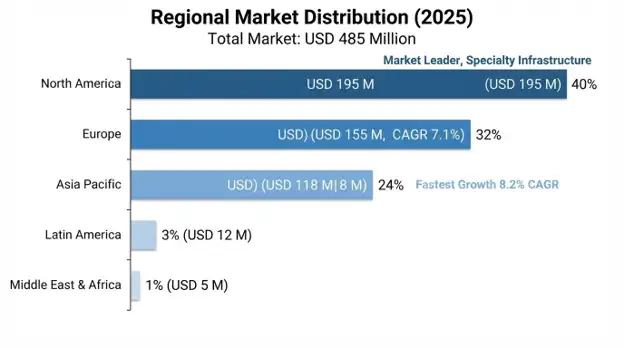
Asia-Pacific is the fastest-growing region with CAGR of 8.2% until 2034, amounting to approximately $118 million in 2025. Growth in the region is attributed to the quick growth of specialized dentistry training programs in countries such as China, India, South Korea, and Japan, along with a growing middle-class population that have the means to afford dental rehabilitation; and increased awareness of hereditary dental diseases via continued education programs.
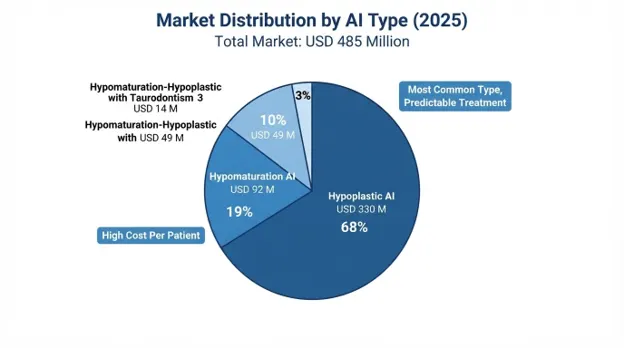
Hypoplastic amelogenesis imperfecta constitutes the largest phenotypic group, comprising 65-75% of all cases and contributing the most income for the treatment owing to predictable results of adhesive restorations on reduced enamel quantitatively but adequate in its mineralization to ensure proper bonding. On the other hand, hypocalcified amelogenesis imperfecta comprises 8-14% of all cases but produces high costs per patient owing to fragile teeth that lose their structure fast after eruption, thus needing prompt protection through full coverage restorations.
Restorative therapies occupy the highest market share, amounting to about 54%, which include restorations using composite materials, porcelain veneers, full-coverage crowns, and total rehabilitation therapies constituting the basis of managing amelogenesis imperfecta. Prosthodontic therapy occupies about 22% of the market share, constituting definitive rehabilitation of adult patients with implants and other full-coverage prostheses.
Specialized dental centers and academic hospitals together make up around 71% of the market value since the complexity of the condition dictates that treatment takes place in facilities with multi-specialists working in tandem, sophisticated diagnostics and laboratory facilities capable of producing intricate restoration work.
The global amelogenesis imperfecta treatment market is characterized by high fragmentation in the clinical services category where there is no monopolistic organization providing treatment, whereas the dental materials segment exhibits moderate market concentration. in terms of well-established producers of materials for restoration, ceramics and digital technologies utilized in amelogenesis imperfecta treatment. Competition in the market is based on performance and aesthetics of materials in enamel bonding conditions, as well as training programs that teach professionals the use of specific materials.
March 2026: Ivoclar Vivadent introduced a new generation of lithium disilicate ceramic materials, which have been developed using advanced surface treatments that are suitable for bonding with hypomineralized enamel surfaces, thus achieving higher adhesion values through laboratory studies applicable to amelogenesis imperfecta.
February 2026: The European Academy of Paediatric Dentistry published comprehensive clinical guidelines. regarding amelogenesis imperfecta with emphasis on genetic testing procedures and minimal invasive approaches to therapy based on type of disease.
January 2026: Straumann Group acquired a treatment planning software company. using digital technology for USD 145 million, with their product roadmap being the development of amelogenesis imperfecta-related products that include defect mapping and restoration simulation features.
November 2025: GC Corporation has been approved to develop a new resin-modified glass ionomer with improved adhesion properties to hypomineralized enamel in children's teeth.
September 2025: National Institute of Dental and Craniofacial Research allocated USD 7.8 million grants for research on amelogenin-related therapies for hypomaturation amelogenesis imperfecta.
You'll get the sample you asked for by email. Remember to check your spam folder as well. If you have any further questions or require additional assistance, feel free to let us know via-
+1 724 648 0810 +91 976 407 9503 sales@intellectualmarketinsights.com
22 Jul 2026
Intellectual Market Insights Research © 2026. All rights reserved.