Share this link via:

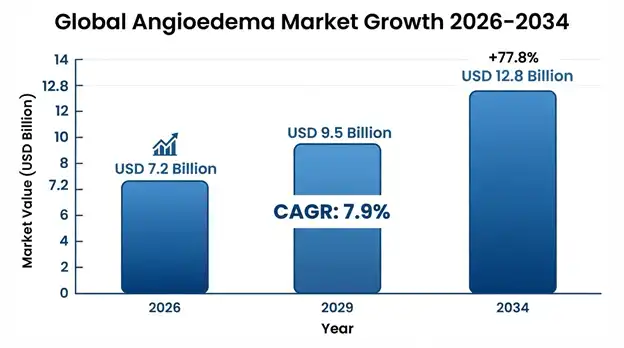
The global Angioedema Market was valued at USD 6.5 billion in 2025 and is projected to reach USD 7.2 billion in 2026, expanding to USD 12.8 billion by 2034, growing at a CAGR of 7.9% during the forecast period (2026-2034).
Angioedema is a serious condition characterized by swelling of the deep layers of the skin and mucous membranes caused by activation of vasoactive mediators by allergens, medications, or genetic disorders that produce a defect in the regulation of complement and contact system. There are three main types of the disease, hereditary angioedema, acquired angioedema, and drug-induced angioedema that affect the production or activity of C1-esterase inhibitor, and are associated with genetic mutations, lymphoproliferative disorders and autoimmune disease, respectively, and affect about 1 in 50,000 people worldwide; and Drug-induced angioedema is triggered by medications such as angiotensin-converting enzyme (ACE) inhibitors, nonsteroidal anti-inflammatory drugs (NSAIDs), and other pharmaceuticals., nonsteroidal anti-inflammatory drugs and other pharmaceuticals and affects about 2.43 per 100,000 people in North America. Clinical symptoms vary from life-threatening airway compromise, necessitating emergency intubation and mechanical ventilation to debilitating gastrointestinal symptoms characterised by severe abdominal pain, nausea and vomiting which lead to unnecessary visits to the ED and hospitalisation.
Over the last few years, the diagnosis and treatment of angioedema have evolved to include sophisticated multimodal therapeutic interventions designed to treat the acute attacks and to prevent chronic disease by using a variety of drug therapies. Therapies used during attack are rapid acting such as plasma-derived or recombinant C1-inhibitor concentrates that provide systemic enzyme replacement within hours after injection, bradykinin B2 receptor antagonists which act on the main vasoactive factor which causes swelling and immediately alleviate the symptoms, and plasma kallikrein inhibitors that block the activation of the contact system. Prophylactic therapy includes long-acting kallikrein inhibitors administered orally, with convenient once or twice-daily dosing, sustained-release C1-inhibitor replacement via subcutaneous injection every 2 weeks, and innovative RNA-targeted therapeutics which are a new class of long-acting prevention agents, with extended dosing intervals of 4 to 8 weeks between injections.
The commercial value is not limited to the sales of pharmaceutical products, but also to the creation of a full disease management ecosystem that includes the possibility of performing the diagnostic testing of C1-inhibitor level and function, as well as genetic counseling of hereditary cases, patient education on identification of triggers and early signs of symptoms, and personalization of treatment planning for optimal clinical outcomes while reducing the morbidity associated with attacks and the use of health resources. The market addresses important unmet medical needs in various patient populations, and figures for the number of people in North America who have inherited angioedema range from 9,500 to 12,000 and the number of diagnosed patients worldwide may be higher than 100,000, considering underdiagnosis, especially in emerging markets. HAE is a chronic, progressive disease. that requires long-term treatment, with average patient lifetime treatment costs of $450,000-$650,000, reflecting direct costs of pharmaceuticals, emergency department visits, hospital admissions, and indirect costs of impairment of quality of life and loss of work.
| Report Coverage | Details |
|---|---|
| Base Year | 2025 |
| Base Year Value | USD 6.5 Billion |
| Forecast Value | USD 12.8 Billion |
| CAGR | 7.9% |
| Forecast Period | 2025-2034 |
| Historical Data | 2022-2025 |
| Largest Market | North America |
| Fastest Growing Market | Asia Pacific |
| Segments Covered | By Type, Treatment, Formulation, Disease Severity, Route of Administration, End-User |
| Region Covered | North America, Europe, Asia Pacific, Middle East & Africa, Latin America |
| Countries Covered | US, Canada, Mexico, UK, Germany, France, Italy, Spain, Netherlands, China, Japan, India, Australia, South Korea, Brazil, Argentina, UAE, Saudi Arabia, South Africa |
| Key Market Playes | CSL Behring, BioCryst Pharmaceuticals, Ionis Pharmaceuticals, Takeda Pharmaceutical, KalVista Pharmaceuticals, Pharming Group, Sanofi, Attune Pharmaceuticals, Pharvaris B.V., Arrowhead Pharmaceuticals |
Get more details on this report - Request Free Sample
Hereditary angioedema is gaining increasing recognition, and advances in diagnostics have improved patient identification, making it possible to identify previously undiagnosed patients, this is the main factor driving the angioedema market. The rapid advancement of genetic testing, the development of better laboratory methods of assessing the levels and function of C1-inhibitor, and improved physician awareness, have greatly reduced the time involved in the diagnosis and detection of this disease, especially in children in whom symptoms can occur early in life.
Clinical guidelines have been standardized, and physician education has expanded, improving diagnostic accuracy and facilitating timely interventions across health systems leading to improved health outcomes for patients. With growing understanding, the addressable market is increasing for patients being diagnosed and treated with targeted prophylactic and on-demand therapies. Early diagnosis also helps prevent life-threatening complications and swelling of the airways, underscoring the need for thorough screening and targeted treatment for HAE.
Advancements in drug delivery technologies and therapeutic mechanisms have revolutionized the way in which the disease angioedema is being treated today through enhancing ease and adherence without compromising on disease management. The use of oral plasma kallikrein inhibitors has aided in lowering the dependency of the drug on injections, making it easier for patients to take these drugs at home for prophylaxis.
Subcutaneous administration of C1-inhibitors and monoclonal antibodies has made treatment easy for patients while at the same time ensuring that there are no attacks of the hereditary form of angioedema. RNA-targeted therapies using prolonged doses have helped make treatment simpler through lowering the number of doses while disease management has been ensured.
The high cost and complexity of developing drugs for rare diseases are a major barrier that is restricting the growth of the angioedema market. The low incidence of hereditary angioedema leads to challenges in conducting clinical trials, increasing the time needed for drug development, and increasing the overall cost of research and regulatory compliance. The production of recombinant protein drugs, advanced biologic drugs, plasma-derived C1-inhibitor drugs, and future RNA-based therapies requires special manufacturing plants, strict quality control measures, and regulatory compliance, which create barriers for new market entrants. Such barriers justify the pricing strategy of approved drugs and restrict competition. Despite the proven clinical benefits offered by innovative drugs used for the prevention and treatment of hereditary angioedema, their high cost per year puts pressure on the budget of healthcare programs.
The emergence of gene therapies and RNA-targeted that offer the possibility of achieving a cure for hereditary angioedema through the provision of sustained relief from the symptoms of the condition treatments presents a significant market opportunity in the angioedema sector. Therapies based on the adeno-associated virus (AAV) vector and gene editing technologies are currently under investigation.
Therapies targeting RNA such as antisense oligonucleotide therapy and small interfering RNA (siRNA) are quickly progressing in development, allowing sustained suppression of the disease pathway with greatly extended dosing intervals. The next generation of drugs holds the promise to not only make treatment easier but also more effective through innovative mechanism of action. Coupled with their high price tag and strong clinical interest, RNA-based therapies are poised to be highly lucrative opportunities in hereditary angioedema treatment going forward.
The angioedema market is undergoing a fundamental shift from parenteral therapies to oral prophylactic treatments to the oral prophylaxis drugs that allow for easier administration, enhanced self-reliance on the part of patients, and minimized use of medical facilities. Oral kallikrein inhibitors such as berotralstat and sebetralstat feature easy-to-take once- or twice-daily doses which facilitate self-administration without professional assistance and, hence, help overcome the difficulties of intravenous infusions which require regular consultations with doctors. Satisfaction rate of patients who prefer the oral administration mode is well above 85%.
This therapeutic change is a paradigm shift in how the disease is managed from dependency on the physician and treatment in a clinical environment to a patient-centred therapeutic regimen with the option to manage the disease with patient-directed prophylaxis, supported by clinical management. Simplicity of oral delivery is especially advantageous for children with injection anxiety and to improve adherence to treatment while in school. Access to remote administration decreases the number of trips to the healthcare system (from weekly IV access to periodic clinical monitoring) and allows patients to continue working, attending school and keeping up with social activities while receiving optimal disease management.
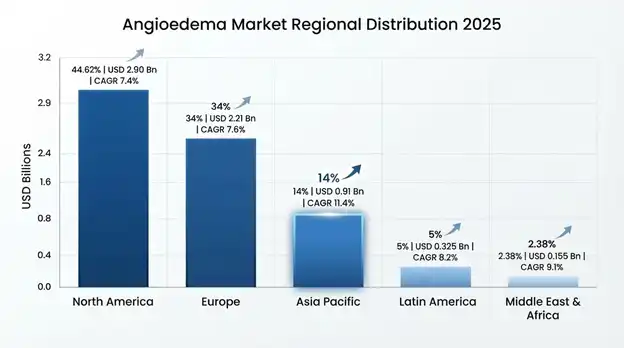
Advanced healthcare facilities, high prevalence of the disease in diagnosis, and easy access to innovative hereditary angioedema therapies are driving the largest share in the global angioedema market in North America. Well-developed allergy and immunology networks, comprehensive insurance coverage, and genetic and complement testing to accurately diagnose is widespread within the United States, most of the regional revenue comes from the U.S. market.
Reimbursement policies are robust to encourage uptake of high-cost biologics or long-acting prophylactic drugs, alongside specialist treatment centres for best disease management. The region also has an advantageous regulatory framework that supports innovation, such as incentives for orphan drugs and accelerated authorisation processes for rare disease treatments. Furthermore, strong clinical research and post-marketing surveillance activities continue to provide real-world evidence, which is used to expand indications, enhance patient outcomes, and maintain market growth in North America.
Europe is the second-largest angioedema market, due to highly developed rare disease health care system, diagnosis procedures, and wide availability of advanced treatment options. Regional guidelines and specialized immunology centers, early diagnosis and effective long-term management of hereditary angioedema have become possible.
In some European countries favorable reimbursement policies encourage patients' access to new innovative oral, subcutaneous and biological agents, while research programs actively drive further development and implementation of new drugs. In the UK patients can rely on the existence of specialized referral centers and good reimbursement in the National Health Service. Germany still plays an important role in the market owing to the advanced health care infrastructure and quick implementation of novel drugs. France continues improving its position due to rare disease networks and multidisciplinary centers for hereditary angioedema management.
Asia-Pacific is the fastest-growing regional market for treatments of angioedema on account of improved healthcare infrastructure, advanced diagnostics, and heightened awareness about hereditary angioedema amongst healthcare practitioners. The large number of people in the region along with increasing investment in rare disease treatment and genetic tests will contribute to the growing patient base.
China is the fastest-growing regional market because of modernized healthcare facilities, availability of innovative treatment solutions, and government-driven initiatives to help diagnose and treat rare diseases. The Indian market is fast-growing owing to greater insurance penetration, improved medical education, and accessibility to specialized treatment centers. Japan has been a mature market owing to established diagnosis facilities, special treatment centers, and early adoption of new treatments.
The indication segments include hereditary angioedema (HAE), which is the largest, owing to the lifelong requirement for managing the condition, increasing incidences of the condition being diagnosed, and the existence of specific targeted therapeutic options. HAE has Type I, Type II, and hereditary angioedema with normal C1-inhibitor types, all which require specific diagnostic and treatment approaches. Acquired angioedema is the second largest, where the condition results from autoimmune diseases and lymphoproliferative disorders, whose incidences continue to increase because of increased awareness and diagnosis of the condition. The third largest indication segment is drug-induced angioedema caused mainly by ACE inhibitors.
The C1-inhibitor concentrates segment holds the largest market share holds its position owing to their efficiency, safety record, and frequent usage for both acute attacks treatment and prophylactic therapy. Plasma and recombinant forms of C1-inhibitors have an important place in treating hereditary angioedema, having gained wide clinical acceptance and reimbursement. The market segment with the highest growth rate is comprised of kallikrein inhibitors due to availability of convenient oral medication. Their specific mode of action and the ability to prevent attacks of hereditary angioedema contribute to their fast adoption. Another major market segment is composed of bradykinin B2 receptor antagonists. They play an important role in treating angioedema attacks owing to their efficiency in relieving patients' symptoms.
Hospitals and clinics are the dominant end-user segment within the angioedema market due to their function in diagnosing hereditary angioedema, treating acute attacks, and managing chronic symptoms through specialist departments of allergies and immunology. Such facilities provide a wide range of diagnostic opportunities, advanced therapeutic methods, and emergency assistance for severe cases with compromised airways. The fastest growing end-user category is the specialized treatment centers that take advantage of specialized knowledge of rare diseases and comprehensive care teams for improved clinical results. The ambulatory care facilities are also expected to grow due to the increase in number of patients getting routine care and prophylaxis in an ambulatory setting. The home health care facilities have become one of the most promising end-user categories owing to the availability of oral medications and self-administrable therapy regimens.
The global angioedema market shows moderate to high concentration in terms of the leading seven firms accounting for 58-65% market share by virtue of their comprehensive product range including diverse treatment options across several modalities, strong clinical pipeline, well-established connections with specialty medical communities, and highly advanced manufacturing expertise enabling high-quality products and dependable supply chain. Competitive advantages include clinical data supporting superior efficacy of drugs in prevention of attacks and fast relief of symptoms, novel drug delivery methods minimizing the treatment regimen with easy administration modes, robust patient programs ensuring drug accessibility and adherence, as well as strategic collaborations with healthcare organizations enabling favorable formulary placement. Industry trends are reflected in the acquisitions of rare hereditary angioedema firms by major pharma companies.
August 2025: Ionis Pharmaceuticals reported FDA approval of its novel drug named DAWNZERA (donidalorsen) for use as a unique RNA-targeted prophylactic treatment for hereditary angioedema in patients above the age of 12 years. The 80 mg subcutaneous injection every four or eight weeks resulted in a significant 81% and 87% reduction in monthly attacks within 24 weeks and second dose in Phase 3 OASIS HAE trial, respectively. After a year of treatment, the rate was 94%. Furthermore, the 16-week extended OASISplus study showed a 62% attack reduction with a preference of 84% for donidalorsen treatment.
June 2025: BioCryst Pharmaceuticals released positive data from APeX-P trial in its pediatric expansion at the European Academy of Allergy and Clinical Immunology meeting. A total of 29 patients between ages 2-11 years with an average age of 8 years showed weight-based dosing cohorts for berotralstat (ORLADEYO). This resulted in an 86% reduction in monthly attack rates, from 1.28 to 0.38 attacks per month.
April 2025: CSL Behring announced the launch in Japan. of garadacimab (ANDEMBRY) after the February 20, 2025, approval for the indication of hereditary angioedema attack prevention in individuals 12 years old and above. The regimen that included an initial 400 mg loading dose and 200 mg monthly doses was priced under National Health Insurance on April 16, 2025, and commercially launched on April 18, 2025. There were about 430 diagnosed cases of hereditary angioedema out of an estimated 2,500 affected individuals across Japan.
February 2025: Takeda Pharmaceutical announced additional studies examining long-term efficacy of prophylactic therapy using C1-inhibitor replacement therapy which provided sustained disease control during five years of follow-up studies thus optimizing the long-term treatment of HAE patients.
January 2025: KalVista Pharmaceuticals announced positive KONFIDENT-S study results. of sebetralstat (EKTERLY) based on the results of 35 patients experiencing 382 acute attacks, showing the median time of 6 minutes for the treatment and the duration of the effects of 1.3 hours.
List of Key Players in Global Angioedema Market
You'll get the sample you asked for by email. Remember to check your spam folder as well. If you have any further questions or require additional assistance, feel free to let us know via-
+1 724 648 0810 +91 976 407 9503 sales@intellectualmarketinsights.com
22 Jul 2026
Intellectual Market Insights Research © 2026. All rights reserved.


