Share this link via:

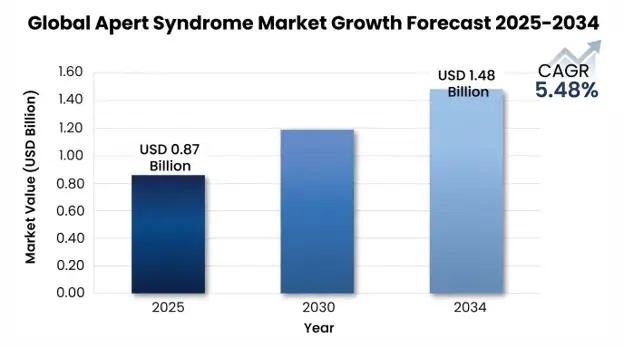
The global Apert syndrome market size was valued at USD 0.82 billion in 2024 and is projected to reach USD 0.87 billion in 2025, expanding to USD 1.48 billion by 2034, growing at a CAGR of 5.48% during the forecast period (2025-2034).
Apert syndrome is a rare genetic disorder of craniosynostosis (fused skull bones) with unique syndactyly (spanning fingers and toes). It is caused by gain-of-function missense mutations in the gene for fibroblast growth factor receptor 2 (FGFR2) on chromosome 10 there are two main mutations: the Ser252Trp mutation (represented by 66% of cases), which is strongly associated with cleft palate manifestations, and the Pro253Arg mutation (represented by 33% of cases), which is linked to more severe digital fusion patterns. The estimated prevalence of Apert syndrome is one in 65,000 to 200,000 live births worldwide, with no sex preference, but there is a strong correlation with advanced paternal age as a risk factor for de novo mutations.
The clinical presentation includes multisuture craniosynostosis with a characteristic head shape (brachiturricephalic), severe midface hypoplasia and retruded maxilla with shallow orbits and functional breathing impairment, complex symmetric syndactyly with variable severity (mild webbing to complete fusion of all digits), conductive hearing loss in up to 80% of patients, obstructive sleep apnea in approximately 30% of patients, visual abnormalities (strabismus and refractive errors), intellectual impairment (neurological abnormalities) typically mild, and visceral anomalies (cardiac defects, intestinal malrotation, and genitourinary anomalies).
Today, the treatment of Apert syndrome is a truly multidisciplinary process that involves craniofacial surgery, neurosurgery, ophthalmology, otolaryngology, dentistry and orthopedic procedures spanning from infancy to adulthood. The therapeutic market includes surgery for the cranium, such as cranioplasty, posterior vault expansion, and distraction osteogenesis for cranial vault reconstruction, the midface, including Le Fort and monobloc, separation and reconstruction of syndactyly and palatal clefts, and many accessory surgeries to refine aesthetics and optimize function. In addition to surgery, there are therapeutic treatments for any other underlying conditions, genetic counseling services, hearing rehabilitation, orthodontic management, and supportive care that offers psychosocial support and rehabilitation and continuous surveillance for possible complications such as elevated ICP that may require intervention.
The commercial landscape is not limited to individual procedures but also to the whole disease management ecosystem, which includes the use of advanced imaging technologies that enable pre-operative planning, navigation technology that guides surgery, protocols to monitor patients after the procedure, and long-term follow-up care to support optimal function and esthetic outcomes as well as reduce treatment burden. The market addresses the critical healthcare needs for about 8,000-12,000 newly diagnosed patients per year across the world; the cumulative prevalence is estimated at 150,000-200,000 patients with Apert syndrome throughout the world, making it a lifelong chronic condition that requires multidisciplinary treatment.
| Report Coverage | Details |
|---|---|
| Base Year | 2025 |
| Base Year Value | USD 0.82 Billion |
| Forecast Value | USD 1.48 Billion |
| CAGR | 5.48% |
| Forecast Period | 2025-2034 |
| Historical Data | 2022-2025 |
| Largest Market | North America |
| Fastest Growing Market | Asia Pacific |
| Segments Covered | By Diagnosis Type, Treatment Type, Severity Level, End-User |
| Region Covered | North America, Europe, Asia Pacific, Middle East & Africa, Latin America |
| Countries Covered | US, Canada, Mexico, UK, Germany, France, Italy, Spain, Netherlands, China, Japan, India, Australia, South Korea, Brazil, Argentina, UAE, Saudi Arabia, South Africa |
| Key Market Playes | Pfizer Inc, Novartis AG, Bristol-Myers Squibb Company, Roche Holding AG, Sanofi S.A., AstraZeneca PLC, Johnson & Johnson, Merck & Co., Inc |
Get more details on this report - Request Free Sample
The primary driver of market growth of the Apert syndrome market is increasing awareness about the disease both among the healthcare professionals and patients' families, which helps enable early diagnosis and timely treatment. In the past, many instances of the syndrome went unnoticed and were diagnosed late, depriving the children of crucial surgery and therapy that can prevent serious problems in the future. Thanks to the modern methods of prenatal imaging, such as three-dimensional ultrasonography, MRI, and fetoscopy, it is possible to detect typical signs of Apert syndrome as early as the mid-trimester of pregnancy.
The postnatal diagnosis of Apert syndrome has been significantly improved by the increased awareness of clinicians, namely pediatricians, obstetricians, and neonatal doctors who notice the characteristic triad of acrocephaly along with the distinct syndactyly. The increased availability of genetic testing for the confirmation of mutations in the FGFR2 gene and definitive diagnosis leads to a quick multidisciplinary involvement and implementation of preventive measures. Advocacy groups around the globe that focus on Apert syndrome and provide educational materials, websites, and support programs help the patients and their relatives to diagnose the condition.
Key performance indicators supporting this trend include: diagnostic rates increasing from 35% in cases prior to 2015 to more than 85% by 2025; prenatal diagnosis of the disorder increasing up to 60-70% accuracy during the third trimester imaging; genetic test confirmation rate growing to 98% specificity of the FGFR2 mutations.
Innovative surgical techniques have transformed Apert syndrome treatment through the development of distraction osteogenesis technology, minimally invasive endoscopy, navigation systems, and 3D surgery. Distraction osteogenesis using either internal or external fixation allows for bone displacement over several weeks or months to achieve increased movement compared to single-stage procedures with gradual adaptation of soft tissues and neurovascular structures to significantly decrease complications such as meningitis and insufficient soft tissue coverage.
The endoscopic-assisted strip craniectomy approaches provide the ability for early treatment, minimal surgical trauma, shorter surgery time, lower incidence of perioperative complications, and superior cosmetic results with fast recovery for patients in comparison with open approaches of vault expansion. The computer-assisted surgical planning systems allow for creating a very accurate three-dimensional model of the skull based on preoperative images, which helps in planning an appropriate osteotomy, predicting possible problems, performing virtual surgery, and designing individual implants.
Craniofacial surgical protocols have age-specific multidimensional algorithms which incorporate cranial vault procedures, midface advancement, and other modifications from childhood through adulthood, timing the surgeries to minimize anesthesia time. Recent studies indicate that surgery within the first year of life results in better cognitive outcomes, with over 70% of patients achieving an intelligence quotient within the normal range. who had early surgery.
The major restraint for the Apert syndrome market is the complex nature of surgery involving stages of operations spanning 20 years of treatment, resulting in several exposure levels to general anesthesia and neurocognitive problems. The best way to treat Apert syndrome involves the undertaking of 8-12 major surgeries performed successively between birth and early adulthood, where cranioplasty and the first expansion of the vault take place in 0-2 years, while midface advancement surgeries happen in 6-12 years, followed by final cosmetic touch-ups once maturation of the skeleton is complete.
Studies have shown that the adverse effects of several instances of general anesthesia administration on the developing brains of young children leading to neuro-cognitive deficit and intellectual deficiency in the future. Although the early surgical intervention helps avoid problems associated with intracranial hypertension and proper neurological development, too many surgeries can lead to complications due to anesthesia. The need for a balance in surgical decision making and anesthesia techniques is therefore inevitable.
A significant market opportunity lies in the development of gene therapy and molecular-based therapeutics that target the inherent FGFR2 mutations underlying the Apert syndrome pathophysiology to create either disease-modifying or curative therapies with less dependence on major surgery. Modern knowledge on the effects of FGFR2 mutations has shown that gain-of-function mutations lead to the loss of receptor ligand specificity, aberrant signaling of the fibroblast growth factor pathways, abnormal osteoblast cell death, and alteration in the extracellular matrix composition to facilitate the premature fusion of the bones and skeletal deformity.
Investigational trials using tyrosine kinase inhibitors and selective FGFR inhibitors in syndromic craniosynostosis are underway, with some studies being carried out in Apert syndrome. Molecular therapy options that may consist of FGFR pathway modulators, fibroblast growth factor receptor blockers, or gene editing methods will help decrease the severity of the cranial vault fusion, reduce midface hypoplasia, facilitate proper skeletal formation, and thus reduce the need for reconstructive surgeries. Success in molecular therapies will indicate a paradigm shift from treating the consequences by reconstructive surgery to preventing pathophysiology biologically.
The metrics of Gene Therapy and Molecular Therapy Opportunity show that 12-15 Investigational trials on FGFR modulators in craniosynostosis conditions are currently under development; pharmaceutical development investment into syndromic craniosynostosis treatments has reached about USD 150-200 million by 2025; and potential molecular therapies can help reduce the need for surgeries by 30-50%.
The Apert syndrome market is witnessing increasing standardization of multidisciplinary team approach protocols, development of treatment algorithms based on clinical evidence, and creation of international outcomes registries that allow for systematic analysis of treatment success and comparative effectiveness with various surgical interventions and institutions. The complexity of treatment for Apert Syndrome has led to a very high degree of variability in treatment methods used, surgical timing, and outcomes measurement at various craniofacial centers, preventing the possibility of identifying the most effective ways to treat the condition.
The development of international Apert syndrome registries, such as the International Craniosynostosis Registry and the society-specific registries, allows for a systematic collection of patient demographic information, genetic information, surgeries performed, complications, imaging studies, function evaluations, and outcomes. Registry information helps identify the best treatments, predict complications, and develop surgical algorithms based on evidence, not individual institution experience. Standardized outcome measures, such as intracranial pressure measurement, facial bone growth measurements through computerized tomography or 3D photography, hearing evaluation through audiometry, functional outcomes, and quality of life surveys allow for valid comparison of results across institutions and surgical treatment modalities.
Registry Development Impact Metrics indicate that there are presently between 5,000 and 8,000 Apert syndrome cases included in international craniofacial registries; that research through registries has helped determine the best surgical timing and sequence leading to reduced complications by 15-20%; and that standardized protocols have led to consistent long-term outcomes.
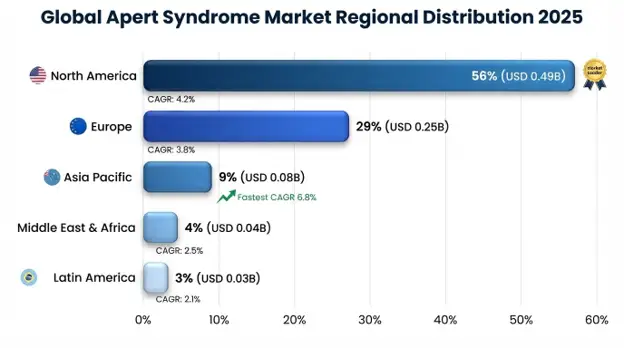
The North American region held the highest market share at around USD 0.49 billion in 2025 accounting for 56% of the global market valuation and is expected to exhibit a CAGR of 5.2% during 2023-2034. This market share is driven by the presence of high expertise in conducting surgeries in the craniofacial region, widespread insurance coverage for complicated surgeries, high awareness levels, and investments in R&D activities in this domain.
The United States accounts for 87% of the regional market share due to the existence of well-developed craniofacial surgery centers at top-notch academic medical centers like Johns Hopkins University, Children's Hospital Boston, Cincinnati Children's Hospital, Los Angeles Children's Hospital, and University of California facilities. Medicare and private insurance cover Apert syndrome diagnosis and treatment entirely. There are FDA approvals including orphan drug designation, breakthrough therapy designation, and humanitarian use device designation for new surgical devices and implants to facilitate market entry.
Canada’s healthcare system offers reimbursement of Apert syndrome treatment costs through health insurance programs that are provincial in nature and cover all aspects of management including imaging, genetics, and multiple stages of surgery irrespective of the socio-economic background of the patient. The existence of pediatric craniofacial centers at Toronto, Montreal, and Vancouver provides geographic dispersion of specialists in the nation.
The Apert syndrome market is seeing tremendous growth in Europe, which stands at around $0.25 billion in 2025, or 29% of the overall global market revenue share, with an anticipated CAGR of 5.6% during 2034. The growth of the market within the region is attributed to the presence of a rich history of craniofacial surgeries in United Kingdom, France, Netherlands, and Germany, regulations that foster the development of orphan drugs and rare diseases treatments, and universal health care programs.
The UK is at the forefront of Europe in terms of their famous craniofacial surgery departments at hospitals including Great Ormond Street Hospital and University College London as well as regional specialists providing multidisciplinary treatment services. The UK National Health Service provides universal coverage for diagnosis and surgical intervention in cases of Apert syndrome regardless of the economic status of the patient. The designation of Orphan Drugs by the European Medicines Agency to treat rare diseases like syndromic craniosynostosis provides the much-needed push towards developing new treatments.
In France and the Netherlands, excellent tradition in craniofacial surgery exists along with specialized centers in Paris, Amsterdam, and Rotterdam where highly skilled surgeons and researchers carry out craniofacial surgery innovations. Germany also has many centers specializing in craniofacial surgery with focus on minimally invasive endoscopic surgery and computer-aided surgical treatment plans. Spain and Italy have specialized centers with specialization in distraction osteogenesis surgery.
The Asia-Pacific is expected to become the fastest-growing regional segment with a CAGR of 6.8% over 2034 and presently accounts for around USD 0.08 billion in 2025 or 9% of the total market share, owing to tremendous market potential fueled by the sheer number of people, growing middle class, healthcare infrastructure spending, and increasing craniofacial surgery skills. The Asia-Pacific region constitutes around 60% of the world’s population, with an estimated 4,800-7,200 new cases of Apert syndrome per year.
China is leading regional market development by setting up special centers for conducting craniofacial surgery in major cities such as Beijing, Shanghai, and Chengdu. The healthcare reform has resulted in the inclusion of insurance programs under the national health insurance program and commercial insurance. Medical tourism that involves people from other countries visiting China for their craniofacial surgery has increased market opportunities.
India presents a significant potential market due to high patient prevalence, rapid expansion of craniofacial surgery training programs, creation of cost-effective delivery mechanisms for surgical services in high-volume centers, and use of telemedicine to extend expertise to underserved markets. Major urban centers such as Delhi, Mumbai, Bangalore, and Chennai have created craniofacial programs that offer comprehensive multidisciplinary treatments at prices much lower than in developed countries. Indian healthcare system with its high-volume approach, efficient surgical protocols, and effective resource allocation makes it possible to deliver quality surgical treatment to larger populations.
Advanced craniofacial surgery programs with well-developed imaging and surgical technologies exist in Japan and South Korea. Australia is home to multiple specialized centers that possess skill in revision surgeries and follow-up treatment evaluations. The growth of the Asia-Pacific region is impeded by lack of qualified craniofacial surgeons in the rural and underdeveloped parts of the continent, poor diagnostic capabilities, and lack of genetic testing facilities.
The regions of Middle East and Africa together with Latin America account for about USD 0.06 billion or 7% of the total market value in 2025 at a CAGR of 4.9% in the coming years till 2034. This is an emerging market with high potential for growth that is constrained with limited healthcare infrastructure and resource limitations. In these regions, there are 2 billion people with an estimated 12,000-18,000 patients suffering from Apert syndrome with very little treatment available.
The United Arab Emirates, especially Dubai and Abu Dhabi, have invested heavily in their health care facilities and medical tourism industry, thus developing specialized programs for craniofacial surgery that cater both regional and international patients. Specialized centers have been set up in Saudi Arabia and Qatar. South Africa is known to be the biggest provider of craniofacial surgery services in the African continent, having specialized centers located in Johannesburg and Cape Town. Brazil and Argentina are the biggest developers of the Latin America market due to their craniofacial surgery programs located in the major medical centers of São Paulo, Rio de Janeiro, Buenos Aires, and Cordoba. Mexico has made emerging developments in the field of craniofacial expertise.
Clinical Diagnosis is the leading product segment in terms of market share with 40% share value worth USD 0.33 billion in 2025, which is growing at a CAGR of 5.1% from 2025 to 2034. In clinical diagnosis, there needs to be the detection of certain physical findings such as abnormal head shape, facial dysmorphism, and syndactyly of hands and feet. The availability of clinical diagnosis without the need for advanced laboratory tests or genetic analysis makes this modality very important for diagnosing Apert syndrome in any setting of healthcare. Clinical diagnosis continues to be an essential process in diagnosing this disorder especially in developing countries.
Genetic Testing makes up 30% market share worth USD 0.25 billion in 2025 and grows at a CAGR of 6.2% from 2025-2034. Genetic testing that can detect mutations in FGFR2 genes can give a confirmatory diagnosis, genetic counseling, and prenatal diagnosis. There has been a significant increase in the use of genetic testing in the diagnosis of this syndrome due to lower cost of DNA sequencing, laboratory capacity, and the importance of testing in healthcare providers. Sequencing techniques include FGFR2 gene sequencing and craniosynostosis genes panel sequencing.
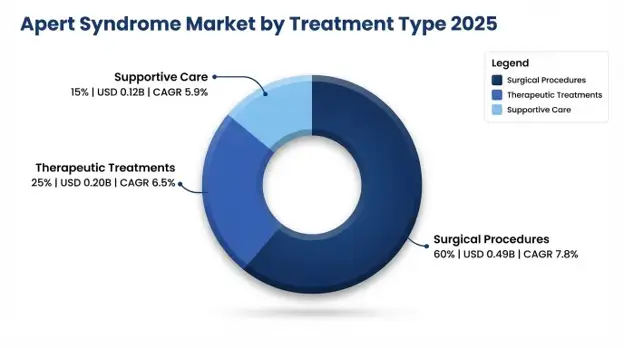
Surgical Procedures constitute the largest segment of the treatment market share, which is 60% worth of USD 0.49 billion in 2025 and will grow at a CAGR of 5.7% until 2034. Surgery is the primary modality used for treating Apert syndrome that aims to deal with craniosynostosis through vault expansion and reconstruction, midface hypoplasia through Le Fort and monobloc advancement surgeries, syndactyly through separation and reconstruction surgery of fingers, cleft palate through surgical closure, among others.
Therapeutic Treatments hold a 25% market share valued at USD 0.20 billion in 2025 and expected to grow at a CAGR of 5.9% until 2034. These therapies include orthodontic care to treat dental malocclusion and misalignment, hearing rehabilitation for conductive hearing loss, speech therapy for communication disorders, physical rehabilitation after surgery, and psychosocial therapy. The development of new molecular therapeutics for abnormal FGFR pathways constitutes emerging treatment options. Genetic counseling educates families about the mode of inheritance and recurrence risks.
The market share for severe forms accounts for 13% and is worth USD 0.11 billion in 2025 with CAGR of 6.9% from 2025 to 2034. Severe forms manifest themselves with specific syndactyly of middle three fingers of hands, complex syndactyly of web space of the fourth finger, significant deformity of skull shape and associated systemic anomalies.
Severe cases have a market share of 30% that will be worth USD 0.25 billion in 2025, with a CAGR of 6.1% by 2034, the fastest growing segment due to improved identification and treatment of complicated cases. Severe cases have features of complete fusion of all digits leading to cup hand, acrocephaly, midfacial hypoplasia, and frequently associated complications like intellectual disability and increased intracranial pressure. Treatment of severe cases involves multistage surgery with advanced techniques.
Mild cases constitute 25% market share with a value of USD 0.21 billion in 2025 and a CAGR of 5.0% by 2034. Mild presentation includes mild deformities of the head, incomplete/simple syndactyly of digits, and fewer systemic signs. The mild cases are mostly managed with conservative measures and selected surgeries.
The End User Analysis shows that Hospitals & Clinics constitute the biggest end-user group accounting for 55% of the total market size, valued at USD 0.45 billion in 2025. This includes general hospitals equipped to perform craniofacial surgeries, tertiary hospitals with specific craniofacial programs, and pediatric hospitals.
The Specialized Clinics Segment commands 30% market share with value of USD 0.25 billion in 2025 at 5.9% CAGR till 2034, growing at the highest rate due to emergence of specialized centers for treating patients with craniofacial deformities. Specialized clinics offer specialized expertise, optimized facilities, and multidisciplinary care. for complex surgeries, experienced multidisciplinary professionals, and efficient coordination.
The Research Institutes segment holds 15% market share with value of USD 0.12 billion in 2025, which comprises academic medical institutes engaged in clinical research and study of pathophysiology of FGFR2 mutation, development of surgical techniques, and outcome assessment. The research activities enhance knowledge of Apert syndrome and develop treatment methodologies.
The global market for Apert syndrome is moderately concentrated with the leading eight firms in the pharmaceutical and medical devices industry holding around 48-55% of total market share with full product range covering diagnosis, implants, surgical instruments, and new treatment methods. Competitive advantage lies in demonstrating superior clinical outcomes of surgical interventions through clinical evidence, advanced treatment procedures to decrease treatment load and reduce risks, development of full craniofacial programs, and establishment of collaboration with major academic centers specializing in craniofacial surgery.
Leading pharmaceutical companies such as Pfizer Inc., Novartis AG, and Roche Holding AG have been spending large amounts of money to develop research concerning the use of molecular medicines as treatment of FGFR pathway defects, which may become future competitive advantage. Competing in the medical devices segment includes implant and surgical instrument manufacturers that compete using customized implants, 3D printing, and computer-assisted surgical planning technology. Biotechnology companies may become competitors in the future.
August 2026: Pfizer Inc. has initiated a collaboration with the foremost genetic research center with the aim of expediting the development of innovative gene therapy for the treatment of FGFR2 mutations in Apert syndrome patients. This is an indication of the company’s commitment towards development of therapies that can modify the disease.
July 2026: Novartis AG has initiated the program of extending the availability of the current treatment regimen for Apert syndrome in underprivileged regions through collaborations with healthcare organizations in Southeast Asia and sub-Saharan Africa.
June 2026: Roche Holding AG launched innovative diagnostic platform that combines artificial intelligence-based facial imagery analysis along with genetic information analysis allowing early diagnosis and optimized treatment recommendations. FDA approval of the diagnostic platform is expected by late 2026.
May 2026: Bristol-Myers Squibb Company announced positive results of Phase II clinical trials of selective FGFR inhibitor in syndromic craniosynostosis proving its efficacy in decreasing craniosynostosis phenotype severity. Launch of clinical trial on children with Apert syndrome is expected in 2027.
April 2026: Boston, Los Angeles, and London's major surgical centers specializing in treating craniofacial anomalies created an international research consortium to study the effectiveness of treatments for Apert syndrome patients using a coordinated database with data from more than 2,000 cases.
You'll get the sample you asked for by email. Remember to check your spam folder as well. If you have any further questions or require additional assistance, feel free to let us know via-
+1 724 648 0810 +91 976 407 9503 sales@intellectualmarketinsights.com
23 Jul 2026
Intellectual Market Insights Research © 2026. All rights reserved.