Share this link via:

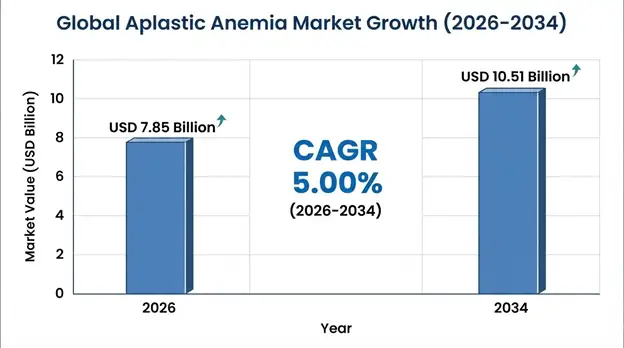
The Global Aplastic Anemia Market size was valued at USD 7.12 billion in 2025 and is projected to reach USD 7.85 billion in 2026, expanding to USD 10.51 billion by 2034, growing at a CAGR of 5.00% during the forecast period (2026-2034).
Aplastic anemia is a rare life-threatening hematologic disorder, associated with the failure of the bone marrow to produce blood cells of all lineages, which poses significant therapeutic challenges requiring prompt clinical management and applying complex treatment protocols which include HSCT, immunosuppressive drugs and new targeted drugs. The disease has a heterogeneous etiology with autoimmune-mediated destruction of bone marrow stem cells accounting for 60-70% of cases, drug-induced bone marrow toxicity due to drugs such as chemotherapy agents and antibiotics, viral infections such as hepatitis and HIV which cause immune-mediated aplasia, constitutional genetic disorders such as Fanconi anemia and dyskeratosis congenita, and idiopathic presentations in which the cause of the disease remains undetermined after careful investigation.
Modern concepts of aplastic anemia management include coordinated multidisciplinary strategies that combine supportive care, including transfusion programs, with specialized processing of blood products to reduce transfusion-related complications, antimicrobial prophylaxis and growth factor administration to prevent infection, immunosuppressive therapy with antithymocyte globulin and cyclosporine and improved by the use of thrombopoietin receptor agonists such as eltrombopag that achieve a high overall response rate of 70-75%, hematopoietic stem cell transplantation with curative potential, and emerging cellular therapies such as T-regulatory cells and ex vivo expanded cord blood progenitor cells that provide transfusion independence in large patient cohorts.
This is not just about improving individual care; it is also about creating a rare disease management ecosystem that connects rare disease centers with a depth of experience in complex treatment protocols, advanced diagnostics with immunophenotyping and cytogenetics for disease characterization and risk stratification, international registries for real-world evidence generation and treatment optimization, patient advocacy networks to raise awareness and improve early diagnosis, and coordinated healthcare systems for equitable access to life-saving interventions. The market meets critical unmet needs in a range of patient segments that include an estimated 1.8-2.0 million patients worldwide with aplastic anemia of varying severities, including approximately 430,000-600,000 with severe disease that will require urgent therapeutic intervention, and has bimodal age distributions with a peak in the teenage and elderly populations.
| Report Coverage | Details |
|---|---|
| Base Year | 2025 |
| Base Year Value | USD 7.12 Billion |
| Forecast Value | USD 10.51 Billion |
| CAGR | 5.00% |
| Forecast Period | 2025-2034 |
| Historical Data | 2022-2025 |
| Largest Market | North America |
| Fastest Growing Market | Asia Pacific |
| Segments Covered | By Disease Type, Treatment Type, Mode of Administration, Distribution Channel, End-User Novartis AG, Pfizer Inc., Roche AG, Fresenius Kabi, Sanofi S.A., Bayer AG, AbbVie Inc., Amgen Inc., Takeda Pharmaceutical, Teva Pharmaceuticals |
| Region Covered | North America, Europe, Asia Pacific, Middle East & Africa, Latin America |
| Countries Covered | US, Canada, Mexico, UK, Germany, France, Italy, Spain, Netherlands, China, Japan, India, Australia, South Korea, Brazil, Argentina, UAE, Saudi Arabia, South Africa |
| Key Market Playes | Novartis AG, Pfizer Inc., Roche AG, Fresenius Kabi, Sanofi S.A., Bayer AG, AbbVie Inc., Amgen Inc., Takeda Pharmaceutical, Teva Pharmaceuticals |
Get more details on this report - Request Free Sample
The primary driver of the aplastic anemia market’s growth is the increasing global awareness of this rare hematologic disease. Its incidence is believed to occur at a rate of two cases per million people each year in North America, Europe, and Australia. However, the prevalence rate in East Asia is estimated to be much higher 3.9 to 7.4 cases per million. There are around 1.8-2 million patients with aplastic anemia globally, and 430,000-600,000 of these people suffer from severe aplastic anemia.
The bimodal distribution of the age of patients with aplastic anemia, characterized by disease peaks in the pediatric population and adults older than 60 years, presents numerous market opportunities in different age groups, where patients from the pediatric group exhibit more aggressive disease characteristics, while adult-onset diseases demonstrate varying disease progression depending on immune disorders related to aging and accompanying diseases. Better diagnosis of the disease is possible because of improved bone marrow biopsy procedures, immunophenotyping approaches, and diagnosis standards according to international classifications.
The increased awareness of primary care physicians, hematologists, and emergency medicine specialists about the presentation pattern of aplastic anemia such as the rapid onset of cytopenia, recurrent infections, bleeding tendency, and fatigue is resulting in timely diagnosis and commencement of treatment for this condition, which previously took 2–3 months in some populations before. Patient support groups and rare disease networks around the world have enhanced disease awareness campaigns such that patients and their families can recognize the symptoms early which include easy bruising, recurrent infections, and fatigue.
Innovative developments in drug combination therapy for immune suppression, thrombopoietin receptor agonists, and cellular therapy have greatly transformed the treatment of aplastic anemia by increasing response rate, decreasing mortality related to treatment, and providing cure in previously refractory patient groups. The use of eltrombopag, an oral thrombopoietin receptor agonist, together with immunosuppressive therapy consisting of antithymocyte globulin and cyclosporine has yielded overall response rates of 70-75%, which is higher than the 50-60% seen with conventional therapy, resulting in complete hematological response in 35-45% of the patients and being transfusion-independent even up to 5 years.
Novel cellular therapies, such as T-regulatory cell populations, from autologous lymphocytes or cord blood, ex vivo expanded umbilical cord blood hematopoietic progenitor cells, and gene modified stem cells with a specific disease mechanism have shown clinical efficacy in Phase II studies with 87-92% of patients achieving neutrophil recovery, resulting in a significant reduction in infectious complications and transfusion support. Advanced cell expansion technologies to rapidly produce therapeutic cell numbers within 28 days for urgent clinical use, optimized cryopreservation techniques that ensure cell survival for “off-the-shelf” clinical application and standardization of manufacturing processes across multiple production centers have broadened the availability of cellular therapy beyond academic research centers.
These risk stratification biomarkers can predict the response to immunosuppressive therapy with a 70-80% accuracy and means that clinicians can choose the best treatment for each patient and alter their management strategy if they are not responding to treatment - allowing earlier transition to stem cell transplantation or salvage therapy before disease progression becomes irreversible. Combination therapy using a combination of drugs with different mechanisms of action such as immune checkpoint inhibitors, complement inhibitors and iron chelators has shown synergistic response rates while decreasing the toxicity profile by need for lower dosage of each agent.
The high cost of advanced aplastic anemia treatments represents one of the major limitations to the growth of this market, since curative therapies such as hematopoietic stem cell transplantation and immunosuppressive therapy are very expensive. Advanced therapies require advanced centers for transplantation, sophisticated laboratory equipment, lengthy hospitalization, and special staff of qualified physicians. In addition, limited reimbursements for treatments of rare diseases, complicated insurance approval procedures, as well as low budgetary allocations in developing countries, and limited access to proper treatment.
Lack of compatible donors, specialists of stem cell transplants, and specialists of immunohematology can cause treatment delays and affect clinical outcomes. The problem with supply chains of blood products, immunosuppressive agents, and components of cellular therapy can result in interruption of treatment processes, especially in less developed countries.
A potential growth area in the aplastic anemia market is the development of gene therapy and gene editing solutions for bone marrow failure syndrome conditions, such as Fanconi anemia and dyskeratosis congenita. These promising treatment options intend to address the fundamental genetic problem causing aplastic anemia rather than alleviate disease symptoms. The advances made in CRISPR gene editing technology and lentivirus gene therapy have already shown positive clinical data as far as the restoration of blood cells formation using a patient's hematopoietic stem cells. This can be used as an alternative to allogeneic stem cell transplantation. The advances in genetics testing, cell manufacturing and cryopreservation are enabling the development of customized gene-based therapies for mutations. As a result, there is a high potential for growth of gene-based therapies in the aplastic anemia market.
Treatment of aplastic anemia is undergoing a change owing to the increased sophistication and advancement in the use of combination immunosuppression that is based on different target mechanisms and step-up approaches customized for each patient. There has been significant improvement in the standard ATG-cyclosporine regimen through the incorporation of eltrombopag and other thrombopoietin receptor agonists, resulting in 70-80% overall response and 40-50% hematologic remission in current protocols versus 50-60% response in the past with ATG-cyclosporine alone.
The use of sequential treatment algorithms that involve initial immunosuppression along with salvage strategies, such as other combination regimens of immunosuppression, repeat treatment with ATG, and stem cell transplantation based on initial response to therapy has proven beneficial. in terms of individualizing treatment according to prognosis and course of the disease. The risk assessment based on parameters such as bone marrow cellularity, cytogenetics, age of the patient, and immunophenotype allows for personalized treatment in terms of predicting 70-80% accurately the right patients for immunosuppression or stem cell transplant.
North America: Market Leadership Through Advanced Healthcare Infrastructure and Specialized Centers
North America is the leading region in the global market for aplastic anemia as it possesses sophisticated healthcare facilities along with immunosuppressive therapy and hematopoietic stem cell transplantation, which receives reimbursement. North American countries, particularly the United States, dominate the regional market for aplastic anemia due to availability of advanced treatment methods, transplant programs, and presence of biotechnology/pharmaceutical companies engaged in the development of new drugs.
Wide range of coverage through public and private healthcare programs makes the use of advanced treatment techniques possible. In addition, the region enjoys numerous clinical trial centers, highly developed diagnostics, and professional services of specialists in hematology that help to diagnose the disease at early stages and provide optimal patient management. Positive regulatory incentives such as orphan drug programs also contribute to the ongoing development of effective therapies, while patient registries in the country further promote treatment strategies.
Europe is the second-largest regional market, valued at USD 1.68 billion in 2025, and is expected to grow at a CAGR of 4.9% through 2034. until 2034. The strengths of the region consist of well-developed health care systems focused on rare disease management, insurance covering immunosuppressive treatment and stem cell transplant in all members of the region, international registers ensuring the best treatment results, and hematology network with experience in treating aplastic anemia.
Some European countries, such as Germany, France, United Kingdom, and Italy, have their national or regional registries to monitor the treatment results and optimize the treatment. This market benefits from the established guidelines by the European Society for Blood and Marrow Transplantation (EBMT) regarding the diagnosis and treatment methods to deliver the treatment equally in all health care systems. Bone marrow transplant registries, such as European Society for Blood and Marrow Transplantation, ensure the availability of evidence-based transplant protocols and donor selection.
The Asia Pacific is the leading market for aplastic anemia and the growth rate is higher because of the huge population base, the development of healthcare facilities, and the improved diagnosis of bone marrow failure diseases. Investments in the services of hematology, increased use of stem cell transplantation services, and increased usage of immunosuppressive drugs are driving the market in the region. China is the dominant player in the market due to the increasing transplant facilities, improvement in the reimbursement policy, and government efforts to promote the diagnosis and treatment of rare diseases. India is another country where there is rapid expansion of the market due to the creation of specialized bone marrow transplant centers, increased awareness about the disease, and cost-effective treatment options.
Acquired Aplastic Anemia is the leading segment., accounting for 62.4% market share worth USD 4.45 billion by 2025 and registering a CAGR of 4.8% during 2024-2034. The market consists of acquired aplasia caused due to autoimmune mediated damage to bone marrow stem cells, aplasia induced by drug, aplasia induced by virus, and aplasia that has no known cause. The key drivers in this market include larger population base, high prevalence rate, and immunosuppressive treatment procedure with 60-75% efficacy.
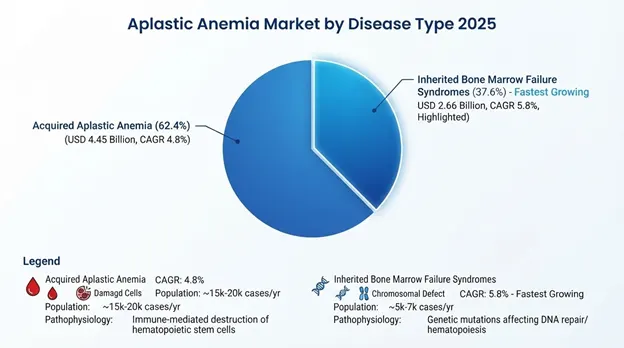
Inherited Bone Marrow Failure Syndromes, with their 37.6% market share worth USD 2.66 billion in 2025, include Fanconi anemia, dyskeratosis congenita, and several other types of inherited disorders. This segment is characterized by concentrated clusters of young patients with critical conditions that demand immediate treatment, which ensures high life-time value of treatment despite relatively small number of such patients. In addition, it is currently the most dynamically growing segment of the studied market with 5.8% CAGR until 2034 due to increased diagnosis via genetic tests and innovative treatments.
Inherited Bone Marrow Failure Syndromes constitute a market share of 37.6% worth USD 2.66 billion in 2025 and include Fanconi anemia, dyskeratosis congenita, and other inherited diseases. The segment includes younger patients with more serious illnesses that require intense treatment; thus, there is huge therapeutic worth throughout their life, although the number of patients may be comparatively lower. The segment is growing at the fastest pace at 5.8% CAGR till 2034 due to better diagnosis through genetic tests, targeted treatment options, and gene therapy options.
Injectable Administration constitutes the leading segment with 70.2% market share worth USD 5.01 billion in 2025, growing at 4.7% CAGR to 2034. Injectable Administration remains the leader due to the requirement of antithymocyte globulin injection therapy in immunosuppressive therapy, parenteral delivery of growth factors, administration of stem cells, and cell therapy delivery. The segment derives strength from proven protocols of administration, presence of hospital infrastructure, and monitoring facilities for safe and efficacious therapy.
Oral Administration constitutes 29.8% market share with value at USD 2.13 billion in 2025, growing at the highest rate at 5.8% CAGR to 2034. Oral Administration includes oral cyclosporine, oral eltrombopag, and novel oral immunomodulators allowing outpatient therapy, better patient compliance, and ease of therapy. The segment gains strength from the availability of new formulations, patient preference for outpatient therapy, and telemedicine facilities.
Hospitals constitute the highest end-user market share of 54.6% worth USD 3.90 billion in 2025. The hospitals manage aplastic anemia via advanced treatments including immunosuppression, stem cell transplant, and other supportive therapies that require dedicated infrastructural facilities. The end-user segment derives benefits owing to complexity of the conditions, the availability of reimbursement methods, and multi-disciplinary care coordination.
The Specialty Clinics are projected to register a 5.4% CAGR and occupy a 31.8% market share of USD 2.27 billion in 2025. The specialty clinics have demonstrated high efficiency owing to standardization in the process, specific equipment, and complete service coverage, including diagnostic, treatments, and follow-ups.
Homecare has a 13.6% market share of USD 0.97 billion in 2025 and a 5.9% CAGR through 2034. Homecare enables outpatient disease management through oral medications and supportive care.
Market share analysis shows that the aplastic anemia market across the globe is moderately concentrated, as the top ten companies have a market share of around 58-68%, based on diversified product portfolio consisting of immunosuppressants, transplant supporting products, cellular therapies, and innovative targeted therapies, a robust pipeline of 18 ongoing Phase II–III clinical trials, a strong network of hematology specialists, and advanced manufacturing expertise. Phase II-III clinical trials; strong presence within the network of hematology specialists; and advanced manufacturing expertise. The sources of competitive advantage include evidence for superiority of efficacy or safety over current standard of care treatments; innovative mechanisms to fulfill the therapeutic gaps; patient support programs to increase the accessibility of treatments; and collaboration with healthcare providers to secure favorable positioning within treatment guidelines.
June 2026: Eltrombopag along with ATG-cyclosporine showed positive results in Novartis’s phase III trial for the treatment of severe aplastic anemia with overall responses of 78%, against 62% using conventional therapies. Moreover, 52% of patients achieved complete hematological recovery and maintained transfusion independence in the long run exceeding two years of follow-up period. Regulatory submissions were made to the US FDA and EMA in anticipation of the approval in Q3 2026.
April 2026: FDA granted orphan drug designation to Cellenkos CK0801 T-regulatory cell therapy for the treatment of aplastic anemia after achieving transfusion independence in 63% patients in one year through phase I clinical trials.
February 2026: Gamida Cell announced encouraging Phase II interim results with omidubicel, which is a drug for allogeneic hematopoietic progenitor cells derived from ex-vivo expanded umbilical cord blood, showing 92.9% success rate of rapid neutrophil recovery with a median of 7 days for neutrophil engraftment compared to 14-21 days in unmanipulated cord blood, significantly lowering infection-related complications and death rates.
January 2026: Pfizer received FDA approval for the high-dose form of eltrombopag that allows for the realization of oral thrombopoietin receptor agonist therapy through a simpler dosing regimen with its commercial launch set to occur in Q1 2026.
November 2025: Sanofi and Swedish Orphan Biopharma have successfully acquired the immunosuppressive therapy specialist company for USD 450 million, securing the access to their own proprietary immunosuppressive therapies and combination therapy intellectual property for the development of advanced immunotherapy for aplastic anemia and other bone marrow failure syndromes.
List of Key Players in Global Aplastic Anemia Market
You'll get the sample you asked for by email. Remember to check your spam folder as well. If you have any further questions or require additional assistance, feel free to let us know via-
+1 724 648 0810 +91 976 407 9503 sales@intellectualmarketinsights.com
22 Jul 2026
Intellectual Market Insights Research © 2026. All rights reserved.