Share this link via:

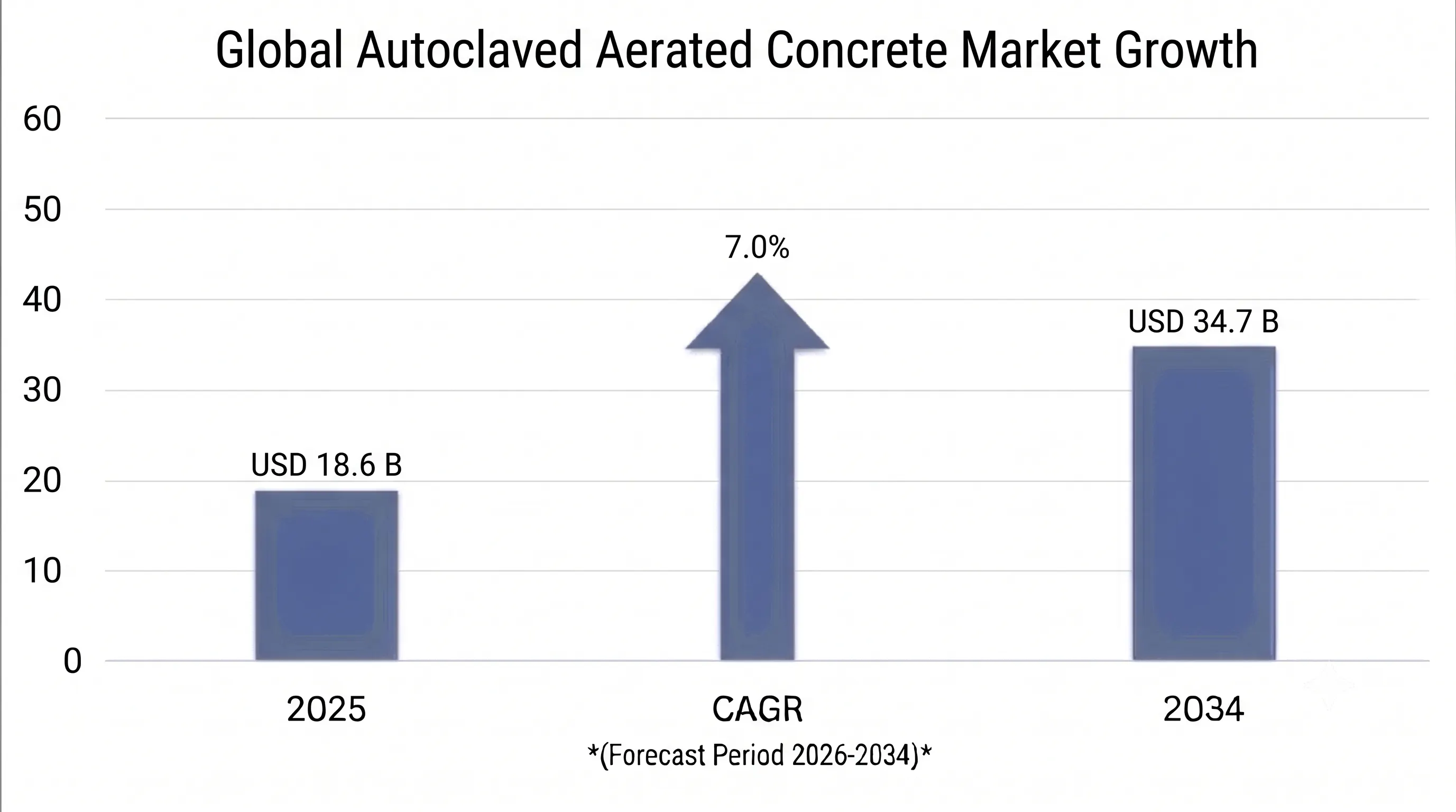
The global autoclaved aerated concrete market size was valued at USD 18.6 billion in 2025 and is projected to reach USD 20.1 billion in 2026, expanding to USD 34.7 billion by 2034, growing at a CAGR of 7.0% during the forecast period (2026-2034).
Autoclaved aerated concrete is an innovative form of lightweight, prefabricated construction material which provides excellent thermal insulation while maintaining considerable structural strength. because of its cellular nature. The material itself is produced by means of a complex procedure from a highly calculated mixture of Portland cement, lime, silica sand or fly ash, water, and aluminum powder as an expansion agent. As part of the manufacturing process, millions of equally distributed microscopic air cells, which comprise 60-80% of the total material mass, are formed. The production process starts off with precise batching and mixing of the material, after which expansion takes place when aluminum powder reacts with calcium hydroxide releasing hydrogen gas that forms a cellular structure.. Then the semi-solid mixture is wire cut into required dimensions and cured at high pressure under steam autoclave treatment at temperatures of 180-200°C and a pressure of 8-12 bar within 8-12 hours resulting in the formation of tobermorite crystals.
Performance features of the material are remarkable and make it significantly different from ordinary concrete and masonry systems by having dry density between 300-900 kg/m³ while the usual concrete material has the density of 2,300 kg/m³, thermal conductivity varying between 0.09-0.30 W/mK based on density grade for better energy performance, compression strength between 2-8 MPa sufficient for load-bearing and non-load-bearing applications., and up to 4-hour fire resistance without any additional fireproofing techniques. Such comprehensive performance features allow AAC to solve the issues of structural loads, insulation, fire protection, and soundproofing all at once using a single system and eliminating the need for a multilayer system.
Economic importance of autoclaved aerated concrete exists at all stages of construction processes, from foundation reduction due to its lightweight nature to acceleration of construction works due to larger size and high dimensional tolerance. AAC blocks can be installed at the rate of 3-4 times faster than traditional bricks because of larger sizes, lower weight allowing easy handling and suitability to thin-bed mortar that requires joints no thicker than 2-3 mm instead of 10-15 mm used in traditional brick structures. Its dimensional precision, which usually allows for tolerances of ±1-2 mm in advanced production plants, permits industrialized methods such as prefabricated buildings or Building Information Modeling.
Market growth is driven by several global factors, including rapid urbanization, leading to the need for high-efficiency construction, stringent energy efficiency laws that call for high thermal efficiency in buildings, and the shift towards industrialization in construction due to labor shortages and requirement for consistent product quality. The sustainability of the material, which includes its ability to utilize industrial by-products as alternatives to natural raw materials, low energy requirements in transport because of its lightweight nature, and recyclable nature at the end-of-life cycle, reflects rising environmental awareness.
| Report Coverage | Details |
|---|---|
| Base Year | 2025 |
| Base Year Value | USD 18.6 Billion |
| Forecast Value | USD 34.7 Billion |
| CAGR | 7.0% |
| Forecast Period | 2025-2034 |
| Historical Data | 2022-2025 |
| Largest Market | Asia Pacific |
| Fastest Growing Market | Middle East & Africa |
| Segments Covered | By Product Type, Density Grade, Application, End-User, Region |
| Region Covered | North America, Europe, Asia Pacific, Middle East & Africa, Latin America |
| Countries Covered | US, Canada, Mexico, UK, Germany, France, Italy, Spain, Poland, Netherlands, China, Japan, India, Australia, South Korea, Brazil, Argentina, UAE, Saudi Arabia, South Africa |
| Key Market Playes | Xella International GmbH, H+H International A/S, Aercon AAC, CSR Limited, Biltech Building Elements Ltd., JK Lakshmi Cement Ltd., AKG Gazbeton, Solbet Sp. z o.o. |
Get more details on this report - Request Free Sample
The primary driver of the AAC market is the rapid pace of urbanization across the globe, where the urban population is projected to rise from 4.6 billion in 2025 to a staggering 6.7 billion people in 2050, with all population growth taking place in urban centers of developing countries, which is where AAC construction’s cost-effective nature would prove to be a big asset. With India’s housing shortage expected to reach 29 million in 2025, most of them being in the poorer sections of society, Pradhan Mantri Awas Yojana program to construct 20 million affordable housing units provides a huge opportunity for AAC.
AAC delivers significant productivity improvements in construction projects on a grand scale via several means, which all contribute to decreased total construction time and costs. Firstly, the larger unit sizes of AAC compared to ordinary bricks, along with weights that are 40-75% lighter than the respective masonry materials, contribute to improved efficiency in bricklaying activities (up to 20-40%) without increasing labor intensity. Secondly, the modern technologies in AAC factories permit construction of joints that are 2-3mm wide, unlike the 10-15mm thick layers required in case of ordinary brick masonry, resulting in decreased mortar usage (by 70-80%).
The economic benefits that can be achieved from using AAC at a system level are more apparent when multiple stories are used, as lighter dead loads allow for reduced size foundations, reduced-size structural members, and reduced material usage in the building system. The economic savings that can be gained from this approach help to meet the financial limitations required for affordable housing delivery.
The increasing trend of mandatory building energy performance standards being implemented in the global environment is a very strong push factor favoring the uptake of AAC since the thermal insulation nature of the product allows it to meet more stringent energy requirements without needing any insulation added. Given that buildings consume about 36% of total energy used and produce about 39% of the world’s carbon dioxide, building performance enhancement has become one of the main pillars of climate strategy.
The European Union’s Energy Performance of Buildings Directive recast, which mandates that all new construction must meet nearly zero energy performance by 2030, provides an opportunity for the market uptake of highly performing wall systems where the use of AAC, due to its thermal mass and insulation characteristics, allows for economic compliance routes. The German Building Energy Act, French RE2020 law, and other such measures across developed countries are increasingly tightening the U-value of external walls, posing a challenge for conventional masonry.
The high thermal conductivities of AAC ranging from 0.09 W/mk to 0.30 W/mk depending on density class allow for constructing walls using a single-layer wall system that can meet or exceed the building energy codes in many climates, giving architects and developers the benefit of simpler construction which results in saving time and money. Another beneficial characteristic of AAC is its high thermal mass which ensures comfort of building occupants by regulating temperatures and minimizing HVAC loads.
The key factor that poses restrictions on the use of AAC blocks in developing nations where cost sensitivity reigns high is the added cost associated with the raw material used compared to bricks made locally at 20-40% more than the latter due to lower labor costs, lack of stringent environmental regulations, and fragmented brick production industry in such environments. The added cost makes it difficult for cost-conscious users to appreciate the overall savings that accrue using AAC blocks.
The high capital requirement of AAC plants, which requires an investment of between $15-45 million in typical production plants featuring autoclaving equipment and precision cutting machinery, hampers the establishment of production capacity in smaller countries. The geographical dispersion of plants is one factor that leads to increased cost levels associated with the distance of transportation from such remote plants.
The integration of AAC panels with the rapidly growing prefabricated and modular construction industry is a promising market opportunity, with features such as precise manufacturing, stability, and overall performance of this building material perfectly matching the needs of off-site construction. The global prefabricated construction market is estimated to reach USD157 billion in 2025 and grow by 6.8% annually, is a high value application area for AAC panels where a complete building envelope solution is possible.
The use of large AAC panel assemblies with pre-installed reinforcement, utility channels, and pre-finished exterior surfaces allows for almost complete enclosure of buildings without significant need for on-site finishing work. The approach not only solves problems of limited construction workforce but also ensures greater quality of work compared to conventional methods. The evolution of AAC panel assembly systems opens up possibilities for manufacturers to develop more complex products with higher value.
The integration of AAC into digital construction workflows has become increasingly efficient by way of fully developed BIM object libraries, parametric modeling programs, and automated production interface that allow seamless transfer from design to production. The major suppliers of AAC have started designing complex digital systems for thermal and structural analysis, automatic quantity calculation and optimization of cuts, and production scheduling to minimize waste and align production with the construction schedule.
Such technological integration also allows architects and engineers to maximize the wall thickness, insulation capacity, and structural suitability during the design process through a manufacturing perspective design-for-manufacturing-and-assembly methodology which makes full use of the precise manufacturing capabilities of AAC. Further innovations in installation guidelines in AR technology and digital quality control system facilitate the transition towards tech-driven construction delivery model.
The Asia Pacific region controls about 65-68% of the AAC market, estimated to be worth USD 12.2 billion in 2025, primarily due to the huge construction industry in China and rising adoption of AAC in India, which is facilitated by the housing plans undertaken by the Indian Government. China is the single biggest national AAC market, as it accounts for about 45% of the AAC market in terms of production and consumption.
India emerges as the most dynamic country in the region of Asia Pacific, with the AAC production capacity expected to rise by 18% per annum until 2020-2025 owing to the establishment of additional AAC factories to cater to rising demands emanating from affordable housing schemes, commercial construction activities, and infrastructure development. The supportive regulations of the Indian Government in terms of code mandates, green buildings, and public procurement help sustain the positive momentum in the market.
Middle East & Africa: Fastest Growing Region Through Infrastructure Investment
The ME&A region is one of the rapidly growing regions globally with an expected CAGR of 9.2% between 2023 and 2034 due to massive infrastructure projects in GCC nations, increase in construction activities in Sub-Saharan Africa, and appreciation of the thermal characteristics of AAC in construction in tropical environments. Given the high temperatures experienced in most areas, which can go beyond 45°C during summer, there is a need for materials with superior thermal resistance to minimize the energy consumed by air conditioning systems.
The Vision 2030 plan by Saudi Arabia, UAE urbanization efforts, and the Egyptian administration’s new capital city plan are all large-scale projects worth billions in terms of infrastructure construction costs where the efficiency and thermal characteristics of AAC make its use very advantageous. Increased focus on sustainable building techniques in the region coupled with energy efficiency requirements will also help make the case for using AAC more appealing.
European AAC market constitutes a highly developed segment, with value reaching roughly USD 3.8 billion in 2025, being technologically advanced, having robust product certification regimes, and being closely attuned to sustainability considerations. Europe is one of the key innovators in terms of advancement in AAC technology, including development of new panel designs, building solutions, and efficient manufacturing processes.
European producers invest heavily in high-performance products in order to sustain their competitive advantage in mature markets through high quality and innovations in systems. High building energy performance requirements and near-zero-energy buildings make the AAC products highly demanded and stimulate innovation in the technology involved in their production.
AAC blocks dominate the product type category with around 58-62% market share in the worldwide market value by 2025, which is worth between USD 10.8 and 11.5 billion, as it is the most used walling material in both residential and commercial construction projects. AAC blocks can be used in various wall thicknesses ranging between 75mm and 365mm makes their use more flexible in several constructions.
The AAC panels emerge as the fastest growing category constituting about 22-25% of the total market value, worth USD 4.1-4.6 billion in 2025 with a compound annual growth rate of 8.1% up to 2034. Reinforced AAC panels offer larger-format walls, floors, and roof applications, which aid rapid construction practices and industrialized building systems widely required in the commercial and industrial construction segments.
Lintels, U-blocks, and special shapes constitute 15-18% of the total market value and provide complete building system solutions that facilitate monolithic AAC building construction with minimal thermal bridging and detailing issues.
The largest segment of AAC consumption is accounted for by the residential segment, which includes single family housing units, multifamily residential housing, and affordable housing projects in emerging growth regions, with a market size ranging from 55-58%, amounting to US$ 10.2-10.8 billion by 2025. The advantages offered by AAC products for developers, in terms of their insulation properties, fire resistance, acoustics, and faster construction times are contributing factors.
Commercial construction accounts for a 25–28% share with USD 4.7-5.2 billion consumptions in 2025 with CAGR of 7.4%, driven by office buildings, retail structures, schools, and hotel constructions which prefer AAC due to its combined performance properties and efficiencies in construction.
Industrial construction accounts for 12–15% supported by rapid increase in warehouse, logistics, and factory construction which require AAC panels that provide quick erection of large structures.
Contractors and builders constitute the largest end-user segment accounting for about 45-48% of the total market value including general contractors, masonry specialty contractors, and construction firms buying AAC products to be used in their projects. This group takes advantage of the efficiency provided by AAC during construction and its comprehensive performance attributes.
The real estate developer end user group comprises 25-28%, and includes residential developers, commercial developers, and mixed-use project developers utilizing AAC based on economic considerations related to fast construction, energy efficiency, and overall building system costs.
The government/public sector end users make up 15-18%, based on their need for durable, fire resistant, and energy-efficient buildings as part of public housing initiatives and institutional buildings.
The global AAC market is moderately concentrated, with competitive dynamics varying across regions.; it includes multinational companies that have both technological capabilities as well as market presence, along with regional companies who cater to certain geographical markets. Xella International, which is known internationally for the Ytong and Hebel products, has been named as the most prominent company due to its presence in the international market.
In Europe, regional competitors such as H+H International A/S, Biltech Building Elements in India and many Chinese manufacturers maintain strong regional competitiveness by utilizing their advantages such as lower costs of local production, well-established distribution channels and knowledge of construction practices in each region. Product quality consistency, economies of scale, proximity to major construction sites, as well as technical assistance in implementing complete systems as opposed to standard products, are key aspects of competitive differentiation.
Further evolution of the market structure is expected towards increased consolidation as large enterprises benefit from more strict quality, environmental and financial requirements. Strategic relationships with leading construction companies, real estate developers, and governmental organizations responsible for providing homes to citizens can be viewed as important competitive advantage factors, especially in emerging markets with high growth potential.
April 2026: To capitalize on the fast-growing demand from the Asian construction industry, Xella International has planned to invest EUR 95 million in two new AAC plants in India and Vietnam, each capable of producing 1.8 million m3 annually using energy-efficient automated technology that will come online by 2027-2028.
March 2026: H+H International A/S successfully developed a high fly ash AAC block containing up to 55% of recycled fly ash and achieving the desired performance properties. H+H achieved BREEAM Excellent material rating for its product, aiming at European sustainable construction segments.
February 2026: Aercon AAC has recently invested USD 42 million in expanding capacity at its Florida production plant with an increase in capacity of 35%, responding to increased demand for AAC in the southeastern United States’ construction industry, both residential and commercial.
January 2026: Biltech Building Elements Ltd., a manufacturer of AAC blocks, has entered a strategic tie-up with a major Indian real estate developer for AAC supply worth USD 28 million over a period of three years for 15,000 housing units, which is one of the biggest orders in Indian AAC market history.
December 2025: Solbet Sp. z o.o. introduced its new line of AAC blocks with improved thermal conductivity of 0.09 W/mK, aimed at Polish and Central European markets, where almost zero energy buildings' laws make high-end masonry systems with no extra insulation layers sought after by the market.
November 2025: A key sovereign wealth fund from one of the GCC countries has made AAC blocks its preferred building material for government-sponsored construction projects in the UAE, which include projects worth around USD 12 billion until 2030 and is definitely a market breakthrough for AAC block manufacturers in the region.
You'll get the sample you asked for by email. Remember to check your spam folder as well. If you have any further questions or require additional assistance, feel free to let us know via-
+1 724 648 0810 +91 976 407 9503 sales@intellectualmarketinsights.com
01 Jul 2026
Intellectual Market Insights Research © 2026. All rights reserved.