Share this link via:

The global autoimmune hepatitis market size was valued at USD 2.1 billion in 2025 and is projected to reach USD 2.4 billion in 2026, expanding to USD 4.8 billion by 2034, growing at a CAGR of 9.3% during the forecast period (2026-2034).
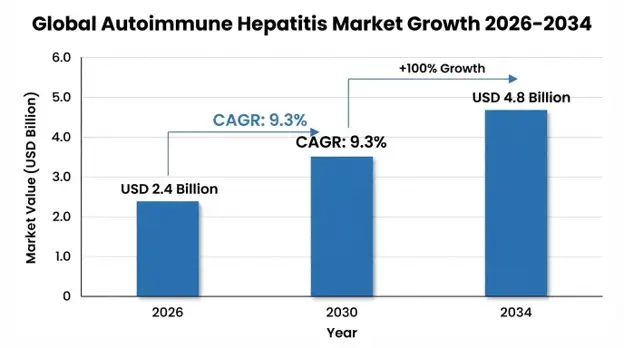
Autoimmune hepatitis is a chronic progressive immune-mediated liver disease characterized by circulating autoantibodies, raised serum levels of immunoglobulin G and interface hepatitis on liver biopsy and is treated lifelong with pharmacological immunosuppressive drugs that prevent progression to cirrhosis, liver failure and/or life-saving liver transplantation. The disease occurs because of a complex interaction of genetic factors (varied expression patterns of human leukocyte antigen), environmental factors (infections, and exposure to medications) and defects in immune regulatory mechanisms leading to the destruction of hepatocytes by T cells. Pathophysiology is characterized by loss of immunologic tolerance in susceptible individuals, and the clinical signs and symptoms range from non-specific, asymptomatic elevation of liver enzymes noted during routine screening to acute, fulminant hepatic failure with coagulopathy, hepatic encephalopathy and multi-organ dysfunction that necessitate emergency liver transplantation.
There are a variety of treatment options for modern autoimmune hepatitis, from conventional corticosteroid-based induction therapy with doses as high as 60 mg/day of prednisone tapered to 20 mg/day maintenance dose, to combination immunosuppression using azathioprine, mycophenolate mofetil or newer agents such as tyrosine kinase inhibitors and cell targeted biologics that maintain therapeutic efficacy while reducing the adverse effects of the steroid, including osteoporosis, opportunistic infections, metabolic issues and secondary malignancies. Treatment goals are to attain complete biochemical remission (normalization of transaminases, gamma-globulin and inflammatory markers), histologic regression (repeat liver biopsy showing resolution of interface hepatitis and fibrosis stabilization), and clinical remission (disappearance of symptoms and improvement of quality of life). The therapeutic challenge lies in tailoring the intensity of the immunosuppression according to the severity of the disease at diagnosis, the presence of anti-soluble liver antigen antibodies associated with treatment failure and with aggressive disease, the baseline histologic stage (which reflects the degree of fibrosis progression), the contraindications of using certain immunomodulatory agents in the presence of other clinical conditions, and the notion of pregnancy planning.
Its commercial value is not limited to the sales of pharmaceutical products but extends to the creation of disease management ecosystems that combine autoantibody detection platforms, serologic disease classification, non-invasive technologies for fibrosis assessment, strategies for optimizing immunosuppression levels, and hepatology services for managing disease heterogeneity, treatment-related complications, and end-stage liver disease. The market addresses a significant unmet need among patients with autoimmune hepatitis of 240,000-384,000 people worldwide at a rate of about 15.65 per 100,000 population, with considerable geographic variation, which may be a function of genetic susceptibility, health care infrastructure, diagnostic capacity, and disease recognition.
| Report Coverage | Details |
|---|---|
| Base Year | 2025 |
| Base Year Value | USD 2.1 Billion |
| Forecast Value | USD 4.8 Billion |
| CAGR | 9.3% |
| Forecast Period | 2022-2034 |
| Historical Data | 2022-2025 |
| Largest Market | North America |
| Fastest Growing Market | Asia Pacific |
| Segments Covered | By Type, Therapy, Formulation, Disease Stage, Route of Administration, End-User |
| Region Covered | North America, Europe, Asia Pacific, Middle East & Africa, Latin America |
| Countries Covered | US, Canada, Mexico, UK, Germany, France, Italy, Spain, Netherlands, Japan, South Korea, China, India, Australia, Brazil, Argentina, UAE, Saudi Arabia, South Africa |
| Key Market Playes | Novartis AG, Merck & Co., Pfizer Inc., Johnson & Johnson, Astellas Pharma, Mitsubishi Tanabe Pharma, Mallinckrodt Pharmaceuticals, Viking Therapeutics, Micregen Pharmaceuticals |
Get more details on this report - Request Free Sample
The autoimmune hepatitis market is driven by the increasing global disease burden, facilitated by improvements in diagnostic techniques and growing clinical awareness. Improvements in the detection of specific autoantibodies in serum testing, liver biopsy, and improved imaging have led to increased detection of disease. Increased awareness among family doctors and hepatologists has contributed further to the diagnosis of early disease onset and timely treatment. Autoimmune hepatitis is seen more commonly in women and elderly patients, and increased prevalence is attributed to the increased screening of the disease, an aging population, and improved access to specialized health facilities. Improved healthcare facilities in developing nations are also contributing to higher diagnosis rates and treatment of the disease. The rising requirement for effective treatment owing to increased immunosuppressant therapy among patients has also boosted the autoimmune hepatitis market on a global level.
The United States reports an incidence of approximately 2.94 cases per 100,000 person-years. However, the figure of 7.8 million reported cases is inconsistent with the known epidemiology of autoimmune hepatitis and shouldbe verified or replaced with an accurate prevalence estimate. Europe shows varying prevalence with 23.9 per 100,000 in Denmark and 18.3 per 100,000 in the Netherlands as well as 23.4 per 100,000 in Japan. The incidence in the Asia Pacific region shows increasing disease detection with 156% increase from 2020-2025. About 35% of people with autoimmune hepatitis will develop cirrhosis despite treatment which results in increased healthcare utilization. 80% of people suffering from autoimmune hepatitis are female patients.
The chronic nature of the disease is a major driver of sustained market growth. Most people must be under immunosuppressive treatment on a prolonged basis, sometimes life-long, to prevent further development and relapse of the disease. Without timely treatment, autoimmune hepatitis can quickly turn into liver cirrhosis, liver failure, and higher mortality rates. Therefore, a patient must manage his/her condition on a permanent basis. Modern treatment approaches allow almost all patients to attain biochemical remission, however, there is a high risk of relapses in case of stopping the treatment, and hence the necessity for prolonged treatment and monitoring. Patients also need regular liver function tests, visits to specialists and monitoring for possible complications like liver cirrhosis, portal hypertension, and hepatocellular carcinoma. Some patients with a refractory form of the disease might need liver transplant eventually.
Around 60.5% of patients with autoimmune hepatitis take corticosteroid medication, while 35.8% need to be put on azathioprine combined medication treatment, along with new agents such as mycophenolate mofetil that are prescribed to 8.7% of patients. Treatment burden scores dropped considerably when switching from more intensive monitoring protocols. The costs related to poor management of autoimmune hepatitis are 2-3 times higher than the treatment cost itself.
One of the key limiting factors for autoimmune hepatitis market is the restricted number of innovative disease-modifying therapies, as treatment remains dependent on corticosteroids and azathioprine therapies. While these therapies efficiently control disease activity in many patients, their prolonged use leads to a significant side effect burden, including bone loss, metabolic syndromes, infections and lower adherence. The lack of specific therapy that could be aimed at the autoimmune component of the disease makes it difficult to enhance the efficiency of long-term treatment and patient outcomes. Furthermore, the pipeline of potential therapies is not very big due to small patient base for the disease, difficulties in carrying out clinical studies on a large scale and the lack of biomarkers for proper patient selection.
The success rate of drug development of novel drugs for autoimmune hepatitis ranges from 8% to 12% from phase 1 until FDA approval, which is significantly lower when compared to traditional drug development where the success rate is 19.8%. The average time required for the development of novel autoimmune hepatitis drugs is between 10-14 years. There are 2-3 novel pharmacological drugs that have been approved by regulatory agencies in the last decade for the treatment of autoimmune hepatitis.
The major opportunity in the autoimmune hepatitis market is the creation of next-generation immunotherapies based on the use of targeted therapy that can help inhibit specific disease processes without compromising immune functions. New treatment concepts such as the use of tyrosine kinase inhibitors, JAK-STAT pathway inhibitors, immune checkpoint inhibitors, and B-cell and T-cell immunotherapy can potentially increase remission rates and decrease dependence on corticosteroids. It will be possible to provide effective treatment for patients suffering from refractory disease using the mentioned approaches while minimizing adverse side effects associated with the use of currently available immunosuppressive agents. Moreover, in the long term, opportunities will include personalized immunotherapy, immunotherapy based on regulatory T-cells, tolerogenic cells and genes that will help restore the process of immune tolerance rather than suppressing the immune system permanently.
Numerous investigational products, such as zetomipzomib, have obtained clearance from the FDA to be used as investigational new drugs. JAK inhibitors are being investigated for use in autoimmune hepatitis in 5 ongoing Phase II studies. Cell therapy approaches are in preclinical development aimed at immune tolerance induction. Newer targeted treatments could increase the patient pool by 40-60%.
Autoimmune hepatitis management is becoming increasingly technology-driven in relation to the increased use of non-invasive methods for diagnosis and disease monitoring to minimize the need for liver biopsy and early detection. Such innovations as transient elastography and sophisticated serological testing allow for effective assessment of liver fibrosis, disease activity, and overlap syndromes while providing a comfortable experience for patients and making disease monitoring possible. The increased use of electronic medical records and disease registries provides important information on the effectiveness of the treatment, its outcomes, and the use of health care resources, contributing to clinical decision-making. Besides, artificial intelligence and machine learning can be considered innovative tools in this area as they help integrate all available data on patients for better diagnosis, prediction of treatment outcome, and personalized treatment.
Fibrosis non-invasive tests utilization rate in Europe among diagnostic tests in 2025 was 42%. Biomarkers serologic panel used for the classification of the disease had accuracy rates between 89-93% when compared to the accuracy rates obtained using histology. The use of EHR for disease monitoring reduced clinical trial recruitment periods by 34%.
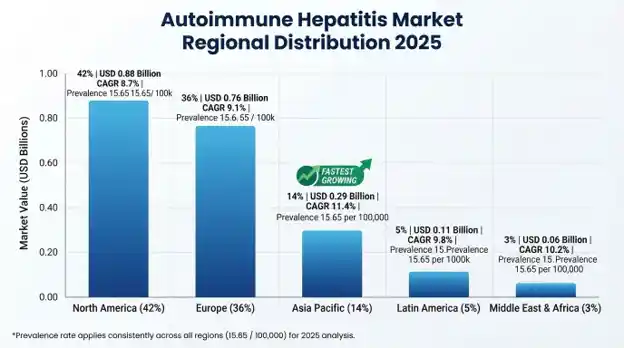
North America dominates the autoimmune hepatitis market owing to advanced hepatology practices, high levels of awareness, and easy access to diagnostics as well as treatment services for the condition. The United States accounts for a major part of the regional revenues due to the presence of many hepatologists in the region, good reimbursement scenario for diagnostic procedures as well as immunosuppressive therapies, and an effective healthcare framework. The use of advanced diagnostic technologies such as serological tests and liver fibrosis assessment has led to better early diagnosis and disease management. The region has been active in conducting clinical trials as well as research activities in the autoimmune liver diseases space, thereby supporting the development of a promising pipeline of innovative therapies.
Patient Population Diagnosed with Autoimmune Hepatitis in United States was 11,600 by the year 2025 with an average yearly increase in the diagnosis rate of 7.2%. Cost incurred by Medicare in 2025 for immunosuppressive treatment for autoimmune hepatitis was USD 380 million. New autoimmune hepatitis drug development pipeline programs in North America were 18 by 2025. Average yearly cost of treating a patient with immunosuppression therapy is estimated to be between USD 15,000-22,000.
Europe is the second largest market for autoimmune hepatitis, owing to the availability of hepatology centers, universal health coverage, and consistent clinical management throughout the region. Countries such as Germany, France, the United Kingdom, the Netherlands, and the Nordic countries offer excellent diagnostic services which allow the early detection of the disease using sophisticated serological testing and non-invasive methods for assessing the liver. Immunomodulatory therapy and specialist consultations are completely reimbursable, thus offering good patient accessibility to the therapy. The region enjoys extensive academic research, multinational clinical trials, and disease registries which consistently improve treatment protocols and the quality of care. The regulatory environment for rare diseases combined with pharmaceutical research and post marketing surveillance helps to drive innovation. Increasing uptake of precision medicine, better physician education, and long-term follow up programs make Europe a significant market for autoimmune hepatitis treatments during the forecast period.
Prevalence figures in autoimmune hepatitis patients in Europe are estimated at around 180,000-240,000 people in key markets. The prevalence rate is highest in Northern Europe. Clinical trials in Europe represent 31% of global efforts towards the development of treatments for autoimmune hepatitis. Annual medical expenses for autoimmune hepatitis are estimated at USD 18,000-USD 28,000 per patient in developed European countries.
The market for autoimmune hepatitis in Asia Pacific is growing at the fastest rate on account of the growing healthcare facilities, improved diagnostic procedures, and increased awareness about autoimmune diseases of the liver in the region. The market for autoimmune hepatitis in China holds the largest regional potential owing to the large population base, healthcare reforms, expansion in the insurance sector, and development of dedicated centers for the treatment of hepatology which help in early diagnosis and treatment of the condition. India is witnessing strong market growth because of physician awareness, improved availability of diagnostic tests, expansion in the public health insurance sector, and tertiary healthcare services at affordable costs. Japan and South Korea represent the technically advanced markets that have high diagnostic accuracy, good hepatology network, and an aging population that contributes to the increased prevalence of the disease.
The number of people living in Asia Pacific aged above 60 exceeded 1.2 billion in 2025 with future projections to reach 1.8 billion in 2050. The detection rate of autoimmune hepatitis in Asia Pacific region improved by 142% from 2020-2025. Specialist training for hepatology improved in Asia Pacific by 67% from 2020-2025. The annual cost of managing autoimmune hepatitis varies from approximately USD 8,000 to USD 18,000 per patient, depending on disease severity and treatment approach.
Autoimmune hepatitis type 1 is the leading subtype that accounts for most diagnosed cases worldwide and creates the highest revenue generation in the market. It is marked by the occurrence of ASMA and/or ANA antibodies and predominantly occurs in middle-aged females although it can occur at any age. This market benefits by the availability of well-defined diagnostic criteria, the existence of robust clinical evidence regarding corticosteroids and azathioprine treatment, and good long-term prognosis if the condition is diagnosed in time. Prevalence of the disease, well-known treatment protocols, and increasing diagnosis rates ensure its market supremacy.
The less prevalent and clinically important market segment is autoimmune hepatitis type 2, which is usually encountered in children, adolescents, and young adults. This market segment is characterized by the presence of anti-LKM1 and anti-LC1 antibodies and has a tendency toward a more aggressive course of the disease, a high frequency of relapses, and liver failure risk. Seronegative autoimmune hepatitis is a less common market segment, which can be diagnosed by the means of clinical manifestations, liver biopsy results, and therapy response.
A combination immunosuppressive treatment with corticosteroids and azathioprine is the dominant treatment segment within the market for autoimmune hepatitis since it has the largest patient share. Combination treatment is still preferred as the first-line regimen because it provides high remission rates while keeping corticosteroid intake low enough, minimizing potential adverse effects related to the prolonged use of steroids.
Corticosteroid monotherapy, primarily using prednisone or prednisolone, continues to be one of the important segments for the patients who have contraindications to taking azathioprine, deficiencies of thiopurine methyltransferase enzyme, are pregnant or plan pregnancy, and have contraindications to the use of combination therapy. While being effective in inducing remission, the long-term use of corticosteroids is associated with considerable adverse effects and leads to the need to shift to maintenance treatment.
Novel therapeutics represent the fastest-growing segment, driven by the increasing application of mycophenolate mofetil in treatment-resistant patients and the emergence of new targeted immunomodulators and biologics.
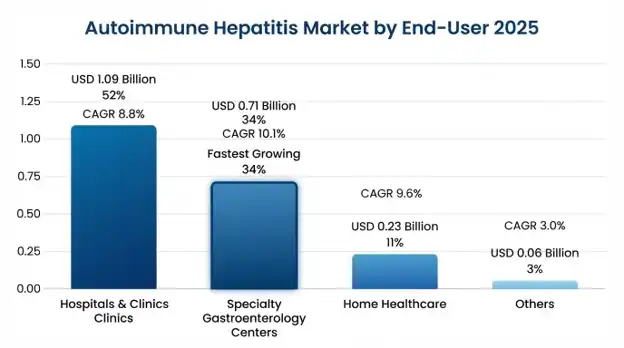
Hospital & Clinics segment constitutes the largest end-user group accounting for 52% market share, worth USD 1.09 billion by 2025, including internal medicine units, gastroenterologists, and hepatologists conducting diagnostic assessments, initiating treatments, and managing complications. Gastroenterology specialists constitute 34% market share worth USD 0.71 billion by 2025, growing at a 10.1% CAGR, being the fastest growing end-user segment due to expertise in managing autoimmune liver diseases, optimized diagnostic processes, and disease monitoring facilities.
The global autoimmune hepatitis market shows some degree of consolidation where the top nine companies collectively account for approximately 58–67% of the market based on immunosuppressive products in terms of market value, robust clinical development pipeline exploring new mechanisms of action, well-versed connections with hepatology specialist community, and advanced production facilities guaranteeing the quality and availability of their products. Competitive advantage can be derived from clinical proof of higher remission rates achieved with certain combinations of immunosuppressants, new drugs with better steroid-sparing effect, complete patient support initiatives for adherence, and health economic information.
You'll get the sample you asked for by email. Remember to check your spam folder as well. If you have any further questions or require additional assistance, feel free to let us know via-
+1 724 648 0810 +91 976 407 9503 sales@intellectualmarketinsights.com
23 Jul 2026
Intellectual Market Insights Research © 2026. All rights reserved.


