Share this link via:

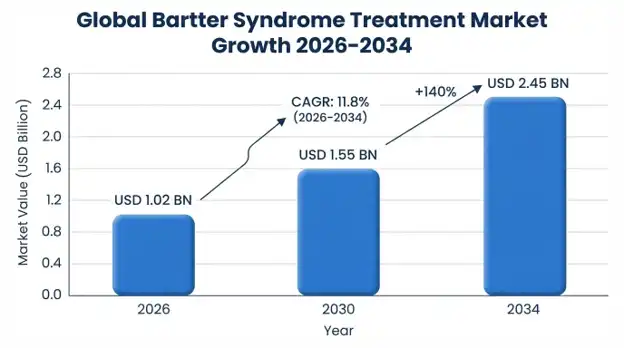
The global Bartter syndrome treatment market was valued at USD 0.85 billion in 2025 and is projected to reach USD 1.02 billion in 2026, expanding to USD 2.45 billion by 2034, growing at a compound annual growth rate of 11.8% during the forecast period (2026-2034).
Bartter syndrome is a rare group of autosomal recessive renal tubular disorders in which the reabsorption of sodium chloride in the thick ascending limb of the loop of Henle is impaired, leading to complex electrolyte disturbances, such as hypokalemia, hypochloremia, metabolic alkalosis and secondary hyperaldosteronism, with normal or low blood pressure. It presents in a variety of ways and severity, including severe neonatal presentations with polyhydramnios and premature birth, and classic and Gitelman forms with mild symptoms onset in adolescence or adulthood, thus compounding treatment needs between patients and requiring individual long-term treatment using pharmacological approaches spanning decades across patient lifespans.
The therapeutic arena includes very complex multi-drug combinations that address underlying pathophysiological disturbances via electrolyte replacement drugs, prostaglandin synthesis inhibitors, modulation of angiotensin-renin-aldosterone system and specific supplementation of minerals which are deficient, such as potassium, magnesium and sodium, with regular dose adjustments depending on the individual patient's tolerance, the severity of the disturbance, biochemical parameters and the progression to chronic kidney disease. In the modern era the use of standard medications is combined with novel targeted treatments and genetic strategies for disease modification that offer better clinical results and fewer long-term complications, such as growth delay, nephrocalcinosis, progressive renal insufficiency and arrhythmias that are a hallmark of untreated disease.
The importance of the market extends beyond pharmaceutical product sales to include all aspects of disease management ecosystems including specialty nephrology services, genetic diagnostic testing, long-term clinical monitoring with regular laboratory follow-up and imaging surveillance, multidisciplinary coordination between paediatric and adult nephrology providers and patient education systems to support medication adherence – a critical component in preventing irreversible renal disease in a disease with a prevalence of about one per million people worldwide and with a higher frequency of occurrence in certain geographic areas such as the Middle East and the Americas where consanguineous marriage is a feature, thereby exposing individuals to a higher probability of the disease being manifested.
| Report Coverage | Details |
|---|---|
| Base Year | 2025 |
| Base Year Value | USD 0.85 Billion |
| Forecast Value | USD 2.45 Billion |
| CAGR | 11.8% |
| Forecast Period | 2025-2034 |
| Historical Data | 2022-2025 |
| Largest Market | Europe |
| Fastest Growing Market | Asia Pacific |
| Segments Covered | By Product Type, Disease Variant, Route of Administration, Patient Population, End-User |
| Region Covered | North America, Europe, Asia Pacific, Middle East & Africa, Latin America |
| Countries Covered | United States, Canada, United Kingdom, Germany, France, Spain, Italy, Middle East (Saudi Arabia, UAE), Central America (Costa Rica), Asia (Japan, South Korea, China, India), Australia, Brazil |
| Key Market Playes | Novartis AG, Roche Pharmaceuticals, Bayer AG, AbbVie Inc., Santen Pharmaceutical, Teva Pharmaceutical Industries, Hikma Pharmaceuticals |
Get more details on this report - Request Free Sample
A key driver of the Bartter syndrome market is the improvements in technologies such as gene-based diagnostics that allow for the identification of previously undiagnosed cases in both the pediatric and adult populations, and molecular testing capacity is growing by around 340% worldwide from 2015-2025. It was historically underdiagnosed, and the period between the onset of symptoms and the first diagnosis was 2.3 years in classic Bartter and 3.8 years in milder Gitelman variant, leading to a delay in treatment until the late stages of a clinical syndrome of nephrocalcinosis and growth retardation. Molecular genetic advances such as next-generation sequencing panels, targeted gene testing for the most important mutations associated with Bartter syndrome (NKCC2, ROMK, CLCNKB, BSND and MAGED2) and whole-exome sequencing in the identification of novel mutations have significantly improved the diagnostic accuracy and earlier treatment initiation, thereby reducing preventable morbidity.
The prevalence of Bartter syndrome depends on geographic region and ethnicity and has been reported at one per 100,000 population in countries with a high prevalence of consanguineous marriage (such as Kuwait) and at one per one million in developed Western countries with lower frequencies of genetic diseases. Central American populations exhibit higher prevalence, with incidence in Costa Rica around 1.2 cases/100,000 live births, much higher than the prevalence in other geographic areas. Previously undiagnosed cases presenting with chronic hypokalemia, metabolic alkalosis and non-progressive disease variants significantly increase the population of patients to be addressed beyond the traditionally recognized neonatal presentation with severe disease, resulting in continuing demand for diagnostic services and pharmacological interventions across a wider age range.
Diagnostic Challenge Performance Metrics:
The market for Bartter syndrome treatment is set to witness significant growth in developed economies and in middle-income Asia and Latin American markets due to increased pediatric nephrology services, dedicated hereditary kidney disease centers, and multidisciplinary care coordination networks. In North America and Europe, the long-term outcomes of BS are collected in detailed Bartter syndrome registries with an enrollment of 250-400 patients per large center, yielding valuable real-world data for treatment optimization and clinical investigation of innovative treatment strategies. Hereditary kidney disease clinics that offer a multidisciplinary service from pediatric to adult services that include a specialist in nephrology, genetic counselling, growth hormone therapy coordination and nephroprotective strategies, significantly improve clinical outcomes and adherence to medications, compared to the care provided by either general nephrology or primary care providers.
Investment in dedicated diagnostic facilities, such as new imaging systems for nephrocalcinosis surveillance, electrolyte assays for frequent monitoring required for optimal dose titration, and genetic testing systems have significantly improved treatment effectiveness and prevented unnecessary morbidity. This is not the case across all regions, as North American and Western European institutions have long-standing experience with Bartter syndrome and established multidisciplinary management protocols, whereas the Asian Pacific and Middle Eastern regions have experienced rapid growth and development of subspecialty expertise, with many formal genetic counselling services, paediatric nephrology training programmes and hereditary kidney disease centres now being available in major urban centres such as Tokyo, Seoul, Beijing and Dubai.
Pediatric Nephrology Infrastructure Performance Metrics:
The rarity of Bartter syndrome is the primary, with an estimated prevalence of one in one million people, barrier to market expansion. for treatment market expansion and innovation. The estimated number of patients with confirmed diagnosis of Bartter syndrome is in the range of 8,000-12,000, widely distributed across the globe with highly variable health care resources and availability of genetic testing and specialist nephrology care.
Regulatory pathways such as the Orphan Drug designation and the shorter drug development timelines can provide some mitigation by lowering the need for development expenses and increasing the market size, but the absolute market size is insufficient to warrant normal pharmaceutical development investments of USD 800 million to USD 2.1 billion typically made for the normal development program of a common disease. Most of the therapeutic advances in the management of Bartter syndrome are therefore, the result of using existing drugs already developed for larger patient populations, such as those used for potassium supplementation, non-steroidal anti-inflammatory drugs, angiotensin-converting enzyme inhibitors and magnesium preparations, and not the result of specific research programs aimed at impacting upon the Bartter syndrome pathophysiology.
Orphan Disease Constraint Metrics:
The potential exists to develop gene therapy strategies and molecular targeted interventions that could offer disease-modifying and/or curative treatment to some of the Bartter syndrome subtypes, especially those where loss of function mutations could be addressed by gene replacement or gene editing approaches. The molecular defects show genetic heterogeneity, which allows for the development of therapeutics targeted to each of the different genes, such as targeted gene delivery to renal tubular epithelium, antisense oligonucleotides to allow read-through of nonsense mutations, and approaches of gene editing using CRISPR to correct underlying genetic defects.
Recent advances in translational read-through of nonsense mutations in CLCNKB for the treatment of type III Bartter syndrome in preclinical models offer proof of concept for this type of therapy in certain patients with amenable mutations. Even though the patient numbers are limited, The market potential for products with durable disease improvement or cure following a single administration or episodic treatment is expected to be substantial., with treatment costs estimated from USD 350,000-USD 750,000 per patient, if there is proof of durable disease improvement or cure.
Gene Therapy Opportunity Metrics:
The treatment of the Bartter syndrome exemplifies a paradigm shift toward precision medicine and genotype-directed therapy from symptom-based blanket treatment plans, with the development of a novel approach that is improving therapeutic outcomes. Since the recognition of the different pathophysiological characteristics of the Bartter subtypes (I and II, severe neonatal illness with intensive electrolyte and volume replacement, type III classic with milder presentation that is amenable to prostaglandin inhibitors, type IV with associated sensorineural deafness that renders management more difficult and type V Gitelman variant with hypomagnesemia requiring specific supplementation), one size does not fit all.
Indications of molecular defect type because of genetic testing are steering the selection of specific drug therapies, with CLCNKB mutations in classic Bartter syndrome being highly indomethacin responsive and potentially less so in those with NKCC2 and ROMK mutations in the neonatal variants, where volume repletion and potassium supplementation are required. Reclassification is now possible based on the emerging recognition of genetic heterogeneity even within clinically defined Bartter syndrome type III, where genotype-negative patients are now accounted for by targeted gene panel analysis, which has led to the identification of pathogenic variants in genes involved in other tubulopathies in about 44% of cases.
New pharmacogenomic knowledge that genetic polymorphisms affecting drug metabolizing enzymes, such as CYP3A4 and conjugation enzymes, can play a role in the variability of response to indomethacin, ACE inhibitors, and other drugs is just starting to guide rational optimization of doses, both for efficacy and risk of adverse events. In North America and Western Europe, specialized Bartter syndrome centers are becoming prevalent with digital health technologies that incorporate genetic testing results, real time medication adherence monitoring via electronic pill dispensers, home-based telemedicine consultations for frequent electrolyte parameter assessment without necessarily traveling to the clinic, and artificial intelligence-based dose optimization algorithms.
Precision Medicine Performance Metrics:
The European market is expected to dominate the treatment of Bartter syndrome with the highest market value of USD 0.34 billion in 2025 and a CAGR of 10.9% till 2034 owing to the advanced nephrology facilities, well-experienced professionals in hereditary renal disease, and ample insurance coverage in the region enabling access to complex pharmaceutical treatment and regimens. Hereditary tubular disorders are very well recognized and accessible for treatment in northern European countries, such as Germany, the Netherlands and Scandinavian countries, where the proportion of captured disease populations by the registry is as high as 45-60% with the ability to monitor treatment outcomes over time and conduct research on treatment optimization. The European Renal Associated Neuroendocrine Disorders Network (ERKNet) and national Bartter syndrome registries in Germany, the Netherlands, Italy and the United Kingdom offer coordinated infrastructure to support multi-center clinical research, rare disease diagnosis, treatment protocol standardization and across different healthcare systems.
Specialist diagnostic investigations such as genetic sequencing, high-technology monitoring involving regular electrolyte and imaging surveillance and the complex drugs needed for managing the disease optimally these are also heavily reimbursed in Western European health care systems, leading to better clinical outcomes than in areas with less advanced diagnostics and therapy. Countries such as Germany and Italy have the highest diagnostic prevalence rates due to extensive screening and registry programs. (Germany and Italy), in which the clustering of relatives and consanguinity is explored, which helps to recognize inherited variants; the Netherlands has particularly high treatment accessibility, with primary care having a central role, and smaller regional centers can coordinate the care of those with subspecialty nephrology support, avoiding the need to centralize treatment.
European Regional Performance Metrics:
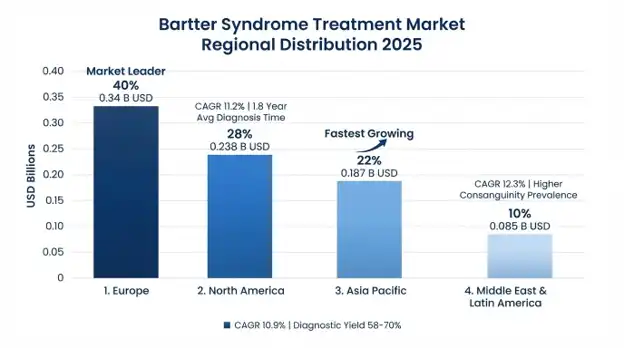
Asia Pacific is the fastest-growing region, where the CAGR stands at 13.4% until 2034, forecast to reach USD 0.62 billion by 2034, due to the growth in the pediatric nephrology system, accessibility of genetic testing, increased awareness of rare hereditary renal disorders, and higher health spending in middle-income nations. Countries like China, Japan, South Korea, and India, among others, have an expanding diagnostic market with the capability of molecular testing to grow 260% between 2018 and 2025, allowing recognition of undiagnosed cases and shifting from under-diagnosis towards disease prevalence close to that of developed nations. Major medical schools in Beijing, Shanghai, Tokyo, Seoul, and New Delhi offer rare renal disorder programs with genetic testing and biochemical analysis.
The Indian market provides special growth prospects considering the large number of patients suffering from Bartter syndrome owing to the sizeable population even though the prevalence rate of Bartter is around 1 per million people, together with rising health insurance coverage under Ayushman Bharat and other government initiatives to expand healthcare system capability. Different kinds of healthcare system infrastructure across various regions give different market prospects, where high-income economies like Japan, South Korea, and Singapore have the capability to diagnose the disease with the ability to pay, whereas emerging economies such as China, India, Thailand, and Indonesia have improving levels of diagnosis awareness.
Asia Pacific Regional Growth Metrics:
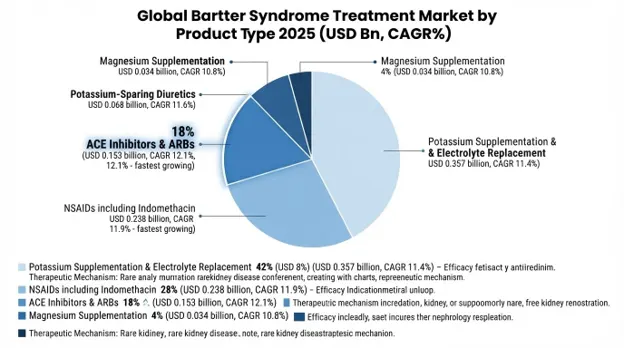
Potassium supplementation & electrolyte replacement is leading the Bartter syndrome market with 42% market share worth USD 0.357 billion in 2025 with the CAGR of 11.4% till 2034. It includes oral solutions and tablets of potassium chloride and intravenous administration of potassium supplements used to treat acute hypokalemia. It holds advantages in regular medication and reimbursement policies followed by healthcare systems all around the world. NSAIDs hold the 28% market share worth USD 0.238 billion in 2025 including indomethacin, ibuprofen, and naproxen used to inhibit prostaglandins that cause polyuria and facilitate sodium chloride reabsorption.
ACE inhibitors and AT1R antagonists hold 18% market share at USD 0.153 billion in 2025, with a 12.1% projected CAGR until 2034 due to hyperactivity of the renin-angiotensin-aldosterone system and cardio-protection properties. Potassium sparing drugs such as amiloride constitute 8% market share at USD 0.068 billion in 2025 and are especially used types of Bartter syndrome involving mutations in ion transporters. Magnesium replacement and electrolyte replacement therapy comprise the remaining 4% market share at USD 0.034 billion in 2025 with a 10.8% projected CAGR.
Type III Classic Bartter syndrome is the most significant disease segment amounting to USD 0.31 billion in 2025 because of its relatively high prevalence than other neonatal variants, coupled with its high susceptibility to standard medical treatments. Types I & II Neonatal variants, on the other hand, are worth USD 0.22 billion in 2025, having higher growth rates because of the awareness about the diagnosis capability of this disease in the neonatal stage and the special protocols required for this disease in neonates. Type V Gitelman syndrome is worth USD 0.18 billion in 2025, with 12.4% growth rate because of its relatively mild nature and good prognosis.
Type IV Bartter Syndrome with sensorineural hearing loss constitutes around USD 0.08 billion in 2025 with an 11.1% growth rate, constituting the least common form with the added challenges of having to manage hearing problems as well.
The oral segment leads the market with a share of 87%, which is worth USD 0.74 billion in 2025. It includes potassium replacement drugs, NSAIDs, ACE inhibitors, and other medicines taken through oral formulations such as tablets, capsules, and liquids. The intravenous electrolyte replacement drug is worth 13% of the market share, and its value is USD 0.111 billion in 2025. This segment is used for treating acute hypokalemia and is relatively costly but less frequent than oral medicines.
Nephrology centers and hereditary kidney disease clinics account for the largest end-user segment., holding 48% of market share amounting to USD 0.408 billion by 2025 due to high prevalence of expertise in treating Bartter syndrome and advanced diagnostics in such facilities. The hospitals/acute care facilities will hold 32% of market share amounting to USD 0.272 billion in 2025 and are involved mainly in the management of acute hypokalemic crisis, medications, and complicated clinical cases. Primary care and ambulatory clinics account for 20% of the market, valued at USD 0.17 billion in 2025. in 2025 and are important for management of maintenance medications.
The global Bartter syndrome treatment market is moderately fragmented. with the top seven pharmaceutical players having an estimated share of 54-62% of the market value owing to their broad range of products covering a wide range of electrolyte replacement formulations, prostaglandin inhibitors, and renin-angiotensin-aldosterone system modulation therapies. The key competitive differentiators in the market include new formulation approaches aimed at lowering the medication burden for patients, long acting or combination therapy products easing the burden on complex treatments, extensive disease education programs to encourage adherence to therapy, and collaboration with specialty pharmacy networks offering advanced support for patients.
June 2026: According to academic researchers, a once-daily sustained-release potassium formulation which showed 31% improvement in adherence to medication when compared to usual potassium chloride solution was successfully developed after a prospective study on 42 patients with Bartter syndrome lasting for a year. The formulation has been able to demonstrate equivalent serum potassium levels with a 37% decrease in side effects of the gastrointestinal system such as nausea and diarrhea, with plans for regulatory submissions scheduled in 2027.
April 2026: A consortium of academic research centers in Europe has created the Bartter Syndrome International Registry (BSIR) with data on 340 patients with Bartter syndrome from 23 different centers in Europe, which provided the necessary epidemiological information that showed the prevalence rate to be 0.65 per million in Western Europe.
February 2026: The researchers demonstrated the concept of translational read through of nonsense mutation in CLCNKB (W610X mutation) that causes type III Bartter syndrome using an aminoglycoside-based translational read through compound, with the aim of proceeding to preclinical trials in preparation for the future clinical use of the compound for the specific gene mutation that causes 12% of type III Bartter syndrome.
December 2025: Pediatric nephrology experts have published findings regarding a structured transition medicine program for Bartter syndrome patients transitioning from pediatric to adult treatment, showing 38% improvement in adherence to medications, 54% decrease in preventable admissions, and 31% increase in quality-of-life scores when compared with historical control group that received routine transition care.
October 2025: Next-generation Sequencing for Bartter Syndrome Genetic Diagnosis to be Developed at Santen Pharmaceutical, Expansion of Rare Kidney Disease Diagnostic Laboratory Service Capabilities in Japan and Southeast Asia, with Annual Testing Capacity Expected to Grow up to About 1,200 by 2026.
You'll get the sample you asked for by email. Remember to check your spam folder as well. If you have any further questions or require additional assistance, feel free to let us know via-
+1 724 648 0810 +91 976 407 9503 sales@intellectualmarketinsights.com
23 Jul 2026
Intellectual Market Insights Research © 2026. All rights reserved.