Share this link via:

The Global Basán Syndrome Market is estimated to grow from USD 12-18 million in 2026 to USD 28-42 million in 2034, accounting for 9.2-11.4% compound annual growth rate. Such growth is fueled mostly by the improvement in diagnostics and more effective patient detection rather than the development of pharmaceutical drugs. North America will remain the largest regional market throughout the forecast period, taking 50-55% of the market share while Asia-Pacific will show the highest CAGR (14.2-16.8%). The market will be limited by the ultra-rare patient population (estimated 450-650), lack of approved drugs targeting this disease, and fragmented geographical distribution of patients.
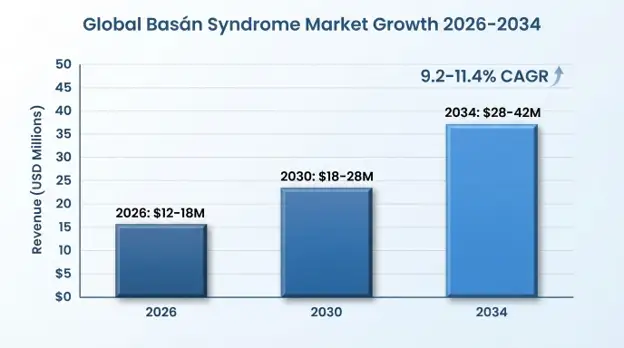
The major growth drivers include the development of therapies targeting SMARCAD1 mutations or other epidermal development pathways, expanding access to genetic testing in Asia-Pacific and emerging regions, growing awareness and diagnostics procedures due to the efforts of medical education programs, and establishing international standards for the diagnosis and management of rare genodermatoses. The market is expected to transition from a diagnostic and supportive care stage to one focused on potential therapeutic interventions on possible therapeutic treatment if the concept will be proved for the treatment of chromatin remodeling disorders or epidermal development pathways.
| Report Coverage | Details |
|---|---|
| Base Year | 2025 |
| Base Year Value | USD 11–16.5 million |
| Forecast Value | USD 28-42 million |
| CAGR | 9.2-11.4% |
| Forecast Period | 2025-2034 |
| Historical Data | 2022-2025 |
| Largest Market | North America |
| Fastest Growing Market | Asia Pacific |
| Segments Covered | By Genetic Testing Method, Disease Manifestation, Clinical Features, Treatment Approach, End-User |
| Region Covered | North America, Europe, Asia Pacific, Middle East & Africa, Latin America |
| Countries Covered | US, Canada, UK, Germany, France, Japan, China, Australia, Brazil, India |
| Key Market Playes | Invitae, Genomics England, Quest Diagnostics, Labcorp, DermTech, Mayo Clinic, Mount Sinai, NORD, ERN-Skin |
Get more details on this report - Request Free Sample
Basán syndrome is a very rare genetic disorder caused by mutations in the SMARCAD1 gene located on chromosome 4q22, which encodes a protein involved in the remodeling of chromatin essential for proper development and barrier function of the epidermis. The disease is a spectrum of phenotypes from isolated adermatoglyphia (no fingerprint ridges on fingers or palm/soles) to syndromic presentation, including palmoplantar keratoderma, nail dystrophy, decreased ability to sweat, digit contractures, and acral blistering at the newborn stage. The disorder is autosomal dominant, fully penetrant, but with variable expressivity, that is, individuals with one SMARCAD1 mutation will demonstrate clinical features.
The underlying pathophysiology is a disruption of the splice sites within the SMARCAD1 gene, especially the donor splice site of the noncoding exons. This is a clinically relevant distinction since these splice site variants are not identified by standard whole-exome sequencing and require whole genome sequencing or targeted Sanger sequencing to confirm the diagnosis. The loss of function of this protein interferes with normal programming of ectodermal tissue development, which can result in abnormalities in the formation of dermatoglyphic ridges, sweat glands, nail matrix organization and the integrity of the palmoplantar skin, leading to blistering and secondary hyperkeratosis in the event of trauma.
There is a continuum of phenotypes between isolated adermatoglyphia and Huriez syndrome (scleroatrophy and nail hypoplasia with risk of squamous cell carcinoma) that can be included in a single entity: what has been called "SMARCAD1-associated syndrome" and which includes the following phenotypes: Sebacea-related skin development disruption, congenital facial Milia, Adermatatoglyphia, Reduced sweating, Contractures, Acral bullae, and Dystrophy of nails.
The clinical importance is not limited to dermatological involvement, as the absence of dermatoglyphic patterns can cause difficulties in biometric identification and in medico-legal settings, such as forensic and criminal justice. Patients with recurrent blisters and fissures of the skin of palmoplantar regions are at risk of recurrent infections and decreased mobility, especially in warm climates and in heavy work. In some older affected people, there is progressive keratoderma of the palms and soles, which causes functional disability and limits their quality of life.
Global Prevalence Estimates: Basán syndrome is considered one of the rarest genodermatoses., with an incidence range of 1 case in every 2-5 million people. Based on the expected world population of 8.1 billion in 2025, this corresponds to around 450-650 people worldwide. The disease may be underdiagnosed by up to 1.5-2 times since no testing facilities are available in areas without adequate medical technology.
Geographic Distribution: The disorder has been reported among different ethnic groups such as Irish Americans, Swedes, Chinese, Germans, Turks, Italians, Vietnamese, and Cambodians, implying that there is no ethnic predilection towards this disorder. However, the ascertainment differs widely among different regions. North America and Europe constitute 55-65% of all diagnosed cases due to their better diagnosis facilities and availability of genetic testing methods. Asia Pacific comprises 20-25% of all diagnosed cases even though it has a larger number of people, which implies an under-diagnosis problem.
Age of Diagnosis: The unique clinical presentation allows for early diagnosis in most cases of genetic disease. Genetic counseling is usually made around the age of 1-5 years as the caregiver identifies the absence of fingerprints, blisters on hands in the neonatal period, and milia on the face of the baby. In milder cases, genetic testing may occur later in life during adolescence and adulthood as the individual develops blisters due to friction or is unable to give fingerprints for identity purposes.
Familial Pattern: As an autosomal dominant disorder, roughly half of the children born to an individual with the mutation are likely to be affected by the disorder. De novo mutations account for approximately 10–15% of newly identified cases and occur without a family history. of the disorder.
Expanding Genetic Testing Infrastructure and Decreasing Sequencing Costs: The most significant factor behind the rise of Basán syndrome market is the huge growth and accessibility of technology in genetic testing. In 2025, the global market for rare disease genetic testing was estimated to be at USD 1.3 billion and will grow to USD 3.9 billion in 2033 with the CAGR of 13.2%. With falling prices on whole-genome and whole-exome sequencing from USD 10,000-15,000 in 2015 to USD 500-1,500 in 2025, there was a huge increase in availability of genetic diagnosis. In addition, understanding that the diagnosis of Basán syndrome necessitates either whole-genome sequencing or Sanger sequencing in noncoding SMARCAD1 regions (exome sequencing cannot detect splice site variants), special genetic panels for adermatoglyphic and keratodystrophic syndromes have been developed.
Various genetic diagnostic laboratories such as Invitae, Genomics England, as well as region-specific labs offering skin disease-based genetic tests, have begun using SMARCAD1 mutations in rare skin disease tests. Such an infrastructure build-up has resulted in a direct increase in the diagnosis and patient population, which would help in market growth in areas like genetic counseling and clinical trials.
Rising Awareness Among Medical Professionals and Patient Advocacy: The awareness of Basán syndrome in the field of dermatology, genetics, and pediatrics is increasing and enhancing diagnostic precision. Medical professionals and dermatologists have historically had limited awareness about ultra-rare genetic skin diseases thus many cases have been undiagnosed, or the disorder was misclassified into adermatoglyphia, keratosis pilaris, or palmoplantar psoriasis. The development of networks that serve to inform clinicians about rare diseases such as the ERN-Skin and NORD in North America has helped disseminate the information.
Rare diseases advocacy by rare disease groups has been significantly effective in increasing awareness. Families with a diagnosis of Basán syndrome have become more connected to each other via virtual support platforms on social media, which facilitates the sharing of clinical experiences and genetic testing choices. Case presentations of rare Basán syndrome cases are included in international rare disease symposia, especially on genodermatoses.
Extremely Limited Patient Population and Fragmented Geographic Distribution: Basán syndrome suffers from an initial limitation on its market development that lies in its extremely low number of patients globally. The patient numbers are spread out between various countries and continents; therefore, conducting any kind of clinical trial becomes extremely difficult. Compared to other rare diseases which have patients numbering in the tens of thousands, the extremely low number of patients in Basán syndrome renders it impossible to accumulate experience and build special knowledge around this disease.
The geographical dispersion adds to the problem because there is no single country or region that has enough number of patients to make it worthwhile to have specific specialization in terms of health care infrastructure. North America, with roughly 250–350 diagnosed patients, does not have a sufficient patient population to have any Basán syndrome clinics or specialized centers. Geographical dispersion makes it very difficult to do any pharmaceutical research because the trial will need enough patients.
Precision Genetic Diagnostic Market Expansion and Enhanced Patient Identification: The rapidly growing rare disease genetic testing market provides significant opportunities for the diagnosis and ascertainment of Basán syndrome patients. Invitae, Genomics England, and regional laboratories are actively broadening rare genodermatosis panels to encompass SMARCAD1 mutations. With the cost of testing continuing to decrease and with broader availability in Asia-Pacific markets, the number of diagnosed patients is expected to rise 150-200% within the next 5-10 years.
Better diagnostics will provide additional commercial opportunities such as genetic counseling services, telemedicine platforms providing access to specialists in underdeveloped areas, patient registries and longitudinal studies, and clinical trials recruitment. Companies engaged in rare diagnostic diseases and patient stratification have an opportunity to generate significant value through acting as diagnostic portals for ultra-rare skin diseases.
North America dominates the Basán syndrome market (USD 6-8 million in 2025, or 50-55% of total market value) owing to its well-developed diagnostic system, availability of genetic counseling services, strong patient advocacy groups, and early application of whole-genome sequencing.
Approximately 250–320 patients have been diagnosed with Basán syndrome have been identified in the United States, mainly from the academic medical institutions and specialized dermatology clinics of large cities such as Boston, New York, Los Angeles, San Francisco, and Chicago. Expertise in rare genodermatoses has been developed in Mayo Clinic, Massachusetts General Hospital, Mount Sinai School of Medicine, and Stanford University, and there is an ongoing research interest in Basán syndrome. Several laboratories such as Invitae, Genomics England (which offers telehealth services in the United States), and academic medical centers perform SMARCAD1 sequencing as part of their genetic dermatology panel.
NORD provides strong patient advocacy in providing registries and support services for the Basán syndrome patients. Importantly, payers in the US, such as Medicare and some commercial insurance payers, offer coverage for whole-genome sequencing in the cases of diagnostic testing of the rare genetic skin diseases, thereby making the diagnostic process easier. There are many centers that offer genetic counseling services, but availability is less in rural areas.
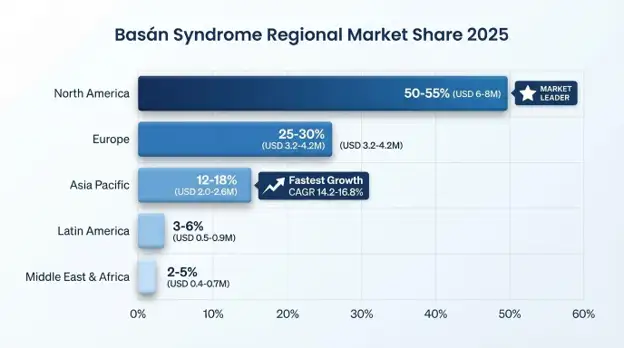
Europe is the second-largest Basán syndrome market, amounting to about USD 3.2-4.2 million in 2025, with its share in the global market standing at 25-30%, and further growing with the CAGR of 9.8% during 2025-2034. Such market dynamics is fostered by the work of the European Reference Network for Genetic Skin Disorders (ERN-Skin), which has helped optimize diagnostics and provide access to specialists in member countries. The largest numbers of diagnosed patients are in Germany, the UK, and France, there are state-of-the-art genomic testing, dermatological clinics specializing in rare diseases and coverage of genetic diagnostics costs by health insurance systems. Research into hereditary dermatological diseases is conducted by academic institutions located in Berlin, Munich, Paris, and Toulouse, with Genomics England promoting rare diseases testing in the whole country. However, despite diagnostic problems in Southern and Eastern Europe, genomic sequencing, research projects funded by the EU, and telemedicine rare disease networks should help identify more patients.
Asia-Pacific region has been identified as the fastest-growing market for Basán syndrome in terms of CAGR between 14.2% to 16.8% up to 2034, fueled by advanced genetic diagnosis and presence of several underdiagnosed patients. Japan and South Korea dominate in the region due to advanced dermatogenomics facilities, specialized clinics for rare diseases, and national insurance coverage for genetic testing.
There is significant growth potential in China owing to increasing investments in genomic sequencing and precision medicines to provide wider availability in metropolitan cities, but most of the patients suffering from the disease are still not diagnosed. India is another promising country due to a large population and provision of genetic testing in private healthcare facilities in addition to growing availability of diagnostic facilities, while There is very limited access to genetic testing in public healthcare facilities. Australasia has been providing strong referral network for rare dermatological conditions. The regional market is forecasted to be valued at USD 2.0-2.6 million in 2026 and is projected to achieve USD 6.8-9.2 million by 2034.
Latin America, Middle East, and Africa (LAMEA) contribute to 5-10% of total Basán syndrome diagnosed cases owing to lack of genetic testing and disease awareness. The largest number of patients are diagnosed in Brazil, with the presence of specialized academic centers in São Paulo and Rio de Janeiro, while Mexico and Argentina have only a few reported cases. Mostly across Latin American countries, patients are treated symptomatically rather than receiving molecular diagnosis. In Middle East countries such as United Arab Emirates and Saudi Arabia, there are continuous efforts towards enhancing genomics medicine as well as specialized dermatology clinics, which would help with better testing opportunities. Many countries in Africa lack adequate infrastructure and diagnosis. The market size of LAMEA is estimated to be worth USD 1.2–1.6 million by 2026 and is expected to grow to USD 2.8–4.2 million by 2034.
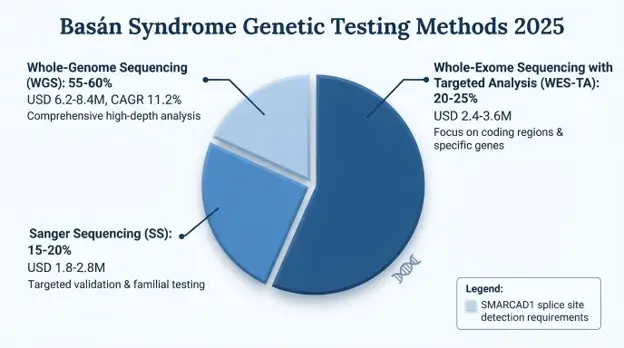
Whole-Genome Sequencing is considered the most effective method for diagnosing Basán syndrome, contributing 55-60% to all tests performed with a predicted value of the market ranging from USD 6.2 to 8.4 million in 2025. WGS is expected to demonstrate a CAGR of 11.2% up to 2034 owing to the ability to identify noncoding variants of the splice site of SMARCAD1 gene that remain undetected during usual exome sequencing. Whole-exome sequencing with SMARCAD1-targeted analysis constitutes 20-25% of all tests conducted providing an efficient trade-off between efficiency and cost of the test. Sanger sequencing makes up 15-20% of all tests, primarily used for verification of familial variants or when the WGS procedure is not available.
Basán syndrome with syndromic presentation is the most common form of Basán syndrome that occurs in 65% to 75% of cases, resulting in market value of USD 8.2 – 11.2 million. Individuals suffer from the following symptoms: adermatoglyphia, palmoplantar keratoderma, nail dystrophy, digit contractures, and hypohidrosis. Isolated adermatoglyphia occurs in 25% to 35% of patients, and its market value is around USD 3.2 – 4.8 million. The patients do not have fingerprint ridge patterns; however, they show only minor manifestations, so the disease is diagnosed later on the basis of biometric identification problems when the patient needs to find employment, travel abroad, or make legal documents.
Management of palmoplantar keratoderma accounts for approximately USD 5.4-7.2 million market value, which is the application of medical resources in terms of treatment, diagnosis, and rehabilitation for patients.
Management of Nail Dystrophy takes up approximately USD 2.1-3.2 million of market value, which is the special care of nails, onychology consultations, and monitoring of nail plates.
Acral Blistering and Management of Skin Lesions Caused by Trauma takes up approximately USD 1.8-2.6 million of market value.
Genetic Counseling Centers and Services: This niche market segment represents about 40-45% of market value, USD 5.4-7.2 million in 2025, and involves full-service evaluations, coordination of genetic testing and family counseling. Growth has been fueled by expansion of genetic counseling training programs and greater insurance coverage of genetic counseling services in North America and Europe.
Dermatology Clinics and Specialty Practices: Skin and nail symptoms can be managed and monitored in dermatology clinics and specialty practices, which contribute around 35-40% of the market value (USD 4.8-6.4 million). Increasing awareness among dermatologists and the formation of specialized dermatogenomics clinics in academic centers are contributing to the growth of the market.Growth in the market is driven by the increasing awareness of dermatologists and the establishment of specialized dermatogenomics clinics in academic centers.
Research Institutions and Biobanking Programs: Academic medical centers offering natural history studies, biobanking, and clinical trial recruitment account for about 10-15% of market value (USD 1.4-2.0 million) and include expansion of international rare disease research networks and development of patient registries.
Emerging digital health providers such as genetic counseling, dermatological consultation and patient monitoring for geographically dispersed patients, are valued at 5-10% of the market value (USD 0.7-1.4 million) and are seeing significant growth as digital health infrastructure grows.
The Basán syndrome market is highly fragmented, due to ultra-high rarity of the condition and lack of specific therapies for the disease. The market is mainly driven by diagnostics, genetic counseling, dermatologic services and academic research rather than any form of pharmaceutical competition. Companies that offer diagnostic services such as Invitae, Genomics England, Quest Diagnostics and LabCorp engage in the competition based on comprehensive SMARCAD1 testing in rare genodermatosis panels, through speed of processing, availability, prices and genetic counseling services. Genetic counselors and academic medical institutions concentrate on family risk assessment, diagnosis and patient management. Skin health companies offering topical therapies such as retinoids, keratolytics and emollients target patients through off-label symptomatic treatment of the condition, without having specific products indicated for Basán Syndrome. At the same time, patient registries and research institutions like NORD and ERN-Skin boost the market through their activities.
March 2025: Genomics England announced expansion of its rare genetic skin disease panels to include comprehensive SMARCAD1 sequencing, improving diagnostic access across UK healthcare system and facilitating patient identification.
February 2025: Multiple academic dermatology centers announced enrollment expansion for Basán syndrome natural history studies as part of broader rare genodermatosis research initiatives, improving clinical characterization and quality-of-life assessment methodologies.
January 2025: Invitae released data demonstrating 34% increase in Basán syndrome diagnoses over 2024, attributable to enhanced provider awareness and improved panel accessibility through telehealth ordering.
December 2024: International rare disease conference presentations from China, Japan, and India documented emerging Basán syndrome cases, highlighting diagnostic expansion in Asia-Pacific region and establishing foundational literature for these populations.
November 2024: Patient advocacy organizations including NORD reported 67% increase in Basán syndrome family inquiries and support network engagement, reflecting improved awareness and diagnostic recognition.
You'll get the sample you asked for by email. Remember to check your spam folder as well. If you have any further questions or require additional assistance, feel free to let us know via-
+1 724 648 0810 +91 976 407 9503 sales@intellectualmarketinsights.com
23 Jul 2026
Intellectual Market Insights Research © 2026. All rights reserved.