Share this link via:

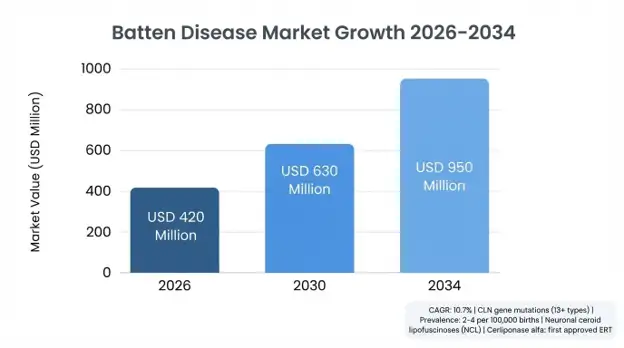
The global Batten disease market was valued at USD 380 million in 2025 and is estimated to reach USD 420 million in 2026, expanding to approximately USD 950 million by 2034, growing at a CAGR of 10.7% during the forecast period (2026-2034).
Batten disease is the term historically used for the most common type of childhood form of a series of inherited diseases characterized by the progressive death of brain cells referred to generally as the neuronal ceroid lipofuscinoses (NCLs). Batten disease occurs as a result of mutations in one of at least thirteen CLN genes that code for proteins which play vital roles in the proper functioning of lysosomes and their activities, including protein transport within the cell and autophagy. Due to the lack of this important cellular machinery, there is an accumulation of autofluorescent pigments, lipopigments or ceroid-lipofuscin, in lysosomes of the affected nerve cells. This results in cell damage and cell death, giving rise to a range of symptoms such as epileptic seizures that cannot be controlled with drugs, visual disturbances ending in blindness, impaired motor control, mental deterioration, and changes in behaviour.
The classification of NCL into subtypes can be carried out based on the age of symptom appearance and gene mutation. The infantile type of NCL (CLN1, PPT1-deficient) and the late-infantile type of NCL (CLN2, TPP1-deficient) are represented within the first years of patients' lives and develop most rapidly. The juvenile type of NCL is the most common one in the population of Western and Northern Europe and develops more slowly up to the second and third decade of life. Rare forms of NCL, including CLN4–CLN8 and others, represent smaller but clinically significant groups of patients lacking therapeutic options.
The commercial outlook for the Batten disease market was dramatically altered by the regulatory approval of cerliponase alfa, an enzyme replacement therapy for recombinant human tripeptidyl peptidase-1 protein designed to treat CLN2 disease. Delivered every other week via infusion into the cerebrospinal fluid via an intracerebroventricular reservoir device, this treatment became the first demonstration of efficacy of a pharmacologic agent to delay the progression of ambulatory and language skills in NCL and remains a cornerstone of market revenues worldwide. The commercial and clinical success of this product has spurred significant investments into adeno-associated viral vector-based gene therapies in CLN1, CLN3, CLN5, CLN6, and CLN7 disease, all of which are in early to mid-stage clinical development.
Although the global prevalence of all forms of NCLs taken together is approximately 2-4 in 100,000 live births, with higher incidences seen in certain founder populations in Newfoundland, Finland, and Northern Europe, the business will not make money based on the size of the patient population. The company will succeed due to the combination of high orphan-drug prices, extended market exclusivity periods based on regulatory support, patient advocacy-backed natural history databases and registries, and the development of treatments such as gene and enzyme therapies to create a set of treatments for a group of lethal diseases that have never been successfully managed before.
| Report Coverage | Details |
|---|---|
| Base Year | 2025 |
| Base Year Value | USD 380 Million |
| Forecast Value | USD 950 million |
| CAGR | 10.7% |
| Forecast Period | 2025-2034 |
| Historical Data | 2022-2025 |
| Largest Market | North America |
| Fastest Growing Market | Europe |
| Segments Covered | By Disease Type, Therapy Type, Route of Administration, Diagnosis, End-User |
| Region Covered | North America, Europe, Asia Pacific, Middle East & Africa, Latin America |
| Countries Covered | US, Canada, Mexico, UK, Germany, France, Italy, Netherlands, Finland, Sweden, China, Japan, India, Australia, South Korea, Brazil, UAE, Saudi Arabia |
| Key Market Playes | BioMarin Pharmaceutical, Amicus Therapeutics, Neurogene, REGENXBIO, Abeona Therapeutics, Taysha Gene Therapies, Ultragenyx Pharmaceutical |
Get more details on this report - Request Free Sample
The factor which plays the key role in market expansion is the marked progress made in terms of diagnosis, which is possible due to the next-generation sequencing panels for all known CLN genes. In fact, the diagnosis of Batten disease has been accompanied by an extended diagnostic journey, since it was common practice to mistakenly diagnose kids suffering from idiopathic epilepsy or developmental disorders with an NCL subtype. The increased application of whole-exome and gene-panel tests within paediatric neurological and ophthalmological offices, along with cascade testing of siblings within families with known mutations, has contributed to reducing this time.
Since Batten disease is monogenetic and confined to the CNS, it becomes a favorable candidate for gene supplementation approaches based on the delivery of adeno-associated viral vectors. Regulatory systems that provide orphan drug status, market exclusivity periods, tax incentives, and fast track or priority reviews significantly mitigate the unusually high development costs per patient in ultrarare diseases. Cerliponase alfa has provided clinical evidence that builds confidence in the application of CNS-targeted biologicals for NCL variants, thereby enabling many gene therapy programs to progress through the early clinical stages.
Each subtype of CLN has a very low global prevalence, limiting the total number of patients available in each nation, making it difficult to enroll enough patients in trials that will be large enough to achieve statistically significant results. Trial sponsors will need to turn to natural history comparisons and multinational patient registries to meet regulatory requirements.
The need for delivery of existing or novel disease-modifying agents to cerebrospinal fluid or brain tissue in the form of intracerebroventricular or intrathecal administration through surgically placed pumps presents significant barriers to care in the form of need for neurosurgical intervention, sophisticated pump equipment, and periodic visits to select centers, along with annual expenses of hundreds of thousands of dollars for approved enzyme replacement therapy treatment per patient.
The greatest opportunity is in applying the single-administration AAV-based gene therapy platforms developed for CLN2 to treat CLN1, CLN3, CLN5, CLN6, and CLN7, all of which have no approved treatment available to date. Since these indications have similar CNS-limited monogenic disease etiology, vector-based platforms tested in one indication can usually be used to develop platforms for other indications by just switching the promoter and cargo, thus minimizing development costs and creating multi-indication portfolio of programs for sponsors. Even if one of those treatments were approved, it would bring significant revenue with its million-dollar per patient pricing based on the precedent set by other single-administration gene therapies of the CNS.
The use of intrathecal or cisterna magna delivery approaches and vector tropism optimization has become a common trend to avoid using open neurosurgical implantation, thus making the patient population broader and lowering risks of procedures. At the same time, there is a validation of CSF or blood biomarkers, such as neurofilament light chain, as well as brain imaging quantitation, which may be used as disease progression markers and can help shorten the period of the clinical trial.
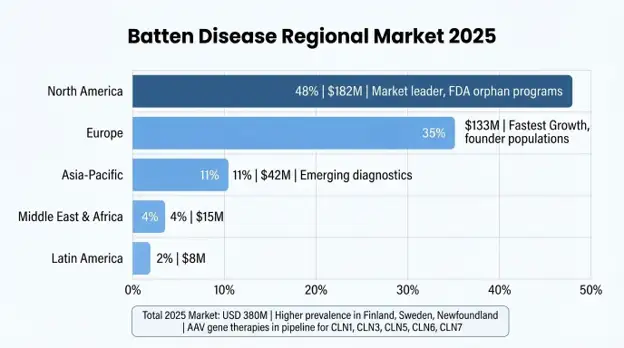
North America is the largest regional market due to well-established reimbursement procedures of cerliponase alfa from Medicaid and commercial payers; high density of specialised paediatric neurology and gene therapy research facilities; FDA schemes like breakthrough therapy and orphan drug designation that have been used to advance various Batten disease programmes; and the largest number of US-based global clinical trials for NCL gene therapies. The US has the most advanced natural history registry framework.
Europe is experiencing fast growth because of the rare disease infrastructure in Europe through the European Reference Networks, unified orphan drugs incentives with market exclusivity, and unusually high prevalence of NCL in founder populations in Finland, Sweden, and some parts of the United Kingdom. The health technology assessment process in Europe and increased use of conditional marketing authorizations in Europe for rare neurological disorders in children are facilitating faster access to treatments.
Asia Pacific, Latin America, and Middle East & Africa are still at the early stage due to the lack of genetic testing capacity, misdiagnosed cases, and non-affordability of expensive treatment outside the major urban centers. Japan and Australia have taken the lead in their regions through being part of multinational studies and reimbursement of orphan drugs, while awareness building and partnerships with world excellence centers are slowly leading to proper case identification in China, India, and Gulf countries.
The CLN3 type of disease forms the largest portion due to its prevalence among all NCL types as well as having the largest patient population that requires new treatments. The CLN2 type of disease forms the second largest segment and is driven wholly by revenues generated through commercial sales of cerliponase alfa, the only drug for any type of NCL disease. Other NCL types such as CLN1, CLN5, CLN6, CLN7, and CLN8 collectively form the smallest portion of revenues but are likely to make a larger contribution in the future.
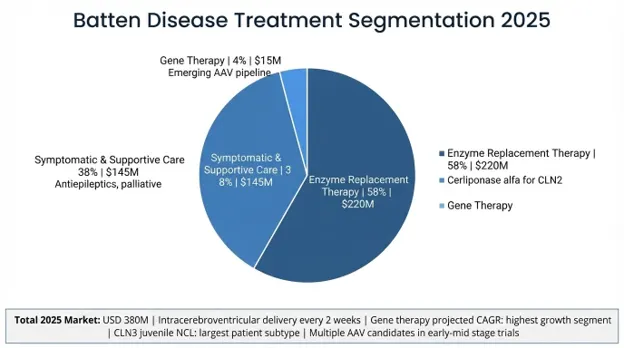
Revenues are dominated by enzyme replacement therapy now, fuelled by the patent exclusivity and entrenched presence of cerliponase alfa in CLN2. Supportive treatments, which consist of antiepileptic and antispastic drugs and palliative care, are the second biggest category of treatments and cater to all the patients irrespective of their access to disease-modifying treatments. Gene and cell therapies are not generating a lot of revenue now but are expected to grow the most in the next two decades.
Academic medical centres as well as speciality paediatric neurology centres are the leading users of the technology due to their specialisation in NCL diagnosis, the availability of neurosurgeons who can implant intracerebroventricular devices, and their involvement in clinical trials. The other users include hospitals having more extensive neurology departments and home health care companies providing palliative and supportive care services.
The market for Batten disease is highly concentrated, considering that it involves an ultra-rare patient base and unique expertise needed in diagnosing and treating the disease. The main player in the commercialisation of the disease is the BioMarin Pharmaceutical company with its drug, cerliponase alfa, while a few biotech firms and industry-academia collaborations compete for other CLN subtypes in gene therapies. Competitive distinction is based on capability of reducing neurodegeneration in validated scales, safety in delivering genes to the CNS, long-lasting expression of the gene, and registry collaboration for regulatory and payer discussions.
May 2025: Theranexus reported favorable real-world evidence for Batten-1 (miglustat) in CLN3 Batten disease patients, showing visual function preservation and validating its move forward into a pivotal Phase III clinical trial.
May 2025: NICE, published draft guide to allow continued use of Brineura (cerliponase alfa) for patients with CLN2 Batten disease via an agreement with BioMarin Pharmaceutical.
April 2025: CLN-301 AAV9 gene therapy for CLN3 Batten disease was progressed by Alcyone Therapeutics with positive phase I/II clinical trials that exhibited promising long-term safety and functional data.
May 2025: Neurogene Inc. made advances with clinical development of NGN-101, a gene therapy for CLN5 Batten disease, with further development of gene replacement approaches for rare neuronal ceroid lipofuscinoses.
You'll get the sample you asked for by email. Remember to check your spam folder as well. If you have any further questions or require additional assistance, feel free to let us know via-
+1 724 648 0810 +91 976 407 9503 sales@intellectualmarketinsights.com
22 Aug 2026
Intellectual Market Insights Research © 2026. All rights reserved.