Share this link via:

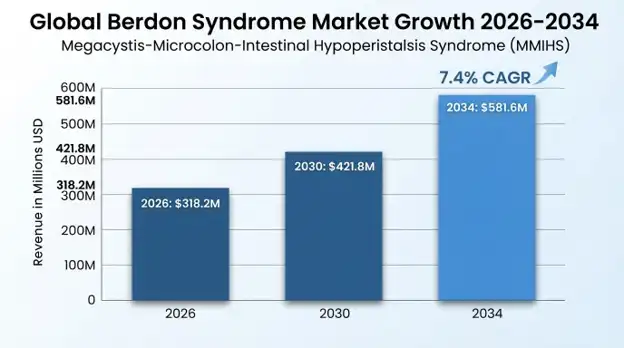
The global Berdon Syndrome market was estimated at USD 287.4 million in 2025 and is projected to reach USD 318.2 million in 2026 and further expand to USD 581.6 million by 2034, growing at a CAGR of 7.4% during the forecast period (2026-2034). Berdon syndrome, which is scientifically termed megacystis microcolon intestinal hypoperistalsis syndrome (MMIHS) is a rare congenital disorder characterized by severe gastrointestinal and urogenital dysmotility that requires a holistic approach for treatment throughout life.
The symptoms of Berdon’s syndrome include a fatal triad of manifestations consisting of megacystis (bladder distension caused by smooth muscle malfunctioning), microcolon (narrowing of the large intestine owing to insufficient functioning of the smooth muscles), and hypoperistalsis (lack or reduced intestinal contraction). The condition develops because of genetic defects in the genes that encode smooth muscle protein, with the ACTG2 gene being the most affected one. Other genetic sources of the problem may include MYH11, MYLK, LMOD1, and MYL9 genes.
The market encompasses the complete therapeutic ecosystem, including parenteral nutrition support system, drugs, devices for managing the urination process, diagnostic imaging systems, clinical coordination and surgeries that collectively keep the organs functional and ensure survival of the patients. Management of the disorder requires therapeutic involvement for several decades as many patients require lifelong parenteral nutrition since they cannot absorb the nutrition from their GI tract and hence are categorized as ultra-rare diseases.
| Report Coverage | Details |
|---|---|
| Base Year | 2025 |
| Base Year Value | USD 287.4 Million |
| Forecast Value | USD 581.6 Million |
| CAGR | 7.4% |
| Forecast Period | 2025-2034 |
| Historical Data | 2022-2025 |
| Largest Market | North America |
| Fastest Growing Market | Asia Pacific |
| Segments Covered | By Product Type, Technology, Formulation, Disease Management, Treatment Type, End-User |
| Region Covered | North America, Europe, Asia Pacific, Middle East & Africa, Latin America |
| Countries Covered | US, Canada, Mexico, UK, Germany, France, Italy, Spain, Netherlands, China, Japan, India, Australia, South Korea, Brazil, Argentina, UAE, Saudi Arabia, South Africa |
| Key Market Playes | Takeda Pharmaceutical, Nestlé Health Science, Fresenius Kabi, Baxter International, B. Braun, Clarion Pharmaceuticals, Hospital Specialties Corporation |
Get more details on this report - Request Free Sample
The global market for Berdon syndrome has received considerable boosts due to revolutionary innovations in the field of genetic test procedures that have helped make the diagnosis of diseases and family management shift from late diagnoses in the past that were diagnosed when individuals were babies to today’s prenatal diagnosis which can help with planning interventions and counselling parents before birth. With the creation of genomic sequencing devices such as next-generation sequencing, it has been possible to identify the genes such as ACTG2 and MYH11 associated with Berdon syndrome.
Fetal ultrasound examination to detect megacystis along with specific anomalies in the urinary and gastrointestinal system can currently enable the detection of about 25% of cases in the prenatal period. Such a development has important consequences for clinical management, including intrauterine counseling of patients, planning delivery at quaternary care facilities, preparation of pediatric surgery and gastroenterology teams, and pre-implementation of parenteral nutrition systems.
The market expands due to genetic testing becoming routine practice in pediatric gastroenterology and obstetric settings, and health-care organizations implementing necessary infrastructure for such testing. The expenditure made for such diagnostic tools shows recognition that timely diagnosis significantly decreases the likelihood of developing severe complications, eliminates the prolonged process of diagnosing the condition (which consumes much health-care resources), and allows building evidence on how the condition should be managed initially.
The market for Berdon syndrome is marked by continuous growth due to increased clinical awareness by gastroenterologists, pediatric surgeons, and urologists on disease diagnosis, presentation patterns, and appropriate management approaches. The reason why Berdon syndrome was traditionally underdiagnosed was that its typical characteristics were associated with other prevalent disorders such as Hirschsprung disease, bowel obstruction, and neurogenic bladder disorder.
Modern medical education programs, publications in scientific journals, and training courses have increased clinicians' knowledge about the diagnostic criteria of Berdon syndrome, thus enabling faster diagnosis and referral to specialized care centers capable of offering complete treatment. Patient advocacy groups and rare diseases networks have become very popular in developed countries, providing affected families with a platform where they can share their experiences, participate in clinical trials, and raise funds and support for research and innovation.
MMIHS Foundation and patient support organizations in North America and Europe have created patient registries featuring more than 100 known cases worldwide. Affected patients can now be used in clinical research and retrospective outcome analysis as well as in the development of clinical trials. Such patient advocacy groups have improved health literacy of affected families while at the same time forcing pharmaceutical and medical device companies to view Berdon syndrome as a potential target for therapy development.
The primary restraint is the extremely low incidence of Berdon syndrome of the syndrome, which has been estimated to be between 230 and 450 cases in worldwide medical literature by 2025 and prevalence rate of fewer than 1-5 cases per million live births worldwide. The highly limited number of patients presents great challenges for companies interested in developing medicines and devices related to the condition due to the very limited market size that will not bring enough revenue to cover more than USD 100-250 million development expenses.
The limited availability of patients makes it difficult to design any kind of clinical trial because obtaining prospective randomized controlled trials with sufficient sample sizes required for regulatory approvals is difficult. It is necessary for companies to opt for compassionate use trials, single-arm efficacy trials, and retrospective studies that are not as valuable to regulatory authorities as the gold standard randomized controlled trials. The lack of sufficient numbers of patients limits the scope of pivotal trials and prolongs development phases.
Reimbursement problems intensify when insurance companies consider highly specialized technologies that have been created for extremely rare conditions based on evidence gathered through retrospective studies involving relatively small patient numbers. The problem is even more pronounced when one considers how difficult it is to justify the purchase of Berdon syndrome-specific technologies given such evidence.
Market opportunities abound in the development of drugs which can target the underlying physiopathology involved in Berdon syndrome by increasing smooth muscle contractility, facilitating compensation of the dysmotile tissues, or preventing secondary effects of diminished motility of the gastro-intestinal tract. Current treatment for Berdon syndrome is primarily supportive.
Pharmacological targets identified through research include substances that increase the efficiency of actin polymerization in smooth muscle, improve myosin-actin interaction efficiency, interfere with calcium signaling in smooth muscle contraction pathway and facilitate compensatory neural processes that may restore motility even in the presence of smooth muscle dysfunction on a genetic level. Results from preclinical trials using animal models and retrospective study of patient response to various pharmacological compounds provide theoretical grounds for the implementation of clinical trial programs.
The creation of such pharmacological breakthroughs would help fulfill an immense unmet need in medicine, since even slight improvement in gastrointestinal motility would decrease dependence on parenteral nutrition and enhance the absorption of enteral nutrition, greatly improving the quality of life. Biotech companies focused on treating genetic disorders and rare gastroenterological illnesses are ideal candidates to undertake such programs.
The Berdon Syndrome market is undergoing a lot of change through the creation of multidisciplinary centers of excellence in which all the various aspects of managing patients with the condition are coordinated in gastroenterology, pediatric surgery, urology, nutrition, infectious diseases, and genetics. This creates centers that bring together the patient base for research and clinical trials.
Through the MMIHS foundation, there has been encouragement for the formation of informal networks linking families affected by the condition to specialists who have experience managing the condition. North American centers, such as the leading pediatric gastroenterology departments at medical facilities in Boston, New York, Los Angeles, and Toronto, have formed themselves into specialty centers where cases of the illness are referred due to their complexity. These entities have developed disease registries, protocols for treatment, and trained other physicians on managing patients with Berdon syndrome.
Such developments are creating opportunities in terms of recognition of the disease, standardizing the treatment, and conducting outcome-based research, which were not possible when patients of the disease were isolated in dispersed healthcare facilities. There are now possibilities for medical device manufacturers of new solutions to tap into the Berdon syndrome market.
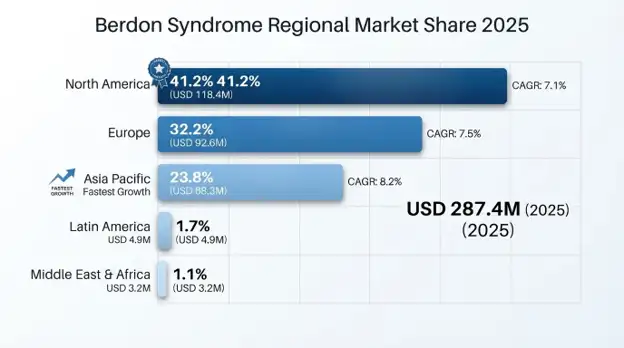
North America led the Berdon syndrome market with a market value of USD 118.4 million in 2025 and has a compounded annual growth rate projection of 7.1% up to 2034. North America’s dominance is attributed to the rare disease expertise found in top-tier academic medical institutions, good coverage of specialized pediatric gastroenterology care, established parenteral nutrition systems, and advanced surgical and medical treatment facilities that sustain patient life.
The United States accounts for 79% of the regional market due to Medicare insurance that helps in provision of specialized care, access to home infusion nurse services, as well as patient advocates’ organizations such as the MMIHS Foundation that promote awareness of disease and support medical research. The rate of board-certified pediatric gastroenterologists is above 1.2 per 100,000 children living in the major metropolitan areas, thus providing networks of specialists for people with the disease.
Canada has similar densities of specialized centers and accessibility to health care facilities with the help of pediatric gastroenterology programs at McGill University and University of Toronto as regional Berdon syndrome knowledge centers. The two nations have developed the infrastructure for home parenteral nutrition programs.
Europe holds the second-largest market share, which is expected to reach $92.6 million by 2025 with an estimated CAGR of 7.5% up to 2034. This is attributed to the presence of extensive rare disease identification mechanisms, especially in the healthcare setup in Western Europe, where patients with ultra-rare diseases that occur approximately one case per 100,000 people have coordinated care management.
Germany, France, and United Kingdom have developed national rare disease policies and reference networks, particularly aimed at the treatment of Berdon syndrome among other conditions. The establishment of ERNs through EU regulation has facilitated virtual collaboration for rare diseases and helped to aggregate cases from smaller nations to conduct research and quality improvement efforts.
Major European centers in pediatric surgery and gastroenterology in London, Paris, and Berlin have come to prominence as centers of expertise for Berdon syndrome within their respective regions. Major pharmaceutical companies in Europe including Takeda and Recordati have created departments dedicated to rare disease treatments to explore opportunities for developing supportive therapies for Berdon syndrome.
The Asia Pacific region will show the fastest growth in the market with the compounded annual growth rate of 8.2% for the forecast period up to 2034, even though the market value is less with an amount of USD 68.3 million in 2025. Growth in the region is driven by increased availability of genetic testing facilities, improved healthcare facilities in children and gastroenterology fields.
Japan is ahead in the regional growth in terms of its highly developed neonatal intensive care infrastructure and by being one of the first regions to utilize the next-generation sequencing in its pediatric population. Thanks to its national rare disease registry and government funding for rare diseases research, Japan has been able to identify 12-18 reported cases of Berdon syndrome.
China is growing rapidly due to the development of pediatric gastroenterology sub-specialties, the establishment of large academic medical centers in major cities, and the use of advanced genetic testing in its tertiary care facilities. Nevertheless, the lack of reimbursement for long-term parenteral nutrition remains a significant barrier.
India represents emerging market opportunity by virtue of establishing specialty healthcare networks for pediatrics in major cities such as Delhi and Mumbai, health insurance schemes by the government that can be inclusive of Berdon treatment, and heightened awareness of medical literature among gastroenterologists. High out-of-pocket expenditures and lack of home infusion facilities pose constraints to market expansion in present times.
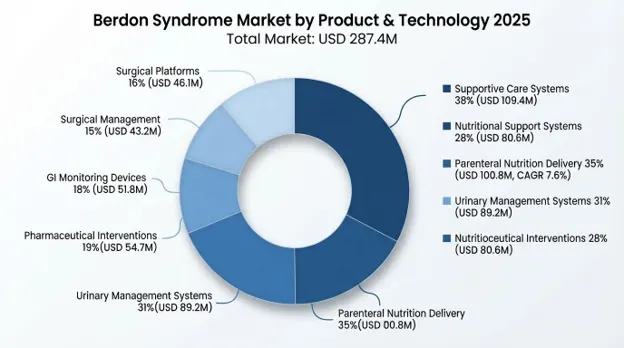
The market for Berdon syndrome is occupied by supportive care systems, which hold a 38% share of the market at USD 109.4 million in 2025. The supportive care systems include parenteral nutrition products, hardware components of the delivery system, home infusion products, and chronic disease management products that are important infrastructures for disease management.
The nutritional support systems occupy 28% share of the market at USD 80.6 million in 2025. They include special enteral nutrition products that may be used for partial enteral nutrition supplementation for some patients, micronutrients supplementation programs, and nutrition assessment devices. Growth in the market is due to the growing recognition of the fact that even partial tolerability of enteral nutrition is beneficial for gut function through intestinal barrier protection.
Pharmaceutical Interventions have a market share of 19% with an estimated value of USD 54.7 million in 2025, and this consists of medicines used to treat complications arising due to the disease, like gastroesophageal reflux, infections from bacterial overgrowth in the dysmotility of intestinal tracts, chronic pain, and neuropsychiatric disorders that come with the disease.
The Surgical Management Systems have a market share of 15% valued at USD 43.2 million in 2025, and this consists of surgical equipment, diversion devices for urinary problems, and other surgical systems.
Parenteral Nutrition Delivery Systems hold the largest market share (35%), valued at USD 100.8 million by 2025, with CAGR of 7.6% until 2034. The technology segment is leading in providing care for Berdon syndrome because the root cause of the syndrome involves intestinal dysfunction which makes it impossible for oral/enteral nutrition absorption. The technology segment also has the advantage of clinical infrastructure, strong reimbursements, and technological innovations including advanced infusion pump technology, portable infusion system, and cyclic infusion protocols.
The second leading segment with 31% share worth USD 89.2 million by 2025 is the Urinary Management Systems technology segment. It helps to meet the demand of urinary catheter management of Berdon syndrome patients due to bladder dysfunction in most of the cases of Berdon syndrome, who require long-term catheterization.
Gastrointestinal Monitoring Devices are expected to hold 18% market share by accounting for USD 51.8 million in 2025 and include imaging techniques, studies on motility patterns, and innovative sensors for gastrointestinal monitoring.
Surgical Intervention Platforms have a market share of 16% in 2025, generating USD 46.1 million and including special instruments and devices to aid surgery in acute complications and elective diversions.
Gastrointestinal Management leads in indication segments, with USD 128.4 million in 2025 and forecasted 7.5% compound annual growth rate up to 2034, becoming the largest therapeutic market segment. Gastrointestinal Management is defined as management of dysmotility of the intestinal tract, covering consequences of impaired intestinal motility, such as pseudo-obstruction, overgrowth of bacteria, malnutrition, and nutrition support system.
Urinary Management will have revenue of USD 87.6 million in 2025 and compound annual growth rate of 7.2% up to 2034. Urinary Management covers the most serious symptom of Berdon syndrome megacystis, urinary retention, requiring continuous catheterization and infection prevention.
Nutrition Management is projected to be valued at USD 156.8 million in 2025, growing at a CAGR of 7.8%. Nutrition Management is the biggest segment in terms of value. Nutrition Management includes the following categories Parenteral nutrition support, Enteral nutrition supplementation when tolerated, Micronutrient optimization, Metabolic monitoring for nutrition adequacy.
Hospitals & Clinics is the largest end-user segment with a market share of 54% and value worth USD 155.3 million in 2025. This includes tertiary care pediatric hospitals, gastroenterology clinics, and surgical hospitals offering emergency treatments, diagnostics, and surgery procedures. End-user segment gains benefit through reimbursement of services offered in such facilities along with presence of expertise in academic medical centers.
Specialty Medical Centers have a market share of 26% worth USD 74.8 million by 2025 at a CAGR of 8.1%. It is the fastest growing end-user segment. Such specialized medical centers prove to be efficient in their operations due to focused expertise and well-managed services.
Home Healthcare will have 15% of market share worth USD 43.2 million with CAGR of 7.9% in 2025. This growing sector represents emerging industry trends of management of chronic diseases at home to enhance quality of life without burdening healthcare facilities by offering parenteral nutrition support to chronically ill patients.
Diagnostic Centers represent 5% of the market share of USD 14.4 million in 2025, offering genetic testing, advanced imaging, and motility studies for diagnosis and monitoring of diseases.
The market for Berdon syndrome products globally demonstrates a low to moderate level of market concentration due to high level of fragmentation within several different therapy classes comprising manufacturers of parenteral nutrition products, specialist pharmaceuticals, home infusion services, and companies producing devices used for urine management. None of the companies controls full treatment process for Berdon syndrome due to its ultra-rarity and the need for diverse types of equipment.
Market leaders include Takeda Pharmaceutical (19-23% market share), Nestlé Health Science (16-20% market share), Fresenius Kabi (12-16% market share), Baxter International (9-13% market share), B. Braun (7-11% market share), and many smaller regional producers of special equipment. Differentiation between competing companies is based on the quality of parenteral nutrition products, the quality of infusion devices, home infusion nursing services, expertise in disease-specific management, and innovations in technologies.
Competitive forces include the entrance of biotech companies researching pharmaceutical interventions aimed at addressing smooth muscle problems and technology companies specializing in developing new ways to manage urinary and gastrointestinal issues. Academic medical centers have collaborated more often with industrial partners that have been researching new methods of dealing with Berdon syndrome.
June 2025: Nestlé Health Science has made new additions to its parenteral nutrition range, which is customized for the treatment of rare gastrointestinal diseases in children such as pseudo-obstruction syndromes. This new range of products offers improved micronutrient composition that can help address the deficiencies seen in chronic parenteral nutrition patients.
April 2025: Takeda Pharmaceutical has entered a formal collaboration with the Boston Children's Hospital for the study and development of treatments for Berdon syndrome and other gastrointestinal motility diseases. The company will invest USD 12 million towards research up until 2028.
February 2025: Fresenius Kabi obtained FDA approval for a new infusion pump featuring electronic monitoring and alerting systems that help minimize infection complications for people suffering from chronic parenteral nutrition due to Berdon syndrome.
December 2024: Clarion Pharmaceuticals embarked on Phase I/II clinical trial of its drug designed to modulate smooth muscle actin polymerization in a mouse model of Berdon syndrome, showing some success in improving gastrointestinal motility.
October 2024: Patient advocacy groups like MMIHS Foundation set up an official disease registry with electronic documentation involving more than 240 patients to conduct prospective studies and facilitate the process of developing pharmaceuticals needing clinical trials.
You'll get the sample you asked for by email. Remember to check your spam folder as well. If you have any further questions or require additional assistance, feel free to let us know via-
+1 724 648 0810 +91 976 407 9503 sales@intellectualmarketinsights.com
23 Jul 2026
Intellectual Market Insights Research © 2026. All rights reserved.