Share this link via:

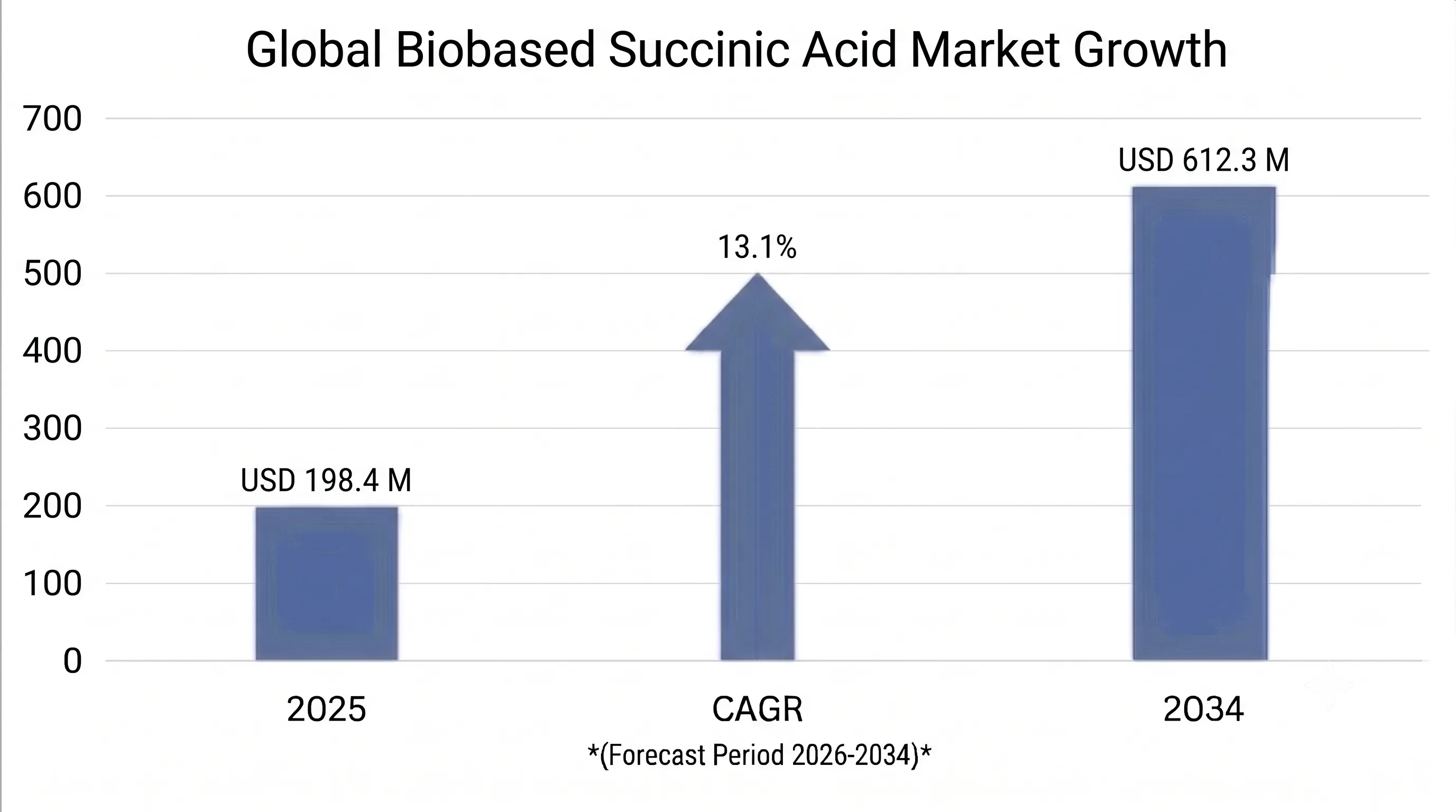
The global biobased succinic acid market was valued at USD 198.4 million in 2025 and is projected to reach USD 228.6 million in 2026, expanding to USD 612.3 million by 2034, growing at a CAGR of 13.1% during the forecast period (2026-2034).
Biobased succinic acid is a breakthrough 4-carbon dicarboxylic acid produced through advanced microbial fermentation of renewable biomass, and is an important platform chemical in the shift to sustainable chemical production. In contrast to the petrochemical succinic acid, which is produced by oxidation of maleic anhydride, biobased succinic acid production is based on the fermentation of glucose, sucrose or lignocellulosic hydrolysates with high molar yield of succinic acid (which is in excess of 1.2 mol/mol glucose) using highly engineered microorganisms, namely Actinobacillus succinogenes, Mannheimia succiniciproducens, Basfia succiniciproducens and recombinant Escherichia coli and Saccharomyces cerevisiae.
The chemical is located in a strategically important position in green chemistry, since it is a direct precursor for a large number of industrially important derivatives, such as 1,4-butanediol, tetrahydrofuran, gamma-butyrolactone, N-methyl-2-pyrrolidone, and polybutylene succinate, a thermoplastic that is fully biodegradable and is being used increasingly as a substitute for conventional petroleum-based polyesters in packaging and film applications in agriculture. A further advantage of the fermentation route is the inherent carbon capture, which is realized when succinic acid is produced in an anaerobic process, making the theoretical carbon capture approximately 0.37 tonnes of CO₂ per tonne of biobased succinic acid produced when compared with the petrochemical route.
Today, the use of continuous improvements in metabolic engineering, fermentation process optimization, and downstream purification technologies has brought the price of succinic acid in line with the price of petrochemical-made succinic acid. The production cost of biobased succinic acid is projected to drop from USD 2,800-3,200 per tonne in 2015 to USD 1,450-1,850 per tonne in 2025 for the leading commercial producers, making it close to the price of succinic acid produced from petroleum at USD 1,100-1,400 per tonne at crude oil price of USD 70-80 per barrel.
The commercial impact is not limited to chemical sales; it represents a complete sustainable material ecosystem, with a focus on delivering a range of eco-responsible materials, including renewable feed that is carbon-negative, and biodegradable end-products that respond to regulatory pressure on single-use plastics, corporate decarbonization targets, and consumer demand for sustainable goods, not just in the packaging, automotive and consumer goods sectors, but across the board.
| Report Coverage | Details |
|---|---|
| Base Year | 2025 |
| Base Year Value | USD 198.4 Million |
| Forecast Value | USD 612.3 Million |
| CAGR | 13.1% |
| Forecast Period | 2025-2034 |
| Historical Data | 2022-2025 |
| Largest Market | Europe |
| Fastest Growing Market | Asia Pacific |
| Segments Covered | By Application, Production Technology, Feedstock, End-Use Industry, Region |
| Region Covered | North America, Europe, Asia Pacific, Middle East & Africa, Latin America |
| Countries Covered | US, Canada, Germany, France, Netherlands, Belgium, UK, Italy, China, Japan, India, South Korea, Thailand, Brazil, Argentina, South Africa, UAE |
| Key Market Playes | Roquette Frères, BASF SE, Corbion N.V., Mitsubishi Chemical Corporation, Reverdia (DSM–Roquette JV), Succinity GmbH |
Get more details on this report - Request Free Sample
The key growth factor for the biobased succinic acid market is the rapid global transition toward biodegradable and compostable polymer systems in which succinic acid is used as a key monomer feedstock material that complies with stringent environmental regulations. In Europe, the Single-Use Plastics Directive (SUP) enforced by the member countries, and extended producer responsibility (EPR) systems in Germany, France and the Netherlands, have forced packaging companies to adjust their packaging portfolios with the help of certified compostable materials. Polybutylene succinate made from biobased succinic acid is technically proven and commercially viable for the flexible packaging sector, agricultural mulch film, cutlery and food service containers to comply with EN 13432 and ASTM D6400 standards for composability
In 2025, bioplastics production capacity worldwide is estimated to be 2.18 million tonnes, of which 64.3% is biodegradable. The consumption volume of polybutylene succinate and polybutylene succinate co adipate amounted to approximately 68,000 tons of succinic acid equivalent in 2025, increasing to exceed 210,000 tons by 2034, on account of growing consumption among packaging converters. The dedication towards sustainability in major consumer goods companies like Unilever, Nestlé, and Danone is behind the rise of additional 38% demand for succinic acid from 2024 to 2034 because these three companies have set a goal that their packaging material, which will be produced through succinic acid, will become either recyclable or compostable by 2030.
Government policies relating to biobased succinic acid are numerous and wide-ranging and include areas such as production subsidies, mandatory purchase requirements, carbon-based pricing policies, and constraints on the use of alternative petroleum-based products. The United States Bio preferred Program by USDA encourages federal agencies to use biobased succinic acid and its derivatives as preferred procurement products, and the provisions of the Inflation Reduction Act for domestic biomanufacturing have spurred investment in fermentation infrastructure. The European Green Deal and Chemicals Strategy for Sustainability make a clear statement on replacing hazardous petrochemicals with bio-based alternatives, which makes succinic acid a platform chemical in the European Commission's strategy for the bioeconomy.
The fermentation approach with negative carbon intensity (when renewable energy is used for fermentation and downstream processing) is favored by carbon pricing (e.g., EU ETS, developing carbon adjustment mechanisms) for petrochemical succinic acid production. LCA studies always show that the carbon credit value of the biobased succinic acid pathway is 60-75% lower than the maleic anhydride hydrogenation pathway, thus securing biobased succinic acid as the preferred supplier under corporate scope 3 emissions reduction initiatives.
Cost parity between biobased succinic acid and petrochemical alternatives has been achieved through continuous reductions in production costs because of metabolic engineering, optimization of the fermentation process, and improvements in the technology used for purification of the downstream product. This cost trajectory is driven by steadily increasing fermentation titters, rates, and yields of engineered production strains, which have reached succinic acid titters of over 100 g/L, productivities of more than 3.5 g/L/h and molar yields from glucose greater than 1.2 mol/mol.
The innovations of downstream processing, such as reactive extraction, electrodialysis and membrane-based separation technologies, have greatly reduced the costs associated with purification, which represented 40-60% of the total production cost, allowing succinic acid crystals to be recovered and purified to pharmaceutical and food-grade purity at a premium price. The integration of the biorefining process to produce succinic acid together with other added value products from the same biomass feedstock will enhance the process economics by having benefits of common infrastructure costs and diversification of revenue.
The most significant structural constraint facing the biobased succinic acid sector is its reliance on agricultural commodity feedstocks, such as corn starch, sucrose from sugarcane, and cassava starch, the prices of which are highly volatile and sensitive to weather, geopolitical events, energy costs affecting fertilizer prices, and the competition from food, feed and fuel industries. Prices of corn fluctuated by 40-65% over four years between 2020 and 2024, partly due to the COVID-19 pandemic, and had a significant effect on biobased succinic acid production costs because feedstock costs account for 35-55% of the biobased succinic acid production costs at commercial scale. Such price fluctuations can cause margin compression risk for producers that have long-term supply contracts for feeders with downstream customers and can prove difficult for financial modeling when investment decisions are made for new capacity.
With the growth in land use issues and discussions about food security around the world, there is a growing reputational and regulatory risk due to the food vs fuel vs chemicals demands on agricultural feedstocks. The increased pressure on producers to switch to second generation feedstocks like agricultural residues, municipal solid waste streams and specific energy crops on marginal land represents a transition to lignocellulosic feedstocks which also require extra pretreatment and hydrolysis steps adding USD 180-280 per tonne of production costs to the first-generation starch or sugar feedstocks.
Even though numerous advances have been made in technology, the scale of commercial biobased succinic acid production is still quite small, and is limited among a few producers, which creates a lack of reliability that is distressing to large volume industrial customers to make succinic acid their primary feedstock for high volume products. In 2025, global capacity to produce biobased succinic acid is estimated to be approximately 74,000 tonnes/year or less than 12% of the total succinic acid market demand of approximately 650,000 tonnes per year, while the production of succinic acid from petrochemicals will continue to dominate the industrial market.
Others, such as BioAmber, a first-generation commercial producer, exited commercial operations due to financial problems, indicating the fragility of first-generation commercial facilities that were operating below the critical points of technology learning curves. These market withdrawals caused supply shortages and led to greater customer reservations by relying on a single source for bio-based supplies, which delayed adoption of bio-based applications that require supply continuity over several years.
Applications of biobased succinic acid in pharmaceutical excipients, Active Pharmaceutical Ingredient (API) intermediates, and food additives represent high-value markets where it commands a significant price premium of USD 3,500–8,000 per tonneonne driven by the high purity requirements, regulatory compliance documentation, and supply chain traceability requirements to which biobased fermentation routes respond through controlled process environments and comprehensive quality management systems. The highest-margin application vertical for succinic acid is food, which is used as an acidulant and for flavoring; in pharmaceutical formulations, as an excipient in controlled-release products and as a pH-buffering component in parenteral drug products.
Food manufacturers are finding biobased succinic acid offers commercial differentiation opportunities to organic food acidulants versus other synthetic acidulants in response to consumer preference for clean labels and natural or biobased origin claims, assisting with premium product positioning and retailer product placement. Regulatory frameworks permit the market differentiation strategy of biobased origin labeling claims on approved food additives in Europe.
A major opportunity for succinic acid lies in integrating its bioproduction into multi-product biorefinery facilities and novel circular carbon systems where succinic acid is one of multiple products that can be generated using lignocellulosic biomass, sugar crops, or industrial waste streams. Succinic acid production could be integrated with sugar mills, starch plants, or ethanol refineries to have access to cheap sugar streams and shared utilities, incorporated with biodiesel plants to use crude glycerol as the raw material while making the overall biodiesel production more economical, and combined with CO₂ capture units where either process or external CO₂ streams are converted to succinate by carboxylation pathways.
Such approaches drastically reduce the cost of succinic acid production and ensure resilience in face of high fluctuations in the price of raw materials.
Biobased succinic acid production involves a shift in strategy in terms of the source of feedstocks for bioproduction from first generation to second generation feedstocks. First generation succinic acid feedstocks include the use of sugars produced from food crops whereas the second-generation feedstocks include the use of lignocellulosic biomass which may involve agricultural waste products like corn stover, sugarcane bagasse, and wheat straw. Second generation feedstocks may be advantageous because they offer cost savings as pretreatment and hydrolysis technologies are further developed.
MSW (municipal solid waste), as well as cheese whey lactose, citrus processing residues, and glycerol from biodiesel plants are being studied as economically viable fermentation feedstocks, which help to tackle waste management issues and offer carbon negative succinate acid production routes with superior environmental attributes.
The use of genome editing via CRISPR technology, pathway optimization through systems biology principles, and adaptive laboratory evolution is making possible the design of production strains that possess much better performance attributes compared to traditional strain improvement methods. It has been demonstrated that the titer of succinic acid produced by engineered E. coli strains reaches levels more than 146 g/L via fed-batch fermentations, while at the same time improving their resistance to inhibitory compounds in the hydrolysates of lignocellulose materials.
The implementation of artificial intelligence and machine learning for optimizing the fermentation process is leading to rapid discovery of the ideal operating conditions, medium formulation, and feeding methods that will enhance productivity while minimizing side-products, thus bringing about the process optimization period from year to month.
Europe holds the dominant regional market position, with market value standing at around USD 78.4 million in 2025, and it holds on to a projected CAGR of 12.8% throughout 2034. Such regional leadership stems from the continent’s extensive bioeconomy policy framework, strict regulations on the use of single-use plastics that encourage the use of biodegradable polymers, highly developed biotechnology industry in nations like the Netherlands, Germany, Belgium, and France, and sustainable practices among European chemical firms and packaging companies focusing on biobased raw material procurement.
Netherlands and Belgium have some of the most sophisticated biobased chemicals manufacturing plants owing to the already existing infrastructure for port transportation of biomass raw materials, experienced personnel in biochemical engineering, and their proximity to downstream manufacturers of polymers and specialty chemicals. There exist industrial clusters in the Netherlands such as Chemelot and those in Belgium where there are specialized facilities producing biobased chemicals.
Asia Pacific is projected to be the fastest-growing region, registering a CAGR of 14.7% through 2034 and a market size of USD 54.2 million in 2025. The growth in the region is fueled by China's significant polymers and chemicals industry using biobased materials under its stringent environmental policies, Japan's highly developed bioplastics industry that uses Polybutylene Succinate and other technologies, and India's growing bio-economy industry that benefits from various government policies aimed at fostering biomanufacturing capabilities within the country. The Chinese 14th Five-Year Plan included bio-based chemicals industry as one of the strategic sectors of the economy.
Japan is especially important for its roles as manufacturer and user of succinic acid-based chemicals because Mitsubishi Chemical Corporation manufactures polybutylene succinate commercially, while car manufacturers within Japan and packaging companies are strongly adopting biobased plastics. South Korea and Thailand are developing biobased chemicals within their regions using local agriculture-based feedstocks and existing chemical manufacturing capabilities.
The Bioplastics & Polymers segment accounts for the largest market share, accounting for roughly 41% share worth USD 81.3 million by 2025 and registering a CAGR of 14.2% between 2025 and 2034. This category includes polybutylene succinate, polybutylene succinate copolymerized with adipate, and polybutylene succinate copolymerized with terephthalate production wherein succinic acid functions as the major di-acid monomer,
The pharmaceutical industry holds the largest share of 14% at USD 27.8 million in 2025 with the CAGR of 12.4%, accounting for the highest margin application area. Succinic acid acts as a tablet excipient for controlled release tablets, buffer in injectable medicines, and chemical intermediate in active pharmaceutical ingredients, accounting for the highest standardization and pricing due to GMP compliance capability.
Market share for Food & Beverage sector will be accounted for 18% by generating revenue worth of USD 35.7 million by 2025, with the use of succinic acid as food acidulants, flavoring agent, and pH regulator for fermented foods, condiments, and other processed food applications due to its clean label advantage.
The market for global biobased succinic acid has been characterized by high concentration with regards to a few commercial companies after consolidations took place from 2015 to 2022. Some of the major players in the market include Roquette Frères with its Reverdia joint venture partnership with DSM, BASF SE with its Succinity joint venture partnership with Corbion, and Mitsubishi Chemical Corporation, which together constitute about 71% of the total global capacity of production in biobased succinic acid. Competitive advantage is derived through low-cost production using efficient strains and feedstock supply chain, among others.
April 2026: Roquette Frères has issued a statement indicating that they will be making an investment of EUR 95 million in increasing their bio-based succinic acid production plant in Lestrem, France, where their production will reach 18,000 metric tons annually to cater to the growing demands of Polybutylene Succinate in European packing industries.
February 2026: The Mitsubishi Chemical Corporation obtained ISCC PLUS certification for biobased succinic acid manufacturing from the Yokkaichi site, which allows for the provision of certified biobased succinic acid to pharmaceutical clients who require chain-of-custody documentation.
January 2026: The companies BASF SE and Corbion concluded a technology licensing agreement to enable third-party manufacturers in Southeast Asia to use the fermentation technology Succinity along with manufacturing expertise without any financial commitment from the joint venture partners in expanding their capacities to meet rising demands in Asia.
You'll get the sample you asked for by email. Remember to check your spam folder as well. If you have any further questions or require additional assistance, feel free to let us know via-
+1 724 648 0810 +91 976 407 9503 sales@intellectualmarketinsights.com
01 Jul 2026
Intellectual Market Insights Research © 2026. All rights reserved.