Share this link via:

The global Bloom syndrome market size was valued at USD 89.2 million in 2025 and is projected to reach USD 97.8 million in 2026, expanding to USD 164.5 million by 2034, growing at a CAGR of 8.7% during the forecast period (2026-2034).
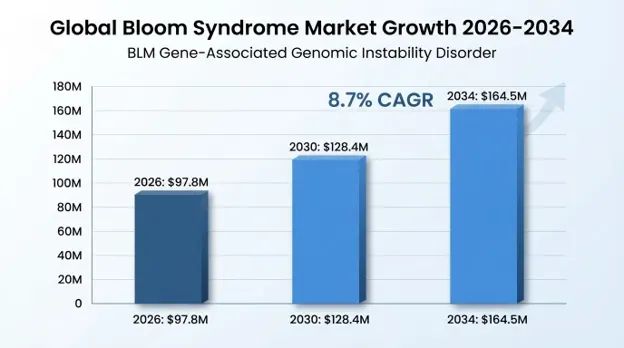
Bloom syndrome is a rare, autosomal recessive genetic disorder that causes growth retardation, including reduced linear growth and head circumference. and is associated with a lack of growth in body proportions throughout life, yet normal body proportions. The disorder is characterized by three cardinal clinical features: photosensitivity (sun-sensitive Telangiectatic erythema) that appears in the characteristic "butterfly" pattern over the nose and cheeks after sun exposure, stunted growth (average height at maturity is 149 cm in males, 138 cm in females) and marked genomic instability, resulting in a 52% risk of cancer by age 30 and over 80% by age 40., to be substantially higher than the incidence in the general population.
However, the medical complexity of Bloom syndrome goes beyond the growth and malignancy predisposition to include immunodeficiency with variable defects in humoral and cellular immunity, particularly in immunoglobulin M and immunoglobulin A production, with decreased antibody response to infections and vaccines, endocrine abnormalities such as hypothyroidism, and a significant number of pulmonary complications, such as chronic bronchitis and bronchiectasis, due to impaired mucociliary clearance mechanisms; and a substantially reduced fertility, with males showing azoospermia or severe oligospermia.
The burden of the disease is lifelong, necessitating multidisciplinary approaches involving genetic diagnosis by molecular analysis of the BLM gene, intensive monitoring for early detection of development of cancer including imaging and hematological surveillance, specific oncologic treatment with dose reduced chemotherapy and other DNA damaging agents, assistance for growth and nutritional support, and psychosocial support to address the impact on the quality of life of living with a chronic condition and its associated risk of death. The market addresses significant unmet medical needs. in <300 patients diagnosed worldwide, but with an extraordinarily high mortality risk with a median age of survival of 36.2 years in registry cohorts, which means a significant healthcare cost per patient throughout childhood and adulthood.
| Report Coverage | Details |
|---|---|
| Base Year | 2025 |
| Base Year Value | USD 89.2 million |
| Forecast Value | USD 164.5 |
| CAGR | 8.7% |
| Forecast Period | 2026–2034 |
| Fastest Growing Market | Europe |
| Region Covered | North America, Europe, Asia Pacific, Middle East & Africa, Latin America |
Get more details on this report - Request Free Sample
The primary driver of Bloom syndrome market growth is is the very high risk of developing cancers requiring complete surveillance from a very young age up to adult life, resulting in the cumulative incidence rate of 52% by 30 years of age, 80% by 40 years of age, and reaching 100% by 50 years of age. Cancers can be hematological, such as acute myeloid leukemia and acute lymphoblastic leukemia diagnosed with the median age of 16-18 years, lymphomas with the median age of 23 years, and solid cancers, such as colorectal carcinoma, breast cancer, oropharyngeal cancers, and skin cancers with the median age of 32-41 years. Multiple primary cancers develop in a very high percentage, being detected in 35% of patients.
The growing need for surveillance technologies creates significant market opportunities. owing to genetic testing for diagnosis, baseline imaging tests to confirm tumor absence during the first assessment, serial imaging tests, such as abdominal ultrasound testing for Wilms' tumor among children starting from age 10-12 years old annually, colonoscopy and fecal immunochemical testing starting from age 10-12 years old annually, whole-body MRI for lymphoma identification starting from age 12-13 years old annually, and breast imaging using MRI among women starting from age 18 years.
Cancer Surveillance Market Metrics:
Technological advancements in genomic sequencing, carrier screening panels, and diagnostic algorithms have led to higher incidence detection of Bloom syndrome cases via molecular genetic testing for symptomatic patients and carrier screening in high-risk populations. The FDA approval of 23andMe’s Bloom Syndrome Carrier Status Report in 2023 marked a significant milestone. that has allowed genetic testing to be more available to larger populations including Ashkenazi Jewish population with carrier rate of 1 in 111-1 in 157. The accessibility of quick and affordable carrier screening via existing consumer-based genetic testing companies enables identification of heterozygous carriers who can undergo genetic counseling. and reproductive planning.
The sensitivity of molecular testing has increased significantly because sequence analysis can find 96-97% of disease-causing mutations, whereas the additional deletion/duplication analysis can detect another 3-4% with structural variations. The increasing role of genomics in the expanding carrier screening programs for preconception counseling, prenatal diagnosis, and pediatric examination creates a greater pool of people for whom genetic testing will be performed than the number of symptomatic patients alone. Such developments create growth opportunities through higher volumes of genetic testing and genetic counseling.
Genomic Testing Growth Drivers:
The major factor limiting Bloom syndrome market growth is is the very low number of patients globally who suffer from this syndrome, which is under 300 patients according to the Bloom Syndrome Registry. This significantly limits commercial viability. for pharmaceutical development. Due to the low prevalence of the disease, it becomes difficult to develop disease modifying therapies by pharmaceutical organizations because the total number of patients is too low to be profitable even with high pricing due to its orphan drug status.
Rarity is not only due to the low incidence of the disease but also because there is a lack of expertise on the part of health practitioners in the treatment of Bloom syndrome. The knowledge that exists is confined to very few specialized centers such as Weill Cornell Medicine where the Bloom Syndrome Registry is housed, Mayo Clinic, and some other major academic medical centers. The geographical dispersion of the patients in different countries also hinders the formation of any centralized service delivery system.
Market Scale Constraints:
Significant market potential exists for developing disease-modifying gene therapies. directed toward the primary genetic defect within the BLM gene causing genomic instability and increased risk for cancer. The 2024 Bloom Syndrome Association seed grants towards gene modification strategies reflect clinical program development efforts examining curative therapies. The potential for curative gene therapy directed toward correcting the underlying genomic instability that causes the disease, as opposed to surveillance for cancer, represents an exciting possibility.
Advancement in gene therapy vectors technology in the form of optimized adeno-associated virus system, development of lentiviral vectors, and non-viral delivery systems makes gene replacement methods technically feasible to be used on BLM. The patient demographic group, despite being relatively small globally, provides a therapeutic life span from childhood to middle age owing to the life span of the disease itself. The use of one-time or few time administration of cure, resulting in the functional repair of BLM, can cost upwards of USD 500,000-1,500,000 per administration.
Gene Therapy Opportunity Metrics:
The Bloom syndrome market is shifting toward population-based carrier screening approaches. during preconception counseling, prenatal diagnosis, and pediatrics evaluation programs. The FDA recently authorized 23andMe’s carrier screening program. for Bloom syndrome in 2023, which will go down in history as a landmark development in facilitating access to genetic risk identification via DTC testing platforms. Cascade genetic testing provides opportunities for better case identification in families of known carriers and affected relatives; the increased routine incorporation of carrier screening into the healthcare system creates these opportunities.
The population health approach allows identification of couples at risk for pregnancy, allows for genetic counseling on embryo selection for the presence of a disease using preimplantation genetic testing. Bloom syndrome carrier screening can be integrated into routine expanded carrier panels and can be incorporated into preconception counseling to provide opportunities for preventive interventions based on the informed decision about reproduction. This trend is leading the market away from the identification of a symptomatic case to earlier disease prevention: genetic risk stratification.
Carrier Screening Trend Metrics:
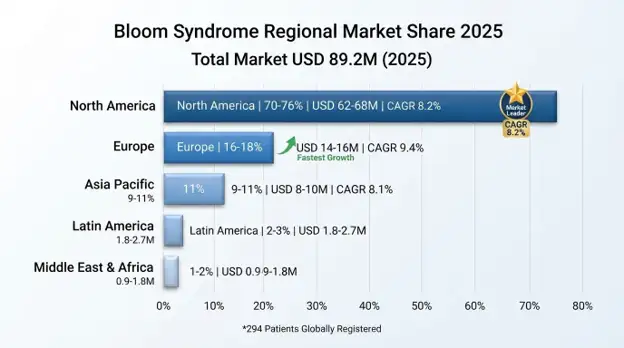
North America dominates the market due to the establishment of the Bloom Syndrome Registry. in Weill Cornell Medicine, which consists of clinical information on 294 registered patients, laying the foundation for the development of evidence-based treatment guidelines, enrollment in clinical trials, and health care use studies. The U.S. accounts for approximately 70% of patients registered in the database., with specialized treatment programs in prominent academic medical institutions located in such cities as New York, Boston, Arizona, and California ensuring multidisciplinary surveillance and cancer treatment. The existing health care infrastructure, good insurance coverage, and NIH grants ensure market development.
Advantages for North America come in the form of timely diagnosis due to greater awareness among healthcare providers, availability of genetic tests via major diagnostic labs, and availability of specialized oncology and genetics counseling services. Medicare as well as private insurance covering genetic testing, imaging screening, and cancer therapy ensures reimbursement for the expensive management strategy. North America’s strong R&D ecosystem supports orphan drug development. for rare genetic disorders.
Regional Performance Metrics:
Europe is the fastest-growing regional market. for Bloom syndrome, registering a CAGR of 9.4% during 2017-2034 due to the emergence of centers for specialized care within major research institutes such as University of Manchester, University College London, and major academic hospitals in Germany, France, and Spain. Patients in Europe increasingly participate in international collaborative research studies. from different centers for multi-centered clinical trials. Rare disease networks of European Union include ERN GENTURIS.
Growth of European markets is facilitated by increased awareness of diseases through patient advocacy groups such as Bloom Syndrome Association Europe operations, better genetic screening inclusion in pre-conception counseling services, and research grants from European research councils. International genetic counseling networks and hereditary cancer programs have contributed to cascade genetic testing among affected individuals.
Regional Growth Metrics:
Asia Pacific is an emerging market region with potential for future growth through the development of genetic screening initiatives in East Asia. Japan and South Korea with their developed health systems and rare disease registry present promising prospects for expanding programs for Bloom Syndrome. The diasporas of the Ashkenazi Jews in other countries represent another ethnic population that can be a target for screening.
Limited possibilities for further development of the market in Asia are connected to low prevalence of the disease among non-Jewish populations and underdevelopment of infrastructure for genetic counseling and testing. However, the increase in accessibility of the next-generation sequencing techniques and genetic tests included into pediatric assessment programs presents new prospects.
Regional Development Metrics:
Surveillance & Monitoring is the largest treatment segment. with 48% market share worth USD 42.8 million in 2025, and includes diagnostic imaging studies, laboratory tests, and clinical assessment of cancer development. This segment is the biggest because of an exceptional cancer susceptibility necessitating life-long monitoring of the condition by means of imaging, laboratory, and clinical assessment that are the main expenses for healthcare.
The Cancer Therapeutics segment accounts for 32% market share worth USD 28.5 million in 2025 and includes oncology treatment, such as chemotherapy, radiotherapy, immunotherapy, and surgery. This segment is related to the prevalence and costliness of cancer as the most common complication.
The Symptomatic Management segment includes the treatment of growth hormone deficiency, gastrointestinal disorders, skin lesions, immunodeficiency, endocrine disorders, and pulmonary conditions, and accounts for 20% market share worth USD 17.9 million in 2025.
Genetic Testing and Counseling contributes to 35% market share in USD 31.2 million in 2025, involving molecular genetic testing for BLM gene, carrier screening, prenatal testing, and genetic counseling. This category is growing very fast due to increasing integration with the carrier screening programs.
Clinical Management Services contribute to 42% market share in USD 37.5 million in 2025, involving management of patients using multidisciplinary care, clinic visits, and disease monitoring by pediatricians, geneticists, and internists.
Cancer Screening Programs contribute to 23% market share in USD 20.5 million in 2025, involving specialized imaging studies, endoscopic studies, and consultation with an oncologist for surveillance of malignancies.
The pediatric population accounts for 58% market share worth USD 51.7 million in 2025, since the disease manifests itself at an early age and continuous surveillance is needed in childhood and adolescence. The adult population accounts for 42% of the market share with worth USD 37.5 million in 2025.
Hospitals & Specialty Clinics are the largest end-user segment. accounting for 52% market share with valuation of USD 46.4 million in 2025 and includes leading academic medical centers hosting Bloom syndrome programs, cancer treatment centers focusing on malignancy treatments, and pediatric specialty centers.
Genetic Counseling Centers form 22% market share worth USD 19.6 million in 2025 and focus on providing genetic testing services, counseling, and reproductive advice.
Cancer Treatment Centers form 18% market share worth USD 16.0 million in 2025 and specialize in treating malignancies using treatments specific to Bloom syndrome.
Specialized Care Facilities form 8% market share worth USD 7.1 million in 2025 and focus on multi-disciplinary treatment of Bloom syndrome.
The global Bloom syndrome market is highly fragmented, with no single organization holding a significant market share. due to the nature of the disease being an orphan disease that lacks any central commercialization of drugs for it.
Healthcare institution competition revolves around developing specialized care and patient referral programs through better surveillance and clinical performance. Competitive advantage is achieved through specialized services such as care coordination, research and patient support.
Mayo Clinic, Cleveland Clinic, Boston Children's Hospital, and other academic institutions that offer care programs for patients in the Bloom Syndrome Registry are the major care providers competing in this environment.
The Bloom Syndrome Association awarded research grants to investigators., one being the new grant for the assessment of approaches to gene modification in Bloom syndrome patients with an award period from April 2025 to March 2026.
The U.S. FDA authorized 23andMe to offer the Bloom Syndrome Carrier Status Test. This is a very important achievement in history, since it has opened access to genetic screening for the direct-to-consumer tests.
Comprehensive surveillance recommendations for Bloom syndrome which were produced by the clinical research team working on a multidisciplinary basis and published in the American Journal of Medical Genetics offered evidence-based surveillance and management guidelines. This included guidelines related to the growth, cancer surveillance, immunological, endocrine, and pulmonary aspects of the condition.
The Bloom Syndrome Registry at Weill Cornell Medical College collected clinical and genotypic information on 294 enrolled subjects up to 2023, providing an international collection of patients for outcome analysis and study involvement. The registry information contributes to the epidemiologic description and natural history evaluation of the disease.
Several leading academic medical centers established formalized Bloom syndrome care programs. through integration of pediatric, oncologic, genetic and support services into multidisciplinary systems from 2022-2025.
You'll get the sample you asked for by email. Remember to check your spam folder as well. If you have any further questions or require additional assistance, feel free to let us know via-
+1 724 648 0810 +91 976 407 9503 sales@intellectualmarketinsights.com
23 Jul 2026
Intellectual Market Insights Research © 2026. All rights reserved.