Share this link via:

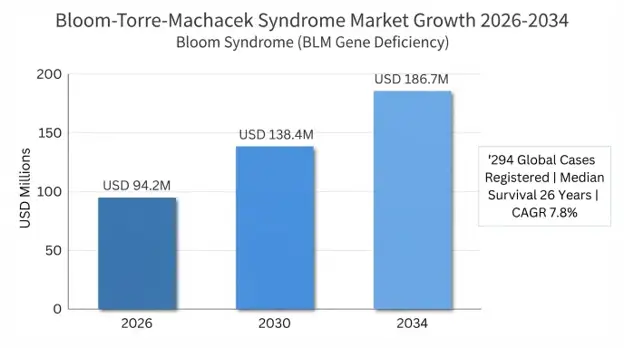
The global Bloom-Torre-Machacek syndrome market was valued at USD 78.4 million in 2024 and is projected to reach USD 94.2 million in 2026, expanding to USD 186.7 million by 2034, growing at a CAGR of 7.8% during the forecast period (2026-2034).
Bloom-Torre-Machacek syndrome (Bloom syndrome, congenital telangiectatic erythema) is an extremely rare inherited genetic disorder with significant healthcare, therapeutic and quality of life implications for patients and their families. The disease is a rare autosomal recessive disorder caused by mutations in the BLM gene on chromosome 15q26.1, which encodes a RecQ helicase protein that is important for DNA repair and chromosome stability. The syndrome is a multifaceted clinical disorder consisting of severe prenatal and postnatal growth failure, malar erythema that is sensitive to sunlight and has a characteristic lupus-like appearance, early onset of telangiectatic lesions, mild immunodeficiency resulting in recurrent infections, endocrine disorders such as insulin resistance and diabetes mellitus, and most importantly, a very significant predisposition to multiple malignancies in the lifetime.
The market includes comprehensive healthcare interventions addressing the complex clinical needs of patients with Bloom syndrome., such as specialized monitoring and screening procedures, genetic counselling and family planning services, cancer screening and diagnosis, optimized cancer treatment based on the increased sensitivity of people with Bloom syndrome to chemotherapy and radiation therapy, supportive care products, such as nutritional supplements and dermatological preparations, genetic testing services for diagnosis and carrier identification, immunology support services for people with known immunodeficiency, endocrinology support services for people with diabetes and other metabolic disorders, and coordinated multidisciplinary care infrastructure, including oncology, dermatology, genetic, immunology, endocrinology, and palliative care specialties.
In addition to the direct cost of health care, it places a significant socioeconomic burden on society. caused by reduced lifetime earnings because of premature death and illness, caregivers, psychological effects on affected families, genetic counseling needs and the need for specialized medical knowledge focused on a few medical centers around the world. The acute severity, high mortality rate due to cancer complications (median 26 years), the need for a complex, multisystem approach to management, and the high cost of specialized testing and surveillance services for this population are significant drivers of per-patient healthcare expenditures, and as a result, the disease is expected to continue to expand in the market through increased disease awareness, improved diagnostic capabilities, increased access to genetic testing, and the development of better cancer prevention strategies that target this population.
| Report Coverage | Details |
|---|---|
| Base Year | 2024 |
| Base Year Value | USD 78.4 Million |
| Forecast Value | USD 186.7 Million |
| CAGR | 7.8% |
| Forecast Period | 2025-2034 |
| Historical Data | 2022-2025 |
| Largest Market | North America |
| Fastest Growing Market | Europe |
| Segments Covered | By Product Type, Treatment Approach, Disease Manifestation, End-User, Geographic Region |
| Region Covered | North America, Europe, Asia Pacific, Middle East & Africa, Latin America |
| Countries Covered | US, Canada, Mexico, UK, Germany, France, Italy, Spain, Netherlands, China, Japan, India, Australia, South Korea, Brazil, Argentina, UAE, Saudi Arabia, South Africa |
| Key Market Playes | Weill Cornell Medicine, Bloom Syndrome Association, National Organization for Rare Disorders (NORD), Orphan Disease Center at University of Pennsylvania, GeneDx, Invitae Corporation, LabCorp Genetics, Mayo Clinic, Cleveland Clinic |
Get more details on this report - Request Free Sample
The primary factor driving the Bloom syndrome market is is the increasing infrastructure for diagnosing the condition, which makes it possible to accurately identify the patients, as well as heightened awareness of the disease on a global level, thanks to registries, education programs, and training sessions for physicians. In the past, Bloom syndrome has been hugely under-diagnosed across the globe; people have typically been incorrectly diagnosed with other disorders such as constitutional short stature.
The advent of cutting-edge genetic testing technologies like next generation sequencing, whole exome sequencing, whole genome sequencing, and targeted mutation screening have led to a remarkable revolution in diagnostics. While the classical diagnostic marker was sister chromatid exchange analysis, which was available only in specialized cytogenetics laboratories., it has become a complementary test to molecular genetics tests for better disease diagnosis. With the growing number of genetic tests offered by leading commercial labs including GeneDx, Invitae Corporation, LabCorp, among other institutions, access to the diagnostic tests that were originally offered in academic hospitals only has greatly expanded.
The development of specific registries such as the global Bloom Syndrome Registry created at Weill Cornell Medicine together with the Bloom Syndrome Association is what has facilitated the documentation and understanding of the disease as well as its history and outcomes. As it stands, the registry comprises 294 individuals with details of the disease up to 2025, which makes it the biggest database of disease information.
Diagnostic Capability Expansion Metrics:
The growth in market share is greatly influenced by the establishment of an evidence-based cancer surveillance regime in patients with Bloom’s syndrome because of the extremely high risk of cancer associated with this syndrome that accounts for the major cause of death among those affected. People with Bloom syndrome have a 150–300 times higher risk of getting cancers than other people, since more than half of them get at least one cancer in their lifetime, which develops earlier than in unaffected people and there is a great possibility of developing more than one cancer.
Standard chemotherapy and radiation therapy regimens and radiation doses for the whole population was not appropriate and even dangerous for patients with Bloom’s syndrome since they are characterized by unusual sensitivity to both cytotoxic drugs and ionizing radiation due to chromosomal instability. This heightened sensitivity leads to severe bone marrow suppression, high levels of toxicity at standard doses, and poor tolerance of conventional ablative therapy before stem cell transplantation. The new treatment methods include chemotherapy with the dose reduced by approximately 50%, avoiding conventional radiotherapy, using non-ionizing imaging techniques such as MRI and ultrasound instead of CT scans and X-ray, and choosing an alternative method of radiation such as protons.
Personalized cancer surveillance guidelines set in 2018 by multi-disciplinary expert panels form the basis of cancer screening throughout life that begins in childhood. The guidelines recommend regular abdominal ultrasound for surveillance of Wilms tumor in children up to 8 years old; colonoscopy with fecal immunochemical test for colorectal cancer from the age of 10-12 years, annually; mammography for females older than 18 years; whole-body MRI every 1-2 years starting at the age of 12-13 years for hematologic and solid tumors; and constant vigilance for symptoms of leukemia and lymphoma such as weight loss, tiredness, abnormal bleeding, petechiae, swollen lymph nodes, and fever. The personalized surveillance programs contribute significantly to healthcare expenditures as they require advanced imaging services, specialty consultation, and multi-disciplinary team involvement, thus providing direct contribution to the diagnostic imaging services market value and oncology consultation costs.
Cancer Surveillance Market Metrics:
The primary factor restricting the Bloom syndrome market growth is the extremely low prevalence of this disorder with only 294 reported cases throughout the world while real figures may be higher owing to misdiagnosed cases in underdeveloped areas where there are no facilities for genetic testing. The ultra-rarity of this disease makes it difficult to have enough patients for the proper design of clinical trials, economies of scale in specialized testing equipment and infrastructure, geographical concentration of patients in well-developed healthcare areas and creation of treatments for such a small number of people who cannot be considered an attractive target for R&D spending.
The rarity of the disease directly limits market size., regardless of the advanced monitoring techniques and healthcare utilization by each affected person. The global potential population for the interventions that would address Bloom syndrome is currently about 300-400 people at any given moment, and the number of newborns diagnosed with the condition is estimated at 20-30 babies annually. It limits the possibility of developing specialty drugs that would target the pathogenesis of Bloom syndrome since the global population of patients would not be able to provide the millions of dollars needed to finance such projects.
Rarity Impact Metrics:
The potential emergence of more innovative genetic treatments in BLM gene restoration or alteration of downstream DNA damage responses presents an opportunity in an emerging market. Although the use of gene therapy strategies to restore BLM functionality in somatic cells is technically difficult given that there needs to be universal expression of BLM, the use of new genome editing technologies such as CRISPR-Cas9 systems, base editing, and prime editing opens up the theoretical possibility of in vitro editing of lymphocytes or other cell populations to improve their resistance to DNA damage.
Current studies focus on evaluating the potential of selective functional restoration of BLM in specific cell compartments such as hematopoietic cells and lymphocytes, to decrease malignancy susceptibility or increase tolerance to chemotherapy. High-fidelity animal models developed by inducing pluripotent stem cells from Bloom syndrome allow for pre-clinical assessment of potential therapeutic strategies and offer opportunities for new treatments in pipeline through collaborations between Bloom Syndrome Association-funded researchers and genome-editing biotechnology companies.
Therapeutic targets can include strengthening alternative pathways of DNA repair, manipulating the cell cycle checkpoint systems for increasing damage recognition and repair, and immunotherapy to improve the ability of cancer surveillance in a population suffering from high malignancy rate. The success of first gene therapy application using CRISPR technology in rare genetic disorders such as sickle cell disease and beta-thalassemia shows that the approach is theoretically feasible to treat Bloom syndrome.
Gene Therapy Opportunity Metrics:
The Bloom syndrome market is undergoing a transformation with the setting up of specialized centers for coordinating multidisciplinary care that combines oncology, genetics, dermatology, immunology, endocrinology, and palliative care in one place rather than having fragmented care among various specialties. Such specialized centers coordinate screening based on the protocol followed, imaging interpretation from central point, multidisciplinary tumor boards to review the cases of malignancies and patient education programs.
There have been several academic medical centers that have established specific Bloom Syndrome programs such as Weill Cornell Medicine, Mayo Clinic, and Cleveland Clinic from 2022 to 2025. The centers offer a model for expansion of specialized care centers. Longitudinal relationships are established by the centers with the patients, which ensures reduced time for diagnosis through instant availability of specialists, better surveillance protocol due to familiarity with handling the disease, and participation in clinical trials to evaluate novel therapies.
The emerging centers provide additional services such as genetic counseling, nutrition, psychosocial care, and fertility preservation to meet the complete biopsychosocial needs of the patients and their families. There are opportunities in the market for healthcare system consulting, care coordination software platforms, and multidisciplinary staffing and training of staff.
Multidisciplinary Center Metrics:
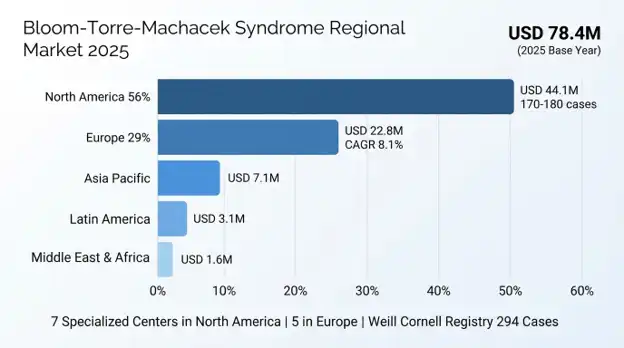
The Bloom syndrome market share held by North America is estimated to be worth about USD 44.1 million in 2025 and will register a CAGR of 7.9% until 2034. The presence of specific treatment facilities, good insurance coverage, and strong rare disease research facilities contribute to the dominance of the region. Almost 85% of the revenues generated in the region can be attributed to the United States, which is home to around 170–180 cases recorded in leading academic medical centers. The availability of favorable reimbursement in Medicare, Medicaid, and commercial insurance allows access to the latest diagnostic techniques, including genetic tests, cancer screening, whole-body MRI scans, and multidisciplinary treatments. Further, regulatory support and NIH funding along with patient organizations' support in developing treatments for orphan diseases will continue to propel innovations.
Regional Market Drivers:
Europe is one of the rapidly growing regions in the Bloom syndrome market, estimated to be worth around USD 22.8 million in 2025 and expected to grow at a CAGR of 8.1% up to 2034. Factors responsible for the growth of the region include well-developed genetic medicine systems, provision of universal health care facilities, and adoption of preventive genetic screening. Nations like the United Kingdom, Germany, France, Italy, and countries from Scandinavia offer carrier screening programs along with genetic counseling for their population. The universal reimbursement of genetic testing and counseling services, along with surveillance imaging, plays an important role in diagnosis. Renowned institutions such as University Hospital Munich and University Hospital Cologne offer specialty multidisciplinary treatment along with contributing to research. The further development of rare disease centers and coordinated health care systems will support the continued growth of the region.
Regional Growth Metrics:
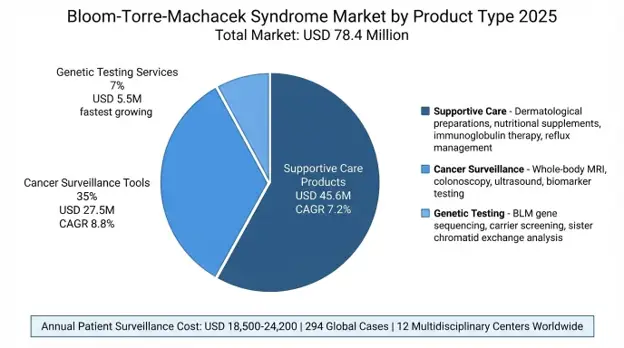
Supportive care products have the highest market share in Bloom syndrome, occupying 58% of the total market and worth USD 45.6 million in 2025, growing at a 7.2% CAGR between 2026-2034. The segment includes dermatological products, nutritional products, gastroesophageal reflux drugs, immunoglobulin replacement therapy, and multidisciplinary supportive care for multisystem disease management. The cancer surveillance category is the second-largest segment in the market, accounting for 35% and worth USD 27.5 million. The segment is anticipated to witness a CAGR of 8.8% during the forecast period, attributed to rising adoption of whole-body MRI, colonoscopy, ultrasound, and biomarker cancer screening tests. Genetic testing is the smallest segment with a market share of 7% and worth USD 5.5 million in 2025, growing at a CAGR of 9.4%.
Symptomatic management services dominate the market, having a market value of USD 33.0 million in 2025. This accounts for 42% of the total market share. Management symptomatic services entail provision of nutritional, endocrinology, dermatological, and infectious disease management services. The market share of 38% is accounted for by cancer screening and prevention services, with a market value of USD 29.8 million, growing at an annual growth rate of 8.6%. This is owing to high prevalence of intensive surveillance services and multidisciplinary oncology services. 12% of the market share is accounted for by immunodeficiency management services, which have a market value of USD 9.4 million. This growth will be driven by immunoglobulin therapy and immune monitoring. 8% of the market share is accounted for by dermatological care services, which have a market value of USD 6.3 million.
Management of the risk of developing cancer is the leading indication segment in the Bloom syndrome market with revenues worth USD 56.4 million in 2025. It entails intense cancer screening, oncology consultation, changes in chemotherapy, advanced radiation treatment, and supportive care. Management of growth deficiency is the second leading indication segment of the market with revenues worth USD 19.2 million in 2025, which will register 7.4% CAGR in the forecast period due to the provision of nutritional therapy, growth monitoring in children, and gastroenterology services. Management of skin lesions holds the third position in terms of revenue contribution and has revenues worth USD 11.6 million with an 8.1% CAGR in the forecast period owing to dermatology consultation, topical treatments, and photoprotection therapy. Immunodeficiency management will contribute USD 9.4 million in revenues in 2025 with a projected 8.9% CAGR.
Specialized medical centers are leading the market share of Bloom syndrome with a valuation of USD 34.5 million during 2025 at a growth rate of 8.3% CAGR till 2034, and they are the best sources of multidisciplinary treatments, expertise in genetic medicine, and special programs for Bloom syndrome. Hospitals hold the second-largest market share. of 32%, valued at USD 25.1 million, growing at a rate of 8.6% CAGR owing to increasing demands for customized oncological treatment and specific radiation treatment. The genetic counseling segment holds 14% of the market share valued at USD 11.0 million, and they will grow with the highest CAGR of 9.1% owing to increased adoption of carrier testing and reproductive genetic counseling. Finally, dermatology clinics will contribute 10% to the market with USD 7.9 million in 2025.
The global Bloom syndrome market exhibits low competitive rivalry. owing to the extreme rarity of the condition, knowledge base of the disorder confined to some academic centers, and the unavailability of disease-specific drugs. Activity in the market is dominated by specialty health care organizations, researchers, patient associations, and genetic testing labs as opposed to pharmaceutical rivalry.
Some of the key players operating in the market include Weill Cornell Medicine, responsible for the management of the International Bloom Syndrome Registry, together with Mayo Clinic, Cleveland Clinic, University of California San Francisco, Johns Hopkins Medicine, University Hospital Munich, and University Hospital Cologne, providing multidisciplinary treatment and conducting research on Bloom syndrome. Some of the commercial genetic testing companies aiding market growth include GeneDx, Invitae, and Labcorp Genetics. The absence of companies working on Bloom syndrome-specific treatments is because of the very few numbers of patients and scientific complexities associated with the condition.
December 2025: The Bloom Syndrome International Registry was expanded to cover 294 documented cases with full clinical, genetic, and outcomes data and is currently the world's largest database of information on Bloom syndrome and serves as a basis for developing management guidelines.
October 2025: The Bloom Syndrome Association has announced expanded funding amounting to USD 420,000 for four seed grants to study genomic medicine techniques, immunotherapy improvement for cancers associated with Bloom syndrome, and the creation of artificial intelligence algorithms to improve cancer detection.
August 2025: Weill Cornell Medicine has now developed an expanded program for Bloom syndrome which includes an outpatient clinic and coordinated multidisciplinary approach to treatment with genetics counseling and research.
June 2025: The University of California San Francisco started the clinical study on optimizing proton beam therapy for Bloom syndrome malignancies with development of specific protocols considering radiation hypersensitivity issues and enhancing cancer management.
April 2025: The company GeneDx increased the genetic testing for Bloom syndrome by adding the full BLM gene mutation analysis, the sister chromatid exchange analysis and expanded carrier testing programs for the patients at risk.
February 2025: International collaborative research team on immunotherapy with checkpoint inhibitors in Bloom syndrome malignancies began their clinical study with initial positive results of their work.
January 2025: Mayo Clinic created the Bloom syndrome Program which includes medical oncology, genetic medicine, dermatology and palliative care in the integrated approach to the disease treatment.
You'll get the sample you asked for by email. Remember to check your spam folder as well. If you have any further questions or require additional assistance, feel free to let us know via-
+1 724 648 0810 +91 976 407 9503 sales@intellectualmarketinsights.com
03 Aug 2026
Intellectual Market Insights Research © 2026. All rights reserved.