Share this link via:

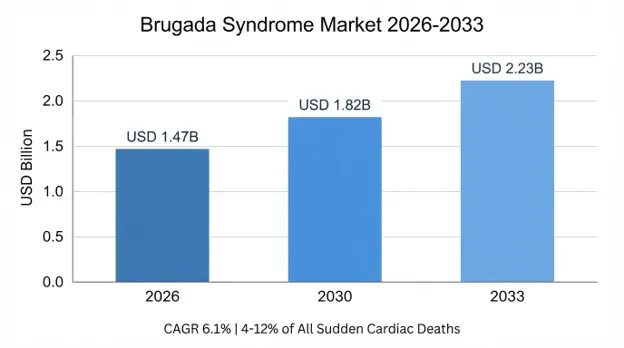
The global Brugada syndrome market size was valued at USD 1.39 billion in 2025 and is projected to reach USD 1.47 billion in 2026, expanding to USD 2.23 billion by 2033, growing at a compound annual growth rate (CAGR) of 6.1% during the forecast period (2026–2033).
Brugada syndrome is an inherited cardiac channelopathy that is clinically important, although rare, with characteristic electrocardiographic changes, including coved-type ST-segment elevation in the right precordial leads, and a high risk for sudden cardiac death due to life-threatening ventricular arrhythmias in persons with structurally normal hearts. It is caused by mutations in genes involved in the generation of cardiac ion currents, primarily the sodium channel alpha-subunit (Nav1.5), which affects the balance of inward depolarizing currents and outward repolarizing currents in the early phase of ventricular action potential generation. This pathophysiologic imbalance results in transmural voltage gradients across the wall of the right ventricular outflow tract, which can lead to formation of re-entry circuits that can cause polymorphic ventricular tachycardia or ventricular fibrillation, often triggered by fever, sleep, or certain medications., sleep, and certain medications.
The clinical importance of Brugada syndrome is not just because it is rare: it has been estimated that 4-12% of all sudden cardiac deaths worldwide are attributable to Brugada syndrome, and close to one-fifth of sudden cardiac deaths in patients with apparently structurally normal hearts are attributed to Brugada syndrome. The syndrome exhibits enormous geographic and ethnic variation in prevalence, with countries in Southeast Asia being a global disease epicenter, with prevalence rates of 3.7–17.7/1000 people: in contrast, prevalence rates in the West are roughly 0.5–5/1000 people. This geographic clustering is the result of both true differences in the distribution of genetic mutations and differences in the expression of the Brugada phenotype depending on gender, age, circadian variations in autonomic tone, body temperature and concentrations of electrolytes that influence the expression of the disease.
The market addresses major unmet clinical needs from the initial diagnostic confirmation, to risk stratification, all the way to the ultimate therapeutic intervention, for the entire range of Brugada syndrome management, from a sophisticated electrocardiographic analysis to a genetic testing platform, to advanced electrophysiological mapping, to implantable device technology, and, finally, emerging pharmacological and ablation-based interventions. Beyond the costs of drugs and devices, the total economic impact of Brugada syndrome is estimated to be USD 6,812 per patient per year for inpatient treatment of arrhythmia, USD 557 per patient per year for specialist outpatient treatment and follow-up and is significantly higher for those with documented ventricular arrhythmias or recurrent electrical storms.
| Report Coverage | Details |
|---|---|
| Base Year | 2025 |
| Base Year Value | USD 1.39 Billion |
| Forecast Value | USD 2.23 Billion |
| CAGR | 6.1% |
| Forecast Period | 2025-2033 |
| Historical Data | 2022-2025 |
| Largest Market | North America |
| Fastest Growing Market | Asia Pacific |
| Segments Covered | By Disease Classification, Product Type, Diagnostic Modality, Age Group, Gender, End-User |
| Region Covered | North America, Europe, Asia Pacific, Middle East & Africa, Latin America |
| Countries Covered | USA, Canada, UK, Germany, France, Italy, Spain, Netherlands, China, Japan, India, South Korea, Australia, Brazil, Argentina, UAE, Saudi Arabia, Thailand, Philippines, Indonesia |
| Key Market Playes | Medtronic, Abbott Laboratories, Boston Scientific, BIOTRONIK, MicroPort, LivaNova, Johnson & Johnson MedTech, GE HealthCare, Philips, Nihon Kohden, Schiller, Mindray, AliveCor, iRhythm Technologies |
Get more details on this report - Request Free Sample
The primary growth driver of the Brugada syndrome market is the increasing awareness about its genetic as well as molecular biology, which will help in early diagnosis and risk stratification. The disorder comprises more than 500 mutations on 20+ genes, with mutations on SCN5A being responsible for nearly 30% of the diagnosed cases. Next-generation sequencing has significantly improved diagnostic yield. that has helped in precise diagnosis, genotype-phenotype correlation, and screening in families. More studies have led to the discovery of new mutations of genes coding sodium, calcium, and potassium channels, which have helped in the understanding of disease pathophysiology. Recent studies have revealed that almost 90% of the patients carry Nav1.5 autoantibodies, which suggest immune-mediated pathway as a possible target for therapies. Moreover, the use of induced pluripotent stem cell-derived cardiomyocyte models allows personalized disease modeling and rapid discovery of drugs.
Another factor driving the growth of the Brugada syndrome market is an increased awareness about age- and gender-based differences in the disease presentation and susceptibility. The disorder is considerably more prevalent among males with a male-to-female ratio of 8:1 to 10:1, while male patients are 5.5 times more likely to suffer from sudden cardiac death. The impact of testosterone on the functioning of the cardiac ion channels is one of the factors that might be responsible for this difference. Women generally develop the disease later in life, usually after the age of 55, and have fewer occurrences of spontaneous Type 1 ECG patterns and fewer arrhythmic episodes. Nevertheless, the less pronounced form of the disease might result in the late diagnosis of Brugada syndrome in women. Patients younger than 20 tend to have a worse prognosis and to be more susceptible to arrhythmias; meanwhile, elderly patients are less likely to be affected by the disease despite abnormal ECG readings.
The key limitation impacting the Brugada syndrome market is the complexity in diagnosing and classifying this condition, due to the heterogeneous manifestations of this disease. About 60% of patients remain asymptomatic and show characteristic abnormalities on electrocardiographic (ECG) examinations only during routine checks; thus, it becomes difficult to define whether such patients need intensive management and monitoring. The main requirement for proper diagnosis is the presence of a typical ECG pattern; however, most patients show atypical patterns of Types 2 and 3, which usually require performing sodium channel blocker provocation test. This test often yields false-negative results in almost 25% of cases. Besides, the manifestation of ECG changes depends on such factors as body temperature, autonomic nervous system activity and electrolyte balance, so additional checking may be necessary. Moreover, inconsistent recommendations about implantable cardioverter-defibrillators use among asymptomatic patients add to the problem.
The largest growth opportunity in the Brugada syndrome market is the availability of disease modification and even potential cure therapies that can target the underlying genetic and molecular pathophysiology rather than using only ICDs for treatment of the condition. Current research is providing impetus to therapies based on gene therapy such as use of AAV-based delivery of SCN5A gene, CRISPR-Cas9-based gene editing, and gene regulation to achieve correction of normal function of cardiac sodium channel. Alongside, new pharmacotherapies that can modulate ion channel dysfunction are becoming available. Better sodium channel enhancers, potassium channel blockers, and kinase inhibitors will help to overcome some limitations of current quinidine-based therapy that includes its adverse effects and variable results. Furthermore, the identification of Nav1.5 autoantibodies in 87% of the patients gives rise to new therapeutic possibilities with the use of monoclonal antibodies and immunomodulating drugs.
Another major trend impacting the Brugada syndrome market is the use of artificial intelligence (AI) and machine learning in diagnostics and risk assessment. Artificial intelligence in the field of electrocardiographic analysis allows for the automatic recognition of specific ST-segment patterns characteristic of Brugada syndrome with an accuracy comparable to that of cardiologists. These technologies are increasingly being integrated into 12-lead ECG systems, wearable cardiac monitorss, and smartphone-based portable ECG devices. Machine learning is currently being used for the development of models that consider the results of electrocardiography, genetics, medical history, and electrophysiological testing to provide personalized risk assessment of the occurrence of potentially fatal arrhythmia. Advanced algorithms for prediction will help in identifying high-risk asymptomatic patients who require ICD treatment but not those who have a low risk of developing Brugada syndrome.
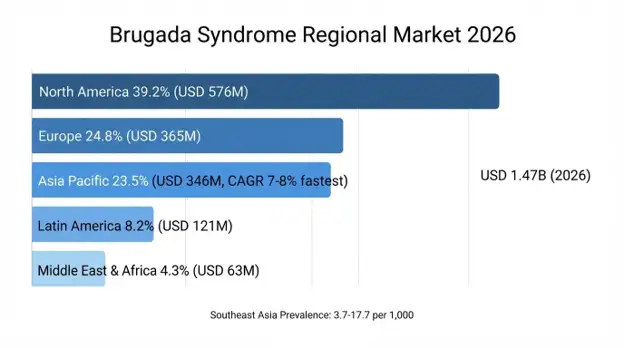
North America is the largest geographical region within the Brugada syndrome market, representing 39.2% share of worldwide revenue in 2026 owing to advanced cardiac electrophysiology framework, favorable reimbursement frameworks, and extensive utilization of implantable cardiac devices. The U.S. is estimated to account for around 87% of the regional market. due to coverage of ECG tests, genetic tests, electrophysiological study, and ICD implantation procedures under Medicare and private insurance plans. Major medical device players are consistently innovating their ICD technology with better battery life, compact design, telemonitoring capabilities, and programming features. Specialty arrhythmia clinics and academic hospitals offer complete management for genetic testing, catheter ablation procedure, and risk evaluation. This region also gains advantage from aggressive screening and higher disease awareness, enabling early diagnosis. Clinical research activity along with substantial investments in novel diagnostic tests, AI-driven ECG interpretation, and novel arrhythmia therapies have been reinforcing the leading position of North America in the global Brugada syndrome market.
Asia Pacific is one of the fastest-growing markets for Brugada syndrome and accounts for 23.5% of the total market share of Brugada syndrome in 2026. The region is expected to grow with a CAGR of 7%-8% during the period from 2021 to 2033. The major reason behind the growth is the extremely high prevalence rate of the Brugada syndrome in Southeast Asia, which is seven to thirty-five times higher compared to that of western nations, making the Asia Pacific region home to the largest population with Brugada syndrome. China dominates the regional market with increasing health insurance penetration, better electrophysiology setup, and availability of superior ECG technology. Japan is also an important contributor due to their long-established experience in clinical practice, well-developed cardiac care systems, and local production of medical devices. India is another fast-growing nation within the region due to the establishment of specialized cardiac hospitals, rising awareness about the sudden cardiac death, and affordability of diagnostic test kits and ICD treatments.
Type 1 Brugada Syndrome has the largest market share in 2026 and is responsible for 53.8% of the market due to its unique coved type of ST-segment elevation on an electrocardiogram and high association with sudden cardiac death. Type 1 Brugada Syndrome has clearly defined diagnostic criteria and is the main indication for implantable cardioverter defibrillators in symptomatic and high-risk patients.
Types 2 and 3 of Brugada syndrome account for 46.2% of the market but have slower growth rate as compared to others due to difficult diagnosis. Patterns 2 and 3 lack specificity and generally need provocative testing for sodium channel blockade or genetic studies for diagnosis. The vagueness regarding diagnosis and the decision to undergo therapy makes them lag behind, but with improved techniques of AI-assisted ECG diagnosis and electrophysiological studies, they will eventually take up more market share.
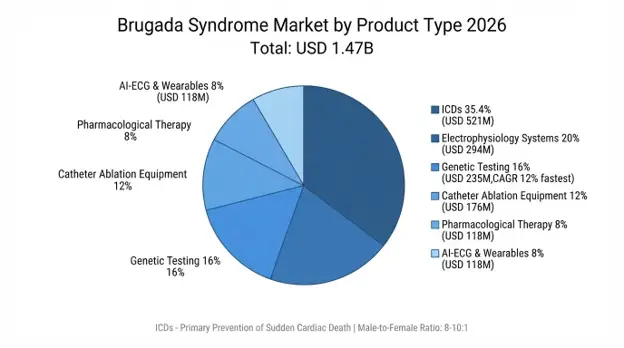
The Brugada syndrome market is led by ICDs with a market share of 35.4% in 2026 and remains to be the main treatment modality for prevention of sudden cardiac death in high-risk patients. The market is driven by the introduction of the next generation ICDs, which feature improved battery life, subcutaneous placement, remote monitoring, and algorithms that help reduce inappropriate shocks. The fastest growing segment of the market is genetic testing with an annual rate of over 12%, facilitated by the implementation of next generation sequencing for family screening and genotype-based risk stratification. Catheter ablation constitutes about 12% of the market size and its increased usage is facilitated by advances in electroanatomical mapping and clinical evidence. Pharmacological treatments such as quinidine constitute about 8% of the market revenue and are mostly used for the management of recurring ventricular arrhythmia. AI-ECG software and wearable cardiac monitors, also making up 8% of the market, experience the highest growth.
Resting electrocardiography (ECG), with a market share of 34.8% in 2026, takes dominance in the Brugada syndrome diagnostics market due to its availability, affordability, and the capacity to diagnose typical Type 1 ECG pattern. Electrophysiology studies (EPS) account for 25% of the market, and the test is largely utilized in the management of asymptomatic patients to assess their susceptibility to ventricular arrhythmias. EPS tests help to make decisions regarding implantable cardioverter defibrillator (ICD). Provocation testing using sodium channel blockers accounts for 22% of the market. and is necessary for diagnosing patients having indeterminate ECG findings since it reveals Type 1 Brugada pattern in such patients. The genetic test, which constitutes 18% of the market, has been identified as the fastest growing segment in the market owing to its decreasing costs and broad use of multi-gene panels providing 35–40% diagnostic yield.
Hospitals and specialized cardiac centers represent the largest end-user segment. and make up for 62% of the total market size. This type of organization offers full-fledged services that range from diagnosis to electrophysiology testing, ICD placement, catheter ablation, genetic counseling, and treatment of acute ventricular arrhythmia episodes.
Diagnostic and genetic laboratories make up 18% of the market due to increasing needs for next-generation sequencing, family cascade testing, and molecular diagnostics. Home and remote service providers constitute 12% of the market due to growing usage of remote ICD monitoring, ambulatory ECG devices, and telecardiology services that allow for constant outpatient surveillance. Research and academic institutions account for the remaining 8% and perform a crucial role in the advancement of Brugada syndrome via clinical trials, biomarkers discovery, and artificial intelligence diagnostic developments.
The global Brugada syndrome market is moderately consolidated, with the top 5-7 firms holding a share of around 65-70% of the market’s overall value. The key drivers of the market leadership include complete product portfolios offering ICDs, cardiac electrophysiology systems, electrocardiography systems, genetic testing, and remote patient monitoring technology. Medtronic, Abbott, and Boston Scientific lead the way in the ICD category owing to their advanced device technology, clinical evidence, and association with electrophysiology centers. Competition among market leaders is driven by their ability to offer AI-powered ECG interpretation services, remote monitoring, catheter ablation, and cardiac rhythm management technology.
July 2025: The BRAVE trial presented live at Heart Rhythm 2025 scientific session demonstrated that epicardial catheter ablation significantly reduced ventricular fibrillation episodes in Brugada syndrome patients with implantable defibrillators, with interim results showing 83% ventricular fibrillation freedom after initial ablation procedure and 90% freedom after repeat procedures, substantially strengthening the evidence base for ablation as preventive strategy in high-risk patients and expanding the addressable market for ablation technologies.
March 2025: Abbott Laboratories received CE Mark approval for Volt Pulsed Field Ablation System for treatment of abnormal heart rhythms, demonstrating 99.1% pulmonary vein isolation success rates and initiating commercial procedures across European markets with potential application to Brugada syndrome substrate ablation procedures as pulsed-field technology offers improved safety and efficacy compared to radiofrequency energy.
January 2025: AliveCor validated its Kardia 12L ECG System demonstrating equivalence to conventional 12-lead electrocardiograms across 35 cardiac determinations including arrhythmia detection and morphologic pattern recognition, strengthening the evidence base for AI-enabled point-of-care cardiac screening and supporting broader deployment of portable electrocardiography in primary care and remote monitoring settings for Brugada syndrome screening.
December 2025: Victor Chang Cardiac Research Institute and Vanderbilt University Medical Center published collaborative findings from high-throughput SCN5A functional testing of 252 genetic variants from over 450 Brugada syndrome patients, demonstrating that nearly 50% of previously uncertain variants were successfully reclassified as pathogenic or benign, substantially improving the clinical utility of genetic testing for diagnosis and risk assessment.
By Disease Classification: Type 1 Brugada Syndrome, Type 2 Brugada Syndrome, Type 3 Brugada Syndrome
By Product Type: Implantable Cardioverter-Defibrillators (ICDs), Pharmacological Therapy, Catheter Ablation Equipment, Genetic Testing Kits, AI-ECG Software, Wearable ECG Monitors, Electrophysiology Systems
By Diagnostic Modality: Resting Electrocardiogram (ECG), Provocation Testing (Sodium Channel Blocker Challenge), Genetic Testing, Electrophysiology Study (EPS)
By Age Group: Pediatric, Adult, Geriatric
By Gender: Male, Female
By End-User: Hospitals & Specialty Cardiac Centers, Diagnostic & Genetic Testing Laboratories, Ambulatory Care Providers, Home/Remote Monitoring Services, Research & Academic Institutes
By Region: North America (USA, Canada), Europe (UK, Germany, France, Italy, Spain, Netherlands, Russia), Asia Pacific (China, Japan, India, South Korea, Australia, Thailand, Philippines, Indonesia), Middle East & Africa (UAE, Saudi Arabia, Israel, South Africa), Latin America (Brazil, Mexico, Argentina)
You'll get the sample you asked for by email. Remember to check your spam folder as well. If you have any further questions or require additional assistance, feel free to let us know via-
+1 724 648 0810 +91 976 407 9503 sales@intellectualmarketinsights.com
03 Aug 2026
Intellectual Market Insights Research © 2026. All rights reserved.