Share this link via:

The global CADASIL (Cerebral Autosomal Dominant Arteriopathy with Subcortical Infarcts and Leukoencephalopathy) market size was valued at USD 3.02 billion in 2025 and is projected to reach USD 3.34 billion in 2026, expanding to USD 5.28 billion by 2034, growing at a CAGR of 6.1% during the forecast period (2026-2034).
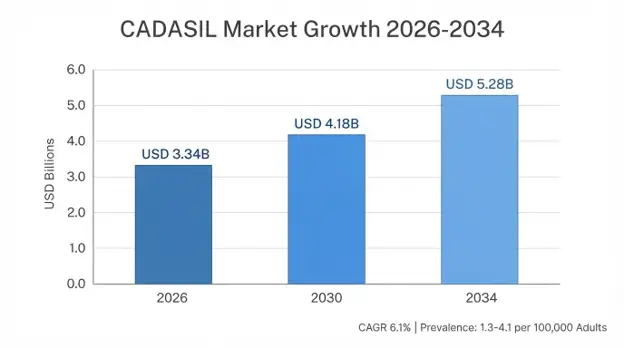
CADASIL is a rare but clinically important hereditary condition of the brain that causes changes in the brain's small blood vessels, which eventually lead to neurological symptoms affecting numerous organ systems. Recurrent lacunar ischemic stroke, occurring in middle-aged adults, progressive changes in white matter seen on brain imaging, cognitive decline culminating in dementia in about two thirds of those who develop the disease, and migraine with aura in almost half of patients are the characteristics of the disease. The NOTCH3 gene mutations produce an abnormal deposition of granular osmiophilic material in the wall of small cerebral blood vessels, causing abnormalities in the function of the vascular smooth muscle cells, impaired vasoreactivity, progressive narrowing of the vessel lumen, and ultimately ischemic injury of cerebral tissues.
Clinical symptoms reflect the progressive vascular pathology, and the onset is generally in the fourth to fifth decade of life, with the earliest symptom often being migraine with aura, followed by transient ischemic attacks and acute ischemic strokes with a primary distribution in subcortical structures, such as basal ganglia, internal capsule, and white matter tracts. Disease progression is characterized by silent lacunar lesions on neuroimaging, progressive cognitive slowing and executive dysfunction, behavioral changes such as apathy and mood disturbance, and eventual vascular dementia in most patients in the 7th decade of life. The disease burden is not just on the patient, and there are significant family implications with the autosomal dominant inheritance pattern because of the need for genetic counseling and screening of affected family members.
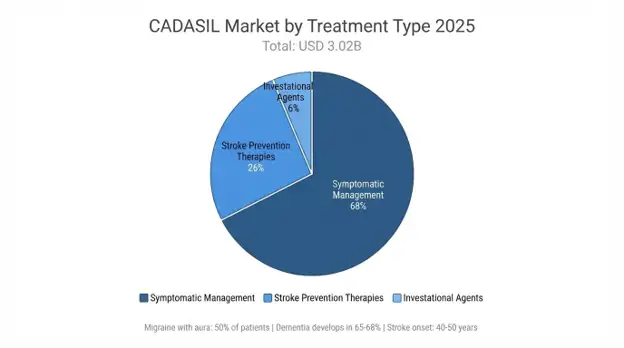
Current therapy is largely symptomatic and stroke prevention, with few disease-modifying drugs, antiplatelet agents such as aspirin and clopidogrel being used for secondary stroke prevention and evidence of efficacy limited to smaller randomized trials that did not specifically focus on CADASIL patients. The market has a high unmet clinical need for treatment and emerging therapies such as the carbonic anhydrase inhibitor acetazolamide, with potential for vascular hemodynamic improvement and potential use in migraine prophylaxis, and several investigational agents targeting NOTCH3 signaling pathways and vascular inflammation offer promising opportunities for development.
| Report Coverage | Details |
|---|---|
| Base Year | 2025 |
| Base Year Value | USD 3.02 billion |
| Forecast Value | USD 5.28 billion |
| CAGR | 6.1% |
| Forecast Period | 2025-2034 |
| Historical Data | 2022-2025 |
| Largest Market | Europe |
| Fastest Growing Market | Asia Pacific |
| Segments Covered | By Treatment Type, Indication, Drug Class, End-User, Region |
| Region Covered | North America, Europe, Asia Pacific, Middle East & Africa, Latin America |
| Countries Covered | United States, Canada, Mexico, United Kingdom, Germany, France, Italy, Spain, China, Japan, South Korea, India, Australia, Brazil, United Arab Emirates, Saudi Arabia |
| Key Market Playes | Roche Holding AG (Genentech), Eli Lilly and Company, Vesper Bio ApS, Artery Therapeutics, Inc., Maze Therapeutics, Novartis AG, Biogen Inc., Takeda Pharmaceutical Company Limited, BioMarin Pharmaceutical Inc., Alnylam Pharmaceuticals, Inc. |
Get more details on this report - Request Free Sample
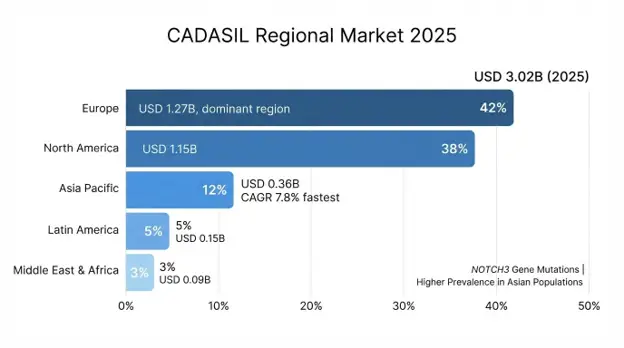
One of the main market drivers for expansion is increasing awareness of actual CADASIL prevalence, achieved by the increasing introduction of genetic screening programs and the enhancement of diagnostic algorithms. CADASIL was previously thought to be an extremely rare disorder, with prevalence estimates ranging from 1.3 to 4.1 per 100,000 adults and thus very small populations of patients, with estimates of 5 per 100,000 carrying pathogenic NOTCH3 mutations. In recent large-scale genomic studies and systematic screening efforts, however, much higher prevalence of NOTCH3 mutations has been found in the general population, with frequencies of mutations being particularly high in Asian populations, indicating a previously unknown disease burden in geographically diverse populations.
The diagnostic paradigm shift is the realization that many patients who have been reported as having sporadic ischemic stroke, unexplained cognitive decline, or primary progressive dementia may be a case of undiagnosed CADASIL, especially if they are younger adults with recurrent strokes or older people with vascular dementia. Using diagnostic criteria refinement, which includes neuroimaging features such as characteristic anterior temporal lobe and external capsule white matter hyperintensities, identification of pathognomonic subcortical lacunar lesions, and pathological skin biopsy findings that show NOTCH3 extracellular domain accumulation in vasculature, has greatly improved diagnostic accuracy. The rising awareness of CADASIL among neurologists, stroke specialists, and geriatricians and the growing number of genetic testing providers and availability of the test in clinical laboratories have driven significant growth in diagnosed prevalence, which enables growth in the market. Market growth is being driven by the increased awareness of diseases among physicians such as neurologists, stroke specialists, and geriatricians and the lower cost of genetic testing and greater availability of the test, including in clinical laboratories.
Key Performance Metrics:
The knowledge that CADASIL is associated with progressive cognitive deterioration leading to dementia in about 65-68% of patients has greatly broadened the clinical approach from only managing stroke and migraines to managing the cognitive and neuropsychiatric issues of CADASIL. The cognitive decline in CADASIL shows unique features with respect to deficits in executive function, slowed processing speed, and cognitive slowing that especially impacts attention and goal-oriented cognition but does not affect memory in early disease stages.
The neuropsychiatric burden includes mood disorders such as depression, which affects between 18 and 35% of CADASIL patients; apathy, experienced by 10-25% of the affected people; anxiety disorder; and behavioral problems, necessitating the incorporation of psychiatric care within CADASIL treatment programs. The burden of vascular cognitive impairment has led to the development of specialized centers for cognitive aging and vascular dementia programs with CADASIL expertise, creating market openings through diagnostic services, cognitive therapy, and behavior modification programs. Additionally, the association of progression of cognitive impairment with imaging findings such as the white matter hyperintensity burden and lacunar infarct formation has made neuroimaging an important measure of disease progression.
Cognitive and Neuropsychiatric Impact Metrics:
The primary restriction on the growth of the CADASIL market is the lack of FDA-approved drugs that can stop vascular pathogenesis caused by the activation of NOTCH3 or prevent the progression of the disease. The currently available methods are limited to the management of symptoms and lifestyle changes and do not target any underlying pathogenesis, thus reducing the value of drug treatment. Antiplatelet agents are used for secondary prevention of strokes following standard stroke prevention guidelines, but no randomized clinical trials proving their effectiveness for CADASIL patients have been conducted.
Therapeutic vacuum is caused by significant scientific barriers in converting knowledge of mutations of the NOTCH3 gene and accumulation of granular osmiophilic materials into therapeutic strategies for their targeting. Several mechanisms of pathological processes such as abnormal activation of the NOTCH3 pathway, aggregation of toxic proteins, and abnormal recruitment of extracellular matrix are not fully elucidated, which leads to the lack of appropriate approaches for developing drugs for CADASIL treatment. Progression of CADASIL with asymptomatic periods before onset of disease symptoms and individual variability in disease progression despite identical NOTCH3 mutations pose serious problems in conducting clinical trials.
Treatment Development Challenge Metrics:
Opportunities for market success will arise due to the development of antibodies and inhibitors that act upon NOTCH3 signaling dysfunction underlying the pathophysiology of CADASIL syndrome. Studies have shown that antibodies directed against the dysfunctional NOTCH3 extracellular domain aggregation are able to inhibit pathogenic aggregation and improve vascular smooth muscle cells in CADASIL animal models. Preliminary clinical studies into anti-NOTCH3 therapies have shown promising results of vascular function improvement by enhancing cerebrovascular vasoreactivity and tissue perfusion.
The therapeutic potential includes the development of small molecules that act as inhibitors of the downstream NOTCH3 signaling pathway, such as gamma-secretase inhibitors, which can block NOTCH3 protein cleavage; modulators for vascular smooth muscle cell dysfunction; and molecules that will help vascular repair mechanisms. The combination therapy using different mechanisms like anti-inflammatory agents, antioxidants to counteract the oxidative stress in vasculature, and drugs to improve cerebrovascular blood flow may be more effective than monotherapy.
Immunotherapy Development Opportunity Metrics:
The worldwide market for CADASIL treatment is marked by low concentration, wherein the treatment landscape consists of generic antiplatelet drugs and off-label use of neurology drugs. Major organizations working on research and development of CADASIL products are Genentech/Roche, developing treatments based on NOTCH3; Eli Lilly, studying therapeutic antibodies; and Biogen and Novartis, collaborating with academia, along with many other small biotech firms that are developing pathway-specific treatments. The competition focuses more on advancements in research and development rather than being market concentrated due to the low availability of specific disease treatments.
June 2026: Positive Phase II trial results for anti-NOTCH3 antibody GEN-001 for improved cerebrovascular vasoreactivity and slowed progression of cognitive decline in CADASIL patients were announced by Genentech, and Phase III trials are expected to get underway in late 2026.
April 2026: The research consortium, with the University of Cambridge at its helm, shared its detailed results on NOTCH3 aggregation mechanisms, fueling efforts to validate NOTCH3 as a therapeutic target and boost investment in NOTCH3-targeting initiatives.
March 2026: The cureCADASIL Foundation established an international patient registry and biobank to facilitate clinical research acceleration and to build up multi-center clinical trial infrastructure.
January 2026: Eli Lilly started Phase II clinical trial for a monoclonal antibody that targets the extracellular domain of NOTCH3 in CADASIL patients, marking the first development program sponsored by a company on CADASIL-specific immunotherapy.
You'll get the sample you asked for by email. Remember to check your spam folder as well. If you have any further questions or require additional assistance, feel free to let us know via-
+1 724 648 0810 +91 976 407 9503 sales@intellectualmarketinsights.com
11 Aug 2026
Intellectual Market Insights Research © 2026. All rights reserved.