Share this link via:

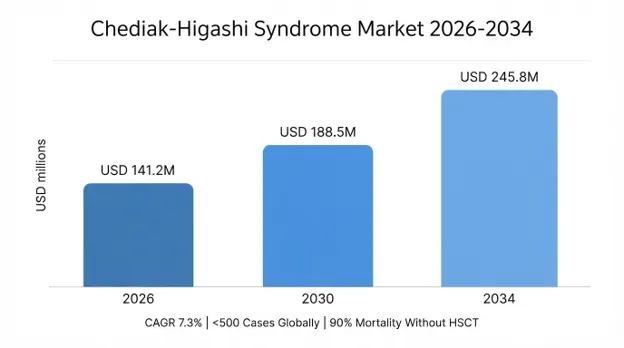
The global Chediak-Higashi syndrome market size was valued at USD 128.4 million in 2025 and is projected to reach USD 141.2 million in 2026, expanding to USD 245.8 million by 2034, growing at a CAGR of 7.3% during the forecast period (2026-2034).
Chediak-Higashi syndrome is an extremely rare condition inherited in an autosomal recessive manner that is caused by biallelic mutations in a gene called "lysosomal trafficking regulator" (LYST or CHS1), which causes defective lysosomal trafficking and organelle biogenesis in several organ systems. This rare disease expresses in a specific clinical trial of impaired melanosome biogenesis (partial oculocutaneous albinism), primary immunodeficiency (recurrent life-threatening infections from defects in neutrophil function and natural killer cells), and progressive neurological degeneration (peripheral nervous system and central nervous system). The pathophysiological feature is the accumulation of abnormally large nonfunctional lysosomes and lysosome-like organelles in granulocytes, melanocytes, platelets, and neurons, which is manifested by the presence of characteristic peroxidase-positive giant azurophilic granules on peripheral blood smear examination.
The clinical significance of Chediak-Higashi syndrome is not limited to the primary features of the disease but also to a more severe phase of the illness, the so-called accelerated phase, which occurs in 50-85 percent of affected children and is a hemophagocytic lymphohistiocytosis-like state involving uncontrolled activation of macrophages and lymphocytes, infiltration into multiple organs, and a systemic inflammatory response that often results in death if it is not treated aggressively. The accelerated phase is characterized by high fever, hepatosplenomegaly, lymphadenopathy, pancytopenia, hemophagocytosis, and coagulopathy and is the most important cause of death in untreated disease, most of whom die before the second decade of life without intervention.
Only about 500 cases of the disease have been reported globally, and the incidence is estimated to be less than one in one million people, but the true prevalence may be higher because of the difficulty of diagnosis in the context of phenotypic variability and delayed diagnosis in atypical presentations. There are different clinical syndromes, with classic Chediak-Higashi syndrome appearing in early childhood with a markedly severe immunodeficiency and rapid onset of disease, while adult-onset or atypical variants with missense mutations exhibit a milder immunologic phenotype and progressive neurological dysfunction and require tailored diagnostic evaluation and treatment approaches. The market serves an ultra-rare disease population that has a very small number of patients but high per-patient healthcare costs due to complex multidisciplinary management needs, specialized diagnostic procedures, intensive supportive care, and high-cost curative interventions.
| Report Coverage | Details |
|---|---|
| Base Year | 2025 |
| Base Year Value | USD 128.4 Million |
| Forecast Value | USD 245.8 Million |
| CAGR | 7.3% |
| Forecast Period | 2025-2034 |
| Historical Data | 2022-2025 |
| Largest Market | North America |
| Fastest Growing Market | Asia Pacific |
| Segments Covered | By Disease Management Category, Treatment Modality, Genetic Testing Approach, Patient Age Group, Disease Severity Classification |
| Region Covered | North America, Europe, Asia Pacific, Middle East & Africa, Latin America |
| Countries Covered | US, Canada, UK, Germany, France, Spain, Italy, Netherlands, Japan, China, India, Australia, South Korea, Brazil, UAE, Saudi Arabia, South Africa |
| Key Market Playes | Specialized Immunology Centers, Hematology-Oncology Hospitals, Stem Cell Transplant Facilities, Rare Disease Research Institutions |
Get more details on this report - Request Free Sample
The key factors fueling the growth of the Chediak-Higashi syndrome market include the significantly enhanced diagnostic recognition and increased uptake of the next-generation genetic testing methodologies, such as next-generation sequencing (NGS) panels for primary immunodeficiencies (PIDs) and whole-exome sequencing (WES) that allows fast and accurate identification of biallelic mutations in the LYST gene. The main problem was the time between the onset of the symptoms and the diagnosis, which was typically 2 to 4 years, giving a window of opportunity for the disease to progress and develop accelerated-phase complications that are life-threatening. As next-generation sequencing has grown in availability and accessibility in recent years with costs falling and lab capacity rising and clinicians are becoming more aware of the manifestations of Chediak-Higashi syndrome, the time between clinical presentation and diagnosis has been decreasing over the years, allowing for earlier diagnosis at a stage when it can be treated with curative stem cell transplantation before irreversible neurological changes or accelerated phase development occurs.
The diagnostic recognition improvement also encompasses the use of sophisticated laboratory techniques, such as flow cytometry, which shows decreased capacity for degranulation of natural killer cells; impaired function of cytotoxic T lymphocytes; immunological testing showing neutropenia and abnormal immune responses; and molecular genetic testing confirming pathogenic variants in the LYST gene. Early-onset partial albinism, recurrent infections, and bleeding disorders have been the subject of screening programs, which have greatly increased the number of cases identified, especially in dedicated referral centers for primary immunodeficiencies. Hospital systems are increasingly establishing infant diagnostic testing programs that include testing of the LYST gene, which allows the identification of affected newborns at a very early stage of the disease, before symptoms or when the symptoms are mild, and when therapeutic intervention has the best chance of success.
Key Performance Metrics:
The absolute therapeutic need in the treatment of Chediak-Higashi syndrome (CHS) is enormous, and the quantity of hematopoietic stem cell transplantation (HSCT) services, conditioning regimens, supportive care products, and post-transplant monitoring from specialized transplant centers around the world is clearly substantial. Management without transplantation has a uniformly poor prognosis, with about 90% of untreated children dying before the age of 10 years, leading mainly to overwhelming infections or the development of accelerated-phase hemophagocytic lymphohistiocytosis, making prompt diagnosis and referral for transplantation a strong motivation.
Over the last 20 years, the outcome of HSCT has continued to improve, with five-year overall survival in more recent cohorts reaching 62 percent in patients who had undergone conditioning using optimized regimens, who were matched for HLA, and who had received supportive care optimized to improve these results. Early diagnosis and timely intervention are critical, as the 5-year survival of patients transplanted before the accelerated phase is >75%, while those transplanted during active HHLH have much lower rates. The transplant market is highly varied with a wide spectrum of modalities such as HLA-identical sibling donations, matched unrelated donor transplants, haploidentical family member transplants, and cord blood transplants, each associated with differing clinical outcomes and different therapeutic implications.
Key Performance Metrics:
The largest restraint that is inhibiting growth within the Chediak-Higashi syndrome market is the fact that there is an extremely small and fractured group of patients, less than 500 worldwide, making it difficult to conduct enough research, develop specific devices, or even build necessary infrastructure when compared with rare diseases that have more patients. This ultra-rare disease will provide limited opportunity for revenue from drug treatments because the patient group worldwide, regardless of severity, is too small to generate profits like those made in conventional disease markets.
The limited number of patients poses challenges related to recruiting and conducting clinical trials, as obtaining relevant data on efficacy and safety would take time, involve multicenter work, and be flexible with respect to statistics and choice of endpoints, especially if considering disease modification therapies. The rare nature of Chediak-Higashi syndrome means that patients are scattered in different academic medical centers and tertiary care facilities all around various regions, which would make it difficult to conduct the comparative effectiveness analysis required for guideline making. Parents of the patients are also geographically isolated from specialized centers, meaning much traveling and staying away from their community for a long time; there are fewer patient support organizations compared to other rare diseases.
Key Performance Metrics:
The market has an exciting prospect for developing novel gene therapies and genome editing techniques that can directly address the problem of correcting the mutations in the LYST gene via gene replacement, base editing, prime editing, or using CRISPR Cas9 methods to restore proper lysosomal traffic flow and prevent the onset of immune and neurological symptoms of this condition. Due to the nature of the genetics of the disease, being linked to certain biallelic mutations in the LYST gene, there is great potential for gene therapeutic approaches as opposed to other polygenic disorders.
Preclinical studies with animal models such as LYST gene knock-in mice and Persian cat models with mutations in the LYST gene have shown that LYST gene replacement can restore normal lysosomal function by using lentiviral and adeno-associated viral (AAV) gene transfer. Optimizing the development of vectors; identification of target tissues (whether hematopoietic stem cell gene therapy is sufficient or combined therapies with neuronal tissue targeting are needed); and scale-up of manufacturing for therapeutic vector production are necessary steps toward human clinical applications. It is noteworthy that the limited number of patients means that market valuation is high; even if the treatment is for a disease that is potentially curatively treatable through gene therapy and could stop disease progression in the nervous system, families and health systems would be willing to pay for such treatment in a normally progressive, fatal disease.
Gene Therapy Opportunity Metrics:
The field of Chediak-Higashi syndrome is undergoing revolutionary change in the way treatments can be offered, transforming from the use of family member donors, where most are HLA-matched, to the use of umbilical cord blood (UCB) transplantation approaches that significantly increase the number of patients available for treatment beyond the HLA-matched sibling and HLA-matched unrelated donor sources. For many years, the demand for HLA-matched donors has restricted transplantation to about 25-30 percent of patients who have a matched sibling or a successfully matched unrelated donor, leaving most disease patients without access to potentially curing them of the disease because their donors were unavailable. Improvements in the technique of haploidentical transplantation, which have occurred over the last few years, have included the use of T cell-replete grafts, accompanied by post-transplant cyclophosphamide-based regimens, selective T cell depletion protocols, and better GVHD prevention, and have led to improved results with haploidentical stem cell transplants, with reported survival rates increasingly approaching those of HLA-matched donor transplantation.
Sources of umbilical cord blood stem cells offer alternative donor options for children who don't have a matched sibling donor, and transplantation from such donors has been successful in the treatment of the rare immunodeficiencies associated with Chediak-Higashi syndrome. Progressively, with the increasing number of cord blood banks and the development of more effective ex vivo expansion methods to achieve the use of high cell doses from smaller cord blood units, the potential of cord blood transplantation has been expanding. New approaches that are currently being investigated involve gene-modified haploidentical transplantation techniques that feature improved T cell selection and positive selection of beneficial T cell populations. By moving to expanded donor source utilization, the prognosis of the disease itself changes because the ability to be able to access the disease for a curative transplant is now open to patients who may have been excluded because of donor limitations, which will have a direct impact on overall disease burden and patient survival rates.
Haploidentical Transplantation Adoption Metrics:
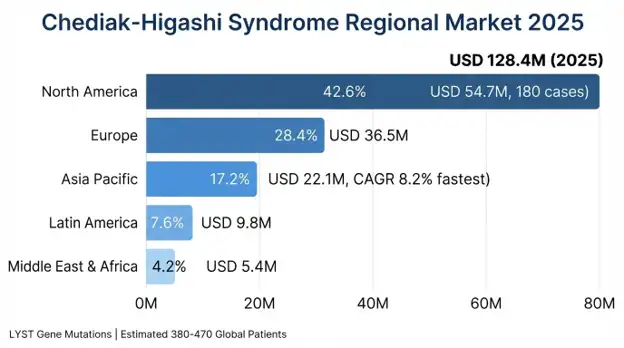
North America was the leading market shareholder with USD 54.7 million in 2025, which accounted for 42.6 percent of the total global market revenue, and the region is expected to hold a steady projected CAGR of 7.1% until 2034. Market dominance by the region can be attributed to the availability of specialized immunology and hematology-oncology clinics; familiarity with complex genetic immunodeficiencies; an advanced hematopoietic stem cell transplantation program with well-established treatment protocols and outcomes databases; provision of comprehensive insurance coverage for expensive diagnostic and treatment measures; and advanced infrastructure for research in understanding the Chediak-Higashi syndrome.
The U.S., accounting for 76% of regional market revenue, has around 180 patients of Chediak-Higashi syndrome recorded via specialized centers and registries. The region has well-established pediatric and adult immunodeficiency clinics with more than 340 certified hematology-oncology specialists having transplant medicine training; comprehensive genetic test facilities through leading laboratory networks and academic medical centers; and advanced imaging facilities allowing for disease surveillance. FDA orphan drug pathway and breakthrough therapy designations for novel treatments are available in the regulatory environment.
Regional Metrics:
The Asia Pacific region has been identified as the region with the highest growth rate at a CAGR of 8.2%, growing from the current market value of USD 22.1 million to a much larger value in 2034. Factors contributing to growth in this region include the increasing availability of next-generation sequencing technologies for genetic testing in major cities of this region; the setting up of specialty immunology centers and transplant centers in China, India, Japan, and South Korea; and increasing awareness among physicians about rare genetic diseases. China has emerged as an important market player in this region due to the presence of around 35-40 documented cases of Chediak-Higashi syndrome.
India exhibits growth potential in the form of development of rare disease diagnostic networks and increased training of medical subspecialties such as immunology and hematology. Japan holds the most established patient registry for Chediak-Higashi syndrome in the Asian region, where there are systematically documented cases of about 28-32 patients of Chediak-Higashi syndrome. The region benefits from participation in international research activities and rare disease registries.
Regional Growth Indicators:
The market share of immunodeficiency management is expected to hold a 48% share, worth USD 61.6 million, by 2025, on account of infection protection, antimicrobial agents, vaccinations, and standard care. Management of accelerated-phase Hemophagocytic Lymphohistiocytosis (HLH) is estimated to hold a 32% share worth USD 41.1 million and is further anticipated to register a CAGR of 7.8% up until 2034, owing to early detection, aggressive immunosuppressive therapy, and urgent transplantation requirements. The rest of 20% of the market share is expected to be held by neurological symptom management, worth USD 25.7 million by 2025.
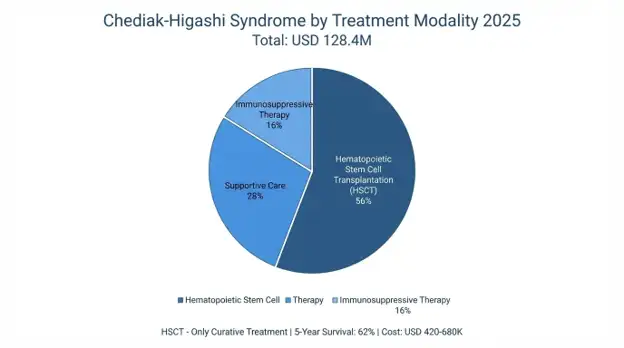
Hematopoietic stem cell transplant (HSCT) takes the lead with a 56% market share in terms of value at USD 71.8 million in 2025, with a forecasted CAGR of 7.9% up to 2034, due to advancements in donor availability, conditioning treatments, and post-transplantation care. The supportive care segment constitutes 28% of the market and is estimated at USD 36.0 million in 2025 due to antimicrobial prophylaxis, blood transfusion, nutrition management, and life-quality improvements. The immunosuppressive therapy accounts for the rest of 16%, which equals USD 20.5 million in 2025, and is driven by treatment protocol innovations for accelerated phase disease.
Specialized immunology centers make up the largest user segment of the market, having a market share of 38 percent and generating a revenue of USD 48.8 million by 2025 through providing diagnosis, genetic counseling, and comprehensive disease management services. Hematology-oncology departments hold a market share of 34 percent, worth USD 43.7 million by 2025, and deal with hematopoietic stem cell transplantations and accelerated phase issues. The rare disease research institutions have a market share of 18%, worth USD 23.1 million, by 2025.
The market for Chediak-Higashi syndrome is characterized by the presence of relatively low to moderate competitive concentration due to the ultra-rare status of the disease and the small size of its patient population base, with no firm holding a dominant position in terms of market share. In fact, the competition in the market for Chediak-Higashi syndrome is defined by the participation of dedicated academic medical centers, tertiary transplant centers, rare disease research organizations, and developing biotech firms.
You'll get the sample you asked for by email. Remember to check your spam folder as well. If you have any further questions or require additional assistance, feel free to let us know via-
+1 724 648 0810 +91 976 407 9503 sales@intellectualmarketinsights.com
11 Aug 2026
Intellectual Market Insights Research © 2026. All rights reserved.