Share this link via:

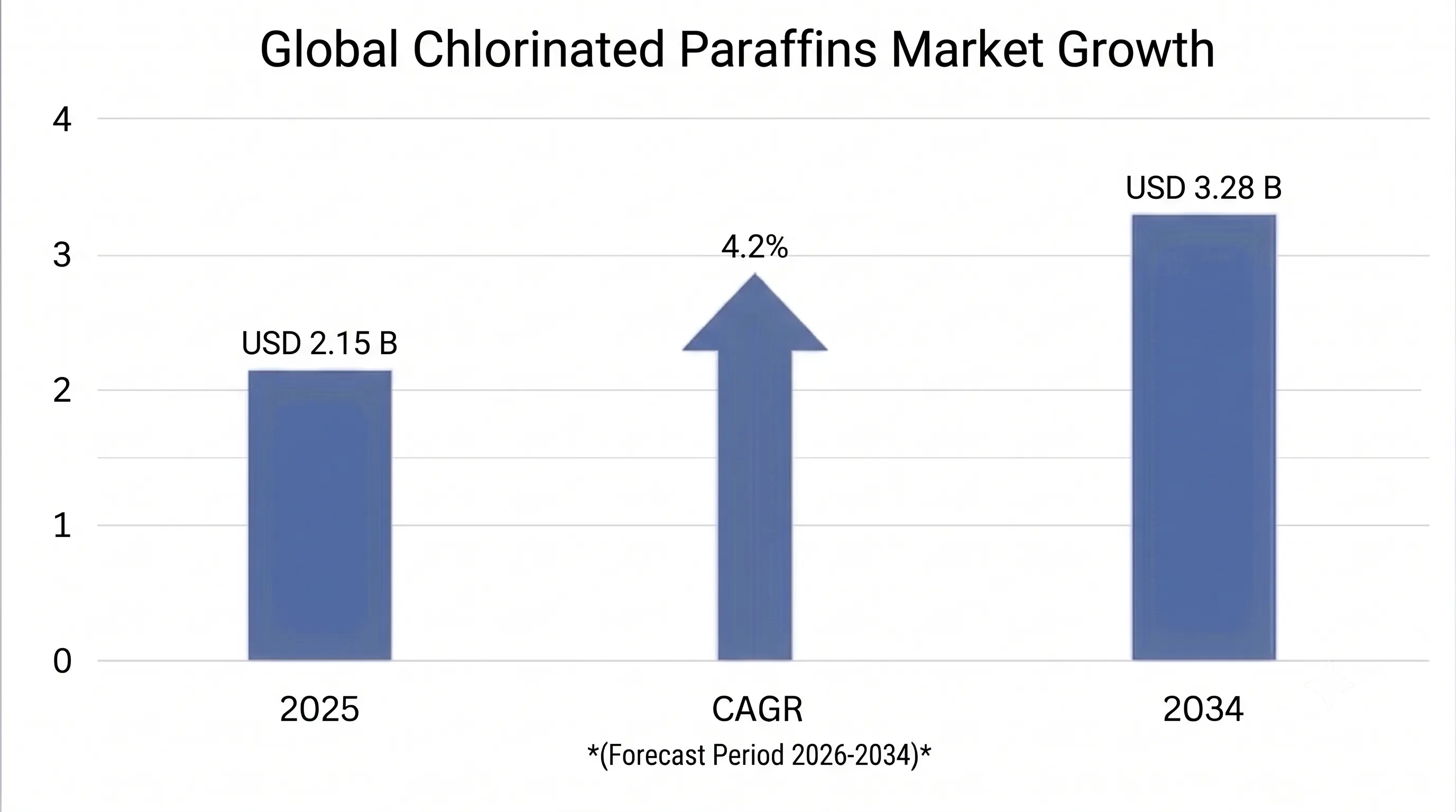
The global chlorinated paraffins market size was valued at USD 2.15 billion in 2025 and is projected to reach USD 2.35 billion in 2026, expanding to USD 3.28 billion by 2034, growing at a CAGR of 4.2% during the forecast period (2026-2034).
Chlorinated paraffins represent complex mixtures of polychlorinated n-alkanes produced through the controlled chlorination of straight-chain paraffin fractions derived from petroleum refining processes. These versatile industrial chemicals are systematically classified by carbon chain length into short-chain chlorinated paraffins (SCCPs, C10-C13), medium-chain chlorinated paraffins (MCCPs, C14-C17), and long-chain chlorinated paraffins (LCCPs, C18-C30), with chlorine content typically ranging from 30% to 72% by weight. Each category exhibits distinct physicochemical properties that determine specific industrial applications, with higher chlorine content generally conferring enhanced flame retardancy and reduced volatility, while carbon chain length influences viscosity, plasticizing efficiency, and critically, environmental persistence characteristics that have become central to global regulatory considerations.
The industrial utility of chlorinated paraffins derives from their exceptional multifunctional performance characteristics, including superior flame retardancy through radical scavenging mechanisms, effective plasticization properties, extreme-pressure lubrication capabilities, and remarkable chemical stability under harsh operating conditions. In polyvinyl chloride compounding, chlorinated paraffins function simultaneously as secondary plasticizers and flame retardants, reducing manufacturing costs while meeting stringent fire safety standards for cables, flooring, wall coverings, and flexible sheeting applications. In metalworking operations, their extreme-pressure lubrication properties are particularly valuable, as the localized heat generated during metal cutting and forming causes controlled decomposition that forms protective metal chloride boundary films on tooling surfaces, preventing micro-welding, reducing friction, and significantly extending tool life in demanding machining applications involving high-strength steels, stainless alloys, and titanium components.
The commercial landscape of the chlorinated paraffins market is currently experiencing profound structural transformation driven by evolving international environmental regulations and health safety standards. The Stockholm Convention’s classification of short-chain chlorinated paraffins as persistent organic pollutants has initiated a comprehensive industry-wide transition toward medium-chain and long-chain alternatives, necessitating extensive reformulation efforts across multiple manufacturing sectors. This regulatory evolution has created a dual-track market dynamic where demand remains robust in emerging economies with expanding industrial bases and relatively flexible regulatory frameworks, while developed markets demonstrate accelerated substitution toward environmentally compliant MCCP and LCCP formulations. The market’s resilience stems from chlorinated paraffins’ cost-effectiveness compared to many alternative systems, their proven performance across decades of industrial use, and the technical challenges associated with direct substitution in critical applications where performance reliability and economic viability must be carefully balanced against environmental considerations.
| Report Coverage | Details |
|---|---|
| Base Year | 2025 |
| Base Year Value | USD 2.15 Billion |
| Forecast Value | USD 3.28 Billion |
| CAGR | 4.2% |
| Forecast Period | 2025-2034 |
| Historical Data | 2022-2025 |
| Largest Market | Asia Pacific |
| Fastest Growing Market | Asia Pacific |
| Segments Covered | By Product Type, Application, Chlorination Level, End-Use Industry, Region |
| Region Covered | North America, Europe, Asia Pacific, Middle East & Africa, Latin America |
| Countries Covered | US, Canada, Mexico, UK, Germany, France, Italy, Spain, Netherlands, Poland, China, Japan, India, South Korea, Australia, Indonesia, Thailand, Vietnam, Brazil, Argentina, UAE, Saudi Arabia, South Africa |
| Key Market Playes | INEOS Group (INOVYN), Aditya Birla Chemicals, Dover Chemical Corporation, KLJ Group, Caffaro Industrie, Leuna-Tenside GmbH, Quimica del Cinca |
Get more details on this report - Request Free Sample
The primary structural driver propelling chlorinated paraffins market expansion is the sustained growth of industrial manufacturing and infrastructure development across Asia Pacific, the Middle East, and Latin America, where chlorinated paraffins serve critical functions in metalworking fluids, PVC processing, and construction materials. China’s manufacturing sector, which represents the world’s largest industrial base, continues to drive substantial demand for CP-containing metalworking fluids in automotive component production, machinery manufacturing, and precision engineering operations. The country’s automotive production reached 31.6 million vehicles in 2024, maintaining its position as the global leader and sustaining substantial consumption of extreme-pressure metalworking fluids incorporating chlorinated paraffins for stamping, machining, and gear manufacturing operations.
Infrastructure expansion across emerging economies directly amplifies chlorinated paraffin demand through consumption in PVC cables, flexible construction materials, and industrial coatings. Asia Pacific construction activity grew at approximately 6.2% annually between 2022 and 2025, translating into increased demand for CP-containing PVC cables, flooring materials, roofing membranes, and building profiles. The urbanization process in India, Indonesia, Vietnam, and other rapidly developing nations is creating sustained demand for electrical infrastructure, residential construction, and commercial development projects that rely heavily on cost-effective PVC systems incorporating chlorinated paraffins as secondary plasticizers and flame retardants.
Chlorinated paraffins maintain significant competitive advantages through their favorable cost-performance ratio compared to alternative plasticizer, flame retardant, and extreme-pressure additive systems, particularly in price-sensitive manufacturing applications where performance reliability and economic efficiency are paramount considerations. In PVC compounding, chlorinated paraffins deliver simultaneous plasticization and flame retardancy at substantially lower cost than combinations of phthalate-free plasticizers with halogen-free flame retardants, making them particularly attractive for mass-market applications including cables, flooring, profiles, and automotive components where cost pressures are intense.
The economic advantages are most pronounced in metalworking applications, where chlorinated paraffins provide extreme-pressure performance equivalent to more expensive sulfur-phosphorus and synthetic ester additives at significantly lower formulation costs. For manufacturers operating in competitive industrial markets, the ability to achieve required machining performance while maintaining cost competitiveness through CP-based formulations represents a critical commercial advantage, particularly in emerging economies where labor costs and operational efficiency directly impact manufacturing viability.
The most consequential constraint limiting the chlorinated paraffins market’s growth is comprehensive international regulatory restrictions targeting environmental persistence, bioaccumulation potential, and toxicity concerns, particularly the Stockholm Convention’s listing of short-chain chlorinated paraffins as persistent organic pollutants requiring global elimination or severe restriction. The European Union’s REACH regulation restricts SCCP concentrations to below 1% by weight in substances and mixtures and below 0.15% in articles, effectively eliminating SCCP use across EU manufacturing operations and creating complex compliance requirements for imported products containing chlorinated paraffins.
The regulatory landscape continues to evolve with increasing scrutiny of medium-chain chlorinated paraffins, as the European Chemicals Agency has initiated restriction evaluation processes that could result in MCCP use limitations by 2028-2030. This regulatory uncertainty creates significant compliance burdens for manufacturers and requires extensive reformulation efforts, supply chain auditing, and documentation systems to ensure market access in regulated jurisdictions. The compliance costs associated with REACH registration, substance characterization, and ongoing monitoring requirements have increased 22% between 2020-2025 for European MCCP manufacturers, creating economic pressures that favor larger, technically sophisticated producers capable of managing complex regulatory obligations.
Beyond formal regulatory restrictions, growing scientific evidence that links chlorinated paraffins to endocrine disruption, hepatotoxicity, and potential carcinogenicity in animal studies is driving precautionary substitution efforts by multinational manufacturers seeking to future-proof their supply chains against anticipated regulatory expansion. Several major automotive OEMs, consumer goods companies, and electronics manufacturers have established internal chemical management policies restricting or phasing out chlorinated paraffin use ahead of formal regulatory requirements, creating demand pressure throughout their supply chains for qualified alternative formulations.
The development and commercialization of alternative systems, including bio-based plasticizers, phosphorus-based flame retardants, and synthetic extreme-pressure additives, is gradually eroding chlorinated paraffin market share in premium applications where environmental attributes command commercial value. While cost differentials remain substantial, with bio-based alternatives commanding 40-120% price premiums over equivalent CP grades, the pace of substitution is accelerating in applications where regulatory compliance, brand sustainability commitments, or customer specifications justify premium costs.
The regulatory elimination of SCCPs and potential future restrictions on MCCPs create substantial market opportunities for long-chain chlorinated paraffins, which currently face fewer regulatory constraints while demonstrating comparable functional performance in many PVC, rubber, and metalworking applications. Manufacturers that invest in LCCP production capacity and application development are strategically positioned to capture demand migration from restricted shorter-chain grades, particularly in markets where regulatory compliance is actively enforced and manufacturers require technically validated substitutes with established regulatory status.
LCCP demand demonstrated exceptional growth at 9.8% annually between 2020-2025, significantly outpacing overall chlorinated paraffin market expansion, as European, North American, and Japanese manufacturers reformulated products to eliminate SCCP content and progressively reduce MCCP usage. The development of application-specific LCCP grades optimized for PVC flexibility, metalworking lubrication, and rubber processing represents ongoing technical differentiation opportunities for producers capable of manufacturing high-purity, consistent LCCP fractions meeting increasingly stringent customer specifications.
Rapid industrialization across Southeast Asia, South Asia, the Middle East, and Sub-Saharan Africa creates substantial structural demand growth opportunities for chlorinated paraffins in markets where regulatory restrictions remain limited and cost-competitive industrial additives command strong preference. India’s manufacturing sector expansion under Production Linked Incentive schemes is driving significant growth in electronics, automotive, and textile manufacturing, sectors that consume chlorinated paraffins in various processing and formulation applications without the substitution pressures characterizing developed market demand.
Manufacturing base diversification strategies redirecting production from China to Vietnam, Indonesia, Bangladesh, Mexico, and other emerging economies are creating new geographic demand centers for industrial chemical additives, including chlorinated paraffins used in metalworking, PVC processing, and rubber manufacturing. These markets offer attractive growth prospects for CP producers capable of establishing local manufacturing, distribution, and technical support capabilities tailored to regional industrial requirements and regulatory environments.
The chlorinated paraffins industry is experiencing significant technical innovation as manufacturers develop application-specific CP grades optimized to deliver the required functional performance at minimum chlorine content and chain length necessary to satisfy evolving regulatory requirements. Advanced chlorination process control technologies enabling precise distribution of chlorine content across paraffin chain lengths are facilitating production of higher-purity, more consistent CP grades that meet increasingly specific customer performance requirements while minimizing regulatory risk exposure.
Computational modeling of chlorinated paraffin structure-activity relationships is enabling more rational design approaches, reducing reliance on empirical formulation development and accelerating qualification of new grades for regulated markets. Leading CP manufacturers have established dedicated application laboratories providing customers with reformulation support, substitution validation services, and comprehensive regulatory documentation, reflecting the increasing technical sophistication required for competitive success in markets where regulatory compliance represents a prerequisite for market access.
A notable industry trend involves progressive transition toward hybrid formulations combining reduced chlorinated paraffin loadings with complementary additive systems, enabling manufacturers to improve environmental profiles while retaining essential CP functionality. Formulators increasingly design metalworking fluids, PVC compounds, and industrial coatings incorporating chlorinated paraffins in synergy with sulfurized, phosphorus-based, or bio-derived additives, achieving overall chlorine content reduction while maintaining performance requirements in critical applications.
This hybrid approach serves as a transitional pathway for manufacturers requiring improved environmental credentials and customer compliance but not yet prepared to completely eliminate chlorinated paraffins due to cost or performance constraints. The market is witnessing proliferation of “optimized” CP-containing systems marketed as balanced solutions between cost efficiency, performance reliability, and regulatory risk management.
Asia Pacific dominates the global chlorinated paraffins market with approximately 68% of total consumption valued at USD 1.46 billion in 2025, driven by the region’s position as the world’s manufacturing center for PVC products, automotive components, electronics, and industrial goods. China alone accounted for approximately 52% of global CP consumption in 2025, reflecting its unparalleled manufacturing scale combined with a regulatory environment that, while increasingly attentive to SCCP risks, has not implemented restrictions as comprehensive as those enforced in Europe or North America.
China’s domestic chlorinated paraffin production capacity reached approximately 1.1 million metric tons annually in 2025, establishing the country as the dominant global producer and exporter, with significant volumes supplied to Southeast Asian, South Asian, Middle Eastern, and African markets. India represents the second-largest regional consumer, with CP consumption growing 8.9% annually between 2020-2025, driven by PVC cable manufacturing, automotive component production, leather processing, and expanding metalworking sectors supported by government industrialization initiatives.
The region’s market trajectory is increasingly influenced by China’s evolving chemical regulatory framework, with the Ministry of Ecology and Environment conducting environmental risk assessments of SCCPs that may result in domestic use restrictions, potentially redirecting Chinese CP production toward MCCP and LCCP grades while maintaining export market leadership through cost-competitive manufacturing capabilities.
Europe represents a mature, highly regulated chlorinated paraffins market characterized by complete SCCP elimination and increasingly restrictive MCCP usage while demonstrating significant value-mix improvement as demand concentrates in compliant LCCP grades commanding premium pricing. The European CP market was valued at USD 198 million in 2025, reflecting regulatory impact that has eliminated broad categories of CP applications while concentrating remaining demand in compliant industrial uses including LCCP-based metalworking fluids, specialized PVC compounds, and technical rubber applications.
European market dynamics are characterized by high technical sophistication requirements, with manufacturers demanding comprehensive regulatory documentation, detailed substance characterization, and extensive environmental fate data supporting REACH registration and downstream user compliance obligations. This regulatory complexity creates significant barriers favoring established CP producers with robust analytical capabilities and regulatory expertise, supporting substantial price premiums for compliant LCCP grades relative to global average pricing levels.
The market outlook remains stable for specialized applications where chlorinated paraffins provide irreplaceable performance characteristics, while continued regulatory evolution may further restrict MCCP usage, accelerating transition toward LCCP-only portfolios for European manufacturers maintaining CP-based product lines.
North America demonstrates relatively stable chlorinated paraffin consumption in industrial applications, with a market value of USD 287 million in 2025, offset by structural decline in consumer-oriented and strictly regulated segments. Regulatory frameworks and corporate sustainability initiatives encourage substitution toward non-chlorinated alternatives, while heavy metalworking, specialized PVC applications, and industrial products maintain CP usage where technical performance and cost efficiency remain paramount considerations.
The regional market increasingly focuses on compliant MCCP and LCCP products with enhanced documentation and technical support, serving niche applications where consistent quality and performance reliability are critical. North American producers compete primarily on regulatory compliance capability and application expertise rather than price, maintaining viable market positions despite cost disadvantages relative to Asian manufacturers.
Medium-Chain Chlorinated Paraffins (MCCPs) dominate global consumption with 48% market share valued at USD 1.03 billion in 2025, reflecting their position as the primary replacement for restricted SCCPs while maintaining favorable regulatory status in many jurisdictions. MCCPs offer optimal performance characteristics across PVC, rubber, and metalworking applications, providing sufficient plasticizing efficiency and flame retardancy to serve as effective SCCP substitutes while currently avoiding the comprehensive restrictions applied to shorter-chain variants.
Long-Chain Chlorinated Paraffins (LCCPs) represent the fastest-growing segment and are projected to grow at a CAGR of 9.1% through 2034, driven by regulatory substitution demand and growing preference among manufacturers seeking supply chain regulatory resilience. LCCPs accounted for 33% of global consumption in 2025, with market share projected to expand to 44% by 2034 as MCCP regulatory risks increase and LCCP application development advances through targeted technical innovation.
Short-Chain Chlorinated Paraffins (SCCPs) retain approximately 19% of global consumption, concentrated in markets without Stockholm Convention restrictions, though this share continues declining as regulatory adoption expands and Chinese regulatory action on SCCPs progresses toward implementation.
PVC Plasticizers represent the largest application segment at 34% market share valued at USD 731 million in 2025, encompassing secondary plasticizer and flame retardant functions in flexible PVC cables, flooring, wall coverings, and automotive components. The segment benefits from construction sector growth and electrical infrastructure expansion in emerging economies where cost-competitive PVC systems incorporating chlorinated paraffins maintain strong market preference.
Metalworking Fluids account for 28% market share at USD 602 million in 2025, representing the most technically differentiated application where extreme-pressure performance characteristics are critical for machining quality and tool life extension. The segment demonstrates resilience to substitution pressure in heavy-duty applications where alternative additives have not demonstrated equivalent performance at competitive costs.
Flame Retardants comprise 22% market share at USD 473 million in 2025, serving fire safety requirements in construction materials, electrical components, and transportation applications where regulatory standards mandate flame retardancy and chlorinated paraffins provide cost-effective compliance solutions.
PVC & Plastics represents the dominant end-use sector at 42% market share, consuming chlorinated paraffins as secondary plasticizers and flame retardants across cable insulation, flexible sheeting, flooring, and automotive interior components. Demand correlates directly with construction activity, automotive production, and electronics manufacturing, providing broad economic exposure supporting demand stability.
Metalworking & Engineering accounts for 28% market share, utilizing chlorinated paraffins as extreme-pressure additives in cutting oils, drawing fluids, and forming lubricants where performance reliability under high-stress conditions is essential for manufacturing quality and operational efficiency.
Construction Industry comprises 18% market share through indirect consumption via CP-containing PVC materials, coatings, sealants, and adhesives used in residential and commercial construction projects, with demand driven by urbanization and infrastructure development in emerging markets.
The global chlorinated paraffins market exhibits moderate concentration with Chinese manufacturers collectively dominating production capacity while Western producers maintain competitive positions through product quality, regulatory compliance expertise, and technical service differentiation in premium market segments. The leading ten global producers control approximately 55-62% of total production capacity, with significant concentration among Chinese chemical companies and established international specialty chemical manufacturers.
Competitive differentiation in regulated markets centers on REACH compliance documentation quality, substance characterization depth, application technical support capabilities, and supply chain traceability assurance. European and North American producers compete primarily on regulatory compliance and technical expertise rather than price, maintaining viable positions in LCCP segments despite cost disadvantages relative to Asian manufacturers.
Market consolidation is anticipated as regulatory requirements increase barriers to entry and favor producers with comprehensive quality control systems, analytical capabilities, and regulatory expertise necessary for success in increasingly sophisticated global markets.
March 2026: INEOS Group announced expansion of LCCP production capacity at European facilities by 35,000 metric tons annually, targeting growing demand from regulated markets seeking SCCP and MCCP substitutes with comprehensive regulatory documentation.
February 2026: The European Chemicals Agency published updated MCCP risk assessment guidance under REACH, initiating restriction evaluation processes that could result in MCCP use limitations in specific applications by 2028-2030.
January 2026: KLJ Group commissioned new chlorinated paraffins production capacity in India with 60,000 metric tons annual capacity, targeting domestic PVC, rubber, and metalworking markets experiencing above-average growth.
November 2025: Dover Chemical Corporation introduced specialized LCCP grades optimized for metalworking applications, demonstrating equivalent extreme-pressure performance to MCCP formulations in comprehensive testing programs.
October 2025: Aditya Birla Chemicals announced strategic partnership with European technical service provider to enhance LCCP application development and regulatory support capabilities for global customers.
You'll get the sample you asked for by email. Remember to check your spam folder as well. If you have any further questions or require additional assistance, feel free to let us know via-
+1 724 648 0810 +91 976 407 9503 sales@intellectualmarketinsights.com
01 Jul 2026
Intellectual Market Insights Research © 2026. All rights reserved.