Share this link via:

The global chondrodysplasia punctata market size was valued at USD 0.62 billion in 2025 and is projected to reach USD 0.71 billion in 2026, expanding to USD 1.28 billion by 2034, growing at a CAGR of 7.8% during the forecast period (2026-2034).
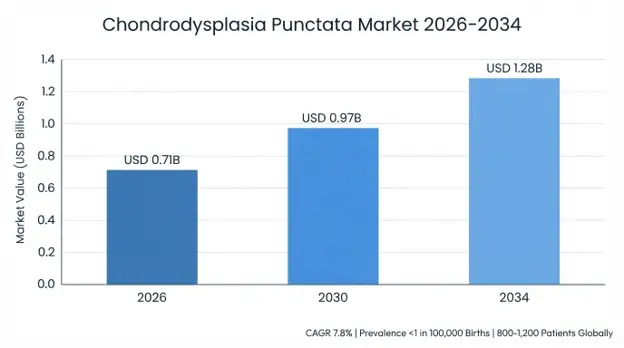
Chondrodysplasia punctata is a collection of rare genetic disorders of the skeleton with distinct X-ray features of stippling in the epiphyseal and metaphyseal areas of growing bones that may be accompanied by a spectrum of clinical findings that involve the skeleton, face, central nervous system, and other organs. The disease is a heterogeneous group of peroxisosomal biogenesis disorders and metabolic abnormalities due to mutations in genes that encode key enzymes in plasmalogen biosynthesis and fatty acid metabolism. Patients with this condition feature progressive skeletal abnormalities such as marked shortening of the proximal long bones, skeletal deformities of the spine, joint contractures, facial dysmorphisms with a characteristic appearance including hypoplasia of the midface and nasal abnormalities, congenital cataracts in almost all those who are very affected, and variable developmental delay and intellectual disability, depending on the severity of the disease and genetic type.
The clinical significance goes beyond the skeletal disorder and includes significant systemic disorders such as chronic respiratory insufficiency due to tracheal stenosis and small airway disease, cardiorespiratory insufficiency due to thoracic deformity, feeding difficulties requiring gastric support, susceptibility to infection due to immune dysfunction and seizure disorders in 40-50% of severely affected children and adults, and cutaneous aspects such as ichthyosis and hyperkeratotic lesions. The condition brings about significant functional impairments and health care burden, and those affected will need complex multidisciplinary management by orthopedic surgeons, geneticists, pulmonologists, developmental pediatricians, neurologists, ophthalmologists, and rehabilitative specialists, who will need to coordinate complex care protocols dealing with the multisystem disease manifestations.
It is now recognized that early diagnosis using modern advanced molecular genetic testing and radiographic imaging should be pursued, that symptom management should be pursued with a focus on individual system complications, that supportive therapy should seek to maximize functional capacity and quality of life, and that new therapies should be developed for the underlying metabolic abnormalities. Specialized diagnostic technologies like next-generation sequencing platforms for high-resolution genetic characterization; high-resolution computed tomography and magnetic resonance imaging for detailed skeletal and neurological assessment; biochemical testing for identification of abnormal lipid profiles characteristic of peroxisomal disorders; and clinical monitoring systems for tracking disease progression and therapy response.
| Report Coverage | Details |
|---|---|
| Base Year | 2025 |
| Base Year Value | USD 0.62 billion |
| Forecast Value | USD 1.28 billion |
| CAGR | 7.8% |
| Forecast Period | 2025-2034 |
| Historical Data | 2022-2025 |
| Largest Market | North America |
| Fastest Growing Market | Asia Pacific |
| Segments Covered | By Disease Type, Genetic Mutations, Treatment Modality, Diagnostic Technology, Management Setting |
| Region Covered | North America, Europe, Asia Pacific, Middle East & Africa, Latin America |
| Countries Covered | US, Canada, Mexico, UK, Germany, France, Italy, Spain, Netherlands, China, Japan, India, Australia, South Korea, Brazil, Argentina, UAE, Saudi Arabia, South Africa |
| Key Market Playes | Specialized Genetic Testing Laboratories, Pediatric Orthopedic Centers, Rare Disease Research Institutions, Diagnostic Equipment Manufacturers |
Get more details on this report - Request Free Sample
The first major catalyst that will drive growth in the market for chondrodysplasia punctata is the innovation in genetic technology diagnostics that allows fast and accurate detection of mutations that cause the different manifestations of the disease. With the use of next-generation sequencing technologies, the clinical diagnosis of the disease no longer depends on phenotypic characteristics and radiographic images that result in a diagnosis being made months to even years after the appearance of the disease. Molecular techniques are now used to detect mutations of the PEX7 gene that cause rhizomelic chondrodysplasia punctata type 1, which constitutes about 80% of RCDP cases diagnosed, GNPAT gene mutations that cause RCDP type 2, and AGPS gene mutations that cause RCDP type 3.
Early genetic testing allows early start of treatment through specialized multidisciplinary approaches, early monitoring of complications, genetic counseling of the family, and participation in various clinical studies of potential new therapeutic approaches. It is known that 80% of rare genetic disorders have no FDA-approved drugs for treatment, and thus, genetic testing itself is valuable due to the possibility to get specialized care, participate in clinical trials, and gain access to various experimental treatment options. Growth of the global molecular diagnostics market to USD 9.2 billion by 2025 with an expected CAGR of 8.4% allows more opportunities for rare genetic disorder testing.
Significant government and institutional funding to enhance the framework for chondrodysplasia punctata is contributing to the improved abilities for its early detection and effective management globally. The global rare disease market was valued at USD 239.3 billion in 2025 and is anticipated to grow up to USD 490.6 billion by 2032 at a CAGR of 10.8%, pointing to increasing importance given to diagnosing and treating rare diseases both in the developed and developing healthcare systems. Such growth contributes to the creation of genetic disorders diagnostic centers, multidisciplinary personnel experienced in treating rare diseases, newborn and pediatric genetic screening programs, and rare disease registers.
There are many countries that have formulated national policies regarding the diagnosis and treatment of rare diseases. In India, the national policy for rare diseases ensures financial support up to USD 60,000 for patients qualified under Centers of Excellence, while in China, there is a nationwide collaboration network set up by the National Health Commission with standardized methods of diagnosis and treatment for 300 health organizations. This adds value to the market in terms of diagnosis and provision of treatment.
The key limitation of market growth of chondrodysplasia punctata is the rarity of this disease, since the prevalence of rhizomelic chondrodysplasia punctata is less than one out of 100,000 children born across the globe and is equivalent to approximately 800 to 1,200 patients found in developed countries. The other types are even rarer, and their patient base in the world numbers in the hundreds only for each type. This limited number of patients is the basic limitation that would impede market growth by deterring incentives for creating diagnostics tests, hindering research and development efforts, and preventing clinical trials due to low patient availability.
A diagnostic delay of 2-4 years following the onset of symptoms further diminishes the ability of the market to realize any diagnostic and therapeutic value because at that time the patients would have already developed the complications of their respective diseases. Many of these cases go undiagnosed or misdiagnosed while on a diagnostic odyssey comprising numerous visits without any conclusive diagnosis. This makes the affected individuals unable to participate in clinical trials and be managed under specialized treatment conditions.
A transformational market opportunity in developing gene therapies aimed at correcting mutations in PEX7, GNPAT, and AGPS involved in plasmalogen synthesis, thus tackling the basic biochemical abnormality behind the symptoms of the disease. Preclinical studies have shown that the proof of concept of correction of the cellular abnormalities in patient fibroblasts by restoring plasmalogen synthesis is feasible, hence the possibility of the use of gene therapy in restoring enzyme activity or plasmalogen synthesis. FDA approval of elivaldogene autotemcel, a gene therapy for X-linked adrenoleukodystrophy, a peroxisomal disorder, has proved the clinical feasibility of gene therapy for inherited peroxisomal diseases.
The development of gene therapy is highly priced due to the high level of research conducted as well as the curative aspect associated with this product. Similar gene therapies in the case of rare genetic diseases cost between USD 300,000 and 600,000 for each treatment course. The development of programs related to inherited peroxisomal diseases like chondrodysplasia punctata will require an estimated USD 200-350 million investment level.
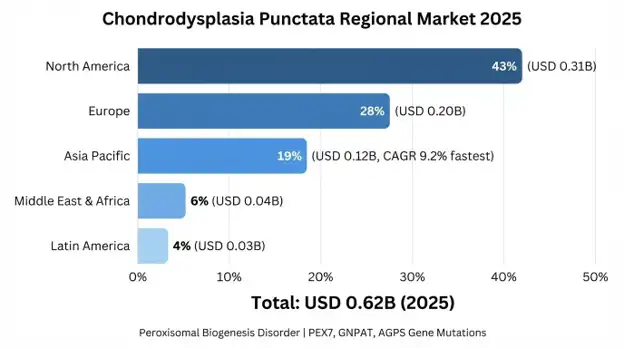
The North American region dominates the market share at USD 0.31 billion by 2025 with a CAGR of 7.6% forecast till 2034. The regional dominance is due to the presence of specialty clinics for pediatric genetics, a well-developed multidisciplinary healthcare system, extensive insurance coverage for managing rare diseases, active clinical trials, and advanced diagnostic services. The United States retains its regional supremacy through its large number of major pediatric hospitals, genetic testing facilities, extensive insurance coverage through Medicare and private health insurers, and active rare disease research consortiums such as the Rare Diseases Clinical Research Network, which gets USD 26 million in NIH funding in 2025 for rare diseases.
Advantages associated with the region include established patient advocacy groups and full access to medical literature and expertise of medical personnel dealing with chondrodysplasia punctata in its complex form of multisystem management. At present about 280-350 patients with chondrodysplasia punctata live in North America.
Asia Pacific will be the fastest-growing regional market, with a CAGR of 9.2% during the forecast period until 2034, from USD 0.12 billion in 2025 to USD 0.24 billion in 2034. Regional growth will be driven by the rapid development of pediatric genetic testing infrastructure, implementation of newborn screening programs for skeletal dysplasia, medical understanding of rare genetic conditions, and large populations, leading to a higher number of cases, even with lower prevalence rates. Japan's existing program of orphan drug designation and precision medicine infrastructure helps in improved diagnosis of diseases and access to care. China's country-wide rare disease diagnostic network provides standard treatment and diagnosis guidelines at hundreds of hospitals.
India’s expanding molecular diagnostic capabilities and growing pediatric medical center network are improving case identification and access to specialized care across a population of 1.4 billion where currently undiagnosed cases likely remain unidentified due to limited diagnostic infrastructure.
By Disease Type: Rhizomelic Chondrodysplasia Punctata Type 1 (PEX7 Related) is the most predominant with a market share of 78%, while RCDP Type 2 (GNPAT Related) takes 12%, and RCDP Type 3 (AGPS Related) accounts for 6%.
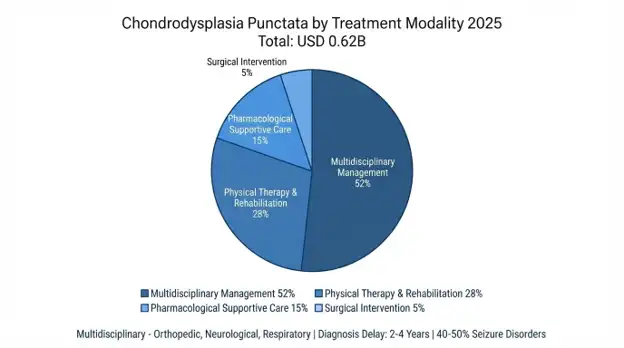
By Treatment Modality: Multidisciplinary management (orthopedic management, neurological care, and respiratory management) comprises 52% of total market value, physical therapy and rehabilitation services constitute 28%, pharmacological supportive care makes up 15%, and surgery constitutes 5%.
By diagnostic technology: The molecular genetics testing (next-generation sequencing and gene sequencing) makes up 48%; the advanced radiological imaging (CT and MRI) is responsible for 32%; biochemical & lipid profiling holds a 15% share, while the clinical phenotyping has 5%.
By Patient Management Setting: Specialized genetic disorder centers make up 44% of the market; pediatric hospitals make up 35%; multidisciplinary outpatient clinics make up 16%; and home care makes up 5%.
By region: North America 43%, Europe 28%, Asia Pacific 19%, Middle East & Africa 6%, and Latin America 4%.
The market for chondrodysplasia punctata is characterized by highly fragmented competition, where the leading organizations are the genetic testing laboratories, children’s hospitals, rare disease institutes, and imaging equipment manufacturers rather than the pharmaceutical firms. The key players in the market are diagnostic laboratories that provide next-generation sequencing-based genetic testing services, pediatric hospital chains that offer multidisciplinary treatment, rare disease research institutes that conduct clinical trials on new therapies, and imaging equipment providers.
January 2026: Multiple academic genetic centers initiated expanded newborn screening programs incorporating PEX7, GNPAT, and AGPS gene sequencing, enabling presymptomatic identification and early intervention in identified cases.
November 2025: A collaborative research consortium published a comprehensive clinical characterization of a chondrodysplasia punctata patient cohort, demonstrating improved outcomes with early multidisciplinary intervention compared to delayed diagnosis groups.
September 2025: Major pharmaceutical companies initiated preclinical gene therapy research programs targeting plasmalogen synthesis restoration in RCDP models, representing first active pharmaceutical development efforts specifically targeting genetic abnormalities underlying chondrodysplasia punctata.
June 2025: International rare disease registry expanded to include standardized clinical and molecular characterization protocols for chondrodysplasia punctata cases, facilitating prospective data collection supporting clinical research programs.
You'll get the sample you asked for by email. Remember to check your spam folder as well. If you have any further questions or require additional assistance, feel free to let us know via-
+1 724 648 0810 +91 976 407 9503 sales@intellectualmarketinsights.com
11 Aug 2026
Intellectual Market Insights Research © 2026. All rights reserved.