Share this link via:

Global market value for treatments of choroideremia stood at USD 1.4 billion in 2025 and is anticipated to reach USD 3.8 billion by 2034, registering a CAGR of 11.6% in the forecast period from 2026 to 2034. Choroideremia is a rare genetic retinal disorder that presents significant gaps in terms of therapy and is characterized by the degenerative condition of the retinal pigment epithelium and choroid, causing vision loss if the disease is not treated in time. The condition mostly affects males with an X-linked recessive genetic condition due to a mutation of the CHM gene, responsible for the expression of Rab Escort Protein-1, a key molecule for vesicle transport and cell homeostasis in the retina. At the molecular level, there is progressive accumulation of intracellular lipofuscin in the cells, dysfunctional retinal pigment epithelium, and subsequent photoreceptor degeneration. Prevalence rates are estimated to be 1 in 50,000 to 1 in 100,000 individuals worldwide, making the condition impact approximately 130,000 patients globally.
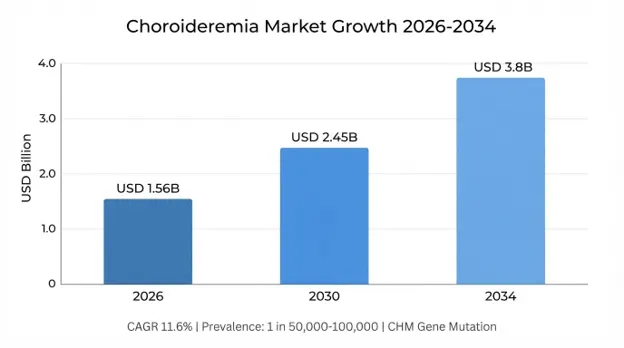
Market growth will largely be fueled by increasing developments in gene replacement therapy using adeno-associated virus delivery systems, which has been found to maintain vision functions and prevent further disease progression. Contrary to most inherited diseases with existing pharmaceutical treatments, choroideremia has continued to lack a cure in the form of any approved medication for several decades, thus leading to a huge unmet medical need that has prompted extensive efforts in developing a solution through research and product development in various therapeutic areas. A combination of favorable regulatory frameworks in relation to orphan drug development, cost reductions of up to 30-40% in manufacturing of adeno-associated virus drugs between 2020 and 2025, and natural history studies showing sensitive biomarkers for disease progression has set the stage for significant growth in the market for choroideremia treatment through 2034. By early 2026, there were already at least six gene therapy programs being developed for choroideremia, up from two in 2020.
The commercial relevance of choroideremia is not just limited to the direct management of patients but extends to the validation of precision medicine platforms for other inherited retinal dystrophies and the regulatory pathway for high-cost, single-administration gene therapies. The projected first-generation list prices for choroideremia gene therapies range from USD 1.5 million to USD 3.5 million per patient, on par with pricing set by Luxturna for RPE65-related retinal dystrophy and Hemgenix for hemophilia B despite the very small size of the patient population. Such high pricing takes into account the complicated nature of manufacturing; the huge costs associated with clinical development in excess of USD 800 million to USD 1.2 billion per program; as well as the extremely high unmet medical needs of this patient group that suffers from blindness.
| Report Coverage | Details |
|---|---|
| Base Year | 2025 |
| Base Year Value | USD 1.4 billion |
| Forecast Value | USD 3.8 Billion |
| CAGR | 11.6% |
| Forecast Period | 2025-2034 |
| Historical Data | 2022-2025 |
| Largest Market | North America |
| Fastest Growing Market | Asia Pacific |
| Segments Covered | By Treatment Type, Administration Route, End-User |
| Region Covered | North America, Europe, Asia Pacific, Latin America, Middle East & Africa |
| Countries Covered | U.S., Canada, U.K., Germany, France, Italy, Spain, Netherlands, China, Japan, India, Australia, South Korea, Brazil, Argentina, UAE, Saudi Arabia, South Africa |
| Key Market Playes | Biogen Inc., Spark Therapeutics (Roche subsidiary), MeiraGTx Holdings, 4D Molecular Therapeutics, AGTC, Novartis AG, Bayer AG, Editas Medicine, Intellia Therapeutics, GenSight Biologics |
Get more details on this report - Request Free Sample
The first and foremost factor responsible for driving the global market for choroideremia treatment is the rapid progress in adeno-associated virus (AAV)-mediated gene replacement therapy. A single gene replacement has shown the capability of saving the vision of patients and slowing down the disease process. The CHM gene, being relatively small in size, is highly amenable to AAV vector-mediated gene replacement. Long-term clinical trials of such gene replacement have shown a lasting improvement in the retina sensitivity as well as the vision of the patient for over a decade now. The reduction in the cost of gene therapy has been brought about by the advancements made in vector manufacturing technology as well as purification of vectors. Gene therapies for inherited retinal diseases gaining regulatory approvals have helped to carve out an approval path for such treatments. A number of companies are working on innovative gene therapies for choroideremia.
The regulatory incentives designed for rare disease treatments are generating substantial growth prospects in the global market for choroideremia treatment through stimulating investments and development activities. The orphan drug designation offered in the US and the European markets will offer extended market exclusivity, reduced regulatory fees, tax credits, and scientific assistance, thereby making the development process of gene therapies more profitable. Gene therapy candidates for choroideremia have been granted orphan status, thereby enhancing the confidence of the developers and investors in therapy’s success. Moreover, the Breakthrough Therapy and Fast Track designations provide the opportunity for working closely with the regulators and faster review of products, leading to the reduction of the time to market. Research grants from public sources for inherited retinal diseases will continue to be available to carry out the research and development for choroideremia.
Designing trials and validating endpoints continue to be the biggest hurdles faced by the worldwide market for choroideremia treatments. The condition develops gradually, and therefore it is difficult for any trial to show statistically significant gains in a short period. The limitations posed by this issue have been exemplified by a leading Phase 3 gene therapy trial that failed to reach its primary endpoint, although it provided positive secondary outcomes. Differences in regulation in the main markets in relation to what is an acceptable amount of visual improvement in the drug candidates make matters worse. While the treatment for choroideremia is more about maintaining existing vision than restoring lost sight, conventional measures of efficacy are less applicable. The absence of universal biomarkers and the requirement for sophisticated assessment of functional and imaging endpoints make clinical development harder.
One of the key opportunities in the global market of choroideremia treatments relates to the development of gene editing techniques, namely CRISPR-Cas9, base editing, and prime editing, that are intended to achieve permanent correction of the CHM gene mutation instead of its supplementation by means of traditional gene replacement therapy. These advanced gene editing tools can provide a more durable effect in a single procedure as well as reduce the risk associated with the continuous transgene expression. The recent advances in regulations for the use of gene editing in ophthalmology increased confidence in the use of this technology for therapeutic purposes and attracted large financial investments into biotech companies. Despite the challenge related to the diversity of CHM mutations, recent advances in allele-specific editing and universal base editing make the treatment of a greater variety of patients possible. Positive outcomes of preclinical studies showing mutation correction and recovery of normal functioning of the cells indicate great commercial perspectives of this technology.
An important trend impacting the worldwide choroideremia therapy market is the establishment of disease-specific registries and natural history studies aimed at improving clinical trial design and accelerating drug development. There are major large-scale studies yielding important information regarding the course of the disease, which helps to pinpoint the most dependable anatomical and functional biomarkers like retinal pigment epithelium area, ellipsoid zone assessment, and sensitivity of the retina. Due to international patient registries and standardized patient data collection, access to appropriate patients is facilitated, and recruiting becomes less complicated. The cooperation between patient organizations, research centers, and biotech companies promotes the building of an efficient research base and improves patient involvement and, ultimately, innovation in drug development.
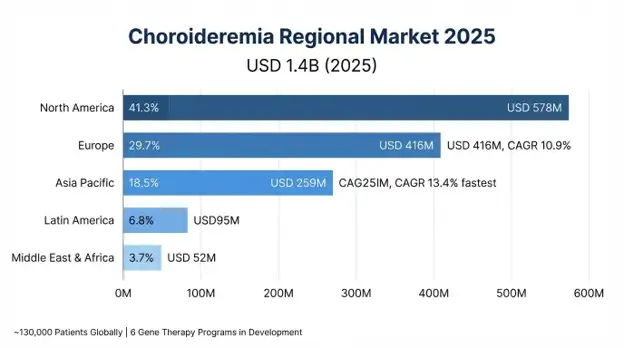
The largest share was recorded by North America in 2025 at 41.3%, achieving an approximate revenue of USD 578 million for the choroideremia treatment market, which is expected to rise at a CAGR of 11.1% over 2034. Leadership of the region is fueled by the high presence of biotech companies engaged in developing treatments for rare diseases, advanced facilities for conducting clinical trials, and an enabling orphan drug pathway. The United States is home to several clinical trials related to gene therapy and distinguished ophthalmology research institutes. The changing landscape of reimbursement for advanced gene therapies on account of the adoption of value-based payment models and growing support from payers is another contributing factor. Robust patient advocacy groups, disease registries, and collaboration between academic and biotech companies are further bolstering clinical research and facilitating access to treatments among patients in the region.
In 2025, Europe represented approximately 29.7% of the overall market for choroideremia treatment across the globe, thereby being the second largest market region. Market growth will be driven by a highly developed academic network for research, rare disease infrastructure, and conducive regulation for the development of gene and cell therapies. Leading regional development includes countries like the United Kingdom, Germany, France, and the Netherlands, which possess specific eye center specialization, advanced research capabilities, and participation in gene therapy studies. Additionally, the region boasts a developed orphan drug policy, regulatory guidance, and centralization of healthcare that increases patient access to diagnostic tools and innovations in therapeutics. Rare disease programs at the national level, genetic counseling services, and patient registries will positively influence patient recruitment for clinical trials and therapeutics. The CAGR for Europe during 2025-2034 will be 10.9%.
The Asia-Pacific region is anticipated to experience the highest growth rate among all regions for the global treatment of the choroideremia market during the forecast period of 2034 at around 13.4% CAGR. The reasons behind high growth include enhanced genetic testing procedures and increased awareness about hereditary retinal diseases as well as rare disease policy frameworks in Japan, China, South Korea, Australia, and India. The regulatory authorities are speeding up the process of innovations in gene therapies, whereas genetic testing facilitates early diagnosis and treatment. While Japan and Australia have advantages in terms of ophthalmology research centers and clinical trials for gene therapies, China and South Korea are focusing on orphan drug approvals. At the same time, India has great potential in the future due to the development of healthcare and ophthalmic care infrastructure, which will facilitate the use of specialized services.
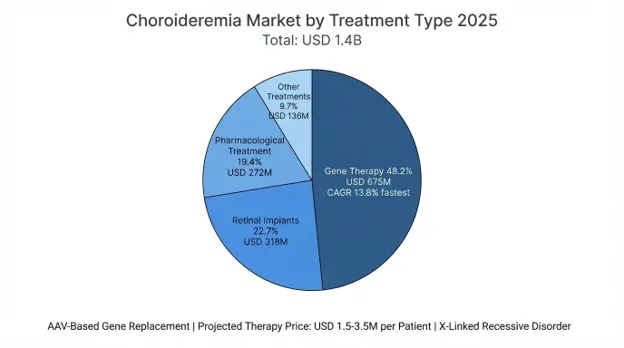
The Gene Therapy segment leads the global choroideremia treatment market with a 48.2% market share, accounting for an estimated USD 675 million in 2025, and is expected to expand at a 13.8% CAGR until 2034 owing to developments in AAV vector-based gene replacement therapy and gene editing. The Retinal Implants and Prosthetics Device segment accounts for a 22.7% share in the market, offering treatments to patients who have already lost their vision but hampered by high costs of procedures and stringent patient eligibility criteria. The Pharmacological Treatment segment accounts for 19.4% of market revenue, which comprises neuroprotective agents, antioxidants, and novel drug molecules.
The hospitals constitute the leading end-user type in the global market for choroideremia treatment, commanding a 44.6% share of the revenue in 2025, estimated to be around USD 624 million, owing to their high-quality surgical setup, multidisciplinary approach, and capability to deliver gene therapy. Ophthalmic clinics and specialty practices have the second-largest market share of 28.3%, which is expected to grow at the highest CAGR, on account of rising demand for monitoring, genetic counseling, advanced imaging, and low vision rehabilitation services. The Research Institutes & Academic Medical Centers contribute 17.8% to the total market revenue, owing to the crucial role of these institutes in conducting clinical trials and translational research for choroideremia treatment.
You'll get the sample you asked for by email. Remember to check your spam folder as well. If you have any further questions or require additional assistance, feel free to let us know via-
+1 724 648 0810 +91 976 407 9503 sales@intellectualmarketinsights.com
11 Aug 2026
Intellectual Market Insights Research © 2026. All rights reserved.