Share this link via:

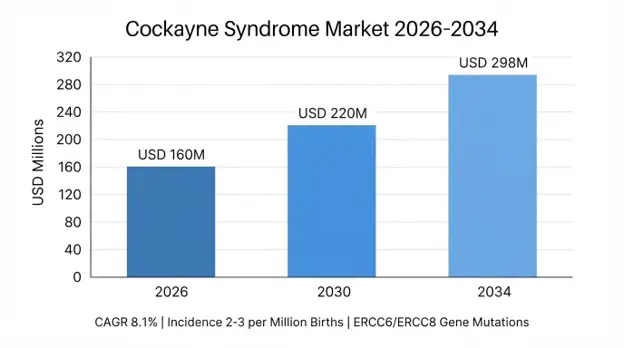
The global Cockayne syndrome market was valued at approximately USD 148 million in 2025 and is estimated to reach USD 160 million in 2026, expanding to nearly USD 298 million by 2034, registering a compound annual growth rate of around 8.1% during the forecast period of 2026 to 2034.
Cockayne syndrome is an ultra-rare, autosomal recessive, neurodegenerative disorder, with most cases caused by pathogenic mutations in the ERCC6 (CSB) gene, contributing to nearly 70-80% of all cases, and most of the remaining cases by pathogenic mutations in the ERCC8 (CSA) gene. These genes encode proteins that are part of a specialized DNA repair pathway called transcription-coupled nucleotide excision repair (TC-NER) that repairs DNA damage in actively transcribed genes. These defects in this pathway cause chronic formation of DNA lesions, defects in transcription, damage and dysfunction of mitochondria, oxidative stress, cellular aging, and progressive neuronal degeneration. The clinical features in the postnatal period include growth failure, microcephaly, marked photosensitivity, progressive deafness, retaining changes, cataracts, developmental delay, mental retardation, joint contractures, and a peculiar cachectic facial expression. Unlike XP, patients with Cockayne syndrome do not show a drastic enhancement of the risk of skin cancer, although they share defects in the nucleotide excision repair system.
There is significant clinical variability of the disease. It is usually type I (classic), occurring in infancy, leading to progressive neurological deterioration, and generally an adult life expectancy. Type II is a severe congenital form, and life expectancy is significantly reduced; Type III is a milder, more delayed form. Cerebro-oculo-facio-skeletal (COFS) syndrome is a part of the same disease spectrum because it shares genetic and clinical features.
The incidence in the world is estimated at about 2 to 3 cases per million live births, that is, about one case per 300,000 to 500,000 births, and is higher in populations with founder mutations and/or a higher rate of consanguinity. This is because of high mortalities in the early phases of treatment, and therefore, the number of living patients is very low worldwide. Thus, while high-volume drugs may drive the market, genetic diagnostics, multidisciplinary supportive care, nutritional management, neurological rehabilitation, ophthalmic and audiological interventions, and specialized pediatric services are key drivers of the Cockayne syndrome market. Treatment is based on symptom control and maintaining a good quality of life, and there is no approved disease-modifying therapy currently. New technologies such as next-generation sequencing, incentives for orphan drugs, international patient registries, and emerging new gene therapy, RNA-based therapeutics, and mitochondrial-targeted treatments will drive research and slowly shift the market focus over the next decade to precision diagnostics and disease-modifying treatment development.
| Report Coverage | Details |
|---|---|
| Base Year | 2025 |
| Base Year Value | USD 148 Million |
| Forecast Value | USD 298 Million |
| CAGR | 8.1% |
| Forecast Period | 2025-2034 |
| Historical Data | 2022-2025 |
| Largest Market | North America |
| Fastest Growing Market | Europe |
| Segments Covered | By Type, Care & Treatment Category, Diagnostic Modality, End-User, Region |
| Region Covered | North America, Europe, Asia Pacific, Middle East & Africa, Latin America |
| Countries Covered | US, Canada, UK, Germany, France, Netherlands, Italy, China, Japan, India, Australia, South Korea, Brazil, UAE, South Africa |
| Key Market Playes | Centogene N.V., GeneDx Holdings Corp., Fulgent Genetics Inc., Blueprint Genetics, PerkinElmer Inc. (Revvity), Invitae Corporation, Baylor Genetics, Specialized supportive-care and nutritional product manufacturers, Academic rare-disease and DNA-repair research centers, Niche biotechnology developers researching gene- and RNA-based DNA-repair therapeutics |
Get more details on this report - Request Free Sample
Expanding Access to Genetic Testing and Earlier, More Accurate Diagnosis: Next-generation sequencing and whole exome sequencing being part of the standard workup of pediatric neurology and clinical genetics have revolutionized the diagnosis of Cockayne syndrome, where the classical method of cell-based ultraviolet light sensitivity has been superseded by the quick detection of ERCC6 or ERCC8 mutations. This has cut down the diagnostic journey of several patients and made possible early multidisciplinary intervention, leading to an increasing need for molecular confirmation, genetic counseling, and prenatal diagnosis in affected families. There has been a continuous increase in numbers of tests done for DNA repair associated with progeroid syndromes in double-digit percentage points annually over the last five years.
Orphan Drug Incentives and Growing Scientific Interest in DNA-Repair and Mitochondrial Biology: Market exclusivity extensions, fee reductions, and clinical trial credits in the US, EU, and Japan provide incentives for rare disease products, thereby greatly enhancing the economic rationale for developing drugs for small populations. Additionally, Cockayne syndrome is also part of a scientifically active field because preclinical studies have shown mitochondrial dysfunction in CSB-deficient animals and the possibility of increasing DNA repair through the administration of NAD+ precursors based on nicotinamide to alleviate hearing loss, creating really scientific and early biotechnology interest in mitochondrial therapies and gene replacement.
The most critical limitation to the development of the market is the extreme rarity of the disease. The disease affects only about a few thousand patients worldwide. Clinical trials are conducted at the international level due to the rarity of the disease, and statistical power is hard to achieve, which means that cost per patient per trial will be high compared to common diseases. Another problem is the lack of validated markers of disease activity. Neuroimaging measurements such as white matter volume can serve as surrogate markers, but they have not been fully validated yet. In addition, functional measurements suffer from floor and ceiling effects considering the variability of patients in terms of their symptoms. Patients with Types I, II, and III diseases can be treated.
The most revolutionary and impactful opportunity is the development of genetic-based or RNA-based therapies based on the ERCC6 or ERCC8 mutation. The relatively shorter coding region of the genes is amenable to the packaging requirements of adeno-associated viral vectors, and preclinical proof-of-principle experiments in animal models have created some guarded optimism about the possibility of its translation into clinical practice, in addition to the use of pharmacological treatments focused on oxidative stress and mitochondrial disorders. Another important opportunity would be the incorporation of the ERCC6/ERCC8 test into expanded newborn or early-childhood genome testing, where the ongoing reduction of the cost of sequencing, combined with pilot projects on broader monogenic disease panels, would enable early intervention for nutritional and respiratory care as well as future research possibilities.
Another trend in the field of Cockayne syndrome is the formation of centers of excellence or research consortia, which will include all the disciplines that come under the umbrella of patient management pathway, such as pediatric neurology, genetics, nutrition, audiology, ophthalmology, and rehabilitation. The formation of such centers and patient registries or natural history studies will lead to better preparedness for clinical trials and the collection of longitudinal biomarker data. Simultaneously, the increased research efforts into mitochondrial dysfunction as the underlying cause of neurodegeneration are fueling interest in metabolic and antioxidant treatments.
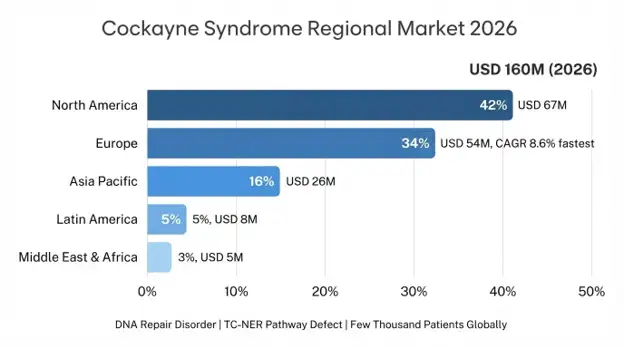
North America dominates the global market due to its well-developed research infrastructure for rare diseases, the availability of advanced genetic testing, reimbursement for orphan diagnostics, and involvement of academic institutions and government funding in research on Cockayne syndrome natural history. Europe is considered the most rapidly growing region thanks to the existence of rare disease reference networks, free access to genomic testing, and a tradition of collaboration in research in countries like Germany, France, the Netherlands, and the UK, where some of the most experienced DNA repair groups operate. Asia Pacific is the smallest regional market now but shows steady growth because of declining prices for genomic testing and expansion of pediatric genetics services in China, Japan, India, and South Korea.
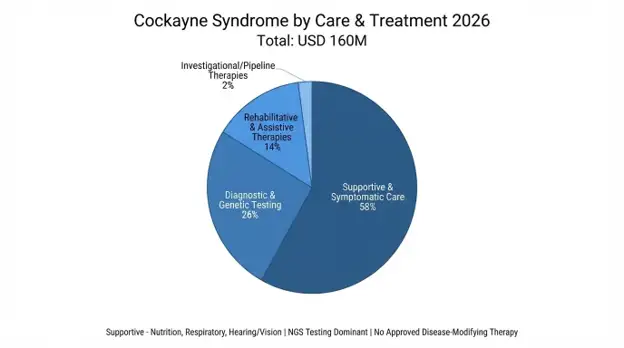
By type, Type I (classic) makes up the largest proportion of diagnosed and managed patients because of the relative longevity in survival and thus use of care, while Type II is responsible for the high expenditure in intense but short-term care, and Type III, along with COFS-associated phenotypes, forms a proportionate and rising market segment. By care and treatment segment, the most dominant market revenue comes from supportive care, which includes nutritional care, respiratory care, sensory care, photosensitivity care, and palliative care, while the fastest-growing care and treatment segment is diagnostic and genetic testing, and the smallest segment is investigational or pipeline treatment. By diagnostic technology, genetic and next-generation sequencing tests dominate, complemented by neuroimaging and clinical assessment for staging and prognosis. By end user, the hospital and specialty clinic segment forms the major market revenue because of the multidisciplinary approach in treatment, while diagnostic lab and research and academic institute segments make up the important complementary segments, and home care and community care segments are rising.
The Cockayne syndrome market is very much fragmented in nature due to the lack of any treatment approved for the disorder. The commercial players include genetic testing and diagnostic labs providing next-generation sequencing panels that can help identify ERCC6 and ERCC8 mutations; natural history studies being conducted by academic centers or medical research consortia; producers of supportive care therapies such as hearing aids and special nutritional formulas; and a few niche biotech companies that are developing gene therapy or mitochondrial approaches to target the disorder as a part of their DNA repair pipeline or rare neurological disorders pipeline.
Registries of Cockayne syndrome patients in different countries and natural history consortia saw an increase in their sample size in 2025, with the introduction of standardized neuroimaging and audiological progression parameters that could be used for future clinical trial designs. Genetic testing laboratories revised their next-generation sequencing panels to facilitate early and accurate identification of structural variations in genes ERCC6 and ERCC8 and improved turn-around times for the tests. Investigator-initiated studies of NAD+ precursor supplementation in patients with Cockayne syndrome to improve their mitochondrial functions started in academic medical centers in North America and Europe based on preclinical data from cellular and animal models. Advocacy groups for patients with Cockayne syndrome increased funding for natural history studies and family support.
You'll get the sample you asked for by email. Remember to check your spam folder as well. If you have any further questions or require additional assistance, feel free to let us know via-
+1 724 648 0810 +91 976 407 9503 sales@intellectualmarketinsights.com
11 Aug 2026
Intellectual Market Insights Research © 2026. All rights reserved.