Share this link via:

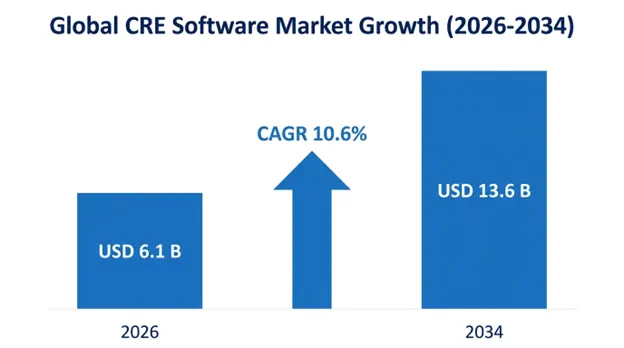
The global commercial real estate software market was valued at approximately USD 5.5 billion in 2025 and is projected to reach USD 6.1 billion in 2026. The market is expected to expand to USD 13.6 billion by 2034, growing at a CAGR of 10.6% during the forecast period (2026–2034).
Commercial real estate software is a sophisticated ecosystem of interconnected technology platforms designed to streamline and optimize the management, analyzing, and optimizing portfolios of commercial property throughout their entire lifecycle. These sophisticated systems are designed to cater to the needs of property owners, investors, managers, and occupants by unifying the separate aspects of property management into an interconnected process, which includes lease management, tenant management, financial reporting, investment analysis, facilities management, and compliance with regulations.
In terms of technological development, the capabilities offered by commercial real estate software far exceed those provided by simple property management systems and now include more advanced solutions such as artificial intelligence-based predictive analytics, machine learning algorithms for analysis of tenant behaviors, automated lease abstracting by means of natural language processing, continuous monitoring of portfolio performance, ESG reporting frameworks, and investment modeling platforms that integrate different types of information sources.
The business impact of this digital revolution is not limited only to operational efficiency gains but also relates directly to competitive differentiation within an industry that handles more than $32 trillion worth of assets in terms of global commercial real estate. Companies that use smart software have been observed to exhibit better results in terms of their investment by virtue of better asset selection, optimal lease agreements, proactive maintenance management, and efficient decision-making practices. This helps organizations reduce operational costs and enhance asset value through smart technology applications such as IoT and building management systems.
| Report Coverage | Details |
|---|---|
| Base Year | 2026 |
| Base Year Value | 2025 |
| Forecast Value | USD 13.6 Billion |
| CAGR | 10.6% |
| Forecast Period | 2025-2034 |
| Historical Data | 2022-2025 |
| Largest Market | North America |
| Fastest Growing Market | Asia Pacific |
| Segments Covered | By Product Type, By Deployment Mode, By Organization Size, Application, End-User, Region |
| Region Covered | North America, Europe, Asia Pacific, Middle East & Africa, Latin America |
| Countries Covered | US, Canada, Mexico, Germany, UK, France, Italy, Spain, Netherlands, China, Japan, India, South Korea, Australia, Brazil, Argentina, Saudi Arabia, UAE, South Africa |
| Key Market Playes | Yardi Systems, MRI Software, CoStar Group, Argus Software (Altus Group), RealPage, AppFolio, VTS, Procore Technologies |
Get more details on this report - Request Free Sample
The underlying factor behind the growth of the commercial real estate software market is the complete digitization of the commercial real estate sector driven by the understanding that legacy systems that relied on spreadsheets were incapable of meeting the requirements of today’s commercial real estate businesses. The ongoing COVID-19 pandemic was one such catalyst, as companies that had a fully digitized platform were able to swiftly adjust themselves to the new working environment of conducting virtual tours of their properties and communicating remotely with their tenants.
In terms of adoption, cloud-based Software as a Service offerings account for more than 75% of all deployments within commercial real estate in 2025. In addition to eliminating high initial costs, Cloud offerings provide instant scalability, security updates, and flexibility needed in today’s commercial real estate sector. Cloud platforms also enable collaboration between different departments irrespective of their geographical locations.
Cloud-based systems of today have built-in integration abilities that help create an environment wherein changes to leases can be instantly reflected in financial projections, maintenance work can lead to budget changes, and interactions between tenants can produce analytics. Integration reduces manual data entry errors by up to 85% and enhances decision making by improving visibility throughout the portfolio.
The implementation of ASC 842 and IFRS 16 lease accounting standards has mandated the adoption of specialized software solutions among corporate tenants and landlords. Lease accounting under ASC 842/IFRS 16 has been transformed from mere administrative tasks to highly technical accounting functions requiring precise calculation. This requirement has affected all companies with significant leases, leading to a continued need for advanced lease administration software solutions.
Compliance with ASC 842 entails thorough identification of leases, classification determinations, calculation of discount rates, and monitoring modifications that must be conducted for thousands of leases. Companies will have to keep detailed audit trails, prepare compliant financial reports, and perform real-time reporting for audits. This is especially true for companies with a global presence with operations in different countries with different currencies. Such an operation cannot but require specialized software solutions.
ESG compliance mandates are adding more compliance drivers as mandatory carbon reporting, energy efficiency, and sustainability reporting requirements are being implemented by regulators in other parts of the world. Commercial real estate technology offering ESG compliance, carbon management, and sustainability reporting features helps organizations meet regulatory mandates as well as accessing sustainable finance and ESG investors.
The integration of AI, machine learning, and predictive analytics into commercial real estate software has enabled data-driven decision-making capabilities that were previously inconceivable. The software makes use of big data to make predictions such as tenant churn, optimal leasing, maintenance needs, and investment opportunities by analyzing tenant payment history data, market trends, demographic information, and building performance metrics.
Applications of predictive analytics demonstrate enhanced performance in various fields such as tenant retention plans which boost renewal rates by 15-20%, predictive maintenance systems that cut down the expenses for unexpected repairs by 25-35%, and investment analytics platforms that help make more accurate decisions when acquiring properties through market intelligence. The machine learning algorithms learn from their results and enhance their abilities to predict future occurrences.
Natural language processing (NLP) enables automated lease abstraction, where unstructured leases can be extracted into structured information and then loaded into complete lease management systems. Automation leads to faster lease abstractions, up to 80% faster in some cases, and increases accuracy and quick analysis of portfolios during acquisition due diligence efforts and other portfolio optimization projects.
The single largest factor that restricts the adoption of software for commercial real estate is the high level of complexity involved in deploying an enterprise-wide solution within an organization with existing processes, outdated technology, and users who have different levels of skill sets. In most cases, the project from signing the contract until the implementation is between 12-24 months, and the total implementation cost is up to 200-400% of the annual licensing fee of the software.
Another recurring challenge for commercial real estate businesses is data migration and data quality management. For many years, commercial real estate businesses have stored their data in multiple sources such as spreadsheets and paper documentation. Migration becomes very challenging and takes a lot of effort from both internal resources and consultants to ensure the data is accurate and consistent.
The organizational resistance encountered by workflow changes brought about by systematic software application causes problems, especially when the employees are long-time real estate specialists who have created their own system after decades of work in the business. This cultural shift from an individual-focused approach to a platform-driven strategy requires more than simply implementing software.
Complexity and Legacy System Dependencies
Commercial real estate firms use advanced technological systems that integrate accounting systems, property management systems, building automation systems, CRM solutions, and capital market systems where integration is key to taking advantage of the full value of software platform solutions. The lack of standardization in commercial real estate technology vendors leads to costly and time-consuming integration processes which may double project implementation duration and costs.
Legacy systems pose special challenges in organizations that have been using their legacy property management systems, accounting systems, and tenant management systems for many years, making it very difficult and costly to completely overhaul these systems at once. This forces companies to adopt a hybrid strategy of maintaining legacy systems while introducing new solutions.
The opportunity to build out ESG measurement capability, carbon footprint measurement, and sustainability reporting on commercial real estate software platforms emerges at a time when regulatory expectations are increasing and institutional investors demand proof of environmental performance. The European Union’s Corporate Sustainability Reporting Directive, climate change disclosures by the SEC, and other related regulations globally impose regulatory expectations that impact virtually all institutions involved in commercial real estate.
Commercial real estate accounts for around 40% of global energy consumption and 33% of global carbon emissions and is a key target for regulation as well as institutional investor interest. The need for software platforms to track energy consumption, measure carbon footprints, track water usage, report waste management metrics, and provide performance benchmarks is significant, and demands premium pricing because of the specialized skills involved.
Opportunities in the market go beyond compliance, as buildings that are verified for having high ESG ratings enjoy premium rentals of between 6 and 12% in large metro markets and benefit from sustainable financing deals. The software solution allows real estate investors to leverage building performance data to create audit-ready reports based on GRESB, LEED, and SASB standards.
In the commercial real estate software market, there is an ongoing trend toward consolidation, as the leading companies attempt to develop all-encompassing platforms which overcome the limitations associated with point-solution software products by delivering a seamless ecosystem that covers the entire lifecycle of any real estate investment. Leading companies such as Yardi Systems, MRI Software, and CoStar Group have aggressively pursued acquisitions of other smaller firms specializing in particular aspects of the industry, such as lease management, investment analysis, facility management, and market research.
The trend toward consolidation is, in essence, a natural progression of both the market itself and the requirements of its customers who, in terms of their business real estate assets, prefer integrated solutions over point solutions due to siloed information, complex integration, and having to engage multiple vendors.
Platform consolidation drives innovation by facilitating open API architectures that would allow third-party applications to integrate with the platform in question, thus implementing a strategy of platforms combined with specialized products through marketplace models. Such a strategy allows companies to address diverse operational requirements while capitalizing on specialization through PropTech startups working with new use cases such as smart buildings, tenant experience, and analytics.
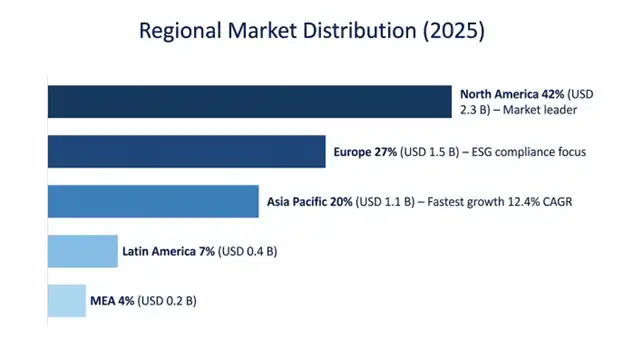
North America holds the leading position in the market with an estimated value of USD 2.3 billion by 2025, expected to retain its lead with a CAGR of 10.2% over the next ten years. The dominance of North America is due to the prevalence of complex and sophisticated commercial real estate investments, considering the total asset value exceeding USD 4.5 trillion managed by US-based real estate investment trusts and a robust PropTech environment.
The US occupies a leading share of 87% of the regional market, owing to mandatory adoption of ASC 842 leases accounting standards by corporations, sophisticated management required for real estate investment trusts and private equity real estate funds, and infrastructure for market data that facilitates the development of complex analytics solutions. The market is aided by developed IT governance frameworks and commitment to technological investments made by commercial real estate operators.
Commercial real estate firms in North America spend more on software per unit of assets managed, spending about USD 12-15 per each thousand dollars in assets managed versus USD 6-9 spent by European counterparts and USD 3-6 spent by companies based in Asia-Pacific. The difference in expenses is attributed to high labor costs that make firms adopt technology and the complexity of operations in institutional real estate.
Asia Pacific shows the highest regional growth trend with 12.4% CAGR up to 2034 and revenue value expected to be USD 2.1 billion by 2034. Regional market expansion is backed by substantial growth in commercial real estate markets within China, India, Japan, Singapore, and Australia, where rapid urbanization, influxes of institutional investment, and formalization of the market ensure steady growth in requirements for professional property management tools compatible with international standards.
China is responsible for leading the growth trends regionally with 38% market share. High market share of China is attributed to high volumes of construction, increasing REIT market after establishment of regulatory framework, and smart city initiatives undertaken by the Chinese government that necessitate deployment of digital solutions for property management purposes in urban areas.
Acceleration in India can be seen by the growing number of commercial office spaces that serve foreign companies operating in technology and business process outsourcing. These developments are expected to increase demand for sophisticated occupancy management systems for integrated systems in lease management, facility management, and tenant experience. This is due to increased institutional investment and international property management standards.
Product Type Insights
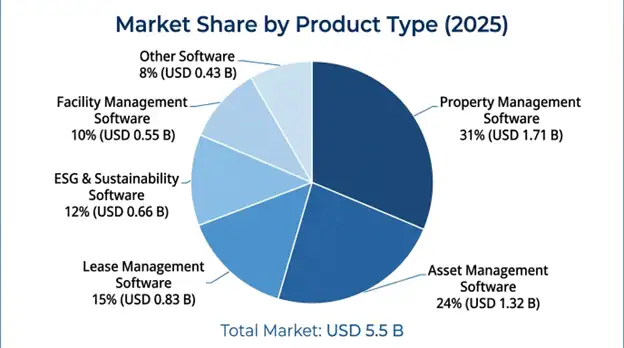
Property Management Software is the highest revenue contributor with a market share of 31%, worth USD 1.71 billion in 2025 and a CAGR of 10.2% through 2034. This property technology segment offers all-inclusive operational management software covering communication with tenants, lease management, facilities management, financial reports, and vendor management for various commercial properties. The Property Management Software market enjoys wide usage across organizations of all sizes that may be single-asset owners or institutional portfolio managers of commercial assets.
Asset Management Software accounts for 24% market share worth USD 1.32 billion in 2025 and a CAGR of 11.8% through 2034. The The Asset Management Software segment offers specialized solutions for institutional property owners, real estate investment trusts (REITs), and private equity firms who need to track asset performance, investment opportunities, investment analysis, and budgeting. Asset Management Software enjoys premium pricing owing to its direct relationship with investment performance and wide adoption among sophisticated institutional players who run diversified commercial property portfolios.
ESG and Sustainability Software holds a market share of 12%, valued at USD 660 million in 2025, and represents the highest CAGR of 15.2% from 2025 to 2034. This emerging category addresses the growing need of regulatory compliance and institutional investors for the complete recording of the environmental performance, carbon footprint, energy efficiency, and sustainability reports.
Cloud-based deployment is the preferred mode, with 72% market share worth about USD 3.96 billion in 2025 and a compound annual growth rate that sits at 12.1% until 2034. The dominance of cloud deployments is driven by lower upfront capital costs, faster implementation, and automated security upgrades.
On-Premises deployment holds a market share of 19%, valued at USD 1.05 billion in 2025, with steady decline owing to the replacement of existing legacy systems. This segment continues to exist among the big players having well-established IT systems, strong data security concerns, and high levels of customization, which regular cloud-based services cannot fulfill.
Hybrid deployment segment captures 9% market share, with a value of USD 495 million in 2025, growing at 8.8% CAGR.
Real Estate Investment Trusts is the largest end-user category, accounting for 29% market share, worth USD 1.60 billion in 2025, due to the extensive software needs for managing their assets, financial statements, compliance, and operations in large and diversified portfolios. Real Estate Investment Trusts spend the most on software at an annual rate of USD 3.2 million per firm.
Corporate Occupiers have a 24% market share worth USD 1.32 billion in 2025, which is mostly due to the lease administration and facility management needs, with mandatory implementation of the ASC 842 standard being the driver behind the demand for Corporate Occupiers among Fortune 1000 companies that have significant real estate portfolios.
The Property Management Companies segment holds 22% market share of USD 1.21 billion in 2025, based on complete management software needs of their diverse customer base with varied property segments.
The market for commercial real estate software worldwide shows a moderately consolidated landscape, where the top players capture about 62–68% of the overall revenue of the market. The competitive forces operating within the industry include the comprehensiveness of the platforms, the level of analytics offered, easy integration options, and effective client retention.
Yardi Systems occupies the number one position by virtue of offering an all-in-one platform that incorporates solutions for property management, investment management, lease administration, construction management, and energy management. MRI Software offers an edge to its customers owing to its open architecture and API-based platforms, which offer high customization and integration options that institutional-level real estate manager’s favor. CoStar Group makes use of its vast database of commercial properties to enhance analytics, valuation, and investment solutions.
April 2026: Yardi Systems made enhancements to its platform with the implementation of AI in automation of lease abstraction using natural language processing, machine learning algorithms for tenant churn prediction, and predictive analytics for maintenance optimization, cutting down administrative workload by up to 65%.
March 2026: MRI Software acquired the leading ESG reporting platform for USD 320 million, integrating features related to carbon accounting, energy management, and sustainability disclosure within the enterprise commercial real estate platform catering to institutional asset managers and occupiers.
February 2026: CoStar Group made platform enhancements with real-time market intelligence, AI-based valuation models, and capabilities for analyzing comparable properties, making it easier for institutional investors to analyze their investments and optimize their portfolios based on data provided by the platform.
January 2026: Altus Group, which includes Argus Software, has raised USD 450 million for further development and deployment of the artificial intelligence platform in foreign markets in Europe and the Asia Pacific region specializing in commercial real estate.
December 2025: AppFolio has developed its next generation commercial property management platform that incorporates IoT sensors, predictive maintenance, and tenant applications for improved operational efficiencies and better performance among mid-market property managers and property owners.
You'll get the sample you asked for by email. Remember to check your spam folder as well. If you have any further questions or require additional assistance, feel free to let us know via-
+1 724 648 0810 +91 976 407 9503 sales@intellectualmarketinsights.com
20 May 2026
Intellectual Market Insights Research © 2026. All rights reserved.