Share this link via:

The global Cowden syndrome market size was valued at USD 420.5 million in 2025 and is projected to reach USD 456.0 million in 2026, expanding to USD 850.4 million by 2034, growing at a CAGR of 8.1% during the forecast period (2026-2034).
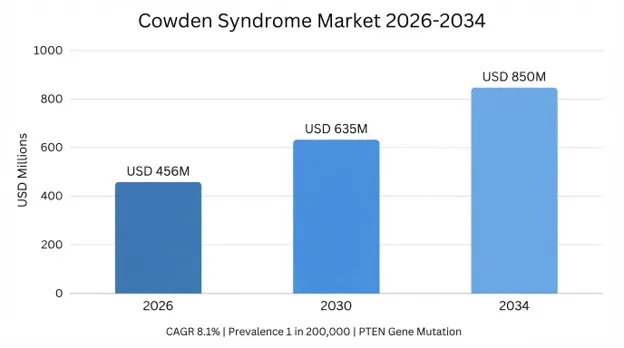
Cowden syndrome is a rare, inherited condition (autosomal dominant) in the spectrum of PTEN Hamartoma Tumor Syndrome, due to pathogenic variants in the PTEN tumor suppressor gene carried in the germline on chromosome 10q23.31. PTEN mutations are found in almost 80% of patients with established diagnostic criteria, and in other cases, where PTEN is not found, mutations in other genes like SDHB, SDHD, KLLN, PIK3CA, and others are found, or there is no genetic resolution. The pattern of the disorder is multiple benign hamartomas involving tissues originating from all three germ layers, with macrocephaly, mucocutaneous lesions, gastrointestinal polyps, lipoma, and Lhermitte-Duclos disease, the cerebellar lesion. While it is estimated that it affects about 1 in 200,000 people globally, the true prevalence may be higher since it can present in a variety of ways, can often go unrecognized, and historically there has been limited access to genetic testing.
Lifetime risk for several malignancies is markedly higher with the syndrome, up to 85% for breast cancer, approximately 35% for thyroid cancer, 28% for endometrial cancer, 9–16% for colorectal cancer, around 33% for renal cell carcinoma, and a slight increase in melanoma risk. Therefore, patients should be followed by multiple specialists over the lifetime of their lives, which includes breast MRI, mammogram, thyroid ultrasound, colonoscopy, renal imaging, dermatologic evaluations, and regular genetic counseling. Thus, the Cowden syndrome market is currently being fueled mainly by complete diagnostics and monitoring instead of disease-specific pharmacotherapy. Molecular diagnostics involve interpretation of PTEN sequence, multigene hereditary cancer panels, and deletion and duplication analysis. Therapeutic management is directed towards surgery or cancer treatment, and investigational therapy with inhibitors of the PI3K/AKT/mTOR pathway is being pursued to decrease the number of hamartomas and enhance disease management. The market for this syndrome is anticipated to continue expanding in the long term, building off the rare syndrome's high diagnostic value and the cascade genetic testing of at-risk family members, adoption of new technologies such as next-generation sequencing, and increasing clinical awareness, which is expected to boost diagnosis rates.
| Report Coverage | Details |
|---|---|
| Base Year | 2025 |
| Base Year Value | USD 420.5 Million |
| Forecast Value | USD 850.4 Million |
| CAGR | 8.1% |
| Forecast Period | 2025-2034 |
| Historical Data | 2022-2025 |
| Largest Market | North America |
| Fastest Growing Market | Asia Pacific |
| Segments Covered | By Diagnosis Type, Treatment Type, Route of Administration, End-User, Region |
| Region Covered | North America, Europe, Asia Pacific, Middle East & Africa, Latin America |
| Countries Covered | US, Canada, Mexico, UK, Germany, France, Italy, Spain, Netherlands, China, Japan, India, Australia, South Korea, Brazil, Argentina, UAE, Saudi Arabia, South Africa |
| Key Market Playes | Novartis AG, Pfizer Inc., Myriad Genetics, Labcorp (Invitae), Ambry Genetics, GeneDx, Illumina Inc. |
Get more details on this report - Request Free Sample
Next-generation sequencing multigene panels for hereditary cancer, which are being increasingly utilized clinically in lieu of sequential single-gene testing and now incorporate PTEN along with BRCA1, BRCA2, TP53, and several other genes predisposing to cancer, represent the single biggest factor driving the Cowden syndrome market. Such multigene panels can identify cases of Cowden syndrome among those who are diagnosed with early-onset breast and thyroid cancer or multiple colonic polyps or show a familial history of these disorders but without having the complete picture of the syndrome first identified. The combination of falling sequencing costs, insurance reimbursement for panels that satisfy criteria for national hereditary cancer testing, and use of various scoring systems like that used by Cleveland Clinic has shortened this traditional diagnostic process significantly.
Cowden syndrome presents a significantly increased risk in several organs: breast, thyroid gland, uterus, colon, and kidneys. Therefore, patients carrying this genetic mutation must undergo thorough screening of all these organs starting in early adulthood and continuing indefinitely. It is recommended that annual clinical breast examinations start from age 25; annual MRI and mammography from age 30; annual ultrasonography of the thyroid gland from the moment of the diagnosis; periodical evaluations of the endometrium; colonoscopy at more frequent intervals than for general population screening; annual dermatology evaluation; and periodically imaging studies of the kidneys starting around age 40.
The basic limitation for market expansion of Cowden syndrome is that it is an ultra-rare condition, which means that the number of patients is limited, and thus there is less financial motivation to develop drugs specifically aimed at the condition as opposed to other prevalent oncologic diseases. It is important to note that recruiting for clinical trials will be difficult due to the dispersion of patients across different geographic areas and heterogeneous phenotypes of the disease. Given the lack of pharmacological treatment aimed specifically at Cowden syndrome, the treatment of hamartomas and skin symptoms currently depends on the off-label usage of medications used to treat other conditions, which introduces some doubts regarding reimbursement and widespread application. Another important limitation is the high overall cost of monitoring multiple organs throughout life in healthcare systems that lack programs for hereditary cancers.
The large opportunity available to the Cowden syndrome market comes from the overlap between the biology of PTEN loss seen in the more prevalent and common sporadic tumors, such as breast, prostate, endometrial, and glioblastoma cancers, where PTEN defects are often seen as drivers. The drugs, diagnostics, and biomarkers that have been developed against PTEN-mutated sporadic tumors can be used straightaway in the Cowden syndrome patient group, thereby allowing this niche market to benefit from research efforts fueled by other larger cancer indications. Ongoing clinical studies with mTOR, PI3K, and AKT inhibitors in sporadic PTEN mutant cancers will provide data that can be applied to patients with hereditary PTEN hamartoma tumor syndrome.
A significant new trend includes the use of AI-supported image recognition technologies to detect the mucocutaneous manifestations of Cowden syndrome, such as trichilemmomas and papillomatous oral papules, that are often missed in routine dermatology practice and serve as the early visual markers occurring years before cancer appearance. Another trend related to the establishment of international databases of patients with Cowden syndrome coordinated in academic networks of hereditary cancer patients and their advocacy groups will provide valuable information for conducting studies on genotype-phenotype correlation and optimizing surveillance periods based on evidence-based approaches. The third promising new trend concerns telemedicine-based genetic counseling of patients located in areas far away from hereditary cancer clinics.
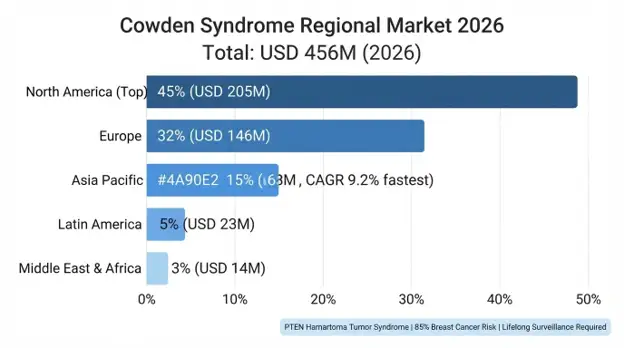
The North American region is the biggest regional market owing to the presence of a well-advanced hereditary cancer genetics system; wide insurance coverage along with Medicare for genetic testing for PTEN and related surveillance services; a strong network of academic centers for hereditary cancers; and nationally structured guidelines for surveillance timing for carriers. North America makes up the significant part of the regional market value due to the advanced genetic counseling system and the ongoing clinical research on mTOR pathway inhibitors.
Europe is the second-biggest regional market featuring developed genetics programs of individual nations, slow integration of PTEN testing into public health care systems for high-risk patients, and collaborative work on guideline harmonization across Europe; however, access to and intensity of the testing differ significantly between Western and Eastern Europe.
Asia Pacific is set to be the fastest-growing region due to the fast expansion of genetics testing facilities in Japan, China, South Korea, and Australia; growing understanding of hereditary cancers among oncologists and dermatologists; and better insurance coverage of multigene panels. Even though it is a trend, there are still a lot of underdiagnosed cases in this region, and big differences exist between city and countryside centers.
Genetic testing is the highest revenue generator among all diagnoses, with rapid growth being attributed to reduced costs of genome sequencing, increased use of multi-gene panels, and cascade screening of family members of the identified patient. Imaging tests along with clinical and dermatological examinations make up a significant percentage of market revenue, given that annual surveillance of affected body parts is needed throughout the life of a carrier.
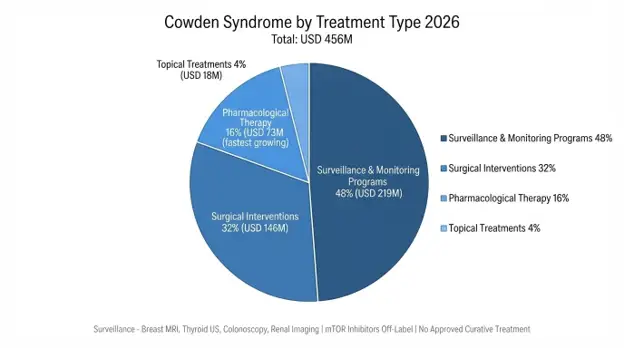
The market size associated with Surveillance & Monitoring Programs and Surgical Interventions collectively accounts for the largest part of the treatment market today since the prevailing approach remains risk-reducing surgery and monitoring without the existence of any approved curative treatment. The pharmacologic approach, specifically mTOR inhibitors as a therapeutic option for managing hamartomata and cutaneous manifestations, is the most rapidly growing treatment category.
Specialty cancer clinics and genetic counseling clinics are regarded as the foremost end-user categories since these facilities are equipped with the necessary multidisciplinary hereditary cancer expertise, advanced imaging technologies, and systematic counseling procedures needed for managing the condition throughout life, whereas diagnostic laboratories have increasingly become significant as an initial access point.
The global market of Cowden syndrome is fragmented due to its ultra-rarity classification and competition between hereditary genetic test laboratories, drug manufacturers providing mTOR inhibitors as treatment of oncology conditions with off-label use in PHTS, and academic centers specializing in hereditary cancer research. Competition in genetic test laboratories depends on the scope of testing, accurate interpretation of results, and timely delivery, whereas pharmaceutical companies compete based on the safety and efficiency of everolimus and interest in future pipeline development of PI3K and AKT inhibitors.
May 2025: The International PTEN Hamartoma Tumor Syndrome (PHTS) Consensus Guidelines provided new surveillance guidelines, such as extending renal cancer screening, outlining refined breast and thyroid cancer screening and management guidelines, and standardizing long-term surveillance guidelines for people with PTEN pathogenic variants.
October 2025: DNA sequencing and RNA-based genetic testing were shown to lead to the identification of pathogenic variants affecting the deep intronic regions of the PTEN gene, which are not often identified by conventional genetic testing, thus enhancing diagnostic accuracy in suspected Cowden syndrome cases.
March 2026: A genomic medicine study led to the identification of genetic modifier variants associated with cancer risk and neurodevelopmental outcomes in PTEN Hamartoma Tumor Syndrome, which will help support future precision medicine and personalized risk assessment approaches.
April 2026: The investigational AKT inhibitor TAS-117 showed clinical activity in a patient with Cowden syndrome–associated metastatic breast cancer, suggesting that pathways that target the AKT/mTOR pathway could be valuable therapeutic targets for PTEN-related disorders.
You'll get the sample you asked for by email. Remember to check your spam folder as well. If you have any further questions or require additional assistance, feel free to let us know via-
+1 724 648 0810 +91 976 407 9503 sales@intellectualmarketinsights.com
11 Aug 2026
Intellectual Market Insights Research © 2026. All rights reserved.