Share this link via:

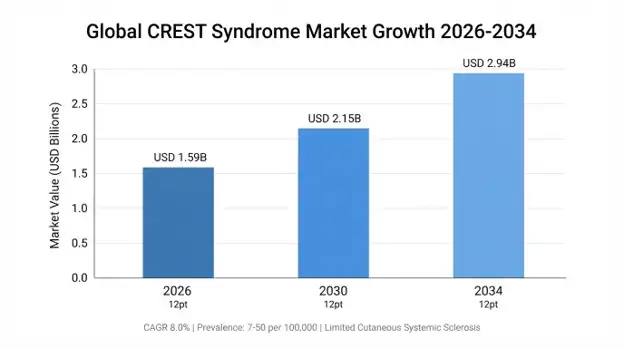
The global CREST syndrome market was valued at approximately USD 1.46 billion in 2025 and is projected to reach USD 1.59 billion in 2026, expanding to nearly USD 2.94 billion by 2034, registering a compound annual growth rate of approximately 8.0% during the forecast period of 2026 to 2034.
Limited cutaneous systemic sclerosis, a type of autoimmune connective tissue disease, is appropriately referred to as CREST syndrome because it shares five clinical characteristics: Calcinosis cutis, Raynaud's phenomenon, esophageal dysmotility, sclerodactyly, and telangiectasia. This disorder is caused by a combination of three interdependent pathological mechanisms that occur together: autoimmune activation (production of disease-specific autoantibodies such as anti-centromere antibodies, which are detected in 70 to 90 percent of those with the disorder); progressive microvascular injury; and dysregulated fibroblast activity (excessive collagen deposition in skin and, in a small group of patients, internal organs). Diffuse cutaneous systemic sclerosis is diagnosed from a combination of changes to the skin, which occur in the fingers, hands, forearms, and face; a comparatively slow course of disease; and a distinctive latency that can cause Raynaud phenomenon to appear several years before the other diagnostic criteria, often leading to a delay in the onset of diagnosis in primary care.
Therapy for CREST syndrome is organ and symptom-specific and cannot reverse the underlying fibrotic and vasculopathic disease process and is thus long-term and often lifelong multi-drug therapy depending on the pattern and severity of organ involvement. Raynaud's phenomenon and digital vasculopathy can be treated with calcium channel blockers, phosphodiesterase type 5 inhibitors, and even endothelin receptor antagonists in more refractory or severe presentations; esophageal dysmotility and reflux can be treated with proton pump inhibitors and prokinetic agents; active skin thickening or early interstitial lung involvement may necessitate use of an immunomodulatory agent such as mycophenolate mofetil or the antifibrotic agent nintedanib; and the most frequent cause of disease-related mortality in this group, pulmonary arterial hypertension, typically requires combination therapy across multiple drug classes used together, from the outset and for life.
The commercial implications of the CREST syndrome market go beyond pharmaceutical sales to include the provision of specialized diagnostic testing, such as autoantibody panels, nailfold capillaroscopy, echocardiography, high-resolution computed tomography, and pulmonary function testing; multidisciplinary care in the field of rheumatology; and long-term disease-monitoring infrastructure. The prevalence of systemic sclerosis is estimated to be 7 to 50 people out of 100,000 people worldwide, depending on region and diagnostic approach, and it is estimated that around 60 to 70 percent of all systemic sclerosis cases are the limited cutaneous disease, the CREST phenotype. It is more common in females than in males, with a ratio of 4:1 to 9:1; and the peak age of onset is between the 4th and 6th decades of life. The overall rarity of the disease and orphan designation of the disease in most major regulatory jurisdictions, coupled with the disease course that is often 10–30 years from diagnosis, creates a significant therapeutic burden per patient over the lifetime of the therapy.
| Report Coverage | Details |
|---|---|
| Base Year | 2025 |
| Base Year Value | USD 1.46 billion |
| Forecast Value | USD 2.94 billion |
| CAGR | 8.0% |
| Forecast Period | 2025-2034 |
| Historical Data | 2022-2025 |
| Largest Market | North America |
| Fastest Growing Market | Asia Pacific |
| Segments Covered | By Drug Class, Disease Manifestation, Diagnostic Modality, Route of Administration, End-User, Region |
| Region Covered | North America, Europe, Asia Pacific, Middle East & Africa, Latin America |
| Countries Covered | US, Canada, Mexico, UK, Germany, France, Italy, Spain, Netherlands, China, Japan, India, Australia, South Korea, Brazil, Argentina, UAE, Saudi Arabia, South Africa |
| Key Market Playes | Johnson & Johnson (Actelion), Boehringer Ingelheim, United Therapeutics, GlaxoSmithKline, Bayer AG, Roche (Genentech), Pfizer Inc |
Get more details on this report - Request Free Sample
Increased Awareness in Diagnosis and More Sophisticated Serologic Testing Increasing the Number of Individuals Treated: The broad application of the ACR/EULAR criteria developed in 2013, along with an increased frequency of anti-centromere antibody testing and nailfold capillaroscopy, has helped reduce the traditional interval between symptoms and diagnosis. The anti-centromere antibody test is a highly specific marker of limited cutaneous CTD, enabling rheumatologists to diagnose patients much earlier even before any signs appear other than Raynaud’s phenomenon.
Expanding the Treatment Strategy in Combination for Pulmonary Arterial Hypertension: Patients suffering from pulmonary arterial hypertension make up 8% to 15% of the CREST patients; however, they account for a large proportion of expenses for the medications due to the fact that they are the primary cause of mortality related to the disease and that the medication necessary to treat the disease with combination therapy is quite expensive. The medical recommendation of early combination treatment compared to sequential monotherapy has increased the cost of pharmaceuticals significantly.
Rare Disease Status and Absence of a Curative, Disease-Modifying Therapy: The categorization of CREST syndrome as a rare disease has implications in terms of the size of the commercial opportunity, difficulties in recruiting patients for clinical trials owing to small numbers of affected individuals scattered throughout different regions, and higher development costs per individual patient. To add to this, the complex interaction among autoimmune response, damage to the blood vessels, and autonomous growth by fibroblasts has made it difficult to develop an intervention that would stop the progression of the fibrotic process in the disease. This is why management of the condition relies on many drugs belonging to different organ-specific categories that are largely prescribed off-label. Pivotal systemic sclerosis trials often require multi-year recruitment across dozens of international sites due to disease rarity.
Antifibrotic and Biologic Pipeline Expansion: Approvals of the antifibrotic drug nintedanib in systemic sclerosis associated with interstitial lung disease were a validation of both the commercial and medical viability of treating the fibrotic pathways of scleroderma, which subsequently resulted in increased investments in drugs aimed at transforming growth factor-beta, connective tissue growth factor, and interleukin-6 signaling pathways. Biological treatments including tocilizumab and rituximab are becoming more common in the treatment algorithms for progressive skin and lung diseases, thus creating a niche of high-cost therapy.
Precision Medicine and Biomarker-Guided Risk Stratification: The existence of unique associations of certain autoantibodies such as anti-centromere, anti-topoisomerase I, and anti-RNA polymerase III with distinct complication risk profiles is resulting in better patient stratification for pulmonary, renal, and cutaneous monitoring. This phenomenon favors the emergence of diagnostics that can be used with new drugs for guiding the use of expensive biologic and antifibrotic therapies where they will provide the best outcomes.
Upfront Combination Therapy and Structured Organ Surveillance: Management regimens are now moving from the strategy of escalating treatments after deterioration to a strategy of proactively using combination therapies in early stages of pulmonary arterial hypertension and surveillance imaging of interstitial lung disease.
Autologous Hematopoietic Stem Cell Transplantation for Refractory Disease: The clinical data obtained from such a study as ASTIS have proven a better long-term survival rate for the group of patients who received autologous hematopoietic stem cell transplantation when compared with the conventional cyclophosphamide treatment for progressive systemic sclerosis. The selection criteria of the patients and the conditioning procedures have minimized the complications and deaths related to transplantation.
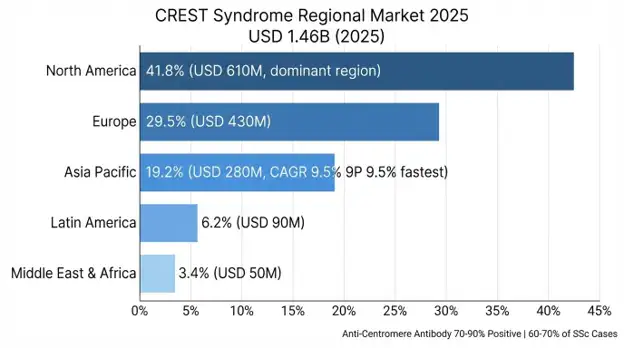
North America is the leading regional market at USD 610 million in 2025, growing at an estimated CAGR close to 7.6 percent until 2034. This market dominance is attributed to concentrated expertise in rheumatology and pulmonary hypertension subspecialties, health insurance for expensive combination treatments, advocacy groups, and the location of most global trials in systemic sclerosis-associated indications, wherein the USA accounts for the major portion of regional revenues.
The European region is the second-leading market in value terms, estimated at around USD 430 million in 2025 due to the presence of dense academic rheumatology centers, national/multinational scleroderma registries, and health coverage, which provides access to core products, though health technology assessments and cost control procedures can limit the acceptance of the latest expensive biologicals.
The Asia Pacific market holds the position of the fastest growing, estimated to be worth about USD 280 million in 2025 with a CAGR of around 9.5 percent forecasted until 2034 owing to increasing rheumatology training infrastructure, growing diagnostic awareness, and a favorable reimbursement landscape for pulmonary hypertension treatments in China, Japan, and South Korea; in particular, Japan's reimbursement policy through a government-subsidized intractable diseases program is quite advanced for expensive regimens.
Middle East & Africa and Latin America represent the rest of the market, which is worth approximately USD 140 million in 2025, exhibiting under-diagnosis but growing rheumatology and pulmonary hypertension specialization capabilities in large private hospitals of the respective countries.
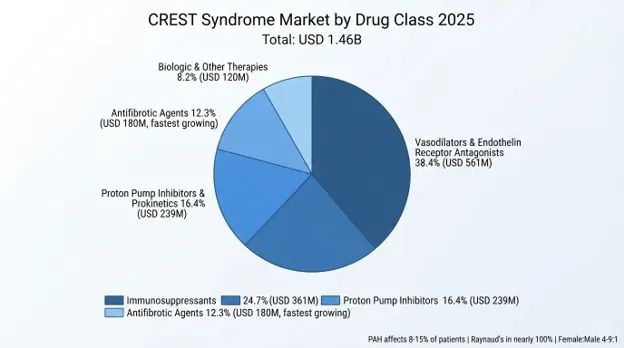
Insights on Drug Classes: The vasodilator and endothelin receptor antagonist drug classes that cover all the available treatments for pulmonary arterial hypertension make up the biggest portion of the drug class category, as they are associated with combination treatment and relatively expensive treatment per year per patient. While immunosuppressants have been fundamental for the treatment of active skin and lung diseases, biological drugs and antifibrotic medications constitute the fastest-growing sub-segments of the category due to approvals of new drugs.
Insights on Disease Manifestations: Raynaud’s phenomenon is the most common disease manifestation, which impacts almost all patients and leads to high prescription volumes of calcium channel blockers and vasodilators. Although pulmonary arterial hypertension impacts fewer patients than other disease manifestations, it occupies the largest portion of the market because of its intensive and expensive combination treatment.
Insights on Diagnostic Modality: Serological tests that involve anti-centromere antibodies constitute the leading segment of diagnostics, followed by pulmonary function tests and imaging, which are crucial to monitor the mandatory pulmonary arterial hypertension and interstitial lung disease. The fastest-growing segment of the diagnosis modality market is nailfold capillaroscopy due to its increasing importance in early detection.
Insights on End Users: Hospitals and specialized rheumatology clinics account for most of the share because of the multidisciplinary expertise necessary in these areas like rheumatology, pulmonology, cardiology, and gastroenterology. The fastest-growing segment among end users is ambulatory centers due to maintenance monitoring.
The CREST syndrome treatment market is moderately concentrated, where the major players focus their competition in certain vertical markets for therapies related to the condition due to the lack of an approved drug as a disease-modifying cure. Pharmaceutical firms possessing portfolios for pulmonary arterial hypertension have a very competitive stance in the most valuable vertical, while those with antifibrotic and immunology strengths compete in the expanding space of skin and lung fibrosis. The competitive distinction revolves around the extent of clinical evidence in patient populations suffering from systemic sclerosis, diversity of pipeline portfolio addressing different organ involvement, and strong connections with scleroderma centers.
March 2026: Boehringer Ingelheim announced successful results from Phase III trials of nintedanib in CREST syndrome patients with interstitial lung disease, demonstrating slower decline of forced vital capacity over 52 weeks.
February 2026: Subcutaneous treprostinil was approved for systemic sclerosis-associated pulmonary arterial hypertension patients at an earlier stage of functional classification by United Therapeutics.
December 2025: Phase II trials were launched by Roche in combination with tocilizumab with antifibrotic agents for treatment of systemic sclerosis-associated interstitial lung disease.
October 2025: Bayer AG provided information about successful Phase II trials of riociguat for systemic sclerosis-associated pulmonary hypertension, demonstrating improvement of exercise capacity and pulmonary vascular resistance.
You'll get the sample you asked for by email. Remember to check your spam folder as well. If you have any further questions or require additional assistance, feel free to let us know via-
+1 724 648 0810 +91 976 407 9503 sales@intellectualmarketinsights.com
11 Aug 2026
Intellectual Market Insights Research © 2026. All rights reserved.