Share this link via:

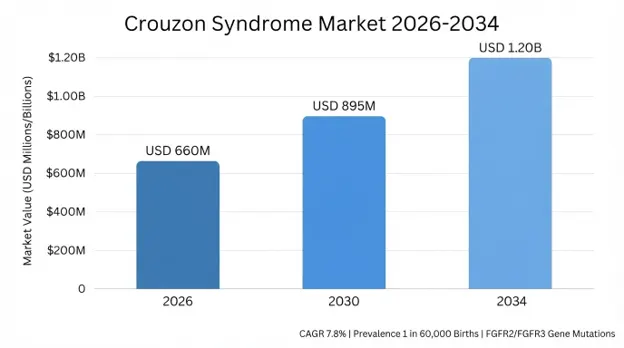
The global Crouzon syndrome market was valued at USD 610 million in 2025 and is projected to reach USD 660 million in 2026, expanding to USD 1.20 billion by 2034, growing at a CAGR of 7.8% during the forecast period (2026-2034).
Crouzon syndrome is a rare autosomal dominant craniosynostosis syndrome, first described in 1912 by the French neurologist Octave Crouzon, characterized by mainly gain-of-function mutations in the gene encoding the fibroblast growth factor receptor 2 (FGFR2) and a lesser number of cases associated with mutations in the gene encoding the fibroblast growth factor receptor 3 (FGFR3). The disorder leads to a premature closure of the cranial sutures; this impedes normal growth of the skull and results in a characteristic craniofacial phenotype, which includes deep orbits, hypertelorism, midface hypoplasia, class III malocclusion, and bilateral proptosis of the eyeballs. Crouzon syndrome is one of the more commonly diagnosed syndromic craniosynostoses and is a major cause for referrals to craniofacial units around the world, with prevalence at ~1 in 60,000 live births, but some population-based studies have reported higher rates of up to 1 in 25,000.
In addition to the physical characteristics, there is significant functional risk in Crouzon syndrome, with a significant proportion of late-diagnosed or untreated patients developing vision-threatening exposure keratopathy (due to severe proptosis), conductive hearing loss (due to middle-ear anomalies), obstructive sleep apnea (due to midface retrusion and nasopharyngeal narrowing), and elevated intracranial pressure. The multisystem complications require lifelong, multidisciplinary care, which goes beyond the traditional single-modality pharmaceutical or device market, by specialists in neurosurgery, craniofacial and plastic surgery, ophthalmology, otolaryngology, orthodontics, speech-language pathology, and clinical genetics.
Crouzon syndrome management is a complex market and should not be considered as a standalone product segment. It includes staged craniofacial reconstructive surgeries; diagnostic services (high-resolution three-dimensional computed tomography, magnetic resonance imaging, and next-generation sequencing panels of FGFR1, FGFR2, and FGFR3 genes); surgical hardware (resorbable and titanium fixation systems, internal and external distraction devices, and patient-specific three-dimensional printed implants and cutting guides); and long-term supportive services (orthodontic and orthognathic surgery, audiology, ophthalmic protection, sleep medicine, and psychosocial support).
In the niche but resource-intensive market, it's not about the price of any single product but about the sum of multiple surgeries, hospitalizations, imaging, orthodontics, and rehabilitation that can occur throughout a child's or teen's life in developed health systems; the total direct medical cost per patient is often USD 250,000-USD 550,000. The growing numbers of early genetic and radiographic diagnoses, the increasing capabilities of advanced craniofacial surgery throughout the world, and the continual evolution of virtual surgical planning, distraction technology, and minimally invasive endoscopic procedures are transforming treatment paradigms from reactive, late diagnosis correction to proactive, functional, and increasingly personalized care pathways.
| Report Coverage | Details |
|---|---|
| Base Year | 2025 |
| Base Year Value | USD 610 Million |
| Forecast Value | USD 1.20 billion |
| CAGR | 7.8% |
| Forecast Period | 2025-2034 |
| Historical Data | 2022-2025 |
| Largest Market | North America |
| Fastest Growing Market | Asia Pacific |
| Segments Covered | By Treatment Type, Surgery Type, Diagnostic Approach, End-User, Region |
| Region Covered | North America, Europe, Asia Pacific, Middle East & Africa, Latin America |
| Countries Covered | US, Canada, Mexico, UK, Germany, France, Italy, Spain, Netherlands, China, Japan, India, Australia, South Korea, Brazil, UAE, Saudi Arabia, South Africa |
| Key Market Playes | DePuy Synthes (J&J MedTech), Stryker Corporation, KLS Martin Group, Medtronic plc, Zimmer Biomet, Integra LifeSciences, Materialise NV |
Get more details on this report - Request Free Sample
Earlier and More Precise Diagnosis Through Expanding Genetic Testing and Advanced Imaging
A key aspect contributing to the development of the market involves better availability of next-generation sequencing panels for FGFR1, FGFR2, and FGFR3; the frequent application of high-resolution three-dimensional computed tomography; and greater awareness among physicians regarding syndromic craniosynostosis in the fields of neonatology, pediatrics, and clinical genetics. Indeed, previously many patients, especially those suffering from milder forms of the condition, were diagnosed relatively late because of the presence of the signs of cranial malformations, elevated intracranial pressure, and problems with visual perception and breathing. However, decreasing costs for targeted genetic tests and an improved network of genetic counseling facilities at academic craniofacial centers have allowed for faster diagnostics and for entering multidisciplinary treatment programs shortly after birth or even before it in case of the detection of a familial mutation of FGFR2.
Key Performance Metrics:
Technological Advancement in Surgical Planning, Distraction Osteogenesis and Patient-Specific Implants
Advances in planning and equipment used in craniofacial surgery are improving the accuracy and predictability of surgeries performed on patients suffering from Crouzon syndrome. The use of virtual surgical planning through three-dimensional imaging allows surgeons to perform virtual osteotomies, determine the degree of bone movement necessary, and fabricate patient-specific cutting guides and implants before performing the actual operation. Devices that allow for distraction osteogenesis have become more accurate in terms of vector positioning and have become capable of producing larger midface advancement without requiring bone grafting.
Key Performance Metrics:
The major factor impeding the growth of the Crouzon syndrome market includes the high cost of disease management in a person's lifetime, as well as poor reimbursement rates throughout different health systems. Treatments include several surgeries of the craniofacial type, which involve cranial vault reconstruction and midface advancement. There is a need for ongoing orthodontic treatment, ophthalmological care, audiological treatment, and treatment related to sleep. Direct medical costs may reach more than USD 300,000-500,000 per patient in developed countries, but the limited insurance available in many developing countries results in considerable costs for patients and their families. This factor limits access to treatment and advanced solutions.
Another important limiting factor includes the lack of experienced craniofacial surgeons and teams able to provide treatments for syndromic craniosynostosis. This expertise is present in only a few centers with high caseloads located mainly in North America and Western Europe. In addition, the absence of facilities in developing countries hinders timely treatment and diagnosis.
An interesting new opportunity is related to the development of novel pharmacological interventions aimed at modulating the aberrant FGFR2 signaling to treat the underlying cause of craniosynostosis. The preclinical studies with small-molecule inhibitors of FGFR tyrosine kinases have demonstrated their ability to reduce the occurrence of premature suture fusion in the animal model of FGFR2-associated craniosynostosis, which is evidence of the potential of targeted therapy. Orphan drug development programs available in the US and in Europe allow obtaining additional regulatory and commercial benefits, which make the development of such a therapy feasible.
Another opportunity is associated with the use of telemedicine solutions to connect remote patients with the limited number of centers of expertise for the treatment of craniosynostosis. Since distraction osteogenesis treatment consists of daily adjustments of the device and monitoring over many weeks, along with years of follow-up periods, it can be beneficial to provide access to the central craniofacial teams through digital platforms to reduce travel burden.
A meaningful shift is underway toward minimally invasive endoscopic strip craniectomy for eligible infants in the first few months of life, followed by extended helmet orthotic therapy to guide skull remodeling as the brain grows. Compared with traditional open cranial vault remodeling, endoscopic approaches are associated with reduced blood loss, shorter hospitalization, and faster recovery, though open midface advancement remains necessary later in childhood for most Crouzon syndrome patients given multi-suture and midface involvement. Separately, artificial intelligence and machine learning tools are increasingly integrated into virtual surgical planning workflows, automating segmentation of cranial bone and suture anatomy from computed tomography data in minutes rather than hours, with early studies suggesting improved accuracy in predicting postoperative skeletal position compared with conventional manual planning.
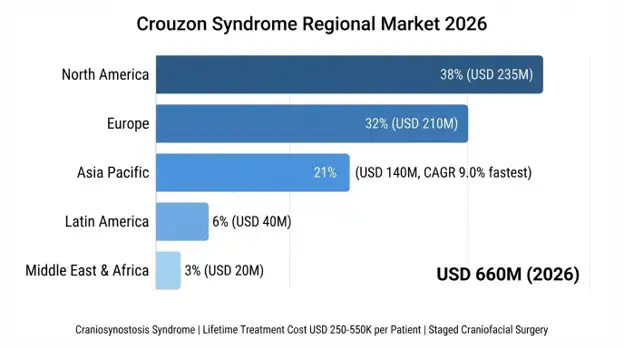
North America led the global Crouzon syndrome market in 2025 with a valuation of around USD 230-240 million and a forecasted CAGR of about 7.5% during 2026-2034, driven by the presence of prominent academic craniofacial programs, full insurance coverage for medically indicated reconstruction, high utilization rates for virtual surgery planning and patient-specific implants, and the presence of genetic testing capability that helps in making early diagnosis possible. The US dominates the regional market value through a network of dedicated pediatric craniofacial surgery centers capable of handling all phases of treatment starting from infancy to adolescence.
Asia Pacific was the fastest-growing regional market with a forecasted CAGR of about 9.0% during 2026-2034 on the back of rapid development of pediatric craniofacial surgery capability in China, India, Japan, South Korea, and Australia, along with increasing awareness among physicians and parents about syndromic craniosynostosis; rising healthcare spending; and medical tourism towards advanced treatment facilities within the region, available at costs much lower than those in the West, albeit with relatively low accessibility in non-metro locations.
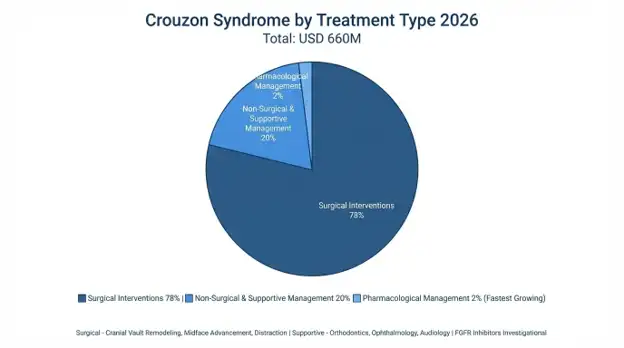
Insights for Treatment Type: Surgical interventions form the largest segment under treatment types, contributing to about 78-80% of total market value in 2025 owing to the pivotal importance of staged craniofacial reconstruction, including cranial vault remodeling and fronto-orbital advancement in infancy; midface advancement and distraction osteogenesis in childhood; and definitive orthognathic correction in adolescence. Non-surgical & supportive management, including helmet orthosis, ophthalmic protection, orthodontics, audiology, and genetic counseling, constitutes the remaining segment that also earns huge cumulative revenue owing to its long-term nature.
Insights for Surgery Type: The Cranial Vault Remodeling & Fronto-Orbital Advancement forms the largest surgery-type segment owing to the almost universal requirement of cranial expansion surgery to alleviate intracranial pressure. Le Fort III Osteotomy and Distraction Osteogenesis surgeries for midface advancement earn the maximum revenue per surgery owing to device cost and prolonged management period, while orbital decompression and revision surgeries form the rest of the market.
Insights into Diagnostic Approach: Clinical and Radiographic Imaging (three-dimensional CT and MRI) is the biggest segment of diagnostic testing and forms the foundational basis for surgical procedures. The genetic testing market segment is the fastest growing one, owing to declining costs of next-generation sequencing and the requirement of distinguishing Crouzon syndrome from other FGFR-related conditions such as Apert and Pfeiffer syndromes.
Insights into End Users: Hospitals and craniofacial centers associated with academic medical centers are the biggest end user segment, as these complex and multiple-stage management cases usually occur at such specialized centers. Ambulatory surgery centers and general hospitals have a smaller share in the end user segment.
The market for Crouzon syndrome around the world is somewhat concentrated in the craniofacial device category, where the bulk of the hardware and technology sales are generated by relatively few specialists who manufacture fixation equipment, distraction devices, and software solutions for virtual surgical planning. Competition is defined primarily through the performance of the distraction devices, the ability to customize implants, the extent of involvement with virtual surgical planning ecosystems, and strong clinical training programs for surgeons.
March 2026: The DePuy Synthes company was granted regulatory approval for a next-generation internal midface distraction system that offers better vector flexibility and smaller device size for pediatric craniofacial surgery.
January 2026: KLS Martin Group expanded its point-of-care three-dimensional printing network in prominent craniofacial institutions, providing for in-house fabrication of patient-specific anatomical models and surgical instruments in less than 24 hours after scanning.
November 2025: A prominent diagnostics company introduced a fast-turnaround gene test for craniosynostosis, which screens for FGFR1, FGFR2, FGFR3, and TWIST1 genes, allowing genetic diagnosis to be performed in less than one week.
September 2025: Scientists from a prominent pediatric craniofacial research center started an early-stage study of a small-molecule FGFR inhibitor, which is expected to decrease re-ossification risk in children with FGFR2-associated craniosynostosis.
You'll get the sample you asked for by email. Remember to check your spam folder as well. If you have any further questions or require additional assistance, feel free to let us know via-
+1 724 648 0810 +91 976 407 9503 sales@intellectualmarketinsights.com
11 Aug 2026
Intellectual Market Insights Research © 2026. All rights reserved.