Share this link via:

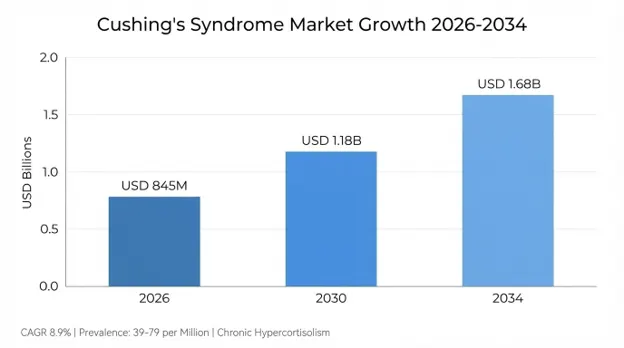
The global Cushing’s syndrome market size was valued at USD 780 million in 2025 and is projected to reach USD 845 million in 2026, expanding to USD 1.68 billion by 2034, growing at a CAGR of 8.9% during the forecast period (2026-2034).
Cushing's syndrome is an extremely uncommon, severe disorder of the endocrine system that occurs when there is too much cortisol in the bloodstream for too long, either due to overproduction of cortisol or to long-term treatment with exogenous glucocorticoids, which are used in the treatment of autoimmune diseases and inflammatory and oncologic diseases. For endogenous cases, about 65-70% are caused by an adrenocorticotropic hormone (ACTH) secreting pituitary adenoma (called Cushing's disease); close to 15-20% are due to autonomous cortisol secreting adrenal adenomas, adrenal hyperplasia, and adrenal carcinomas; and ectopic ACTH secretion from neuroendocrine tumors or small-cell lung carcinomas accounts for the remainder (10-15%). It is an orphan disease, with an estimated incidence of 1.2-2.4 per million and a prevalence of 39-79 per million; there is likely to be significant underestimation of the disease burden due to long diagnostic delay and significant overlap in clinical features with common metabolic disorders like polycystic ovary syndrome, obesity, and type 2 diabetes.
The clinical effects of chronic hypercortisolism are wide-ranging and are multisystemic, affecting central obesity, moon facies, dorsocervical fat pad, proximal myopathy, thin, violaceous striae, treatment-resistant hypertension, impaired glucose tolerance or overt diabetes, hypercoagulability, recurrent infections, and marked neuropsychiatric abnormalities such as depression, anxiety, and cognitive dysfunction. These complications represent a significantly increased risk of cardiovascular complications and premature death in the absence of disease control, and a large portion of patients suffer from residual cardiometabolic and psychological morbidity even after the disease has been rendered biochemically controlled, which necessitates a continued need for other add-on treatments, management of comorbidities, and monitoring services.
A biochemical investigation should be conducted in a systematic fashion and involve measurement of late-night salivary cortisol, twenty-four-hour urinary free cortisol, a low-dose dexamethasone suppression test, and plasma ACTH levels to establish etiology, in addition to high-resolution imaging of the pituitary or adrenal glands. If a diagnosis is not made or is found to be complex or biochemically discordant, inferior petrosal sampling at specialized tertiary centers is needed to accurately identify the origin of ACTH hypersecretion before planning surgery. This diagnostic process is multi-step and involves reoccurring use of specialized laboratory assays, dedicated imaging protocols, and highly trained endocrinology and interventional radiology staff during the initial diagnostic process and during prolonged follow-up after treatment to detect recurrence.
Transsphenoidal resection of the pituitary adenoma or unilateral adrenalectomy is the preferred first-line treatment, potentially a curative option to consider for eligible patients, and second-line options for persistent or recurrent disease are pituitary radiotherapy and bilateral adrenalectomy. Pharmacotherapy involves steroidogenesis inhibitors, glucocorticoid receptor antagonists, and somatostatin receptor ligands and has become an increasingly important part of the treatment continuum, being used as initial treatment in inoperable patients, as a bridge until the delayed effects of radiotherapy, and as chronic maintenance in patients who are not cured by surgery. These have a high lifetime therapeutic value per treated patient, given their orphan-drug pricing and often the need for their indefinite administration, and make Cushing's syndrome a high-value specialty market in the rare endocrine disease market.
| Report Coverage | Details |
|---|---|
| Base Year | 2025 |
| Base Year Value | USD 780 Million |
| Forecast Value | USD 1.68 Billion |
| CAGR | 8.9% |
| Forecast Period | 2025-2034 |
| Historical Data | 2022-2025 |
| Largest Market | North America |
| Fastest Growing Market | Asia Pacific |
| Segments Covered | By Treatment Type, Drug Class, Disease Type, Diagnosis, End-User, Region |
| Region Covered | North America, Europe, Asia Pacific, Middle East & Africa, Latin America |
| Countries Covered | US, Canada, Mexico, UK, Germany, France, Italy, Spain, China, Japan, India, South Korea, Australia, Brazil, Saudi Arabia, UAE, South Africa |
| Key Market Playes | Recordati Rare Diseases, Corcept Therapeutics, Xeris Biopharma, Novartis AG, HRA Pharma, Crinetics Pharmaceuticals, Sparrow Pharmaceuticals |
Get more details on this report - Request Free Sample
Rising Diagnostic Awareness and Expanding Biochemical Screening: Increasing awareness amongst endocrinologists and general practitioners regarding the burden of chronic hypercortisolism, as demonstrated by the updated guidelines for biochemical testing in patients with uncharacteristic presentation of features for their age, including early-onset osteoporosis or hypertension that does not match their body size, will result in more cases being diagnosed. Better access to outpatient late-night salivary cortisol test kits and better pituitary MRIs have reduced the historical lag time of several years beyond the fourth and fifth year from the symptoms of the condition to diagnosis. Rates of biochemical screening amongst poorly controlled type 2 diabetics have increased significantly over the past five years, along with double-digit growth of dedicated pituitary MRIs annually.
Expanding Pharmacological Pipeline and Orphan Drug Incentives: The incentive-driven regulatory framework consisting of orphan drug designation, market exclusivity extension, and fee waivers available from the FDA and EMA has led to continuous research investment in an under-explored class of disease. The approval of steroidogenesis inhibitors, glucocorticoid receptor antagonists, and somatostatin receptor ligands in the past ten years has led to the development of a multi-faceted approach to Cushing’s syndrome drug therapy, which can take individual cases of the disease and treat them according to the underlying disease mechanism and accompanying comorbidities, with more than a dozen orphan designations for Cushing’s syndrome drug candidates active across the globe.
High Treatment Costs and Limited Reimbursement in Emerging Markets: The annual cost of treating rare disease conditions using approved orphan drugs ranges between USD 100,000 and above USD 250,000 on a per-patient basis, depending on the rarity of the disease condition. This pricing strategy makes access to treatments challenging in countries where there are no rare disease reimbursement policies, and even in insured countries, the treatment process is hindered by prior authorizations and step therapy programs that may delay treatment for several weeks or months, during which time organ damage occurs due to cortisone levels.
Diagnostic Complexity and Limited Specialist Access: The demand for repeated confirmatory biochemical testing, exclusion of pseudo-Cushing syndrome caused by depression, obesity, or alcoholism, as well as, when needed, the invasive inferior petrosal sinus sampling, performed only in a few selected tertiary medical facilities, all lead to delayed diagnosis and delay in the start of treatment. The above-mentioned factors, along with the limited global access to specialists skilled in pituitary and adrenal surgery, result in leaving a significant part of the true disease burden off the market.
Combination Therapy and Biomarker-Guided Treatment Selection: The failure of sustained biochemical remission in 45-55% of patients under mono-treatment means there is a potential for rationally combined therapies that will use drugs with complementary modes of action, for instance, steroidogenesis inhibitors in combination with cortisol receptor blockers, thus increasing effectiveness and reducing the dose of each medication. The development of methods for detection of somatostatin receptor subtypes and somatic mutations in corticotroph adenomas allows us to move forward in developing personalized therapy, as is done in oncology.
Expansion of Specialized Endocrine Centers in Emerging Markets: High-volume centers for the surgeries of the pituitary and adrenal glands are anticipated to develop in the Asia Pacific and Latin American regions in the coming years, which will help in diagnosing conditions and gaining access to surgical and pharmacological treatments as per the recommendations, along with increasing the adoption of newer orphan drugs, as these centers are known to be early adopters of newer therapeutic approaches.
Next Generation Selective Glucocorticoid Receptor Modulators: There is an increasing trend towards developing tissue-selective glucocorticoid receptor modulators, which are intended to be more selective and avoid the adverse off-target effects observed with earlier drugs. There are some molecules that are currently undergoing phase III clinical trials as possible replacements or supplements to existing therapy.
Focus on PROs and Tele-Monitoring: As far as clinical trials and evaluation by payers are concerned, there is an increased tendency towards validating quality of life questionnaires along with biochemical remission criteria due to the realization that the normalization of cortisol levels alone is not adequate in describing the entire patient experience. This is compounded by the increased adoption of tele-endocrinology and collection of cortisol at home.
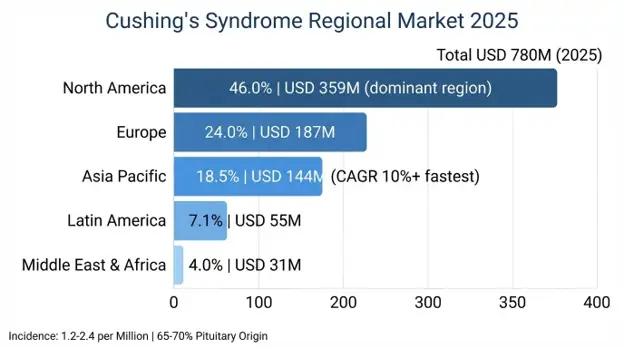
North America had the highest market share value at approximately USD 359 million in 2025 due to the concentration of pituitary centers of excellence, full orphan drug reimbursement, and the existence of rare disease pharmaceutical companies; the US makes the major portion of the regional revenue generation. Europe was the second largest, having a value of roughly USD 187 million in 2025 due to a mature endocrinology network, central reference centers, and structured orphan therapeutic reimbursement across the region.
Asia Pacific was the third largest in 2025 and was estimated to have the highest CAGR of over 10 percent till 2034 due to a growing endocrinology network in China, Japan, and South Korea; increasing diagnosis awareness; and increasing investment by governments into rare disease diagnostics and treatment capacity. The Middle East & Africa, along with Latin America, were the fourth and fifth markets in 2025 at approximately USD 86 million; the growth was seen only in urban centers of excellence.
By treatment type, pharmacotherapy dominates the market with a share of nearly 52% (USD 406 million in 2025) owing to its growing application as primary, bridging, and maintenance therapy, while surgery holds a 34% share (USD 265 million), radiation therapy holds a share of about 9% (USD 70 million), and other therapeutic methods hold a share of 5% (USD 39 million).
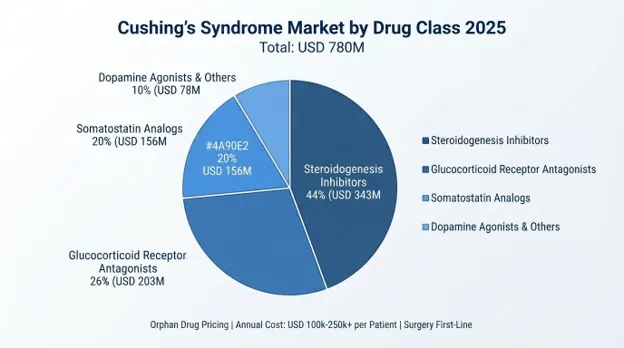
By drug class, steroidogenesis inhibitors occupy the leading position with almost 44% market share (USD 343 million) due to their wide range of applications regardless of etiology; glucocorticoid receptor antagonists comprise 26% (USD 203 million); somatostatin analogs are estimated to constitute almost 20% (USD 156 million); and dopamine agonists as well as other drugs are responsible for 10% (USD 78 million).
By type of disease, Cushing’s disease is the largest portion with an approximate market share of 65% (USD 507 million) due to being the most common endogenous condition, while adrenal Cushing’s syndrome accounts for 19% (USD 148 million), ectopic ACTH syndrome constitutes approximately 9% (USD 70 million), and iatrogenic Cushing’s syndrome makes up about 7% (USD 55 million).
By end-user, hospitals and clinics constitute the largest portion at around 50% (USD 390 million), followed by specialty endocrinology centers that constitute roughly 30% (USD 234 million), ambulatory surgery centers constituting roughly 12% (USD 94 million), and finally, home care constituting about 8% (USD 62 million).
The global Cushing’s syndrome market is moderately consolidated, with a handful of niche pharmaceuticals specializing in rare disease treatment companies along with large pharmaceutical players with wide-ranging endocrinology franchises. The key points of differentiation among competitors are effectiveness and longevity of biochemical cortisol suppression; safety and tolerance, including the risk of liver toxicity and adrenal insufficiency; convenience of administration; and indications for use. Strategic collaborations with academic centers focused on research in the field of pituitary and adrenal glands, along with patient registries and rare disease patient advocacy organizations, have an important part in market access strategy.
March 2026: Results of a Phase III trial of relacorilant by Corcept Therapeutics in endogenous Cushing’s syndrome was presented, showing statistically significant changes in glycemic parameters and blood pressure compared to placebo.
January 2026: Levoketoconazole was supported by Xeris Biopharmaceuticals with expanded real-world evidence on cortisol normalization in patients with Cushing’s syndrome.
November 2025: European insurance reimbursements of osilodrostat of Recordati Rare Diseases were expanded based on extended study results on maintenance of biochemical remission after 72-week continuous therapy.
September 2025: Investigational program of Crinetics Pharmaceuticals directed at the ACTH receptor for treatment of patients with Cushing’s disease with persistent or recurrent hypercortisolism after pituitary surgery reached late-stage clinical trials.
You'll get the sample you asked for by email. Remember to check your spam folder as well. If you have any further questions or require additional assistance, feel free to let us know via-
+1 724 648 0810 +91 976 407 9503 sales@intellectualmarketinsights.com
12 Aug 2026
Intellectual Market Insights Research © 2026. All rights reserved.