Share this link via:

The global cystic fibrosis therapeutics market was valued at USD 11.7 billion in 2025 and is projected to reach USD 13.4 billion in 2026, expanding to USD 28.1 billion by 2034, growing at a compound annual growth rate (CAGR) of 9.6% during the forecast period (2026-2034).
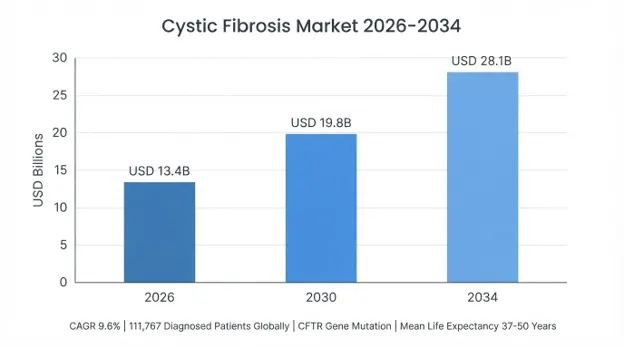
Cystic fibrosis is one of the most important genetic diseases involving several organs in the world, and it is caused by mutations in the CFTR (cystic fibrosis transmembrane conductance regulator) gene, which affects the regulation of the salt and fluid transport across the epithelial cells. This primary defect causes excessive, sticky mucus to build up in the lungs, pancreas, and other organs, causing chronic progressive respiratory infection, pancreatic insufficiency, nutritional malabsorption, and systemic complications that significantly affect patient quality of life and life expectancy.
Modern treatments for CF include increasingly complex and sophisticated drugs, which are either aimed at the treatment of the disease complications (traditional) or modulate the underlying cellular disease (revolutionary). The therapeutic landscape has changed dramatically with the introduction of CFTR corrector and potentiator molecules that improve the amount, transport, and function of faulty CFTR protein, which have revolutionized treatment paradigms and clinical outcomes. This triple combination therapy (elexacaftor-tezacaftor-ivacaftor) is the biggest therapeutic breakthrough in the history of CF therapy and has improved the outlook for everyone who takes it unless they have been treated since birth with CF antibodies. The triple combination (eluxacaftor-tezacaftor-ivacaftor) represents the most important therapeutic breakthrough in CF history, improving the outlook for 90% of those who take it and bringing CF closer to normal life expectancy for newborns unless treated from birth with CF antibodies.
The market includes complete therapeutic ecosystems for tackling respiratory pathophysiology by mucolytics, better airway clearance by inhaled antimicrobials that reduce chronic infection burden, gastrointestinal complications by pancreatic enzyme replacement therapies that restore nutrient absorption, and emerging therapies for extrapulmonary manifestations such as CF-related diabetes and hepatic cirrhosis. Beyond the individual drug sales, commercial impact includes the use of personalized medicine strategies that involve genotype-driven therapeutic approaches, where a growing number of therapies are able to be prescribed as genotype-specific drugs to improve outcomes; the expansion of pulmonary monitoring and infection management systems; the nutrition optimization program; and the multidisciplinary approach that integrates a wide range of treatments into a single package to optimize outcomes and manage the high treatment burden associated with the complexity and chronicity of the disease.
| Report Coverage | Details |
|---|---|
| Base Year | 2025 |
| Base Year Value | USD 11.7 Billion |
| Forecast Value | USD 28.1 billion |
| CAGR | 9.6% |
| Forecast Period | 2025-2034 |
| Historical Data | 2022-2025 |
| Largest Market | North America |
| Fastest Growing Market | Asia Pacific |
| Segments Covered | By Drug Class, Route of Administration, Distribution Channel, Disease Type, End-User |
| Region Covered | North America, Europe, Asia Pacific, Middle East & Africa, Latin America |
| Countries Covered | US, Canada, Mexico, UK, Germany, France, Italy, Spain, Netherlands, Denmark, Sweden, China, Japan, India, Australia, South Korea, Brazil, Argentina, UAE, Saudi Arabia, South Africa |
| Key Market Playes | Vertex Pharmaceuticals Inc., AbbVie Inc., Roche AG (Genentech), Novartis AG, Gilead Sciences Inc., Eli Lilly and Company, Teva Pharmaceutical Industries Ltd., Merck & Co. Inc. |
Get more details on this report - Request Free Sample
The leading factor influencing the cystic fibrosis therapeutics market is the rise in the number of people suffering from cystic fibrosis and the improved life expectancy of the sufferers as a result of improvements in diagnostic and therapeutic methods. Over 75,000 individuals are diagnosed with cystic fibrosis globally. There will be over 111,000 diagnosed cases in the world by 2025, according to the global registries. As a result of implementation of newborn screening procedures and advanced therapies like the CFTR modulators, cystic fibrosis is no longer considered an illness that kills children but rather a chronic disorder that requires permanent treatment.
The increased life expectancy is the reason for the increased incidence of CF-related conditions like diabetes, liver diseases, osteoporosis, and infertility. Moreover, diagnostic facilities in the emerging countries become better, which leads to the rise in identification of cystic fibrosis among children and the adult population. Although the major consumers of cystic fibrosis treatments include North America and Europe, there is a possibility of rapid market expansion in the APAC and other developing regions in the future.
Fast-growing development of small-molecule CFTR drugs is a huge potential area in the cystic fibrosis therapeutics market. Small-molecule CFTR modulators target genetic abnormalities by improving defective CFTR proteins via potentiators, correctors, and combinations. The launch of Trikafta/Kaftrio (elacaftor-tezacaftor-ivacaftor) became revolutionary due to high efficiency in enhancing lung function and offering efficient treatment to almost 90% of patients with cystic fibrosis, including those with the frequent genetic Phe508del mutation. Thus, its impressive results created a new standard of care globally and increased the number of treatable patients.
Continued developments of the next-generation CFTR modulators provide numerous opportunities for the growth of the market. Novel medicines attempt to enhance efficiency, safety, and genotypic coverage as well as to treat patients who do not qualify for current treatments. The approval of Alyftrek (vanzacaftor-tezacaftor-deutivacaftor) by the FDA in 2025 demonstrates an ongoing process of developing more powerful disease-modifying medicines. Apart from that, the combination of CFTR modulators with gene therapy and gene editing provides great potential.
High prices of CFTR modulators such as Trikafta, priced at an average of USD 311,503 per year per person, serve as the major constraint in the cystic fibrosis therapy market. This poses great problems in terms of payment by health systems, insurance companies, and the patients themselves, especially for countries with low pharmaceutical budgets. Despite the negotiations by various European nations as well as Australia, leading to large price cuts, the availability of these medicines in many other parts of the world remains constrained by their unaffordability. Besides the drug itself, cystic fibrosis patients require continuous multidisciplinary treatment throughout life that includes monitoring of lung functions, imaging, nutritional treatment, assessment of pancreas function, and laboratory tests, which increase costs even more. Developing nations experience further constraints due to poor healthcare facilities, lack of reimbursement schemes, and a lower number of cystic fibrosis clinics.
The biggest business opportunity in the cystic fibrosis therapeutics market includes the development of gene therapy, CRISPR-Cas9 gene editing, and messenger RNA (mRNA) therapies that work toward correcting the CFTR genetic mutation rather than merely controlling the symptoms. Contrary to the conventional CFTR modulators, these innovative techniques hold the promise of giving a disease-modifying effect or a functional cure through the restoration of the normal functioning of CFTR protein synthesis.
The application of gene therapy through adeno-associated viruses (AAV) has shown positive outcomes in preclinical studies in terms of delivering the functional CFTR genes in the respiratory epithelial cells, while the clinical trials are still underway for their safety and efficacy. Similarly, the application of CRISPR-Cas9 technology is being researched for permanent correction of disease-causing mutations through various gene-editing methods in vitro and in vivo. The other innovation in this regard includes the application of mRNA therapy, where healthy CFTR protein can be temporarily produced without changing the genomic DNA.
An important trend that influences the development of the cystic fibrosis therapies market is the evolution of new-generation CFTR modulators to be more efficacious, genotype-wide-ranging, and safer than the currently available ones. Innovative correctors and potentiators, which improve the CFTR protein folding, trafficking, and function, are under development by pharmaceutical companies. The recent FDA approval of Alyftrek (vanzacaftor-tezacaftor-deutivacaftor) in January 2025 is a landmark in the field because it ensures better outcomes and makes the therapy possible for patients with CFTR mutations that were hard to treat before. Other new generation CFTR modulators will be available on the market in the coming years.
The trend towards combination treatments with CFTR modulators is another crucial issue impacting the growth of the cystic fibrosis therapeutics market. Pharmaceutical companies are exploring the possibility of the combination of CFTR modulators with anti-inflammatory drugs and advanced anti-infectives and biofilm disruptors.
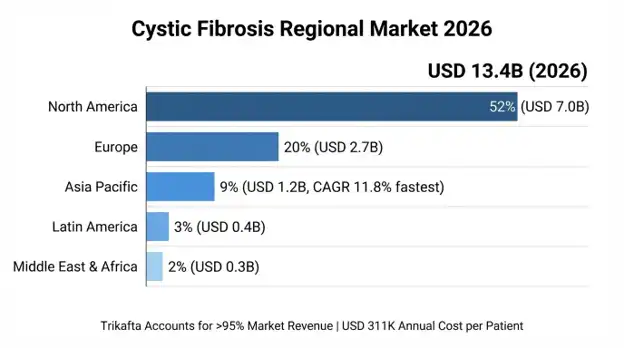
North America accounted for the major share of the cystic fibrosis therapeutics market in 2025, with revenues of USD 7.0 billion, and is estimated to expand at a CAGR of 9.2% up until 2034. The U.S. dominates the market within the region, owing to the presence of nearly 35,000 individuals diagnosed with cystic fibrosis and high adoption of CFTR modulators along with numerous cystic fibrosis care center accreditations. Good market reimbursement through private and public insurance, research funding, and a favorable regulatory framework provided by the Food and Drug Administration drive innovation and market growth.
Europe occupied an estimated 23% of the worldwide market value of cystic fibrosis therapeutics at USD 2.7 billion in 2025 and is expected to witness a CAGR of 9.1% up to 2034. Europe had an estimated 24,000 patients of cystic fibrosis who receive support from the highly structured care network and registries that have been set up in countries like the United Kingdom, Germany, France, Italy, and Spain. Growth in the market will be facilitated by increasing availability of treatments based on CFTR modulators, supportive regulation by the European Medicines Agency, and multidisciplinary care. Despite delayed entry of advanced therapies such as Trikafta in some countries due to reimbursement issues, advanced European countries have achieved universal coverage for cystic fibrosis therapies.
Asia Pacific is the fastest-growing regional segment of the cystic fibrosis therapeutics market, estimated to exhibit a CAGR of 11.8% up to 2034, reaching from USD 1.2 billion in 2025 to USD 3.8 billion in 2034. Factors such as growth in the healthcare infrastructure of the Asia Pacific, increased awareness of rare diseases, improved diagnostics, and availability of advanced therapeutic options contribute to the growth of the market. China holds the leading position in the Asia Pacific market owing to the government's support of research on rare diseases and investments in novel treatments for cystic fibrosis patients. The established systems of care for cystic fibrosis patients in Japan and South Korea and early diagnosis due to newborn screening are other contributing factors. India offers substantial growth potential due to the continuous improvement in diagnostic capabilities and awareness of rare diseases.
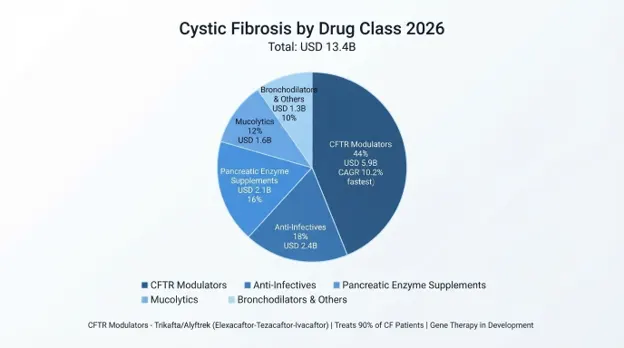
CFTR modulators commanded most of the cystic fibrosis market in 2025 with a 44% market share and a valuation of USD 5.1 billion, growing at a 10.2% CAGR till 2034. Efficacy, increasing genotypic coverage, and growing usage of newer therapies, including triple combination therapy, will fuel the growth in the market segment.
The anti-infective category held an 18% market share with a valuation of USD 2.1 billion in 2025 and a CAGR of 7.8%. Anti-infective therapies continue to be the key to managing chronic respiratory infections in cystic fibrosis; however, the growth of demand is slowing down due to the improved efficacy of CFTR modulators in terms of pulmonary function.
Pancreatic enzyme supplements held a 16% market share and were valued at USD 1.9 billion in 2025, growing at an 8.9% CAGR. Lifelong pancreatic enzyme replacement therapy for patients of cystic fibrosis with pancreatitis continues to be the key treatment modality.
The mucolytics segment held 12% market share and was valued at USD 1.4 billion in 2025, growing at 7.2% CAGR. The mucolytic therapy helps with effective mucus clearance.
Bronchodilators and other treatments held 10% market share and were valued at USD 1.2 billion, growing at 6.5% CAGR.
Oral administration leads the way with 69% of the market, worth USD 8.1 billion by 2025, due to preference for systemic CFTR modulators via oral administration. Systemic delivery via oral administration is represented by drugs like Trikafta, Kalydeco, Orkambi, and Symdeko, which deliver drugs systemically in an easy manner, but oral administration hinders the ability to get high pulmonary concentrations.
Inhaled administration holds 31% of the market, worth USD 3.6 billion by 2025, comprising inhaled antimicrobials, mucolytics, and other inhaled drugs. Inhaled drugs offer pulmonary delivery to achieve high concentration locally while minimizing systemic exposure. This route of administration offers a high rate of growth, owing to innovations in next-generation inhaled CFTR modulators and antimicrobials.
Hospital pharmacies have a market share of 53.5%, which distributes CF drugs through accredited CF care centers and pulmonology specialties. The clustering of CF patients into CF care centers and hospital pulmonology specialty clinics gives an inherent preference for hospital pharmacies.
Retail pharmacies have a 26% market share, distributing CF drugs via their convenient access to CF patients as maintenance therapy and supportive medicines. This comes because of the trend in CF treatment that has become focused on maintenance treatments.
Online pharmacies have a market share of 20.5% and are growing at the highest rate of 13.2% CAGR. Online pharmacists are growing in popularity among CF patients because of the convenience of delivery and easy comparison between prices.
The cystic fibrosis treatment market is characterized by very high market concentration with the dominance of Vertex Pharmaceuticals' portfolio of CFTR modulating drugs that contribute significantly towards generating revenues in the market. The dominance of Vertex Pharmaceuticals in the market is attributable to its strong intellectual property protection, clinical success, wide physician acceptance, and reimbursement arrangement, among other factors. However, there has been an ongoing shift in the competitive dynamics in the market following investment by companies like Novartis, Roche, and Boehringer Ingelheim in next-generation CFTR modulators, gene therapy, and inhaled genetic therapies.
January 2025: Alyftrek (vanzacaftor-tezacaftor-deutivacaftor) was FDA-approved, which is the first next-generation modulator that shows superiority to Trikafta in terms of clinical results. It extends the coverage to patients with certain Class II CFTR mutations and competes with Trikafta on a different mechanism and potentially additional features. Alyftrek will be launched by Vertex Pharmaceuticals in the US market, with sales forecasted at USD 2.5 - 3.5 billion.
November 2024: CF gene therapy program development by Boehringer Ingelheim was achieved through collaboration with the University Consortium; the company is running Phase II studies on inhaled CFTR gene therapy in CF patients irrespective of their CFTR genotype. The program shows progress in the development of an innovative CF gene therapy treatment strategy targeting the primary genetic CFTR defect.
October 2024: The quarterly financial report released by Vertex Pharmaceuticals showed strong third-quarter 2025 performance, with the Trikafta drug accounting for USD 2.8 billion in revenue in the period under review and recording a 13% increase compared to the previous year, with maturity and patent expiry in 2032 that will allow generics to enter the market.
September 2024: Various CF advocacy groups are implementing programs aimed at improving access to CFTR modulators through price negotiation with governments and pharmaceutical firms.
You'll get the sample you asked for by email. Remember to check your spam folder as well. If you have any further questions or require additional assistance, feel free to let us know via-
+1 724 648 0810 +91 976 407 9503 sales@intellectualmarketinsights.com
12 Aug 2026
Intellectual Market Insights Research © 2026. All rights reserved.