Share this link via:

The global Déjerine-Sottas Syndrome market size was valued at USD 1.24 billion in 2025 and is projected to reach USD 1.38 billion in 2026, expanding to USD 2.89 billion by 2034, growing at a compound annual growth rate of 7.6% during the forecast period (2026-2034).
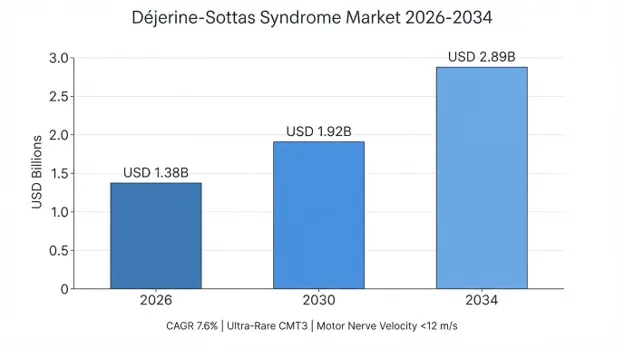
Déjerine-Sottas Syndrome (DS) was once defined as a serious demyelinating hereditary motor and sensory neuropathy but is better described as a type of Charcot-Marie-Tooth disease (CMT3) with an early onset that involves progressive deterioration of the myelin sheaths that surround peripheral nerves. Multiple pathophysiological processes cause the disease, with progressive demyelination of motor and sensory nerve fibers that leads to severely depressed motor nerve conduction velocities (< 12 meters per second) compared to normal velocities (> 40 meters per second); progressive axonal degeneration over time that results in progressive loss of nerve function; systemic complications with involvement of respiratory insufficiency and skeletal deformities that extend beyond peripheral nervous system involvement; and significant functional disability that requires comprehensive multidisciplinary therapeutic intervention in both the pediatric and adult populations.
There are several supportive and emerging disease-modifying therapies available for D.S.S. that consider the extraordinary clinical heterogeneity that results from genetic diversity and mutations in several genes (MPZ, EGR2, PMP22, and PRX), which cause variability in age of onset, disease progression rates, and symptom severity. Current therapeutic strategies focus on treating all symptoms, including a pharmacological approach using tricyclic antidepressants for pain, anticonvulsant drugs, such as gabapentin and carbamazepine (for neuropathic pain), and new treatment modalities that target the underlying mechanisms of demyelination. The market includes specialized diagnostic services, such as advanced electrophysiological assessments; genetic sequencing for definitive molecular diagnosis, which has a diagnostic yield of 45-55% of pathogenic variants identified; magnetic resonance imaging, which can identify hypertrophic nerve changes and secondary structural abnormalities; multidisciplinary clinical management, which involves the coordination of neurologists, physiatrists, orthopedic specialists, and rehabilitation professionals; and patient support programs, which focus on deterioration in quality of life due to progressive disability.
The commercial value is also seen in complex therapeutic ecosystems that include genetic counseling services, genetic testing platforms, specialized neurological care services, orthopedic surgical interventions to correct progressive skeletal deformities such as scoliosis requiring surgical stabilization, respiratory support services for patients that develop ventilatory dysfunction throughout disease evolution, and rehabilitation services to optimize functional capacity maintenance during the course of the disease. Despite its ultra-rare classification, the market for Déjerine-Sottas Syndrome covers the needs of an estimated 4,200-5,600 patients globally and is segmented by several critical unmet medical needs for which the disease has a mechanistic pathway.
| Report Coverage | Details |
|---|---|
| Base Year | 2025 |
| Base Year Value | USD 1.24 billion |
| Forecast Value | USD 2.89 Billion |
| CAGR | 7.6% |
| Forecast Period | 2025-2034 |
| Historical Data | 2022-2025 |
| Largest Market | North America |
| Fastest Growing Market | Europe |
| Segments Covered | By Product Type, Treatment Modality, Age Group, Disease Severity Classification, End-User |
| Region Covered | North America, Europe, Asia Pacific, Middle East & Africa, Latin America |
| Countries Covered | US, Canada, UK, Germany, France, Italy, Spain, Netherlands, Japan, China, India, Australia, South Korea, Brazil, UAE, South Africa |
| Key Market Playes | Novartis AG, Roche (Genentech), Sanofi Genzyme, Biogen Inc., Santhera Pharmaceuticals, Mitochondrial Medicine Frontier Development Center |
Get more details on this report - Request Free Sample
The major structural catalyst for the market expansion of the Déjerine-Sottas Syndrome market is based on the exponential increase in the availability of sophisticated genetic diagnostic tools, especially those of next-generation sequencing, which have transformed rare disease diagnosis through complete genome analysis capable of determining pathogenic mutations in specific genes underlying hereditary neuropathies with exceptional diagnostic accuracy. The rare disease genetic testing market has grown at 18-22% each year from 2020 to 2025, with hereditary neuropathy panels used in developed neurology clinics as part of standard diagnostic procedures.
The existing diagnostics models prove that about 45-55% of DS syndrome cases have molecular genetic verification when assessed in centers that offer sequencing technologies, whereas just 15-20% undergo such diagnostics in territories that do not have any advanced infrastructure, which indicates a potential for market growth by means of diagnostics infrastructure development. Insurance coverage growth was caused by the clinical value of genetic tests used in the diagnosis of hereditary neuropathies; Medicare and most private insurance providers cover the cost of comprehensive neuropathy panel tests at USD 2,500-4,200 each. There is a growing need for genetic counseling among families affected with hereditary neuropathy; thus, the genetic counselors' community grows 12-14% a year.
Key Performance Metrics for Diagnostic Market Growth:
Déjerine-Sottas Syndrome usually presents itself before the age of two with gradual symptom development, posing a huge burden of disease among pediatrics due to developmental and functional issues, as well as related complications like respiratory failure, orthopedic problems, and pain syndromes that require multidisciplinary treatment. The market for pediatric hereditary neuropathies has been seeing rapid growth due to increased clinical awareness, better diagnostic methods in detecting milder cases of hereditary neuropathies, and the understanding that early treatment can affect disease courses.
Pediatric Déjerine-Sottas syndrome has an early onset of reliance on a wheelchair, whereby about 28-35% require mobility assistance through teenage years compared to the other forms that have onset in adolescence and require mobility aids in 18-22%. These complications contribute largely to increased health care spending, whereby respiratory problems occur in 12-18% of the cases and lead to the need for ventilatory assistance or respiratory treatments. Orthopedic complications, including the requirement for spinal surgery due to scoliosis, affect 26-34% of pediatric cases, whereby spinal surgeries cost about USD 45,000-65,000 each, and repeated surgeries make the total orthopedic expenditure USD 120,000-180,000.
Pediatric Disease Burden Metrics:
A constraint to market growth is associated with the ultra-rarity of the disease in question. Estimates show that there are about 4,200 to 5,600 patients affected by Déjerine-Sottas Syndrome worldwide; hence, the potential market is much smaller compared to those of other rare diseases, resulting in less incentive to come up with specialized treatment solutions on the part of pharmaceutical and medical device businesses. The rarity of the disease results in a number of commercial obstacles, namely small numbers of patients to yield significant revenues, infeasibility of conducting clinical trials due to difficulty in recruitment, and increased costs of development per patient.
The nature of the disease affecting children results in market limitations due to the need for pediatric clinical trial designs, high safety standards for pediatric patients, and the difficulties in reimbursements related to the treatment of children within healthcare systems that emphasize cost-effectiveness analysis on a per-quality-adjusted-life-year basis. The geographical location of people affected by Déjerine-Sottas Syndrome leads to fragmented markets with their own regulations, reimbursement schemes, and healthcare system structures. About 60-65 percent of Déjerine-Sottas Syndrome patients live in developed countries where healthcare and insurance facilities are well-established. 35-40 percent of the patients live in underdeveloped regions where diagnosis and neurological treatment are not available.
Market Size Constraint Metrics:
A revolutionary business opportunity in this case would be that of research and development in gene therapy and interventions on specific genetic mutations for the condition known as Déjerine-Sottas Syndrome, which may entail the use of viruses for gene replacements to restore normal expression of myelin-associated proteins or antisense oligonucleotides to modulate gene expressions. Gene therapy for neurological diseases has seen huge advancements after the approval by the FDA of several gene therapies for inherited conditions.
Development of gene therapies for demyelinating hereditary neuropathies will rely on existing delivery mechanisms such as adeno-associated virus vectors capable of delivering prolonged therapeutic gene expression, lipid nanoparticles for the delivery of antisense oligonucleotides to penetrate peripheral nerve barriers, and non-viral delivery methods minimizing immune system reaction risks. Numerous preclinical and initial clinical trials of gene therapy strategies targeting CMT conditions reveal the proof of mechanism feasibility for myelin repair and neuroprotection purposes, with further translation into gene therapy application specifically targeting Déjerine-Sottas Syndrome conditions expected by 2027-2029. A one-time cure or disease stabilization opportunity calls for premium price tags ranging from USD 485,000 to 750,000 per therapy session.
Gene Therapy Development Opportunity Metrics:
The landscape for management of Déjerine-Sottas syndrome is undergoing significant transformation via the creation of rare disease centers that combine the efforts of neurologists, geneticists, physiatrists, orthopedic surgeons, pulmonologists, and rehabilitation specialists for complete diagnosis and optimization of treatment. There has been evidence of better results in patients with hereditary neuropathies seen at hereditary neuropathy centers, where 68-74% of patients get their genetic diagnosis done in comparison to 28-35% in regular neurology clinics.
The rare disease center strategy highlights the importance of diagnosing the disease early via genetic testing; interventions for complications expected, such as respiratory failure and bone abnormalities; pain management techniques; and genetic counseling of families for making informed decisions regarding reproduction. Currently, around 28-32 hereditary neuropathy centers specializing in their operations are found in the global landscape in the year 2025. These centers are primarily located in North America and Western Europe, reflecting significant differences in access to them in developing countries. The market for the services provided by the specialized centers has grown through various payment methods.
Specialized Center Care Model Metrics:
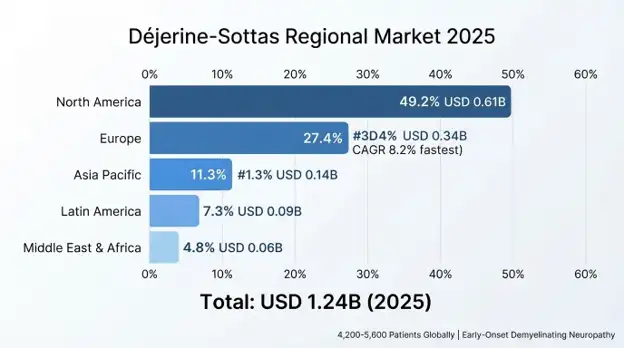
The North America region is estimated to lead the global market share with revenues of USD 0.61 billion in 2025, recording a compounded annual growth rate of 7.8% by 2034. Factors leading to regional supremacy include a preponderance of centers dealing with hereditary neuropathies, such as academic medical centers having rare disease programs; an established diagnostic framework offering molecular genetic testing and neuroimaging; health insurance covering Medicare for specialized neurological care; and a clinical research framework for conducting patient recruitment for genetic and therapy studies.
The U.S. constitutes 83% of the North American market value due to the availability of insurance coverage for neurological services such as genetic testing, genetic counseling, and multidisciplinary coordination in the form of Medicare. The area has roughly 14-16 research and specialized clinics for hereditary neuropathies. North America has high participation in clinical studies as compared to the rest of the world. Around 24-28% of patients suffering from hereditary neuropathies are involved in clinical research studies in North America as opposed to 8-12% elsewhere.
North America Regional Market Metrics:
Europe has a market valuation of USD 0.34 billion in 2025, growing at the highest rate among all regions at an 8.2% compound annual growth rate up to 2034. Growth drivers include universal healthcare offering genetic testing and neurology care irrespective of the socioeconomic condition of the patient, robust development of the infrastructure for genetic medicines, and increased funding of rare disease research programs. Several European nations have established national rare disease registries to enhance epidemiological data gathering and clinical research infrastructure.
The market in Germany, the United Kingdom, France, Italy, and Spain is most developed owing to having 8-10 hereditary neuropathy-specialized centers offering diagnostic and treatment facilities. Rare disease regulations in the European Union drive development of diagnostic infrastructure and drug discovery efforts owing to orphan drug designations in the region. Various research consortia, such as the European CMT Consortium, conduct multi-centered research programs to promote clinical development.
Europe Regional Market Metrics:
The Asia Pacific accounts for USD 0.14 billion of the 2025 market value at a CAGR of 6.8%. The regional market growth will be hampered by underdeveloped diagnostic facilities in various nations, lack of access to genetic testing services in many nations apart from large cities, and fragmented healthcare systems among varying levels of economic development. However, there are ample growth prospects available for this region through the development of genetic testing facilities in China, India, and Southeast Asia; education in medical science in the diagnosis of rare diseases; and increasing investments of pharmaceutical companies in Asia.
China and India are the two nations that have the maximum number of patients in the Asia Pacific region, with an estimated 320-420 and 180-240 patients in each country, respectively, but with a low diagnosis percentage rate of 12-16%. Japan, South Korea, and Australia have more mature diagnostic infrastructure and higher diagnosis percentage rates of 58-64%. The growth prospects for the region are in the form of developing diagnostic infrastructure in the region.
Asia Pacific Regional Market Metrics:
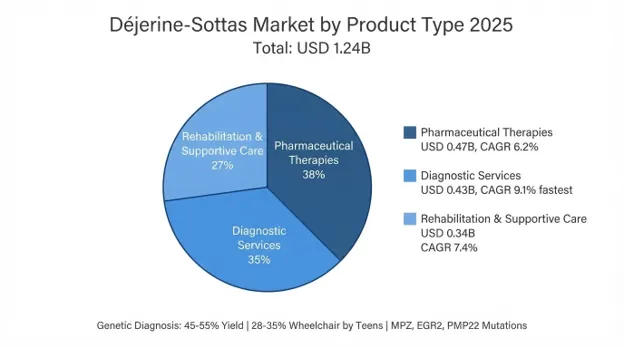
Pharmaceutical therapies occupy 38% market share, valued at USD 0.47 billion in 2025, and include pain relief medications such as tricyclic antidepressants, anticonvulsant drugs, nonsteroidal anti-inflammatory drugs, and neuroprotective therapies. The market segment has an annual growth rate of 6.2% from 2025 to 2034 due to advancements in pain relief therapy options and disease-modifying agents.
Diagnostic services occupy 35% market share, valued at USD 0.43 billion in 2025, and consist of genetic testing, neuroimaging techniques, electrophysiological analysis, and genetic counseling. These services play a significant role in diagnosis and conception planning and have the highest growth rate of 9.1% compound annual growth rate due to the increasing number of diagnostic facilities.
Rehabilitation and supportive care services account for 27% market share, valued at USD 0.34 billion in 2025. The services include physical therapy, occupational therapy, orthopedic surgeries, and respiratory therapies. The market segment will experience 7.4% compound annual growth rate due to innovations in therapy procedures.
Pharmacologic treatment is responsible for 42% of the market value, worth USD 0.52 billion in 2025, and aims to manage pain and novel disease-modifying therapies. Physical and occupational therapy is responsible for 31%, with USD 0.38 billion in 2025. Orthopedic therapies amounted to 18%, with USD 0.22 billion in 2025. Genetic counseling amounts to 9% and is valued at USD 0.1.
Neurology specialty centers are the biggest user segment, holding 44% market share, worth USD 0.54 billion by 2025. Hospitals & general clinics account for 32%, worth USD 0.40 billion, by 2025. Home healthcare & rehabilitation clinics will make up 18%, worth USD 0.22 billion, by 2025. Research institutions & academic centers make up 6%, worth USD 0.07 billion by 2025.
The global market for Déjerine-Sottas syndrome displays moderate fragmentation in which specialist biotechnology firms, drug manufacturing firms with rare disease departments, and research institutes take the forefront. The major players in this market include Santhera Pharmaceuticals, Mitochondrial Medicine Frontier Development Center, and academic consortiums and hold an approximate market share of 42-48% through specialized diagnosis, coordination of research, and therapeutic development. Competitive advantage is built through specialized diagnostic solutions, clinical experience in managing rare neuropathies, patient assistance programs, and innovation in therapy development.
You'll get the sample you asked for by email. Remember to check your spam folder as well. If you have any further questions or require additional assistance, feel free to let us know via-
+1 724 648 0810 +91 976 407 9503 sales@intellectualmarketinsights.com
12 Aug 2026
Intellectual Market Insights Research © 2026. All rights reserved.