Share this link via:

The global Dandy-Walker malformation market size was valued at USD 2.8 billion in 2025 and is projected to reach USD 3.2 billion in 2026, expanding to USD 5.6 billion by 2034, growing at a compound annual growth rate of 8.6% during the forecast period from 2026 to 2034.
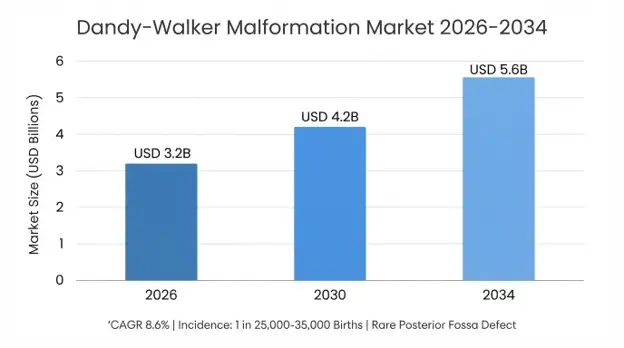
Dandy-Walker malformation is a rare congenital posterior fossa defect, which involves abnormalities in vermis development, enlargement of the fourth ventricle, and elevation of intracranial structures. The incidence of this complex neurological malformation is estimated at 1 in 25,000 to 35,000 live births worldwide and may represent up to 4% of congenital hydrocephalus cases and can be a major health burden for the affected pediatric population requiring lifetime multidisciplinary care.
Dandy-Walker malformation is a spectrum of developmental disorders of the midline cerebellum with a common embryologic origin, including classic Dandy-Walker malformation, which is characterized by vermian agenesis, fourth ventricle cystic enlargement, Dandy-Walker variants (4th ventricular enlargement with vermian hypoplasia), Blake's pouch cysts (persistent posterior membranous area cystic dilatation), and mega cisterna magna (isolated enlargement of the retrocerebellar CSF space). The market includes a full spectrum of treatment modalities, including surgical treatments for ventriculoperitoneal shunt, cystoperitoneal shunt, dual-compartment shunting, and endoscopic third ventriculostomy and multidisciplinary supportive treatments, such as physical rehabilitation, speech and language therapy, occupational therapy, seizure management, and long-term neurological follow-up at specialized centers for pediatric neurosurgical and neurological patients and treatments.
Due to the clinical heterogeneity of DWM, there are different market segments according to the severity of the presentation, presence of accompanying comorbidities, and treatment needs. The percentage of patients with CNS malformations (50-70%), cardiovascular defects (15-20%), and syndromic appearance with specific genetic syndromes is variable, and ~80% develop hydrocephalus requiring definitive surgical management. These are significant lifetime therapeutic costs of USD 450,000 - 680,000 per patient, including surgical costs, hospitalization, device implantation, long-term medication management, rehabilitation, educational support, and ongoing neurological monitoring throughout the patient's childhood and adolescence.
| Report Coverage | Details |
|---|---|
| Base Year | 2025 |
| Base Year Value | USD 2.8 billion |
| Forecast Value | USD 5.6 Billion |
| CAGR | 8.6% |
| Forecast Period | 2025-2034 |
| Historical Data | 2022-2025 |
| Largest Market | North America |
| Fastest Growing Market | Asia Pacific |
| Segments Covered | By Disorder Type, Associated Conditions, Treatment Approach, Surgical Technology, End-User Facility |
| Region Covered | North America, Europe, Asia Pacific, Middle East & Africa, Latin America |
| Countries Covered | US, Canada, Mexico, UK, Germany, France, Italy, Spain, Netherlands, China, Japan, India, Australia, South Korea, Brazil, Argentina, UAE, Saudi Arabia, South Africa |
| Key Market Playes | Medtronic plc, Integra LifeSciences, Johnson & Johnson (Ethicon), Boston Scientific, Stryker Corporation, Zimmer Biomet, Merit Medical Systems |
Get more details on this report - Request Free Sample
The major factor driving the market for Dandy-Walker malformation is the growing usage of sophisticated technologies for prenatal diagnostics such as high-definition ultrasound, fetal MRI, and 3-D imaging. The prenatal diagnosis rate has gone up greatly in countries where the healthcare system is well developed, helping in creating plans for treatment, prenatal counseling, and multidisciplinary prenatally coordinated treatment. Early diagnosis ensures that neurosurgery can be done in time and there will be a correct delivery plan and proper neonatal management, thus improving the neurologic outcome. Also, there is a constant prevalence rate of 1 in 25,000 to 35,000 live-born children around the world, making hundreds of patients annually worldwide. Growing awareness among obstetricians, growing prenatal screening rates, and sophisticated technology for diagnoses make it possible to identify more patients, while specialized pediatric neurosurgery centers improve treatment possibilities, all of which helps to drive the global Dandy-Walker malformation market.
The most important opportunities for the Dandy-Walker malformation market are the development of minimally invasive neurosurgery approaches and new-generation technologies for CSF diversion. The use of endoscopic third ventriculostomy (ETV) is increasingly becoming a preferred method of treatment for appropriate patients, ensuring physiological CSF outflow and decreasing the need for shunt implants. Procedures such as ETV coupled with the use of cauterization of choroid plexus are also bringing higher success rates and favorable neurological results. Apart from that, the creation of new technology related to programmable shunts, antibiotic-impregnated catheters, and more efficient drainage systems resulted in decreased infection and obstruction cases, as well as more personalized management of postoperative treatment.
The major constraint that impacts the Dandy-Walker malformation market includes the cost involved in diagnosing, neurosurgical treatment, and chronic management of the disease, thereby limiting patient access to advanced care. The initial surgery procedure, including the ventriculoperitoneal shunting and endoscopic third ventriculostomy, involves considerable healthcare spending; on the other hand, several patients go through repeat surgeries owing to the failure of the shunt device, its obstruction, and infection. Thus, lifetime treatment cost could even be over USD 150,000–300,000 per individual. Lack of insurance coverage and restrictions in coverage policies, especially in the less-developed countries, also contribute to delayed access to treatment. Moreover, patients suffer from indirect healthcare expenditures due to the need for long-term rehabilitation, special schooling, care provider assistance, and assistive technology.
The Dandy-Walker malformation market presents a huge growth opportunity in gene therapy aimed at mutations like ZIC1, ZIC4, and FOXC1 that can cause syndromic types of the disease. New advancements in prenatal and early postnatal gene-editing techniques could change the natural course of the disease, decrease abnormalities in the cerebellum, and help to achieve better results regarding neurodevelopmental prognosis. Moreover, scientific investigations concerning the development of the cerebellum and embryonic brain have revealed some molecular pathways for the targeted treatment of Dandy-Walker malformation. The growing cooperation of biotechnological firms with universities leads to rapid innovations in precision medicine, and further advancements in gene delivery systems and patient monitoring will provide new market growth opportunities.
The growing trend in the Dandy-Walker malformation market is the increasing incorporation of advanced neuro-imaging technology in diagnosing and planning surgery. Advanced imaging tools like high-resolution MRI, 3D volumetric imaging, diffusion tensor imaging, and intra-operative neuronavigation help in gaining clear views of the anatomy of the posterior fossa and other important nerve structures. Such advances have made diagnosing more accurate and have helped to distinguish Dandy-Walker malformation from other brain malformations. This helps in planning procedures like placing shunts and endoscopic third ventriculostomy, among others. The imaging helps to provide personalized treatment based on the anatomical variables affecting surgery. 3D imaging also assists in counseling families and decision-making. The growing application of advanced imaging in pediatric neurosurgical hospitals is helping increase accuracy and decrease the complications of surgery, thereby contributing to the growing demand in the Dandy-Walker malformation market.
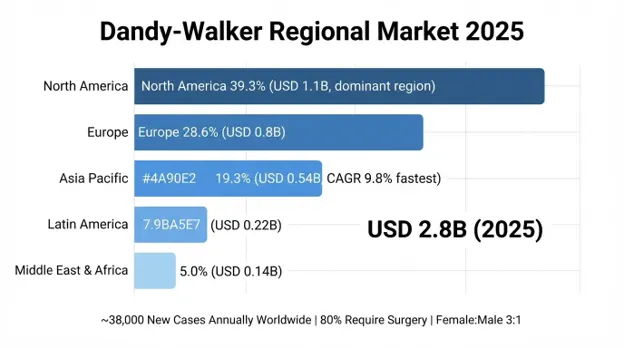
North America held the leading position in the global market for Dandy-Walker malformations with the value of USD 1.1 billion in 2025, having a share of 39.3% of the overall market, and is expected to grow at a CAGR of 8.2% up to 2034. This is due to a combination of well-developed expertise in pediatric neurosurgery, advanced diagnostic imaging, and a developed healthcare system in this region. The United States accounted for the largest part of revenue within the region owing to the presence of specialized tertiary hospitals, insurance reimbursement policy, and treatment methods for complex diseases of the nervous system. Also, high utilization of advanced neurosurgical tools, fetal MRI, neuronavigation, and minimally invasive surgery adds momentum to the market growth.
The Asia-Pacific region will lead the market growth with a CAGR of 9.8% till 2034, with the growth witnessed from USD 0.54 billion in 2025 to an estimated USD 1.2 billion in 2034. The factors that are responsible for the market growth include the development of pediatric health infrastructure, increasing use of advanced technology for prenatal diagnosis, and greater awareness about congenital neurological problems. China dominates the regional market owing to healthcare reforms, improved capacity for pediatric neurosurgery, and favorable government policies towards advanced medical devices and technologies. India witnesses tremendous growth owing to increased availability of diagnostic services, specialist services, and improved healthcare access. In addition, Japan and South Korea enjoy strong growth because of the presence of pediatric neurosurgical centers with advanced infrastructure.
Classic Dandy-Walker malformation dominates the largest market share of 54%, which was estimated to be worth USD 1.5 billion in 2025, due to the high prevalence rate and frequent requirement for surgery. The market share of the Dandy-Walker variant was 28%, estimated to be worth USD 0.79 billion, where treatment depended on the extent of symptoms and development of hydrocephalus. The market share of Blake’s pouch cost was 12%, which had an estimated value of USD 0.34 billion, which required selective surgical treatment.
Hydrocephalus-associated Dandy-Walker malformation was the leading segment with the largest market share, accounting for 68% and generating revenue of USD 1.9 billion in 2025 owing to many patients undergoing the procedure of CSF diversion and neurosurgery. Central nervous system anomalies-associated DWM was responsible for 18% of the market (USD 0.51 billion) due to the need to treat other neurological conditions. The cardiac and systemic abnormalities-associated condition occupied the market share of 10% (USD 0.28 billion). Syndromic Dandy-Walker malformation accounted for the remaining 4% (USD 0.11 billion).
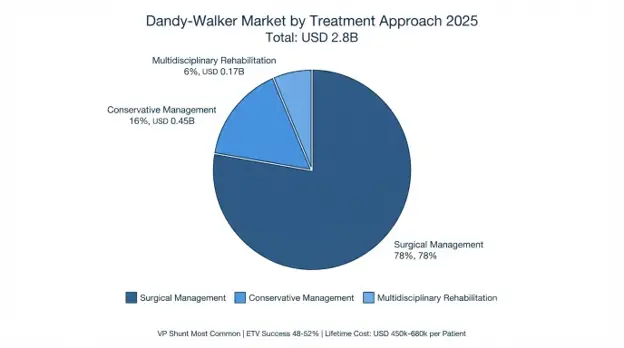
Surgical management was the key player in the market, holding 78%, which equated to USD 2.2 billion in 2025 due to increased demands for the treatment of hydrocephalus. Conservative management occupied 16%, valued at USD 0.45 billion, while multidisciplinary rehabilitation service took 6%, valued at USD 0.17 billion in 2025.
The ventriculoperitoneal shunt was the leader of the industry with a market share of 48%, which is equal to USD 1.35 billion, owing to its safety and extensive application in clinical practice. The endoscopic third ventriculostomy had a market share of 28%, equaling USD 0.79 billion, whereas cystoperitoneal shunt was used in 16% (or USD 0.45 billion) of cases.
The pediatric hospitals with neurosurgery facilities led the market with a 52% share that was worth USD 1.46 billion in 2025 due to their advanced diagnosis and surgery facilities. Neurosurgery specialty centers had a 28% share (USD 0.79 billion), and neurological institutes held the remaining 12% (USD 0.34 billion). The share of home healthcare and community services amounted to 8% (USD 0.23 billion).
The global market for the Dandy-Walker malformation shows some degree of concentration among the seven largest players, which together own about 54-62% of the market value because of their diverse range of products, including shunts, endoscopy equipment, diagnostic imaging, and neurosurgical instruments. Competitive advantages in this market are based on reliability of devices, infection resistance, advanced clinical trials proving better results, education of neurosurgeons in using devices, and partnerships with pediatric medical facilities for better acceptance of devices. The strategy to gain a competitive advantage is based on innovations in design and materials used for devices and the introduction of complementary devices for a complete treatment system.
March 2026: Medtronic has been granted FDA clearance for a new generation adjustable pressure shunt system, having increased durability, patency, and lower infection rates owing to material coating technology, with product launching planned for Q2 2026 in pediatric neurosurgical centers in North America.
February 2026: Integra LifeSciences has reported successful results of the multicenter trial that compared endoscopic third ventriculostomy and choroid plexus cauterization against the conventional shunt placement, showing the same revision-free survival rate and absence of a foreign body in 38% of patients using the former method.
January 2026: Boston Scientific has strengthened its collaboration with pediatric neurosurgical centers in the Asia-Pacific region with training program development for surgeons and imaging integration for the diagnosis and treatment of Dandy-Walker malformation.
December 2025: Stryker Corporation has concluded the acquisition of a unique neuronavigation firm and obtained their exclusive three-dimensional imaging and intraoperative navigation technologies that will allow increasing accuracy in endoscopy and shunt implantations, providing an advantage in minimally invasive surgery innovations.
November 2025: Zimmer Biomet reported the FDA approval of a new generation pediatric shunt valve, which has better programmability and non-invasive capability to adjust the pressure after implantation in case of its necessity.
You'll get the sample you asked for by email. Remember to check your spam folder as well. If you have any further questions or require additional assistance, feel free to let us know via-
+1 724 648 0810 +91 976 407 9503 sales@intellectualmarketinsights.com
12 Aug 2026
Intellectual Market Insights Research © 2026. All rights reserved.