Share this link via:

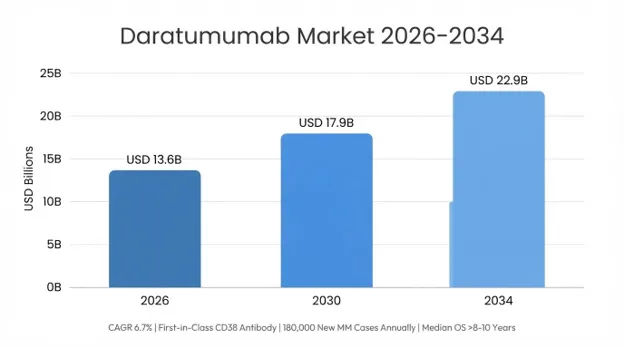
The global daratumumab market was valued at USD 12.6 billion in 2025 and is projected to reach USD 13.6 billion in 2026, expanding to USD 22.9 billion by 2034, growing at a CAGR of 6.7% during the forecast period (2026-2034).
Daratumumab is a first-in-class human immunoglobulin G1-kappa (IgG1κ) monoclonal antibody that targets CD38, a transmembrane glycoprotein that is highly expressed on malignant plasma cells in multiple myeloma and on clonal plasma cells in light chain (AL) amyloidosis but expressed at relatively low levels on normal lymphoid and myeloid cells. When bound to CD38, daratumumab can mediate rapid tumor cell killing by 3 mechanisms: through complement-dependent cytotoxicity, antibody-dependent cellular cytotoxicity, and antibody-dependent cellular phagocytosis, as well as direct apoptosis through Fc-receptor-mediated cross-linking. The molecule's distinctive immunomodulatory activity is its ability to remove CD38⁺ regulatory T cells and B cells, which release suppression of the endogenous immune response and promote the expansion of T cells, which explains its potential clinical synergy with proteasome inhibitors, immunomodulatory drugs, and corticosteroids.
Darumumab was originally discovered and developed by Genmab A/S and licensed for global development and commercialization to Janssen Biotech, a Johnson & Johnson company, and was the first CD38-directed antibody to receive regulatory approval anywhere in the world in November 2015 as a monotherapy in heavily pretreated, relapsed, and refractory multiple myeloma. In the following decade, its label grew exponentially, thanks to key trials such as CASSIOPEIA in the transplant-eligible newly diagnosed population and GRIFFIN in the transplant-ineligible newly diagnosed population, which made daratumumab-based triplet and quadruplet therapy guideline-recommended frontline standard of care. In January 2021, the ANDROMEDA trial results led to daratumumab's approval in newly diagnosed systemic light chain amyloidosis (LC-AL) to extend the molecule's therapeutic potential, making it the first and only targeted therapy approved in this rare, highly fatal plasma cell disorder.
The creation and approval of a subcutaneous co-formulation of daratumumab and recombinant human hyaluronidase PH20, dubbed Darzalex Faspro, with Halozyme Therapeutics' ENHANZE drug-delivery technology, marked a significant commercial turning point for the franchise. The COLUMBA trial confirmed the noninferiority of the subcutaneous formulation and significantly decreased the infusion-related reaction rate from about 34% to 13% and the administration time from several hours to about three-to-five minutes. This shift significantly lowered the occupancy rate of infusion chairs, nursing resource demand, and burden on patients, allowing for a quick and almost complete transition to subcutaneous administration of new prescriptions in most developed markets.
Daratumumab's commercial value is linked to multiple myeloma, one of the most prevalent hematologic malignancies worldwide, with an estimated 180,000 new cases diagnosed worldwide each year and a median age at diagnosis of ~69 years, a remarkable correlation with disease incidence and global demographic aging. Today, median OS in newly diagnosed patients receiving modern, daratumumab-based treatment regimens is >8-10 years, compared with <3 years pre-biologic era, a complete transformation of multiple myeloma from a rapidly fatal to a relatively chronic and continually treated disease with a high drug demand. Though it is rare, with an estimated 4,000-4,500 new cases each year in the United States, systemic AL amyloidosis is a high-value niche for several reasons: 1) The disease is treatable with less favorable alternatives; 2) the disease is likely to be fatal if untreated.
Beyond being a single branded molecule, daratumumab's commercial value lies in the added value it brings to the therapeutic ecosystem, including infusion and injection administration services, companion diagnostic and minimal residual disease monitoring technologies, and institutional treatment protocols that have transformed daratumumab into a virtually universal backbone of myeloma care. Although the competition in the direct daratumumab market is far from homogeneous, Johnson & Johnson has an unusually concentrated commercial position because of its cross-licensed and multi-layered intellectual property portfolio, including the original antibody, also as a subcutaneous co-formulation with ENHANZE, which will likely count on a combined product to maintain its monopoly market dominance. Despite the non-uniform nature of the competition in the direct daratumumab market, Johnson & Johnson has a highly concentrated commercial position supported by multiple layers of IP protection, including the original antibody and also the IP protection for the combination product of daratumumab and ENHANZE in the subcutaneous route, which adds a layer of uncertainty in the future as Sanofi's isatuximab is joined by the expiry of key composition of matter patents in the late 2020s.
| Report Coverage | Details |
|---|---|
| Base Year | 2025 |
| Base Year Value | USD 12.6 Billion |
| Forecast Value | USD 22.9 Billion |
| CAGR | 6.7% |
| Forecast Period | 2025-2034 |
| Historical Data | 2022-2025 |
| Largest Market | North America |
| Fastest Growing Market | Asia Pacific |
| Segments Covered | By indication, line of therapy, formulation, combination regimen, end-user, and region |
| Region Covered | North America, Europe, Asia Pacific, Middle East & Africa, Latin America |
| Countries Covered | US, Canada, Mexico, UK, Germany, France, Italy, Spain, Netherlands, China, Japan, India, Australia, South Korea, Brazil, Argentina, UAE, Saudi Arabia, South Africa |
| Key Market Playes | Janssen Biotech (Johnson & Johnson), Genmab A/S, Sanofi SA, Halozyme Therapeutics, Celltrion Inc., Sandoz Group AG |
Get more details on this report - Request Free Sample
Rising Global Multiple Myeloma Burden and Frontline Therapeutic Migration
The primary factor behind the growth of the market comes from the growing number of multiple myeloma patients worldwide along with the progressive shift of daratumumab from being an emergency rescue treatment to a first-line treatment option. The United States sees the detection of around 35,000-36,000 new cases every year, with more than 180,000 global incidents of multiple myeloma occurring each year. This number is growing every year due to the aging population, considering that the median age of diagnosis in multiple myeloma is 69 years old. The MAIA and CASSIOPEIA trials have made daratumumab-based triplets and quadruplets preferred guidelines among both transplant-ineligible and eligible patients.
Key Performance Metrics:
Subcutaneous Formulation Adoption Driving Efficiency and Access
Adoption of the subcutaneous daratumumab combination for commercial use has had a major impact on reducing logistical constraints in treatment, turning a multi-hour infusion that is pre-medicated into a quick injection given within minutes. This has allowed the treatment to be delivered from a broader range of facilities due to increased capacity at limited infusion centers, decreased costs per patient of treatment, and the ability to provide treatment through home infusion programs in certain markets.
Key Performance Metrics:
Market growth is restrained by high and increasing prices associated with treatment with daratumumab, which in the USA may produce an annual cost of pharmacy of USD 120,000-USD 160,000 just for daratumumab itself, which will rise to USD 300,000-USD 400,000 for a full quadruplet induction regimen when the cost of combination partners is considered. The issue of the high cost of therapy produces certain access problems in LMICs with public budgets and out-of-pocket payment systems that cannot cope with premium-priced biological drugs, while even developed nations impose various managed entry agreements, prior authorization requirements, and step therapy programs to control the cost of biologics in oncology.
The second restraint relates to the approaching loss of market exclusivity, since patents on core composition of matter in key countries are going to expire in the late 2020s, so biosimilar production becomes quite attractive for many multinational producers. To make things worse, the leadership of daratumumab in late-line and heavily pretreated patients is going to be threatened by BCMA-targeted CAR-T cells, bispecific T-cell engagers, and isatuximab, a competitive CD38 antibody.
Daratumumab can also be considered a great opportunity by virtue of its potential to become an integral part of the backbone in future-generation combination therapy involving bispecific antibodies, CAR-T cells, and cereblon E3 ligase modulators (CELMoD). Clinical data emerging from the use of daratumumab alongside drugs like teclistamab and new generation CELMoD suggests synergy of depth of response, making daratumumab the cornerstone for future generation immunotherapies regardless of how the future looks in terms of combination therapy options. The same kind of opportunity exists for the extension of daratumumab for high-risk smoldering multiple myeloma patients who have responded well with delayed progression to symptomatic multiple myeloma using the AQUILA trial design.
Expansion in geographies is another key opportunity that includes geographic penetration across China, India, and other Asia-Pacific and Latin America regions where uptake of daratumumab has not been up to the mark considering clinical needs. The combination of increased inclusion in national reimbursement drug lists and the development of hematology specialties and sub-specialties in these geographies, along with the advantage of subcutaneous administration, will contribute to significant growth.
Strategies for minimal residual disease-directed and fixed-duration treatments are increasingly finding their feet, with studies evaluating whether the absence of MRD, as determined using next-generation flow cytometry or sequencing methods, allows for stopping maintenance treatment in deeply responding patients. The outsourcing of daratumumab infusions to community oncologists, ambulatory infusion facilities, and even at-home settings is rapidly progressing, thanks to the short administration time via subcutaneous injections.
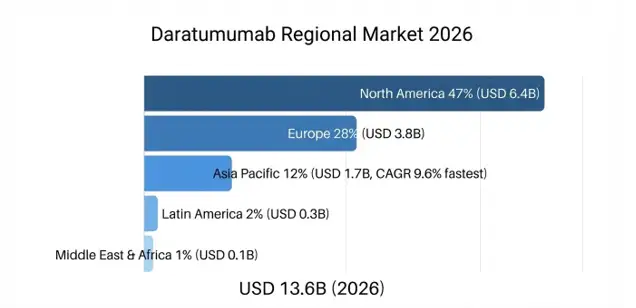
The North America region is expected to command the largest share, estimated at USD 6.4 billion in 2025 with a forecasted CAGR of 6.2%, based on comprehensive Medicare and commercial insurance coverage, quick adoption of formulations of daratumumab by patients in the subcutaneous route, highly developed networks of academic myeloma programs, and broad recommendation of front-line regimens of the therapy. The US will dominate the regional market value due to an advanced community oncology infrastructure.
Asia-Pacific is expected to be the most rapidly growing region, with a forecasted CAGR of 9.6% until 2034 based on an estimated base value of USD 1.7 billion in 2025. The factors behind the growth include the addition of the treatment to the list of drugs reimbursed by the government in China; a fast-aging society in Japan in a universal healthcare system setting; and the development of hematology infrastructure in India, South Korea, and other Southeast Asian countries.
Indications Insights: The multiple myeloma segment dominates, commanding a share of over 90% of worldwide daratumumab sales in 2025 owing to its established presence throughout the full disease pathway induction, maintenance, and relapses. Light chain (AL) amyloidosis forms a small but fast-growing segment on account of lack of any other comparable treatment options.
Line of Therapy Insights: First-line therapy forms the most significant and fastest-growing segment in the market due to increasing use of daratumumab-based therapies at the front line, whereas second-line and third-line and beyond segments command considerable revenues because of a large base of previously treated patients.
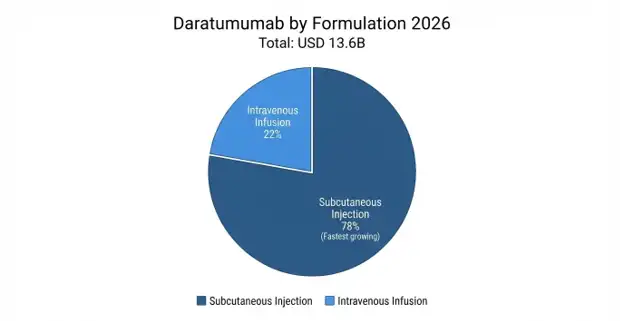
Formulation Insights: Subcutaneous Injection has emerged as the most dominant formulation, which holds a large majority share of all new prescriptions in the world, whereas Intravenous Infusion still holds value in certain clinical trial setups and market areas where the subcutaneous formulation encounters some regulatory or payment issues.
Regimen Combination Insights: The combination of daratumumab with lenalidomide and dexamethasone (D-Rd) and daratumumab with bortezomib and dexamethasone (D-Vd) is the highest volume combination, while the use of quadruplet combinations using bortezomib, lenalidomide, and dexamethasone is gaining popularity among eligible transplants.
End-User Insights: Hospitals and cancer centers account for the largest end-user segment, while ambulatory infusion centers account for the fastest-growing end-user category, due to the subcutaneous formulation.
Market dynamics in the daratumumab industry are quite unique in that there is only one drug molecule acting as an anchor, in which Johnson & Johnson’s Janssen Biotech holds close-to-monopoly power through its Darzalex and Darzalex Faspro products, whereas Genmab A/S retains royalties for its development. Competitive threats to the daratumumab franchise come not from the competition from CD38 antibodies, which now is confined only to Sanofi’s isatuximab, but from changing dynamics of the market of multiple myeloma treatments in general, where CAR-T cells targeting BCMA and bispecific antibodies can be considered. The strategy of Johnson & Johnson in ensuring market dominance involves the use of the subcutaneous form of daratumumab based on ENHANZE technology and the patenting of this technology itself from Halozyme Therapeutics until the early 2030s.
March 2026: Johnson & Johnson provided results regarding the prolonged follow-up overall survival analysis from the MAIA trial, strengthening the frontline standard-of-care position for the combination of daratumumab, lenalidomide, and dexamethasone in patients who are not eligible for transplantation for newly diagnosed multiple myeloma.
January 2026: A global biosimilar developer filed an investigational new drug application for their proposed daratumumab biosimilar.
November 2025: A regulatory submission was made for the expanded use of subcutaneous daratumumab as monotherapy for high-risk smoldering multiple myeloma, following favorable progression-free survival results from the AQUILA trial.
September 2025: Halozyme Therapeutics and Johnson & Johnson have extended the ENHANZE technology licensing agreement, thus further safeguarding intellectual property protection for the subcutaneous daratumumab formulation until the early 2030s.
August 2025: Expanded indication was approved for subcutaneous daratumumab in combination with carfilzomib and dexamethasone in relapsed multiple myeloma patients based on subcutaneous daratumumab cohort results from the CANDOR trial.
You'll get the sample you asked for by email. Remember to check your spam folder as well. If you have any further questions or require additional assistance, feel free to let us know via-
+1 724 648 0810 +91 976 407 9503 sales@intellectualmarketinsights.com
12 Aug 2026
Intellectual Market Insights Research © 2026. All rights reserved.