Share this link via:

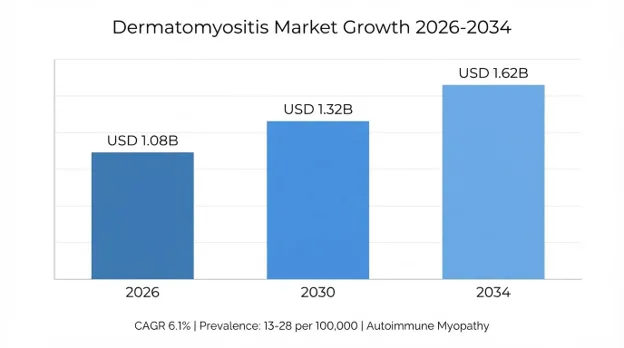
The global dermatomyositis market size was valued at USD 0.92 billion in 2025 and is projected to reach USD 1.08 billion in 2026, expanding to USD 1.62 billion by 2034, growing at a CAGR of 6.1% during the forecast period (2026-2034).
Dermatomyositis is an uncommon systemic autoimmune and inflammatory disorder involving the distal muscles and skin, which is defined by two distinctive skin lesions: heliotrope rash and Gottron papules, associated with a progressive proximal muscle weakness and a painful rise of muscle enzymes reflecting the presence of myositis. The disease is a result of complex genetic susceptibility, environmental factors such as exposure to ultraviolet radiation and previous respiratory infections, and abnormal innate and adaptive immune responses with interferon-mediated inflammatory mechanisms and complement-mediated microvascular injury to muscle and skin. Dermatomyositis is estimated to affect 13-28 cases per 100,000 people in developed countries worldwide and is found in an estimated 72,000 people with diagnosed dermatomyositis, 41% of whom have either clinically amyopathic dermatomyositis or adult-onset dermatomyositis.
Modern treatment of dermatomyositis combines a range of therapeutic options, using different classes to treat different disease manifestations, including the use of first-line corticosteroid therapy for rapid anti-inflammatory effects, steroid-sparing immunosuppressants such as methotrexate and azathioprine to ensure long-term disease control with less exposure to glucocorticoids, targeted biologicals such as rituximab and intravenous immunoglobulin that have proven efficacy in hard-to-treat patient groups, and emerging Janus kinase inhibitors showing promising activity through the inhibition of interferon-mediated inflammatory pathways that underlie the pathogenesis of dermatomyositis. Important clinical heterogeneity has been recognized, such as myopathic variants, which have prominent muscle involvement and require intensive immunosuppression; clinically amyopathic cases with devastating skin disease and high risk for interstitial lung disease; and malignancy-associated dermatomyositis, occurring in 10-15% of adult patients, who require concurrent oncologic evaluation and management.
Beyond the financial burden of medications, the dermatomyositis market is large and commercially important, impacting 18,000–31,500 patients in the United States alone, with significantly higher mortality rates of 2.0-3.1 times greater than those of population comparators and with some devastating impacts on quality of life across all functional domains that affect the chronic disease burden.
| Report Coverage | Details |
|---|---|
| Base Year | 2025 |
| Base Year Value | USD 0.92 billion |
| Forecast Value | USD 1.62 billion |
| CAGR | 6.1% |
| Forecast Period | 2025-2034 |
| Historical Data | 2022-2025 |
| Largest Market | North America |
| Fastest Growing Market | Asia Pacific |
| Segments Covered | By Product Type, Treatment Type, Disease Variant, Therapeutic Application, End-User, Geography |
| Region Covered | North America, Europe, Asia Pacific, Middle East & Africa, Latin America |
| Countries Covered | US, Canada, UK, Germany, France, Italy, Spain, Netherlands, Japan, China, India, Australia, South Korea, Brazil, Argentina, UAE, Saudi Arabia, South Africa |
| Key Market Playes | Corbus Pharmaceuticals, Amgen Inc., Novartis AG, Genentech/Roche, Bristol Myers Squibb, Merck KGaA, GlaxoSmithKline, Pfizer Inc., Eli Lilly and Company, AbbVie Inc., Janssen Pharmaceuticals |
Get more details on this report - Request Free Sample
Factors such as increased diagnosis and heightened disease awareness have facilitated the growth of the dermatomyositis market. The use of the EULAR/ACR classification criteria developed in 2017 has greatly contributed to increased specificity and sensitivity of diagnosis, making it possible to diagnose both classic and clinically amyopathic dermatomyositis. Clinically amyopathic types of dermatomyositis comprise about 41% of patients and could not be diagnosed using the previous criteria.
The increased use of myositis-specific antibody profiles consisting of antibodies to Mi-2, TIF1-gamma, and MDA5 has facilitated molecular subgrouping, thereby making it possible for clinicians to prognosticate disease courses and cancer risk and choose treatment approaches. More understanding on the part of dermatologists, rheumatologists, and primary care physicians has led to the development of comprehensive diagnostic tools that combine clinical evaluation, serum creatine kinase measurements, MRI results, and serology. This has resulted in a decrease in average diagnostic delay from around 12-24 months to almost 3-6 months, facilitating earlier administration of immunosuppressive treatment. The recognition of clinically amyopathic dermatomyositis and juvenile dermatomyositis has further widened the pool of patients eligible for treatment, while the better epidemiological data has led to an increase in the estimates of disease incidence and prevalence in developed health care systems.
The rising awareness about interstitial lung disease (ILD), being among the most serious complications of dermatomyositis, offers considerable prospects for market expansion. ILD occurs in 10-46% of patients suffering from classic dermatomyositis, as well as in 70% of cases of anti-MDA5-positive clinically amyopathic dermatomyositis, which is known for being characterized by fast progression of the disease and fatal outcomes in the absence of treatment. The greater number of patients suffering from interstitial lung disease has led to the growing need for more efficient and safe therapies for the treatment of the disease. The therapeutic approach has changed from symptomatic to more efficient immunosuppression. Mycophenolate mofetil became the preferred first-line steroid-sparing drug.
The JAK inhibitor is considered a potential treatment for ILD that is difficult or rapidly progressing, especially for cases of positive anti-MDA5, thus spurring on pharmaceutical companies to conduct further clinical developments for such treatments. It is becoming common practice for clinical trials to involve pulmonary function tests along with muscle and skin tests as essential outcome measures, indicating the need for proper management of diseases. The use of combination immunosuppressants and increasing investments in novel treatments for dermatomyositis with concurrent lung complications are some of the other trends.
The scarcity of dermatomyositis is another important barrier that hinders research and development efforts and limits the growth potential of the market. At an average prevalence of just 13 to 28 cases per 100,000 individuals, and considering the size of the patient population globally, conducting large-scale clinical trials poses substantial difficulty for drug developers. It may take multinationals and several healthcare systems to conduct a study, leading to increased costs and timeframes for developing new drugs. This becomes particularly true in the case of treatments developed for distinct antibody-associated dermatomyositis cases like the anti-MDA5-positive form, where there is only a fraction of the total population available.
Development timeframes for drugs treating dermatomyositis often take longer compared to other autoimmune disorders, resulting in increased financial risk on the part of the companies developing these products. Although measures have been taken to reduce some difficulties such as offering incentives to orphan drugs and using accelerated regulatory pathways, the small number of patients continues to hinder efficacy studies on a large scale and business ventures. Thus, pharmaceutical companies have no choice but to use international collaboration and adaptability to overcome the obstacles.
An area of growth for the dermatomyositis market space is the development of JAK inhibitors, particularly for patients with resistant dermatomyositis and ILD. While traditional immunosuppressants inhibit immune responses in general, the JAK inhibitors specifically act on interferon-mediated inflammatory pathways involved in the development of dermatomyositis. Clinical data emerging from trials of this drug modality have indicated strong patient responsiveness, with tofacitinib demonstrating much better disease control than standard immunosuppressive agents. Furthermore, the JAK inhibitors have been found effective in rapidly progressive ILD in anti-MDA5-positive patients, in which the combined use of glucocorticoids was linked to better survival and pulmonary function outcomes.
Considering the emphasis of regulatory bodies on the development of drugs that can help treat diseases that are uncommon but have huge unmet medical need, there is a likelihood that JAK inhibitors will enjoy the benefits associated with orphan drugs in the coming years. The growing popularity of precision medicine, the identification of refractory cases of dermatomyositis, and the lack of efficacious targeted therapies add more weight to the commercial prospects of these drugs. With several clinical studies under way, growing evidence, and increasing demand for the management of dermatomyositis, JAK inhibitors will be an integral part of the treatment of the disease in the future.
Janus kinase (JAK) inhibitors are currently witnessing an unprecedented shift in dermatomyositis management as they are emerging as one of the most promising therapeutic options for difficult-to-treat cases of dermatomyositis along with interstitial lung disease (ILD). Contrary to traditional immunosuppressive drugs that act as generalized immunosuppressants, JAK inhibitors have specific action on interferon-signaling pathways, which are crucial in dermatomyositis development. This drug class shows promising results in patients resistant to current standard treatments while having the potential to increase safety in the long term. Numerous studies have emphasized the efficacy of JAK inhibitors in managing rapidly progressing ILD cases, especially in patients with anti-MDA5 antibodies. The awareness of disease heterogeneity has led to increasing use of precision medicine in treatment, considering the type of antibody and clinical phenotype of disease.
Regulatory assistance through orphan drug designation, breakthrough therapy designation, and accelerated approval programs has further boosted investments in JAK inhibitor development and sped up the clinical development process. An increase in drug pipeline activity, high investments in pharmaceutics, and positive clinical results will position JAK inhibitors among the most promising classes of therapeutics for dermatomyositis. With the generation of new clinical data and expansion into more indications, such targeted treatments are likely to change the current treatment standard and significantly drive the dermatomyositis market globally over the forecast period.
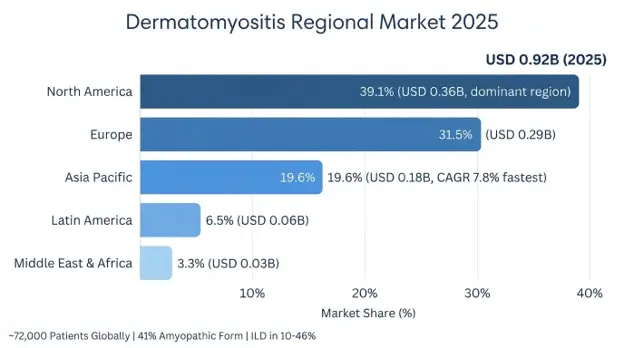
North America was the leading dermatomyositis market worth USD 0.36 billion in 2025, which is expected to register a 5.9% CAGR until 2034. The North American region leads the market owing to the presence of advanced rheumatology services, availability of dedicated myositis centers, diagnostics, and a supportive reimbursement landscape for biologics and novel therapeutics. The United States leads the North American market on account of the availability of Medicare and private healthcare insurance, well-established academic research networks, and regulatory support in the form of orphan and breakthrough drugs. Canada supports the North American market through increased access to advanced therapies, provincial reimbursement programs, and patient registries and clinical research participation.
The Asia Pacific region is estimated to show the highest CAGR of 7.8% during 2025-2034 in the dermatomyositis market and will reach USD 0.18 billion by 2025. The factors responsible for the growth are increasing disease awareness, increasing access to rheumatologists and dermatologists, increased usage of myositis-specific antibody tests, and increased prevalence rate of dermatomyositis that is positive for anti-MDA5 in nations like China, Japan, and South Korea. China is the leading player in the Asia Pacific region due to healthcare reforms and increased access to biologics, whereas Japan is experiencing advanced research, reimbursement, and high biologic usage. India is showing increased cases of dermatomyositis.
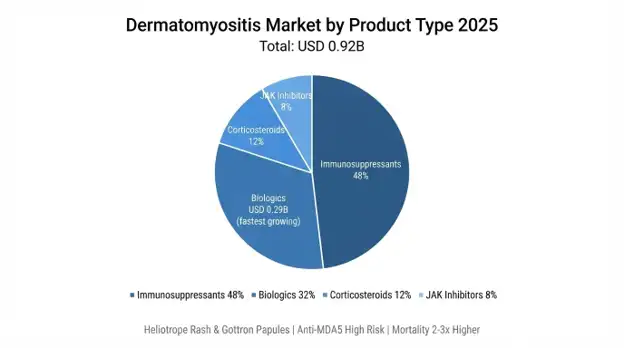
The immunosuppressive drugs segment occupied the largest share of the dermatomyositis market, accounting for 48% (USD 0.44 billion) of the share in 2025 owing to the fact that these drugs were used as the first line of treatment and had shown consistent clinical efficiency. The biologics segment was valued at 32% (USD 0.29 billion) and was the fastest-growing segment of the dermatomyositis market owing to better results for patients with resistant conditions. The JAK inhibitors segment occupied 8% (USD 0.074 billion) and was expected to have the highest growth rate.
Combination therapies led the dermatomyositis market with a 64% market share (USD 0.59 billion) in 2025 because of its efficiency in dealing with the disease in muscles, skin, and lungs via the use of glucocorticoids and immunosuppressants or biologics together. Monotherapies using biologics took 22% (USD 0.20 billion) of the market and are expected to keep growing since they are increasingly used among refractory cases. The market share of JAK inhibitors is at 9% and expected to have the fastest growth because of their good results in resistant cases and interstitial lung diseases.
The myopathic form of dermatomyositis was a leader in the segment and had revenues of USD 0.54 billion in 2025 and is forecast to have a CAGR of 5.8% through 2034. The dominance of the form is due to its higher prevalence rate, presence of clinical diagnostic criteria, and standardized approach towards the treatment process. The clinically amyopathic form had revenues of USD 0.28 billion and is forecast to be the fastest-growing form due to better diagnosis of severe anti-MDA5-associated cases that require intense treatment measures.
Specialty rheumatology clinics/centers accounted for 52% market share (USD 0.48 billion) in 2025 owing to their expertise in diagnosis and treatment with immunosuppressive drugs as well as disease management over the long term. Specialist centers for dermatology had a share of 28% (USD 0.26 billion) due to an increased prevalence of cutaneous and clinically amyopathic dermatomyositis. Multidisciplinary centers located in hospitals were expected to account for 15% (USD 0.14 billion) and would be growing at the fastest rate due to an integrated approach and use of advanced treatment options.
The dermatomyositis market globally can be described as low to moderately consolidated, as major players in the pharmaceutical industry have significant presence through immunology product offerings, biologics, immunosuppressant drugs, and new JAK inhibitors. Key factors that drive competition include clinical effectiveness, adoption of antibody-specific therapy, development of orphan drugs, regulatory approval processes, and precision medicine. Some strategies being adopted by players include collaborations, pipeline expansions, and clinical trials for refractory and interstitial lung disease. Major players in the dermatomyositis market are Corbus Pharmaceuticals, Amgen Inc., Novartis AG, Genentech (Roche), Bristol Myers Squibb, Merck KGaA, GlaxoSmithKline plc, Pfizer Inc., Eli Lilly and Company, AbbVie Inc., and Janssen Pharmaceuticals.
March 2026: Lenabasum has shown positive phase III data in dermatomyositis, showing a marked reduction in scores of the Cutaneous Dermatomyositis Area and Severity Index and showing improvement in the patients’ perception regarding their skin disease. Submission to regulatory authorities in the USA and EU, with approval expected in Q4 2026.
February 2026: Phase II trial has been initiated by Eli Lilly to investigate baricitinib in refractory cases of dermatomyositis associated with interstitial lung disease with an aim to enroll 80 patients.
January 2026: Pfizer reported an extension of the Phase II clinical trial program of its new compound that selectively inhibits the JAK1 receptor in the context of treatment for MDA5-positive amyopathic dermatomyositis with fast-progressing interstitial lung disease.
December 2025: Bristol Myers Squibb concluded the deal to purchase specialized immunology firm featuring a portfolio of treatments for dermatomyositis comprising mycophenolate mofetil investigational drugs and a biologics pipeline.
November 2025: Novartis released results of the Phase IIb study of an experimental biologic drug targeting dermatomyositis in terms of response rates (78%) versus standard immunosuppressive therapy (32%).
You'll get the sample you asked for by email. Remember to check your spam folder as well. If you have any further questions or require additional assistance, feel free to let us know via-
+1 724 648 0810 +91 976 407 9503 sales@intellectualmarketinsights.com
12 Aug 2026
Intellectual Market Insights Research © 2026. All rights reserved.