Share this link via:

The global desmoid tumor market size was valued at USD 2.62 billion in 2025 and is projected to reach USD 2.85 billion in 2026, expanding to USD 4.12 billion by 2034, growing at a CAGR of 6.0% during the forecast period (2026-2034).
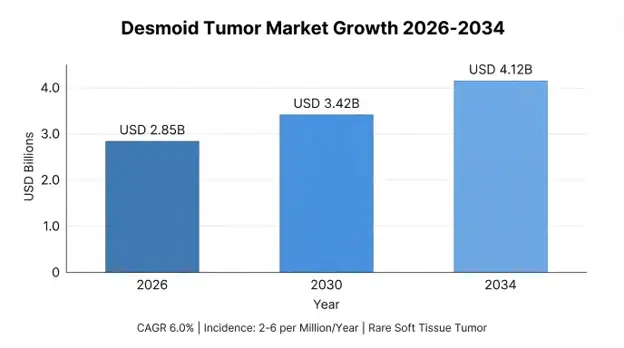
The desmoid tumor market is a niche oncology market with strong therapy demand driven by the chronic disease management needs of the patient population, growth in the diagnostic network, and novel systemic therapy innovations that have revolutionized the treatment approach.
Desmoid tumors (also called desmoid-type fibromatosis or aggressive fibromatosis) are rare, locally aggressive soft tissue tumors that grow in an infiltrative manner, have a relatively high risk of recurrence after surgical removal, and do not metastasize. Clinically, desmoid tumors are locally devastating, but they do not metastasize, and they have a relatively high likelihood of recurrence after surgical removal. The treatment of these tumors offers extraordinary clinical challenges because of their unpredictable disease course, variable clinical symptoms according to anatomic location, and historically few pharmacologic options that have depended on multidisciplinary treatment strategies combining surgical resection, radiation therapy, systemic chemotherapy, and new targeted therapeutics. The disease burden far outweighs considerations of mortality—affected patients report severe pain in up to 63%, functional impairment impacting mobility and range of motion, and psychosocial distress with anxiety and depression in a large proportion of patients and quality of life loss greater than rates seen in many malignant cancers.
Treatment for desmoid tumors includes a variety of approaches that reflect the unpredictable nature of the disease, such as active surveillance with serial imaging monitoring of asymptomatic or slowly growing lesions, allowing spontaneous regression in 10-28% of untreated cases; surgical resection of the tumor with assessment of the margins and functional preservation over aggressive en bloc surgery; radiation therapy with 56-60 GY for adjuvant therapy following incomplete surgical resection; conventional chemotherapy regimes such as doxorubicin-based combinations and vinca alkaloid-methotrexate programs; but also targeted therapies such as tyrosine kinase inhibitors (TKI), such as sorafenib, which have demonstrated progression-free survival (PFS) benefits; and novel gamma-secretase inhibitors (nGI), such as nirogacestat, which is the first drug to be FDA-approved for the treatment of advanced progressive desmoid tumors. The therapeutic landscape has completely shifted with the 2023 FDA approval of nirogacestat, which showed a 71% risk reduction of disease progression compared to placebo and also a 41% objective response rate, thus creating a new market value for pharmaceuticals in a disease traditionally treated by surgical and radiation therapies.
| Report Coverage | Details |
|---|---|
| Base Year | 2025 |
| Base Year Value | USD 2.62 billion |
| Forecast Value | USD 4.12 Billion |
| CAGR | 6.0% |
| Forecast Period | 2025-2034 |
| Historical Data | 2022-2025 |
| Largest Market | North America |
| Fastest Growing Market | Asia Pacific |
| Segments Covered | By Diagnosis Type, Treatment Modality, Disease Type, Tumor Location, End-User |
| Region Covered | North America, Europe, Asia Pacific, Middle East & Africa, Latin America |
| Countries Covered | US, Canada, Mexico, UK, Germany, France, Italy, Spain, Netherlands, China, Japan, India, Australia, South Korea, Brazil, Argentina, UAE, Saudi Arabia, South Africa |
| Key Market Playes | SpringWorks Therapeutics (Nirogacestat), Bayer AG, Novartis AG, Roche, AbbVie Inc., Santen Pharmaceutical, Ocular Therapeutix |
Get more details on this report - Request Free Sample
Improved diagnosis of diseases is one of the key factors driving the market for therapies for desmoid tumors, since an early and accurate diagnosis will ensure that patients receive proper treatment in time. There used to be a delay of 6–12 months in the diagnosis of the disease due to the rarity of desmoid tumors as well as their similarity to other soft tissue tumors, which results in misdiagnosis of the disease in most cases. Inadequate physician experience has also been an issue in the late diagnosis of desmoid tumors.
The advances made in the field of diagnostics through the use of technology such as high-resolution MRI, immunohistochemical detection of nuclear beta-catenin, and molecular testing of CTNNB1 and APC gene mutations have greatly increased diagnostic accuracy. These new technologies assist in differentiation between desmoid tumors and other myofibroblast and soft tissue tumors for the proper administration of the therapy. Apart from this, centralized pathology reviews, dedicated sarcoma centers, tumor board reviews, and education programs conducted by patients' advocates are also contributing to the growing desmoid tumor therapeutics market.
In 2023, the U.S. FDA approved nirogacestat (Ogsiveo) for the first time as a specific treatment for adults with progressing desmoid tumors, offering a breakthrough in the desmoid tumor therapeutics market. Nirogacestat is a selective gamma-secretase inhibitor that prevents the Notch signaling pathway, which is a critical pathway for tumor growth. The therapy provided a significant progression-free survival advantage and an objective response rate of 41% vs. 8% for placebo and statistically meaningful relief from pain, physical function, and overall quality of life benefits in the Phase III DeFi trial. This milestone has moved treatment away from surgery as the first treatment towards systemic therapy that is targeted.
The approval has also sparked interest in other next-generation therapies such as other gamma-secretase inhibitors, tyrosine kinase inhibitors, Wnt pathway modulators, and immunotherapies. The clinical use of nirogacestat is expected to increase as it is part of an ongoing clinical study for its evaluation in a larger patient population; this will further propel growth in the global desmoid tumor therapeutics market.
The basic constraint of the market that poses a limit on the desmoid tumor's therapeutic market growth is the rarity of the disease, as it is expected that about 2-6 people out of one million per year will suffer from this condition. This translates into 15,000-25,000 patients who will get newly diagnosed with desmoid tumors. The rareness of this disease means that there are only few patients, which poses limitations to market size compared to more prevalent types of cancers. It makes it difficult to do research as well. The low market size discourages companies from investing money in developing drugs. If one drug gets approval, it might have as much as 50-70% market share.
Rare diseases add further constraints to the market due to low levels of knowledge among healthcare providers regarding the ideal methods of diagnosing and treating the condition, geographical restrictions of expertise related to desmoid tumors at specialized sarcoma centers that affect patients' access to effective treatments, and low investment from pharmaceutical companies in developing drugs because of the competition from more widespread types of cancer. Orphan drug status brings certain advantages in FDA regulation and market exclusivity, but low levels of potential income decrease their attractiveness as a product category.
Key growth opportunities for the desmoid tumor market exist by extending targeted drugs beyond first-generation gamma-secretase inhibitors. Drug manufacturers are working on developing next-generation gamma-secretase inhibitors that are safer in addition to tyrosine kinase inhibitors, Wnt pathway inhibitors, immune-based treatment approaches, and combination drug therapies that target different molecular pathways. These developments will not only ensure increased control over the disease but will also minimize chances of resistance in the long run and increase the chances of remission. Combination drug therapy involving targeted drugs along with conventional treatments like chemotherapy and radiation can lead to better results. Besides, safer treatments would lead to lower rates of discontinuation due to side effects like nausea and diarrhea.
The management of desmoid tumors has become more tailored towards precision medicine by identifying molecular mutation status, molecular profiling, immune characteristics of the tumor, and validated prognostic scores for making treatment decisions in individual patients rather than using a one-size-fits-all strategy. In this context, identification of different molecular subtypes of CTNNB1 mutations, which have different prognostic implications (mutation 45F has a 23% 5-year recurrence-free survival rate, while that of mutation-negative is 65%), has allowed the stratified use of treatments, where the high-risk molecular subtypes would be aggressively treated systemically and low-risk would be managed with surveillance.
Tumor profiling through the analysis of tumor mutational burden, immune cell infiltration, angiogenesis markers, and circulating biomarkers has been expanded from just analyzing mutations. Multidisciplinary tumor boards in specialized institutions considering comprehensive molecular information, radiographic analysis, pathologic evaluation, and patient functional status have replaced the historically used physician-driven strategy with an evidence-based molecular-guided strategy. Validated prognostic scores using clinical information such as tumor size, location, symptoms, radiographic analysis including growth velocity, organ infiltration, molecular characteristics such as CTNNB1 mutation subtype, tumor mutational burden, and genetic context of sporadic or familial adenomatous polyposis (FAP) association.
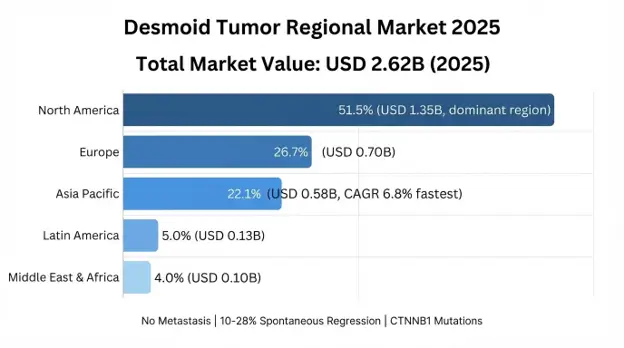
North America dominates the global market for desmoid tumors, which has a value of USD 1.35 billion in 2025 and is expected to exhibit a CAGR of 5.8% during the forecast period up to 2034. North American dominance in the global market is influenced by well-developed health care infrastructure, specialized clinics that treat sarcoma, high awareness about the disease, and early acceptance of new treatment options, including the FDA-approved drug nicoracetam. The United States alone dominates the region by making up 87% of the regional market due to good reimbursement via Medicare and availability of genetic counseling for patients suffering from FAP-associated desmoid tumors.
Asia Pacific is the most rapidly developing regional market of desmoid tumors with a forecasted CAGR of 6.8% until 2034 on the back of USD 0.58 billion in value in 2025. The key factors contributing to the development of this market include the growing number of health facilities, increasing awareness of familial adenomatous polyposis (FAP), greater availability of genetic tests, and rising acceptance of advanced systemic treatments. Leading the development in the region will be China with its health reforms, growing number of sarcoma centers, and wider insurance coverage of rare diseases. Also supporting the development of this market will be Japan and South Korea with their advanced oncology care and diagnostics.
Imaging tests constitute the biggest diagnostic segment, accounting for 38% market share, worth USD 1.0 billion in 2025, including MRI, being the preferred method for detecting tumors outside the abdomen; CT scan for intra-abdominal and retroperitoneal tumors; and ultrasound for detection of superficial tumors and for pregnant women. This segment will gain from advancements in technology that would improve tumor characterizations and allow for non-invasive monitoring of the condition without the risk of any morbidity associated with biopsies.
Biopsy & Histopathology is worth USD 0.92 billion in 2025 and accounts for 35% market share, including expert pathologic diagnosis using immunohistochemical staining and morphological testing. The segment may face challenges in the form of complications that could arise due to biopsy and misdiagnosis requiring expert examination.
Genetic testing has a 27% market share with a value of USD 0.70 billion in 2025 and a 7.2% CAGR through 2034 and is the fastest-growing diagnostic segment.
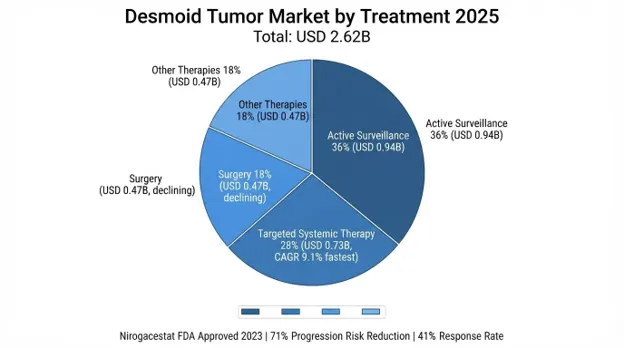
Active surveillance is the most dominant among all treatment segments, with a market share of 36% worth USD 0.94 billion in 2025. The treatment is a standard care approach where the patients are having asymptomatic or slowly growing desmoid tumors and can be monitored by serial imaging.
Targeted systemic therapy is a segment that holds 28% market share, worth USD 0.73 billion in 2025, with a 9.1% CAGR up to 2034. This is one of the fastest-growing treatment segments with dominance in the treatment of nirogacestat and some competitive products. The growth factor includes FDA approval for nirogacestat and an increased patient pool for systemic intervention.
Surgery represents an 18% market share at USD 0.47 billion in 2025, with declining utilization reflecting a paradigm shift toward medical management and functional preservation approaches.
Sporadic desmoid tumors have an 88% share in the market that is valued at USD 2.31 billion in 2025 and consists of most patients having somatic CTNNB1 mutations.
FAP-associated desmoid tumors have a market share of 12%, which is worth USD 0.31 billion in 2025 but comprises 10-25% of all desmoid tumors in FAP-affected
Specialized Sarcoma Centers is the largest end-user category, accounting for 42% market share, worth USD 1.10 billion in 2025, and includes high-volume specialized cancer centers with a multidisciplinary approach. This segment is aided by case concentration and effective treatment procedures.
General oncology practice accounts for 35% market share, worth USD 0.92 billion in 2025, with a 6.3% CAGR up to 2034, due to increasing treatment availability outside specialized centers using systemic treatment procedures.
Academic medical centers are the third major category, representing a 23% market share worth USD 0.60 billion in 2025.
The market for global desmoid tumors is moderately concentrated, with the top five pharmaceutical companies holding 68 to 75% of the market share using nirogacestat (SpringWorks Therapeutics), sorafenib (Bayer AG), imatinib (Novartis AG), and developing drugs. The differentiation in this market revolves around the data from clinical trials showing better progression-free survival and patient outcomes and improved safety and efficacy.
June 2026: SpringWorks Therapeutics reported positive results from a Phase II study of nirogacestat in treatment-naïve patients with progressive desmoid tumors, with a 37% response rate observed in the untreated patient population.
April 2026: Bayer AG started a Phase III study of sorafenib against nirogacestat in patients with advanced desmoid tumors to compare the tyrosine kinase inhibitor approach with the gamma secretase inhibitor approach.
February 2026: Several research institutes started desmoid tumor prevention programs using a systemic therapy approach along with screening of FAP syndrome.
January 2026: Novartis AG started a Phase II clinical trial of a combination of imatinib with nirogacestat in patients with desmoid tumors with dysregulated PDGFRB.
You'll get the sample you asked for by email. Remember to check your spam folder as well. If you have any further questions or require additional assistance, feel free to let us know via-
+1 724 648 0810 +91 976 407 9503 sales@intellectualmarketinsights.com
12 Aug 2026
Intellectual Market Insights Research © 2026. All rights reserved.