Share this link via:

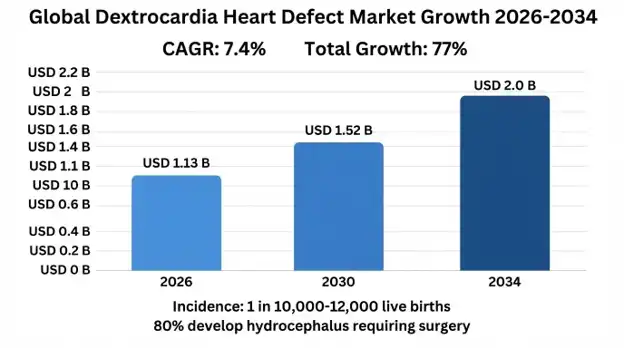
The global dextrocardia heart defect market was valued at USD 1.05 billion in 2025 and is projected to reach USD 1.13 billion in 2026, expanding to USD 2.0 billion by 2034, growing at a CAGR of 7.4% during the forecast period (2026-2034).
Dextrocardia is a rare, congenital positional anomaly in which the heart is more in the right hemithorax than in the left, with the apex of the heart directed rightwards instead of leftwards. It occurs during early embryonic development when normal cardiac looping and visceral lateralization do not occur as they should and is generally divided into three major clinically distinct categories: isolated dextrocardia with situs solitus, in which abdominal organs are normally oriented, but the heart is displaced and is often accompanied by complex structural defects; dextrocardia with situs inversus totalis, where all thoracic and abdominal organs are reversed and cardiac anatomy is generally structurally normal; and dextrocardia with situs ambiguus, a heterogeneous, high acuity group characterized by unpredictable organ lateralization, splenic abnormalities, and often severe intracardiac malformations.
Dextrocardia is seen in 1 in 10,000 to 1 in 12,000 live births worldwide, with the heterotaxy-associated forms being much more common and with significantly increased morbidity and mortality rates than isolated positional variants. Situs ambiguus is a condition often associated with atrioventricular canal defects, anomalous systemic and pulmonary venous return, single-ventricle physiology, and outflow tract obstruction, which require staged surgeries from infancy to adolescence. In contrast, dextrocardia with situs inversus totalis is frequently associated with primary ciliary dyskinesia (PCD), which, when accompanied by chronic sinusitis and bronchiectasis, gives rise to a new dimension to long-term care: respiratory management.
From fetal and neonatal cardiac imaging to cardiac catheterization for diagnostic and interventional cardiac procedures through complex corrective and palliative cardiac surgery, cardiac implantable electronic devices that are adapted for use in reversed anatomy, pharmacological treatment of associated heart failure and arrhythmias, and lifelong multidisciplinary surveillance programs, there is a wide spectrum of diagnostic and therapeutic technologies available in the market. A significant proportion of the costs are in the neonatal and early childhood period because of staged surgical procedures and intensive care needs, although the increasing survival has led to a growing population of adolescents and adults with repaired or palliated DCH that require long-term cardiac care, arrhythmia monitoring, and reintervention.
| Report Coverage | Details |
|---|---|
| Base Year | 2025 |
| Base Year Value | USD 1.05 billion |
| Forecast Value | USD 2.0 Billion |
| CAGR | 7.4% |
| Forecast Period | 2025-2034 |
| Historical Data | 2022-2025 |
| Largest Market | North America |
| Fastest Growing Market | Asia Pacific |
| Segments Covered | By Type, Diagnosis, Treatment, Associated Condition, End-User, Region |
| Region Covered | North America, Europe, Asia Pacific, Middle East & Africa, Latin America |
| Countries Covered | US, Canada, Mexico, UK, Germany, France, Italy, Spain, Netherlands, China, Japan, India, Australia, South Korea, Brazil, Argentina, UAE, Saudi Arabia, South Africa |
| Key Market Playes | GE HealthCare, Siemens Healthineers, Philips Healthcare, Medtronic plc, Abbott Laboratories, Boston Scientific, Edwards Lifesciences |
Get more details on this report - Request Free Sample
One of the most effective ways in which the market has been expanding is due to the improved ability to detect dextrocardia in the prenatal and neonatal stages using fetal echocardiography and systematic obstetric anomaly scanning protocols. The systematic examination of the cardiac situs and axis through second-trimester ultrasounds, now a routine aspect of the fetal anomaly scan that is performed on all pregnancies in developed healthcare systems, makes it possible to detect dextrocardia and its associated anomalies as early as 18-22 weeks gestational age. This helps in deciding on birth at specialized tertiary cardiac centers for immediate evaluation and surgery of the neonate before there is any hemodynamic compromise. The mandatory screening of infants for critical congenital heart disease through pulse oximetry is a routine practice in North America and many parts of Europe.
The continuous development of pediatric and adult congenital cardiac surgical procedures is one of the major engines driving growth in the dextrocardia market. Myocardial protection, cardiopulmonary bypass systems that are specifically designed to fit with the anatomy of mirror image and heterotaxy, and the Norwood, Glenn, and Fontan procedures for staged single-ventricle palliation are among the recent developments that have greatly increased the survival rates in the most anatomically challenging cases of dextrocardia. Everyone who successfully goes through the palliation stages will be under lifelong monitoring with regular cardiac imaging, catheterization to check on hemodynamics, medical treatment for heart failure, and potential future revisions of Fontan, correction of arrhythmia, or even cardiac transplant. Thus, survival is shifting the nature of dextrocardia from a childhood disease to a lifelong condition, resulting in growing numbers of adults with congenital heart disease.
The most fundamental limiting factor about the dextrocardia cardiac anomaly market is the intrinsic rarity and diversity of the condition, which reduces the drive for companies to come up with specialized solutions due to existing platforms targeting congenital heart diseases and addressing similar patients. This ranges from simple cases of dextrocardia, where there is an otherwise normal structure of the heart and very little is needed, to extremely complicated cases involving heterotaxy, where multiple surgeries need to be conducted throughout life. Moreover, this is compounded by the fact that the cost of caring for complicated cases of dextrocardia-related congenital heart disease is extremely high. This applies to neonatal surgery, re-operations, long ICU stays, and other treatments. Financial constraints as well as the lack of specialized pediatric cardiothoracic surgeons are limiting the development of advanced treatment in LMICs.
Potential in the use of 3D cardiac imaging, physical and virtual anatomical modeling, and AI-based diagnostic support to provide personalized management of patients with complex anatomical dextrocardia. Patient-specific 3-D models of the mirror-image anatomy or heterotaxy created from high-resolution cardiac MRI and CT angiography data can be used to model each surgery and plan for technical difficulties before entering the operating room. AI diagnostic assistance tools for fetal and neonatal echocardiograms can automatically identify cardiac axis and situs abnormalities, thereby minimizing diagnostic errors that have been difficult to identify early in the diagnosis of cardiac abnormalities. There is a complementary opportunity in transcatheter interventional techniques tailored to the unique reversed, tortuous vascular anatomy of dextrocardia and the miniaturized transcatheter valves and steerable delivery catheters, which are increasingly being used to treat adults who survived congenital heart surgery and are now 10–15 years older than they were during their initial procedure.
A growing trend includes the incorporation of dextrocardia care within the framework of fetal cardiology and perinatal care programs, where a team of specialists including fetal cardiologists, maternal-fetal medicine physicians, neonatologists, and pediatric cardiac surgeons work together on developing personalized perinatal care programs that include planned delivery at cardiac centers and timely interventions based on the risk of hemodynamic complications. This is also supported by the growing use of computer planning for surgery and a gradual move towards performing surgeries using hybrid and minimally invasive approaches combining surgery and catheter placement of a stent, closure of the septal defects, and valve positioning.
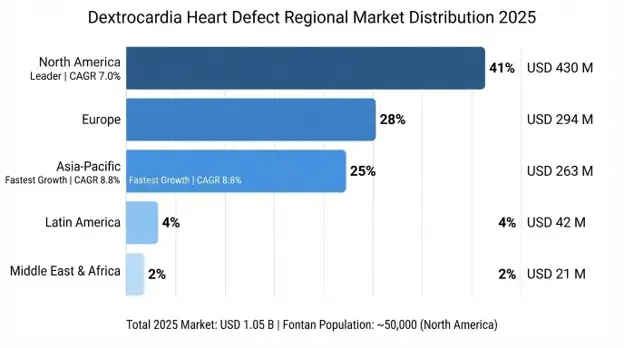
North America accounts for the majority share of the worldwide dextrocardia heart defects market, which was estimated to be worth about USD 430 million in 2025 and forecasted to grow at a CAGR of nearly 7.0% during 2026-2034. This regional dominance is due to the availability of leading pediatric and adult congenital heart surgery programs in leading children’s hospitals; extensive insurance coverage under Medicaid, the Children's Health Insurance Program, and private insurances; and strong fetal medicine facilities allowing for high rates of prenatal diagnosis. The U.S. conducts the highest number of pediatric heart surgeries compared to any other country worldwide, and dextrocardia-related surgeries are a significant portion of those surgeries.
The Asia Pacific region represents the fastest-growing regional market and is expected to grow at a CAGR of around 8.8% from 2025 to 2034, starting from a base of approximately USD 260 million in 2025. The reason for growth is attributed to the birth of large generations of children in both China and India, along with the establishment of extensive capacities for pediatric cardiac surgeries and increased government spending on screening newborns and pediatric facilities. China carries out thousands of procedures for congenital heart diseases every year, with increasing capacities for pediatric cardiac procedures as newer programs are being set up outside the academic hospitals in urban areas, while India sees improvement in government spending on health insurance and investment in hospitals.
Dextrocardia with Situs Inversus Totalis is the leading segment in terms of revenue, accounting for about 44% market share with an estimated value of about USD 460 million in 2025. This dextrocardia variant often does not have any associated cardiac structural abnormalities and hence creates revenue from only diagnostic imaging and management of Kartagener Syndrome cases. Dextrocardia with situs ambiguus is the fastest-growing and the high-acuity segment, with an estimated value of about USD 355 million in 2025 and a growth rate of almost 9% CAGR till 2034.
The echocardiography market constitutes the largest diagnostic category, accounting for approximately 46% market share. This technique is widely employed for fetal and postnatal cardiac studies due to the non-invasive feature and economy of the technique. Cardiac MRI is expected to register the highest growth in the diagnostics sub-category. It is expected to be valued at approximately USD 220 million in 2025.
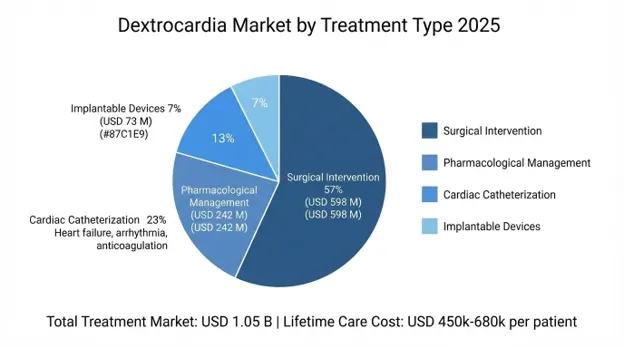
Surgical intervention is the biggest market segment accounting for an estimated 57% of the total market value and includes neonatal surgery, single-ventricle palliation, and reoperative surgeries. Pharmacological management is responsible for about 23% of the total treatment value and includes treatments for heart failure, arrhythmia, and anticoagulation in the Fontan population.
End users' segments consist of hospitals and cardiac centers, which hold about 61% market share due to the heavy management of complicated cases within the larger academic medical centers and children’s hospitals. Pediatric specialty clinics represent around 21% of the market share because of monitoring patients who have undergone surgery as teenagers.
The global dextrocardia heart defects market represents a niche competitive structure whereby leading cardiovascular and imaging products firms compete via overall congenital heart disease and pediatric cardiology platforms and not through dedicated products for dextrocardia. Competitive advantage revolves around complete cardiac and echocardiography imaging portfolios, innovative interventional devices that can be used for abnormal anatomy, and surgical assistance technology during congenital heart surgery. Competitive differentiation now hinges on imaging systems that provide 3D reconstruction and simulation, miniature catheter-based devices that can be used in pediatrics, and clinical registries that enable ongoing quality improvement.
January 2026: A cardiac segmentation module using AI technology has been developed by Siemens Healthineers for performing automated 3D reconstruction of the heart structure associated with dextrocardia in heterotaxy, based on cardiac MRI data.
February 2026: Medtronic plc announced breakthrough medical device approval by the FDA of a new ultra-flexible pacing lead suitable for tortuous venous anatomy in patients with dextrocardia associated with adult congenital heart disease.
November 2025: An improved fetal echocardiography system incorporating the capability to automatically detect the situs and position of the heart was unveiled by Philips Healthcare, which will allow systematic screening for dextrocardia during obstetric ultrasound studies.
September 2025: Boston Scientific Corporation launched a registry study involving multiple centers to assess catheter-based procedures in adult patients with congenital heart diseases, including heterotaxy and dextrocardia.
You'll get the sample you asked for by email. Remember to check your spam folder as well. If you have any further questions or require additional assistance, feel free to let us know via-
+1 724 648 0810 +91 976 407 9503 sales@intellectualmarketinsights.com
12 Aug 2026
Intellectual Market Insights Research © 2026. All rights reserved.