Share this link via:

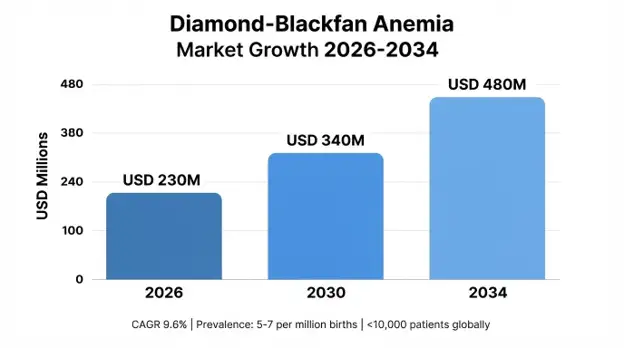
The global Diamond-Blackfan anemia (DBA) market size was valued at approximately USD 210 million in 2025 and is projected to reach nearly USD 230 million in 2026, expanding to close to USD 480 million by 2034, growing at a CAGR of approximately 9.6% during the forecast period (2026–2034). As a sanity check on this trajectory, compounding the 2026 base of USD 230 million forward using the standard compound annual growth relationship confirms internal consistency
Also known as a ribosomopathy, Diamond-Blackfan anemia is a rare inherited bone marrow failure syndrome described in the late 1930s that is not caused by a defect in any single hematopoietic growth factor pathway. Heterozygous mutations in genes encoding ribosomal proteins are found in the vast majority of cases, with RPS19 being the single most frequently implicated gene (about one quarter of diagnosed cases), followed by RPL5, RPL11, RPS26, RPS24, and over a dozen other genes that encode ribosomal proteins, which together account for about 65-70% of cases; the remaining cases involve mutations in genes other than ribosomal protein genes or remain genetically uncharacterized after extensive sequencing. This ribosomal insufficiency leads to activation of a p53 pathway in the erythroid progenitor cells, which causes selective apoptosis of red-cell progenitors and spares many other hematopoietic lineages and gives rise to the common feature of the disease, macrocytic anemia, which usually becomes manifest in the first year of life in most patients.
DBA is not only anemia but also a multi-system disease. About one-third to one-half are associated with congenital malformations, and continuous surveillance via international patient registries has revealed a significantly increased lifetime risk of hematologic and solid malignancies (myelodysplastic syndrome, acute myeloid leukemia, osteosarcoma, and colorectal cancer), with the incidence of cancer beginning to be significantly higher by the fourth to fifth decade of life. The multi-system impact of this lifelong disease involves long-term monitoring not just in hematology and oncology but in endocrinology, cardiology, and genetics as well.
DBA is one of the rarest congenital anemias treated in clinical hematology, with most of the currently diagnosed and actively followed patients residing in a few specialized centers worldwide, with a total patient number of less than 10,000, and most of those cases being in North America and Europe, where genetic testing is most available and registry participation and reimbursement for chronic rare disease care are most developed. In low- and middle-income countries, children with unexplained congenital anemia might not be diagnosed and are treated empirically or lost to follow-up, and this constitutes a latent population with the potential to be identified in the future as more sequencing becomes available.
The three pillars of current management of DBA are corticosteroid therapy, commonly used to treat newly diagnosed patients and which can trigger an initial hematologic response for most of them, although a significant portion fails to respond to such treatment or develops unacceptable toxicity over time; chronic red-cell transfusion and lifelong iron chelation, currently used for steroid-refractory or -intolerant patients, which account for an estimated 35–40% of the population treated; and allogeneic hematopoietic stem cell transplantation, the only established curative treatment but limited by donor availability and risk associated with the transplant procedure. In the last decade, the molecular knowledge of the ribosome has advanced to the point of providing a still-young pipeline of disease-modifying approaches, such as modulation of amino acid pathways, erythroid-maturation agents developed for other transfusion-dependent anemias, and early-stage gene-addition and gene-editing strategies targeting the underlying ribosomal protein shortage at its source.
In addition to sales of the drug, the commercial market for DBA is expanding to include specialized diagnostics (ribosomal protein gene panels, exome sequencing, transfusion and apheresis services, long-term monitoring of the iron load with multiple ferritin measurements and liver/cardiac iron quantification via MRI), transplant conditioning and supportive medication, and the multidisciplinary infrastructure of only a few tertiary centers focused on global expertise in DBA. Over the forecast period, a transition toward higher-value, genetically targeted interventions is anticipated because of orphan-drug incentives, advanced international patient registries, and an increasing appetite of payers for treatments that provide more value for small but highly affected patient populations.
| Report Coverage | Details |
|---|---|
| Base Year | 2025 |
| Base Year Value | USD 210 Million |
| Forecast Value | USD 480 Million |
| CAGR | 9.6% |
| Forecast Period | 2025-2034 |
| Historical Data | 2022-2025 |
| Largest Market | North America |
| Fastest Growing Market | Asia Pacific |
| Segments Covered | By Treatment Type, Drug Class, Route of Administration, Age Group, End-User, Region |
| Region Covered | North America, Europe, Asia Pacific, Middle East & Africa, Latin America |
| Countries Covered | US, Canada, UK, Germany, France, Italy, Spain, Japan, China, India, South Korea, Australia, Brazil, Mexico, UAE, South Africa |
| Key Market Playes | Novartis AG, Bristol-Myers Squibb, Sanofi, Chiesi Farmaceutici, Agios Pharmaceuticals, Sobi (Swedish Orphan Biovitrum), Pharmacosmos |
Get more details on this report - Request Free Sample
Rising Genetic Diagnosis and Registry-Driven Patient Identification: Increased availability of next-generation sequencing technology and ribosomal-gene panel testing is facilitating a shift from merely relying on clinical or morphological evaluation of patients to the precise molecular confirmation of DBA diagnosis, which previously used to take more than a year from the time symptoms first appeared. Registries maintained by organizations like the Diamond Blackfan Anemia Registry of North America since 1991 and networks in Europe working together under the umbrella of EuroDBA have collected extensive data regarding genotype-phenotype association and outcomes over multiple decades that assist in epidemiological studies, trial feasibility assessment, and real-world evidence generation in payer interactions. Even small gains in identifying patients provide substantial financial benefit due to high annual costs per patient for transfusion, chelation, and monitoring.
Structured Lifelong, Multidisciplinary Care as Patients Survive into Adulthood: Advanced care and transplantation techniques have increased patient survival time such that the emphasis has shifted from dealing with emergencies to monitoring iron overload, endocrine disorders, cardiovascular complications, infertility, and malignancies throughout the lifespan. As a result, there has been the establishment of bone marrow failure clinics associated with the transplant unit and trial systems, and an increasing need for structured transitions from pediatrics to adults, adult dosing regimens, and fertility services has emerged.
Extremely Small, Genetically Heterogeneous Patient Population: Due to low prevalence rates of only 5-7 per million births and the widespread nature of causative mutations in over 20 ribosomal protein genes, it becomes necessary to use multinational recruitment and basket trial designs since the number of patients within specific genotype subpopulations is too low to conduct traditional randomized clinical trials. Additionally, low-resource settings are characterized by limited genetic testing, inconsistency in blood transfusions, and lack of chelation therapy, such that any breakthrough will be very slowly implemented in the outside world after approval in key markets.
Gene Therapy, Gene Editing, and Next-Generation Transplant Platforms: Because DBA is mostly a monogenic disease that originates from hematopoiesis, its biology makes it an excellent candidate for autologous gene-corrective approaches that would not face donor shortages and the graft-versus-host complications that come with allogenic transplantation. There have been advances on both fronts of less-toxic conditioning regimens and alternative donor transplantation methods, which make more patients eligible for the curative allogenic approach. Firms that are building comprehensive platforms with respect to all these elements will capture disproportionately more value going forward.
The discipline of DBA management is progressively developing on a foundation of genotype-directed therapy based on the increasing amount of registry data connecting certain ribosomal protein mutations to various probabilities of steroid response, malformation syndromes, and tumor predisposition, thus providing for personalized monitoring and therapy choices. Registry-based real-world evidence is increasingly employed to replace poorly powered studies in the negotiation process with payers. An international collaborative approach and use of common protocols, as seen in cross-country alliances like EuroDBA, have become the standard for the design of clinical trials and guidelines since no single institution has more than a few patients. Lastly, transitional services and survivorship clinics that bridge childhood and adult medical care are forming as a separate class of services, including fertility care, endocrine monitoring, and psychosocial support.
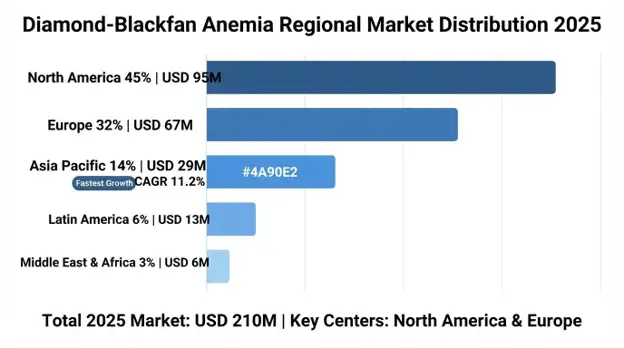
North America represents the leading segment within the DBA market due to the concentration of expertise in pediatric hematology, the long-standing DBAR registry, patient advocacy from organizations like the Diamond Blackfan Anemia Foundation, and Orphan Drug Act benefits of market exclusivity and tax breaks for clinical trials, which make the development of ultra-rare diseases feasible.
Europe is the second leading market, due to the EuroDBA consortium of researchers, orphan medicine processes at the European Medicines Agency, and the universal healthcare systems ensuring wide availability of transfusion, chelation, and transplantation services.
The Asia Pacific is the fastest-developing region due to the expansion of pediatric hematology infrastructure in Japan, South Korea, Australia, and urban areas of China and India, along with national rare disease policies that enhance reimbursement, while Japan’s approval system, which includes accelerated pathways equivalent to breakthrough designation, is enabling Japan to become a regional leader in adoption.
Latin America and the Middle East & Africa are still in an early stage of market development due to low genetic testing capacity and transfusion and chelation availability; however, increasing collaboration and telemedicine connections with established centers are gradually developing local capabilities in these regions.
Treatment-wise, chronic transfusion along with iron chelation accounts for the highest share in revenues due to the lifelong nature of treatment needed by the significant proportion of the population that is steroid-refractory or non-responsive, with corticosteroids accounting for the conventional first line of treatment followed by hematopoietic stem cell transplantation, which is lucrative in terms of per-procedure value even though the number of patients is low; gene-directed therapies, being at the nascent stage, are expected to become increasingly popular.
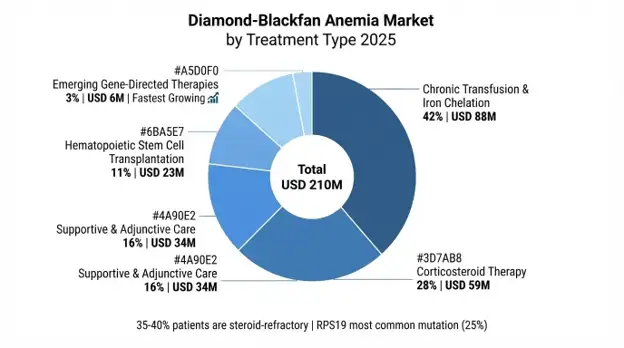
Drug-wise, iron chelators and corticosteroids dominate pharmaceutical sales, followed by novel biologics and small molecule treatments, with gene and cell therapies being at the forefront of high growth.
Route of administration-wise, the oral mode takes up the largest share via steroids and oral chelation, the intravenous route is indispensable for transfusion and pre-transplant conditioning, and subcutaneous or cell infusion modes are becoming increasingly important owing to evolving gene therapy and cell therapies.
Age-wise, children take up the largest share considering the disease manifestation in early life, while adolescents, young adults, and adult survivors form an increasingly large population due to increased survival rates.
By end-user, tertiary hospitals and specialized hematology centers form the major share, considering the complexity of transfusions, transplantations, and clinical trials, while home care and outpatients are gaining importance in regular transfusion and chelation therapy monitoring.
The DBA market is very segmented and made up of well-established pharma companies that provide supportive-care products such as iron chelators, corticosteroids, and transfusion-related drugs together with new biotech companies and academia involved in gene-targeted and disease-modifying strategies. There is no dominant player in this space, and instead, market positioning is based on being able to produce compelling data in small patient populations, collaborating with the best institutions specializing in bone marrow failure and transplantation, orphan drug regulatory benefits, and more recently innovative reimbursement models tailored towards potential curative but costly next-generation drugs. Patient advocacy groups have a particularly important role in this market, often funding natural history studies and registries that significantly lower the cost and time of drug development for their corporate partners.
January 2025: Researchers began to expand clinical trials of gene therapy with autologous hematopoietic stem cells for the correction of defects in the ribosome genes for the purpose of creating a lasting and eventually curative treatment of DBA.
March 2025: Next-generation sequencing (NGS)-guided precision diagnostics were assessed in several academic centers with new studies, which allowed us to achieve earlier genetic confirmation for DBA patients and better patient stratification for targeted treatments and stem cell transplantation.
June 2025: The continued clinical trials internationally investigated erythroid maturation agents and new corticosteroid-sparing medications to decrease transfusion need and minimize chronic adverse effects of steroids in DBA patients.
August 2025: Joint rare disease research groups broadened the scope of their studies on gene editing technologies based on the CRISPR system, which would provide a means to correct the mutations in the genes encoding the pathogenic ribosomal proteins, leading to the development of future cure-related therapies.
You'll get the sample you asked for by email. Remember to check your spam folder as well. If you have any further questions or require additional assistance, feel free to let us know via-
+1 724 648 0810 +91 976 407 9503 sales@intellectualmarketinsights.com
12 Aug 2026
Intellectual Market Insights Research © 2026. All rights reserved.