Share this link via:

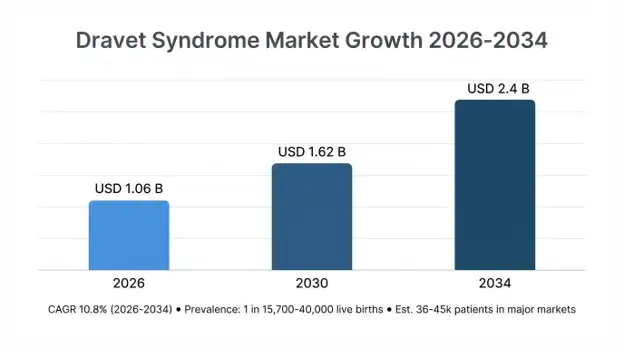
The global Dravet syndrome market was valued at USD 0.95 billion in 2025 and is projected to reach USD 1.06 billion in 2026, expanding to USD 2.4 billion by 2034, growing at a CAGR of 10.8% during the forecast period (2026-2034).
Dravet syndrome (previously called severe myoclonic epilepsy of the infantile type) is a rare, catastrophic, and lifelong developmental and epileptic encephalopathy that starts early in life, usually by five to eight months of age, in a seemingly normal baby. In about 80% of cases, pathogenic variants affecting the gene encoding the voltage-gated sodium channel Nav1.1, which is necessary for the proper function of the inhibitory GABAergic interneurons, are de novo. The loss of this inhibitory control results in hyperexcitability of the cortex, which becomes evident by a prolonged period of febrile and afebrile hemiclonic or generalized tonic-clonic seizures that evolve into multiple refractory seizure types, progressive cognitive and behavioral disturbances, gait, motor and sleep abnormalities, and a significantly increased risk of sudden unexpected death in epilepsy.
The spectrum of therapies has dramatically changed from "one size fits all" anti-seizure medications to disease-specific, mechanism-driven therapies. An important clinically distinguishing characteristic of Dravet syndrome is that several antiseizure drugs that are commonly used to treat seizures have been found to be contraindicated because they inhibit residual Nav1.1 activity and increase seizure frequency, such as sodium channel blockers like carbamazepine, phenytoin, and lamotrigine. Historical management used to be based on drugs such as valproate, clobazam, topiramate, and the ketogenic diet, but with inadequate seizure control in many patients. The approval of stiripentol as an adjunctive treatment to clobazam and valproate and then highly purified cannabidiol and more recently fenfluramine revolutionized clinical practice because it produced statistically significant and clinically significant decreases in convulsive seizure frequency. These drugs were found to be pivotal in modern polytherapy regimens based on the trial data that helped secure their approvals: Cannabidiol reduced the median number of convulsive seizures by 38.9% versus 13.3% placebo, and stiripentol showed a 71% responder rate versus 5% placebo.
Residual unmet need is still high despite these improvements. Despite optimized combination therapy, most patients still have breakthrough seizures, status epilepticus, and progressive neurodevelopmental impairment, and most patients have intellectual disability, and autism-spectrum features are common comorbidities. This chronic deficit and the clear genetic mitogenicity of the disease have resulted in high investment in disease-modifying treatments like antisense oligonucleotides and adeno-associated virus (AAV) gene therapy that seek to restore SCN1A/Nav1.1 function rather than simply reduce seizures. Beyond pharmaceuticals, the overall market includes genetic testing panels, patient registries, EEG and neuroimaging diagnostics, medication that can be used to quickly control acute seizures, long-term ketogenic diet programs, and caregiver support services, all of which keep patients and their families connected to specialized epilepsy centers long after their first treatment.
Little is known about the prevalence of Dravet syndrome, despite prevalence estimates of 1 in 15,700 to 1 in 40,000 live births, which equate to an estimated 36,000-45,000 Dravet patients in major pharmaceutical markets by 2025, with a growing adult population as more people survive and diagnostic awareness moves beyond pediatric neurology. Orphan drug designations in the U.S., EU, and Japan remain the foundation of high price tags, long exclusivity, and fast regulatory approval, preserving a focused but valuable rare-disease market.
| Report Coverage | Details |
|---|---|
| Base Year | 2025 |
| Base Year Value | USD 0.95 billion |
| Forecast Value | USD 2.4 billion |
| CAGR | 10.8% |
| Forecast Period | 2025-2034 |
| Historical Data | 2022-2025 |
| Largest Market | North America |
| Fastest Growing Market | Asia Pacific |
| Segments Covered | By Drug Class, Age Group, Route of Administration, Distribution Channel, End-User |
| Region Covered | North America, Europe, Asia Pacific, Middle East & Africa, Latin America |
| Countries Covered | US, Canada, Mexico, UK, Germany, France, Italy, Spain, Netherlands, China, Japan, India, Australia, South Korea, Brazil, Argentina, UAE, Saudi Arabia, South Africa |
| Key Market Playes | Jazz Pharmaceuticals, UCB S.A., Biocodex SAS, Stoke Therapeutics, Longboard Pharmaceuticals, Marinus Pharmaceuticals, Encoded Therapeutics |
Get more details on this report - Request Free Sample
Expanding Genetic Testing Access and Earlier Diagnosis: The increased accessibility and reduced costs of next-generation sequencing panels have considerably decreased the long time usually associated with the diagnosis of Dravet syndrome and, hence, early confirmation of SCN1A mutations, which then enables the pediatric neurologists to start specific treatment of the patients, rather than the sodium channel-blocking drugs that are contraindicated.
Approval and Adoption of Disease-Specific Orphan Therapies: The commercial launch of stiripentol, cannabidiol, and fenfluramine has effectively boosted pharmacologic expenditure per patient by having a clearly defined indication for Dravet syndrome rather than the broad term of “epilepsy,” allowing premium pricing.
High Treatment Costs and Restrictive Reimbursement Frameworks: The annual cost of branded drugs targeting Dravet patients usually lies between USD 30,000 and above USD 100,000 per patient, which often creates high payer oversight, prior authorization, and step therapy. Moreover, there is a limited number of individuals for treatment, limiting the economic return available in relation to the amount of clinical development needed.
Antisense Oligonucleotide and Gene Therapy Platforms Targeting SCN1A Haploinsufficiency: Transformational potential would stem from approaches that attempt to fix the defect in the genetic code as opposed to addressing the seizures only as a manifestation of this disorder. Antisense oligonucleotides used to increase the levels of the functional SCN1A gene and gene therapy using adeno-associated viruses that deliver Nav1.1 to interneurons could have a significant impact on the natural history of this condition and thus warrant a very high price premium despite a small number of patients.
Rescue Medication Innovation and Digital Seizure Monitoring: Traditional rectal diazepam is gradually becoming less common, as faster-acting intranasal and buccal rescue medication has become available with increased social acceptance in terms of out-of-hospital administration, whereas novel devices that can detect seizures together with telemedicine and pharmacotherapy have been incorporated into treatment to improve response times.
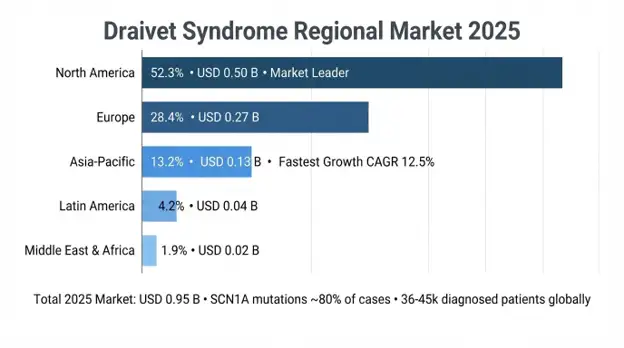
North America: Market Leadership Through Rare-Disease Infrastructure: Market share is dominated by North America, especially the US, due to its high availability of pediatric epileptologists, regulatory approval of orphan drugs, and complete insurance cover via Medicaid and private insurers. There are active patient groups with large patient databases that aid clinical trials and the development of real-world evidence; hence, new drugs are rapidly adopted even at a premium cost.
Asia Pacific: Fastest Growth from an Expanding Diagnostic Base: The fastest growth in terms of regional dynamics is expected in Asia-Pacific, mainly owing to advancements in pediatric neurology infrastructure, an increase in genetic testing in Japan, South Korea, China, and Australia, and the addition of orphan disease treatments to the reimbursement list. The Japan market currently stands out as the most developed regional market, and China offers the highest growth potential for the future.
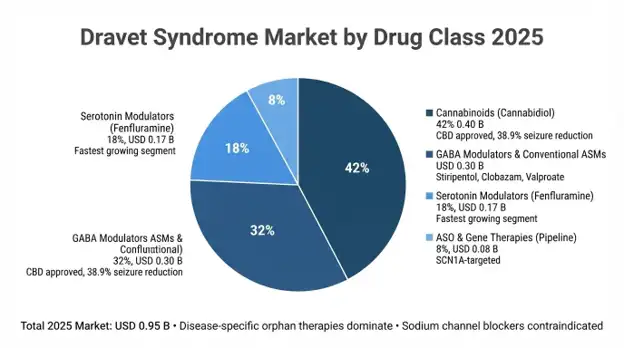
Insights on Drug Class: Cannabinoids form the largest drug class, with cannabidiol being the first-ever plant-based medicine for a particular epilepsy syndrome. GABA modulators and conventional anticonvulsants, which include stiripentol, clobazam, and valproate, form the fundamental part of the combination therapy. The serotonin modulators, especially fenfluramine, have gained considerable significance and are fast gaining popularity due to their increased efficacy in lowering the frequency of convulsive seizures. Antisense oligonucleotides and gene therapies form a small yet quickly increasing end of the pipeline-driven segment.
Insights on Age Group: The pediatric segment forms most of the market share considering that the disease occurs during early childhood, and the adult population, even though smaller, forms the fastest-growing age group since better seizure control and prevention of SUDEP lead to survival until adulthood.
Insights on End-Users: Hospitals and clinics form the largest end-user segment, considering that they are the sites for diagnosis, beginning of treatment, and management of status epilepticus, and neurology and epilepsy specialty centers form the fastest-growing end-user segment due to their ability to handle complex polypharmacy.
The global Dravet Syndrome market is relatively consolidated, with only a few pharmaceutical and biotech companies having dominant shares in terms of market revenue owing to disease-specific products and rich clinical pipelines. Competition differentiates based on proven seizure reduction efficacy, formulation, and ease of administration for pediatric patients, along with patient support programs. Orphan exclusivity offers protection from competition in the run-up to genetic disruption.
March 2026: The results of a Phase III trial conducted on patients with Dravet syndrome demonstrated that Longboard Pharmaceuticals’ drug candidate bexicaserin, which is a selective agonist of serotonin receptors, reduces the incidence of convulsions more than placebo. A filing is expected by the end of 2026.
February 2026: Stoke Therapeutics reported updated Phase II results from its antisense oligonucleotide treatment that is designed to increase the activity of the SCN1A gene, with seizure reduction being sustained for one year and indicating the readiness to proceed with pivotal Phase III.
January 2026: Jazz Pharmaceuticals secured an expanded age indication for its cannabidiol oral solution across additional international markets, broadening the addressable pediatric patient population.
November 2025: Encoded Therapeutics reported advances in preclinical data for its adeno-associated virus gene therapy, intended to increase the expression of the SCN1A gene in interneurons.
You'll get the sample you asked for by email. Remember to check your spam folder as well. If you have any further questions or require additional assistance, feel free to let us know via-
+1 724 648 0810 +91 976 407 9503 sales@intellectualmarketinsights.com
12 Aug 2026
Intellectual Market Insights Research © 2026. All rights reserved.


