Share this link via:

The global Dubowitz syndrome market size was valued at USD 48.6 million in 2025 and is projected to reach USD 51.9 million in 2026, expanding to USD 91.4 million by 2034, growing at a CAGR of 7.4% during the forecast period (2026–2034).
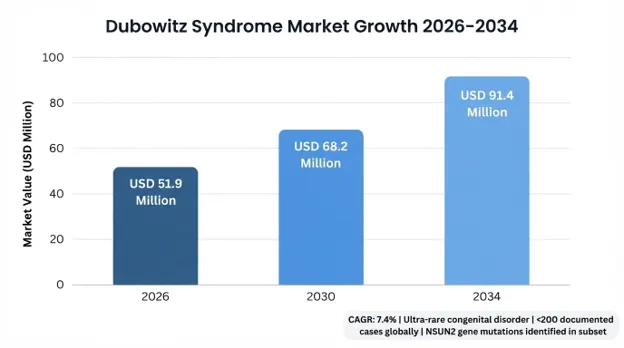
Dubowitz syndrome is a very rare congenital condition first described in 1965 by paediatrician Victor Dubowitz, and is characterized by a unique facial appearance, intellectual disability, microcephaly and intrauterine growth retardation. The facial phenotype is usually small, triangular shaped with a shallow frontal bone, telecanthus, blepharophimosis, ptosis, a broad nasal bridge, and micrognathia, which can help the experienced clinical geneticists make a diagnosis from the physical examination in most cases. Other recognized features are: in most patients, chronic and often severe eczema; in infancy, feeding difficulties and failure to thrive; behavioral abnormalities (hyperactivity, short attention span, and shyness); mild to moderate intellectual disability in most but not all affected patients; and a documented but not universal predisposition to hematologic malignancies such as leukemia and lymphoma, reported in some published case reports.
For decades the precise genetic cause of Dubowitz syndrome has been elusive. Autosomal recessive inheritance has been generally assumed from familial recurrence, but by now, clinical geneticists have recognized this condition as a heterogeneous group of diseases rather than a single-gene disorder. Some of the exome sequencing studies have defined a small subgroup of patients with a Dubowitz-like phenotype based on the presence of biallelic pathogenic variants in NSUN2, an RNA methyltransferase involved in the modification of tRNAs. Differential diagnosis is difficult with other growth-retardation and chromosomal-instability syndromes (Bloom syndrome, Cornelia de Lange syndrome, Smith-Lemli-Opitz syndrome, Russell-Silver syndrome, fetal alcohol spectrum disorder) which have significant overlapping clinical features, and in many cases comprehensive genetic testing is necessary for clinical confirmation of Dubowitz syndrome.
In the published medical literature, there are fewer than 200 reported cases of Dubowitz syndrome worldwide since the syndrome was first described. However, the actual prevalence is thought to be under-estimated because there is no single confirmatory genetic test; there is phenotypic overlap with more familiar syndromes; and there is not a great deal of awareness of the condition outside of specialist clinical genetics practice. Unlike many other recently orphan drug-approved markets, the commercial market of Dubowitz syndrome is driven almost solely by diagnostic services, symptomatic and supportive pharmacological management, and long term, multidisciplinary care by the absence of any approved disease modifying or cure-all therapy.
| Report Coverage | Details |
|---|---|
| Base Year | 2025 |
| Base Year Value | USD 48.6 Million |
| Forecast Value | USD 91.4 Million |
| CAGR | 7.4% |
| Forecast Period | 2025-2034 |
| Historical Data | 2022-2025 |
| Largest Market | North America |
| Fastest Growing Market | Europe |
| Segments Covered | By Diagnosis, Treatment, End-User, Region |
| Region Covered | North America, Europe, Asia Pacific, Middle East & Africa, Latin America |
| Countries Covered | US, Canada, Mexico, UK, Germany, France, Italy, Spain, China, Japan, India, South Korea, Australia, Brazil, UAE, Saudi Arabia, South Africa |
| Key Market Playes | Illumina Inc., Centogene N.V., Invitae Corporation, Novo Nordisk A/S, Pfizer Inc., Sanofi, Recordati Rare Diseases |
Get more details on this report - Request Free Sample
Accessibility of whole exome sequencing and whole genome sequencing for pediatric genetics practices has been the single biggest factor influencing the Dubowitz syndrome market. It has been helping clinicians discover several cases that used to remain undiagnosed or misdiagnosed in syndromic growth failure categories. With sequencing becoming cheaper and with bioinformatics pipelines getting better at detecting rare genetic mutations such as NSUN2 and others, it has become possible to confirm or rule out the Dubowitz syndrome diagnosis. This has helped in organizing patient data in codes.
The continued establishment of focused centers for rare diseases and multidisciplinary pediatric genetics centers has created the clinical capacity needed for managing Dubowitz syndrome in the domains of growth, dermatology, neurodevelopment, and hematology at the same time. Favorable policy environments for orphan diseases, such as long-term market exclusivity periods and low regulatory costs in large economies, have been continuing to encourage the maintenance and growth of rare pediatric syndromes by pharmaceuticals and diagnostic companies, thus helping Dubowitz syndrome patients benefit indirectly from growth hormone treatment, dermatology treatment, and nutritional therapy.
The key limitation to the growth of the Dubowitz syndrome market is the extremely small and scattered global patient base that severely hampers the financial feasibility of developing disease-specific treatments. With less than 200 known cases reported in the published literature and without a common causative gene in most of the patients, drug developers would find it hard to conduct sufficiently powered clinical studies, build an approval pathway based on molecular endpoints or justify their massive expenditures in pursuing an orphan product development pathway. Consequently, all pharmacological interventions employed today such as growth hormone, topical steroids and emollients, antimicrobial prophylaxis, and behavior medications are all being applied off label and have been borrowed from other conditions.
The Dubowitz syndrome market has an important opportunity in the ongoing molecular analysis of patients with Dubowitz syndrome diagnosis via international collaborative sequencing and sharing of patient registries. With the identification of other causative or contributory genes besides NSUN2 in larger patient numbers, the physicians can better classify these patients based on their molecular type and thereby aid in targeted surveillance for hemopathies, genetic counseling, and future eligibility for treatment with therapies that are being developed for other rare genetic pediatric syndromes. Companies providing genetic counseling, carrier testing, and trio sequencing may benefit as there is a growing demand due to family planning after having an affected offspring.
An important developing trend within the field of diagnostics of rare diseases involves the use of artificial intelligence and deep learning-based facial analysis algorithms for the purpose of identifying syndromic phenotypes, including the characteristic facial appearance in case of Dubowitz syndrome. These new technologies, which are increasingly combined with software solutions for interpreting genomic variants, assist genetic clinicians in selecting candidate diagnoses and are also used together with telemedicine/tele-genetics consultations that allow families to obtain the input from specialists in remote geographic locations where there are no rare diseases centers nearby.
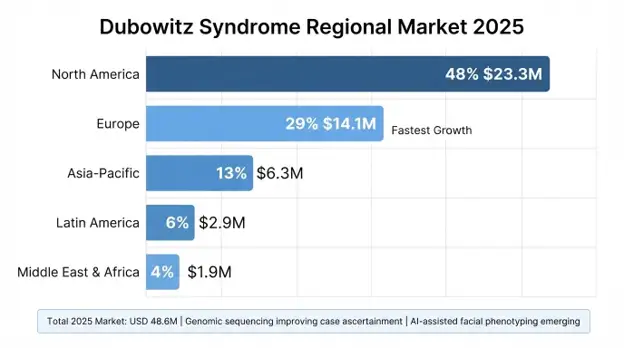
The North American region holds the biggest share in the Dubowitz syndrome market due to its rare disease expertise among the best academic children’s hospitals, insurance coverage of advanced testing and growth hormone treatment, and existing government funding for undiagnosed and rare disease research initiatives. Patient advocacy groups that exist under rare disease umbrella groups keep enhancing physicians' awareness and referral systems, while the United States holds a significant market share in the region owing to the presence of pediatric genetics experts and academic institutions.
The most rapidly expanding regional market is Europe, thanks to incorporation of Dubowitz syndrome along with other related phenotypes into the European Reference Network for rare congenital anomalies and intellectual disabilities, availability of publicly funded genetic screening in each national health system, and high priority of participation in registries as well as guideline creation. Germany, France, and UK continue to make substantial investments in national programs in genomic medicine that result in high detection rates of ultra-rare syndromes.
Genetic Testing is the largest and most rapidly growing diagnostic domain due to the necessity of conducting whole exome sequencing, whole genome sequencing, and chromosomal microarray analysis for confirmation and exclusion of phenocopies. The domains of Clinical Evaluation & Phenotyping and Neuroimaging have smaller shares in relation to the need for conducting initial testing of the syndrome due to its distinctive facial gestalt. Hematologic & Immunologic Screening constitutes another relatively small but necessary share.
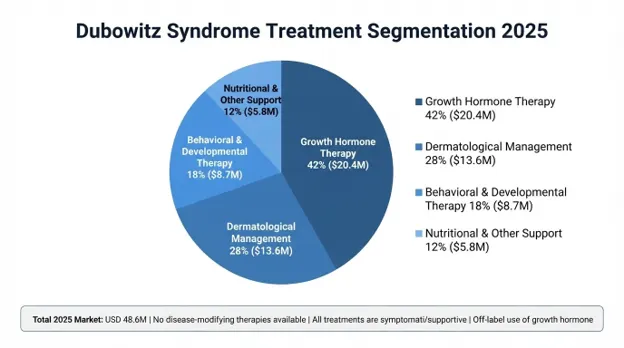
Since there are no disease-modifying therapies, all that the treatment market segment includes is only symptomatic and supportive treatments. Growth Hormone Therapy constitutes the most important treatment sub-segment because of the chronic treatment required for the treatment of growth retardation, while the Dermatological Therapy sub-segment comes next for the chronic eczema affecting most patients, while the Behavioral & Developmental Therapy sub-segment helps with the cognitive and attention problems of the patients.
The End User Segments of Hospitals and Specialty Clinics have the maximum end-user share because of the requirement for coordination and multidisciplinary treatment involving areas such as genetics, endocrinology, dermatology, and developmental pediatrics. Genetic and Rare Diseases Research Centers and Academic Medical Centers come next, being the places where the diagnosis is confirmed and the patients participate in research, while Home Healthcare constitutes a small and developing segment.
The market for Dubowitz syndrome is extremely fragmented and comprised of companies that focus on the provision of services and diagnostics for Dubowitz rather than manufacturers of disease-specific drugs. Companies that offer genomic sequencing will compete based on the accuracy, speed, and number of rare disease gene panels utilized to either confirm or rule out the diagnosis of Dubowitz syndrome. Meanwhile, the pharmaceutical companies that have a portfolio of growth hormone, dermatological, and supportive care products will compete based on the prescribing volumes derived from symptom management.
January 2026: Updated guidelines for the clinical management of Dubowitz syndrome were issued by a consortium of European rare disease reference centers that included a set of guidelines for growth hormone administration and dermatological treatment in individuals with Dubowitz syndrome or overlapping phenotypes.
November 2025: Top genomic testing companies have broadened their panels for sequencing rare diseases in children to include the NSUN2 gene and other candidate genes that may cause symptoms similar to those seen in Dubowitz syndrome.
August 2025: An academic research consortium has announced their intention to collect expanded natural history data for Dubowitz syndrome using an existing registry for rare and undiagnosed diseases.
You'll get the sample you asked for by email. Remember to check your spam folder as well. If you have any further questions or require additional assistance, feel free to let us know via-
+1 724 648 0810 +91 976 407 9503 sales@intellectualmarketinsights.com
12 Aug 2026
Intellectual Market Insights Research © 2026. All rights reserved.


