Share this link via:

The global fibrodysplasia ossificans progressiva treatment market was valued at USD 0.54 billion in 2026 and is projected to expand at a compound annual growth rate of 8.8% through 2034, reaching USD 0.76 billion by 2030 and potentially exceeding USD 1.2 billion by 2034. The market expansion represents a critical transformation in the rare disease therapeutic landscape, driven by the recent regulatory approval of the first targeted disease-modifying therapy and an accelerating clinical development pipeline addressing the profound unmet medical needs of this ultra-rare genetic disorder affecting approximately three thousand individuals worldwide.
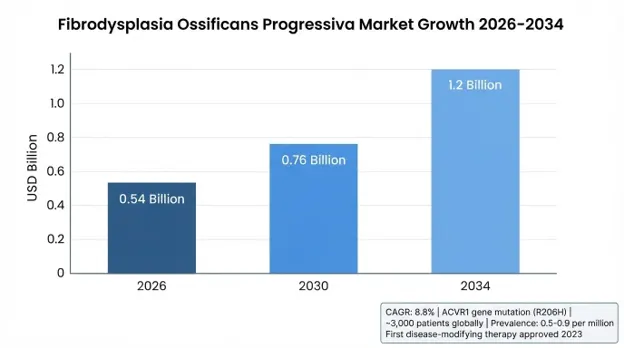
Fibrodysplasia ossificans progressiva represents one of the most devastating genetic disorders characterized by progressive heterotopic ossification, where soft tissues, including muscles, tendons, ligaments, and aponeuroses, undergo abnormal transformation into bone, creating a second skeleton that progressively immobilizes affected patients. The disease results from heterozygous missense mutations in the ACVR1 gene, encoding a bone morphogenetic protein type I receptor, with approximately ninety-seven percent of affected individuals sharing the identical R206H mutation. The condition manifests in early childhood with characteristic malformations of the great toes, progressing through episodic inflammatory flare-ups triggered by minor trauma, immunizations, dental procedures, or influenza-like illnesses that precipitate new bone formation in predictable anatomical patterns affecting the neck, back, shoulders, and torso before progressing to involve lower extremities. Most patients become wheelchair-bound or severely immobilized by their third decade of life, with a median lifespan of approximately fifty-six years primarily limited by thoracic insufficiency syndrome causing cardiorespiratory failure.
The commercial market significance extends beyond conventional symptomatic management to encompass emerging disease-modifying therapies targeting the fundamental pathological mechanisms driving heterotopic ossification, comprehensive diagnostic and monitoring platforms enabling early disease detection and treatment optimization, genetic testing and counseling services essential for diagnosis confirmation and family planning, and integrated care systems coordinating specialized medical expertise, surgical intervention, and psychosocial support required for optimal patient outcomes. The market addresses extraordinary unmet needs, including the critical shortage of effective therapeutic options; high rates of misdiagnosis and iatrogenic harm from unnecessary invasive procedures; limited patient awareness among medical communities; and substantial quality-of-life impacts affecting patients, families, and healthcare systems through work disability, educational disruption, and long-term care requirements.
| Report Coverage | Details |
|---|---|
| Base Year | 2025 |
| Base Year Value | USD 0.50 billion |
| Forecast Value | USD 1.2 Billion |
| CAGR | 8.8% |
| Forecast Period | 2025-2034 |
| Historical Data | 2022-2025 |
| Largest Market | North America |
| Fastest Growing Market | Asia Pacific |
| Segments Covered | By Product Type, Treatment Approach, Disease Stage, Patient Demographics, End-User, Geography |
| Region Covered | North America, Europe, Asia Pacific, Middle East & Africa, Latin America |
| Countries Covered | US, Canada, UK, Germany, France, Italy, Spain, Netherlands, Australia, Japan, China, India, Brazil, Argentina, Saudi Arabia, UAE, South Africa |
| Key Market Playes | Ipsen Pharma (Clementia Pharmaceuticals), Regeneron Pharmaceuticals, Blueprint Medicines, Acceleron Pharma (Merck), Agios Pharmaceuticals |
Get more details on this report - Request Free Sample
The most significant structural driver transforming the FOP market occurred with the FDA accelerated approval of palovarotene (Sohonos) in December 2023, representing the first and only approved pharmacological intervention demonstrated to reduce heterotopic ossification formation in FOP patients. This landmark approval fundamentally altered therapeutic expectations and treatment paradigms for the global FOP community, transitioning from purely supportive palliative management to disease-modifying intervention, substantially expanding addressable market size beyond symptomatic treatment to preventive and disease-slowing therapeutics. Palovarotene, a synthetic retinoid, demonstrated efficacy in the Phase III PIVOINE trial by reducing the volume of new heterotopic ossification lesions by approximately ninety percent compared to placebo, with treatment benefit sustained over extended follow-up periods.
The drug received accelerated approval with a boxed warning addressing embryo-fetal toxicity and premature epiphyseal closure in pediatric patients, with authorization for females aged eight years and above and males aged ten years and above. The commercial launch occurred in 2024 with anticipated global uptake among eligible patients, representing the foundation for market expansion. The palovarotene approval created immediate market opportunity valued at USD 180-220 million annually at steady-state penetration, with lifetime patient treatment costs exceeding USD 1.2-1.8 million when accounting for extended treatment duration potentially spanning multiple decades for pediatric-onset disease.
The FOP treatment landscape is experiencing unprecedented expansion in clinical development with multiple therapeutics targeting distinct pathological mechanisms approaching late-stage clinical evaluation. Garetosmab, a fully human monoclonal antibody designed to neutralize the Activin A protein that promotes heterotopic ossification through bone morphogenetic protein pathway dysregulation, advanced through successful Phase III trials demonstrating reduction in new bone lesion formation and disease progression. Regeneron Pharmaceuticals submitted a Biologics License Application to the FDA with priority review status, anticipated to result in a regulatory decision by mid-2026. Garetosmab demonstrated superiority to palovarotene in some clinical parameters, with clinical trials showing complete blockade of new heterotopic ossification lesion emergence in significant patient proportions, positioning this therapy for a potential market-leading position post-approval.
Additional therapeutic candidates in active clinical development include investigational agents targeting ALK2 kinase signaling, BMP pathway inhibitors, inflammation modulators, and immunosuppressive approaches. Blueprint Medicines conducts Phase II development of BMP signaling inhibitors, Agios Pharmaceuticals investigates ALK2-specific kinase inhibitors, and multiple academic and commercial organizations pursue complementary therapeutic strategies. The cumulative clinical pipeline encompasses over fifteen active investigational programs, representing USD 1.8-2.4 billion in development investment. The diversity of mechanisms provides substantial opportunity for combination therapies addressing disease heterogeneity and potential synergistic benefits, with earlier clinical-stage programs potentially expanding treatment options through the 2032-2034 forecast period.
Global disease awareness initiatives, improved physician education through specialty networks, and implementation of genetic testing algorithms are substantially reducing the diagnostic delays that historically averaged three to four years from symptom onset to confirmed diagnosis. This delay reduction has profound market implications by enabling earlier treatment initiation when heterotopic ossification burden remains limited, potentially maximizing the therapeutic benefit of disease-modifying interventions. Enhanced diagnosis acceleration increases the addressable patient population eligible for treatment by reducing misclassification as other conditions, including tumors, multiple exostoses, hematomas, or inflammatory disorders that previously delayed appropriate FOP diagnosis.
Diagnostic improvements result from multiple factors including increased awareness among primary care physicians prompted by patient advocacy organizations, simplified genetic confirmation through expanded ACVR1 sequencing availability, advanced imaging capabilities identifying characteristic heterotopic ossification patterns, and international diagnostic consensus criteria codified through the International Clinical Council on FOP. The enhanced diagnostic infrastructure substantially increases newly identified patient populations entering specialized care centers, with patient identification rates projected to increase at ten to thirteen percent annually, directly expanding treatable patient populations and market size through improved case ascertainment.
The fundamental market constraint is the ultra-rare disease prevalence estimated at zero point five to zero point nine cases per million individuals globally, translating to approximately three thousand affected individuals worldwide with highly dispersed geographic distribution. This limited patient population creates significant challenges for pharmaceutical company commercial strategy, including compressed market volumes, extended break-even timelines, and compressed revenue potential compared to more common rare diseases. The global FOP population exhibits unequal geographic distribution, with North America accounting for approximately twenty-eight percent of identified patients, Western Europe twenty-four percent, Latin America nineteen percent, and Asia-Pacific only sixteen percent despite significantly larger total population bases.
The dispersed patient population creates operational challenges, including limited referral volumes supporting specialized treatment centers; reduced trial recruitment capabilities constraining clinical development timelines; fragmented healthcare systems complicating patient access to advanced therapies; and insufficient disease awareness in underrepresented regions perpetuating diagnostic delays. Geographic disparities reflect differential healthcare infrastructure quality, specialist availability, genetic testing access, and patient organization connectivity rather than true disease prevalence variation, suggesting substantial undiagnosed populations in developing regions remain outside commercial reach.
The limited treatment availability historically combined with extraordinary therapy costs creates substantial reimbursement challenges limiting patient access and market penetration. Palovarotene and garetosmab command premium pricing justified by life-altering efficacy and extended treatment duration, with annual costs potentially exceeding USD 200,000-350,000 per patient annually when accounting for drug acquisition, monitoring requirements, and supportive care services. The ultra-rare disease status complicates reimbursement negotiations by limiting payer precedent data and comparative effectiveness evidence relative to more common conditions. Many countries lack established reimbursement pathways for ultra-rare diseases, with insurance coverage decisions dependent on individual risk assessment or special committee review, creating access variability and treatment delays.
Out-of-pocket costs and medication access barriers disproportionately affect patients in middle-income and developing countries, where government healthcare systems provide limited coverage for orphan pharmaceuticals, substantially restricting the addressable market to developed economies. Insurance penetration varies substantially across geographic regions from near-universal coverage in developed market healthcare systems to minimal or absent coverage in low-resource countries, directly limiting commercial market expansion potential despite significant global patient populations.
Substantial opportunity exists in developing combination therapeutic approaches addressing disease heterogeneity and maximizing disease modification through complementary mechanisms. Palovarotene targets early inflammation and BMP pathway initiation while garetosmab blocks Activin A-mediated pathway dysregulation, suggesting potential synergistic benefit from combined therapy reducing heterotopic ossification progression more effectively than monotherapy. Clinical and preclinical evidence supports combination strategies targeting multiple points in the ossification pathway, with combination trials anticipated to advance through clinical development during the 2027-2029 forecast period.
Additional opportunity involves combination with immunosuppressive therapies addressing the inflammatory component of flare-ups and ossification initiation. Corticosteroids and NSAIDs demonstrate limited disease-modifying benefit but, combined with emerging targeted therapies, may enhance efficacy. Combination approaches potentially enable dose reduction of each agent, reduce treatment toxicity burden, and improve long-term tolerability critical for pediatric patients requiring decades-long therapy compliance. Successful combination strategies could command premium pricing relative to monotherapy, reflecting enhanced clinical outcomes, substantially expanding per-patient lifetime value and market potential.
Emerging opportunities in gene therapy and CRISPR-based gene editing approaches promise potential curative interventions addressing the fundamental ACVR1 mutation driving FOP pathogenesis. Conceptual approaches include in vivo ACVR1 gene correction utilizing adeno-associated viral vectors, ex vivo hematopoietic stem cell editing with autologous transplantation restoring wild-type ACVR1 function, and emerging base editing technologies enabling precise genetic correction without double-strand breaks. Gene therapy platforms demonstrate extraordinary complexity requiring specialized delivery systems, immunosuppression protocols, surgical administration techniques, and long-term monitoring for integration site safety.
The transformative curative potential of successful gene therapy justifies substantial development investment and commands premium pricing potentially exceeding USD 500,000-1,000,000 per treatment if approved. Multiple academic centers and emerging biotechnology companies pursue gene therapy programs, with the earliest clinical programs anticipated to initiate patient enrollment during the 2027-2029 forecast period. Successfully approved gene therapy would represent a paradigm shift from chronic lifelong pharmacological management to single-administration curative intervention, though regulatory pathways remain novel and development timelines extend beyond the current forecast period.
The FOP market is experiencing a substantial shift toward patient-centered outcome measurement, reflecting disease impact on mobility, self-care, quality of life, and functional independence rather than solely biochemical or radiological parameters. The FOP Connection Registry, managed by the International Fibrodysplasia Ossificans Progressiva Association, collects comprehensive patient-reported outcomes, functional assessment data, and quality-of-life metrics from a representative global FOP population, generating evidence informing treatment decisions and therapy development. Patient-reported outcome measures including mobility assessment, activities of daily living quantification, pain intensity, psychological well-being, and social participation increasingly integrate into clinical trial endpoints, reflecting patient priorities and meaningful clinical benefit definitions.
Real-world evidence generation through patient registries, healthcare utilization databases, and outcomes tracking systems provides comparative effectiveness data informing treatment selection, payer reimbursement decisions, and physician recommendations. The emphasis on patient-centered outcomes acknowledges that biomarker improvement lacks significance if functional outcomes and quality of life remain substantially impaired, driving development of therapies optimizing real-world functional restoration rather than solely ossification reduction.
Advanced diagnostic development encompasses novel biomarker platforms enabling earlier disease detection before substantial heterotopic ossification accumulation limits therapeutic benefit. Serum biomarkers reflecting bone formation activity, inflammatory pathway dysregulation, and heterotopic ossification progression currently under investigation include alkaline phosphatase variants, BMP signaling pathway components, and circulating progenitor cells potentially enabling non-invasive disease monitoring and therapeutic response assessment.
Advanced imaging technologies including specialized CT protocols, MRI sequences optimized for early heterotopic ossification detection, and molecular imaging approaches utilizing radiolabeled tracers targeting ossification pathways enable earlier radiological disease detection. These diagnostic advances facilitate patient stratification for aggressive early intervention, disease progression monitoring, and therapeutic efficacy assessment. Diagnostic development represents a substantial market opportunity through companion diagnostics supporting precision medicine approaches, selecting optimal therapy based on individual ossification progression rates and biomarker profiles.
North America commands the largest FOP market share at approximately USD 0.28 billion in 2026, driven by concentrated expertise among vitreoretinal and orthopedic specialists; established patient advocacy organization infrastructure; comprehensive insurance coverage supporting access to advanced therapies; and predominance of clinical development programs. The United States represents eighty-five percent of regional market value, with Medicare and commercial insurance providing a reimbursement foundation for approved and investigational therapies. The region benefits from three major FOP referral centers located at the University of Pennsylvania, Mayo Clinic, and University of California, San Francisco, concentrating patient expertise and facilitating enrollment into clinical trials.
The regional regulatory environment accelerates therapeutic development through FDA breakthrough therapy designation, orphan drug status providing market exclusivity, and adaptive trial designs enabling accelerated approval pathways. Patient advocacy organizations, including the International Fibrodysplasia Ossificans Progressiva Association, provide comprehensive patient support, clinical trial coordination, and physician education, substantially improving diagnosis rates and care quality. The North American market benefits from health information technology infrastructure enabling real-world evidence generation through electronic medical records and healthcare databases, providing substantial comparative effectiveness data informing treatment algorithms and reimbursement decisions.
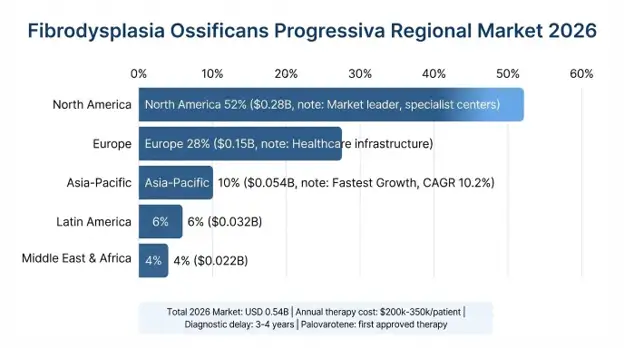
Europe represents the second-largest regional market valued at approximately USD 0.15 billion in 2026, expanding at 8.4% annually through 2034. The region benefits from established healthcare systems providing coverage for ultra-rare disease therapeutics; multiple specialized FOP centers distributed across Western European countries, including the United Kingdom, France, Italy, and Germany; and comprehensive patient networks facilitating diagnosis and treatment coordination. European healthcare systems have demonstrated strong commitment to rare disease management through established referral networks, specialized treatment centers of excellence, and reimbursement mechanisms supporting access to orphan pharmaceuticals.
The regulatory environment supports rapid market access through European Medicines Agency accelerated assessment procedures; orphan medicinal product designation, providing market exclusivity and development support; and centralized approval processes, reducing per-country regulatory burden. Regional healthcare databases and comprehensive patient registries enable real-world evidence generation informing therapeutic development and health technology assessment decisions critical for national reimbursement authorization.
Asia-Pacific represents the fastest-growing regional market with a projected CAGR of 10.2% through 2034, though it currently represents only ten percent of global market value at approximately USD 0.054 billion in 2026. The region encompasses vast populations with estimated twenty million rare disease patients, including substantial undiagnosed FOP cases concentrated in China, India, and Japan. Rapid economic development, expanding healthcare infrastructure, and growing insurance coverage are incrementally improving access to diagnosis and treatment. China has identified FOP as one of eighty-six recognized rare diseases in the national catalogue, facilitating improved awareness and diagnostic infrastructure.
The Asia-Pacific opportunity reflects large undiagnosed patient populations, growing specialist networks in major urban centers, expanding clinical trial capacity, and emerging healthcare reimbursement mechanisms supporting orphan drug access. However, significant barriers persist, including limited diagnostic expertise outside major urban centers, restricted insurance coverage for expensive orphan therapeutics, and language barriers limiting clinical trial participation. Market expansion in this region depends substantially on diagnostic awareness improvements, healthcare infrastructure investment, and regulatory framework development supporting orphan drug access and reimbursement.
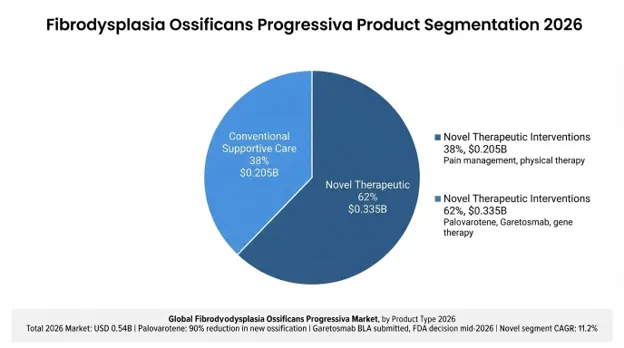
Novel therapeutic interventions represent the dominant and fastest-growing segment at approximately sixty-two percent market share, valued at USD 0.335 billion in 2026, growing at an 11.2% CAGR through 2034 as palovarotene and pipeline therapeutics achieve regulatory approval and market adoption. This segment encompasses disease-modifying pharmaceutical agents, biologic therapeutics targeting Activin A and bone morphogenetic protein pathways, and emerging gene therapy approaches demonstrating efficacy reducing heterotopic ossification progression. The segment benefits from premium pricing, reflecting transformative clinical efficacy enabling functional improvement and disease progression slowing previously impossible with conventional management.
Conventional supportive care products maintain a thirty-eight percent market share valued at USD 0.205 billion in 2026, encompassing anti-inflammatory agents, pain management medications, physical therapy services, mobility assistive devices, and surgical consultation supporting symptomatic management and complication prevention. These supportive interventions remain standard-of-care components providing palliative benefit and functional support for disease progression not yet controlled by disease-modifying therapies.
Pharmacological management dominates treatment approaches with a forty-eight percent market share valued at USD 0.259 billion in 2026, reflecting disease-modifying therapy adoption and continued supportive medication utilization. Surgical intervention represents a twenty-eight percent market share at USD 0.151 billion in 2026, encompassing orthopedic surgical procedures addressing joint contractures, spinal deformities, and thoracic insufficiency syndrome complications. Supportive therapies, including occupational and physical rehabilitation services, represent a twenty-four percent market share at USD 0.130 billion in 2026.
Early-onset disease stages represent the largest segment at thirty-five percent market share, valued at USD 0.189 billion in 2026, reflecting high disease identification rates in pediatric populations and aggressive early intervention philosophy. Progressive Phase represents thirty-eight percent of the market at USD 0.205 billion in 2026, encompassing the majority of identified patients with active heterotopic ossification progression. Advanced immobilization stages represent a twenty-seven percent market share at USD 0.146 billion in 2026.
Pediatric patients comprise fifty-three percent of the identified FOP population, with market share approaching USD 0.286 billion in 2026, reflecting early disease manifestation typically between ages three and five years. Adult patients represent forty-seven percent of the market, valued at approximately USD 0.254 billion in 2026, encompassing patients with established disease often facing maximal functional impairment and treatment complexity.
Hospitals & Specialist Centers represent the largest end-user segment, commanding a fifty-two percent market share valued at USD 0.281 billion in 2026, encompassing comprehensive FOP referral centers providing multidisciplinary expertise integrating orthopedic surgery, rheumatology, genetics, and rehabilitative services. Research institutions account for twenty-one percent market share at USD 0.113 billion in 2026, supporting clinical trial infrastructure and therapeutic development. Home care services represent a twenty-seven percent market share at USD 0.146 billion in 2026, providing patient support and monitoring during and between specialist evaluations.
The global fibrodysplasia ossificans progressiva treatment market exhibits moderate-to-high concentration, with the top five companies controlling approximately seventy-eight percent of market value through proprietary disease-modifying therapeutics, established patient relationships, comprehensive clinical development pipelines, and significant manufacturing and distribution infrastructure. Competitive differentiation centers on clinical evidence demonstrating superior efficacy and safety profiles, innovative mechanisms targeting distinct ossification pathway components, comprehensive patient support programs, and strategic partnerships with patient advocacy organizations and specialist healthcare networks.
December 2024: Regeneron announced positive Phase III OPTIMA trial results for garetosmab, demonstrating significant reduction in new heterotopic ossification lesions and disease progression compared to placebo in adult FOP patients, with a Biologics License Application submitted to the FDA for a priority review decision anticipated mid-2026.
June 2024: Ipsen announced expanded global market availability of palovarotene (Sohonos) with regulatory approval achieved in multiple European countries and Australia, substantially expanding patient access outside North American markets.
March 2024: Blueprint Medicines reported positive Phase II data for a BMP signaling inhibitor demonstrating disease modification potential, advancing the program toward Phase III development initiation planned for 2025.
January 2024: The International Fibrodysplasia Ossificans Progressiva Association published updated clinical guidelines emphasizing early disease recognition, genetic confirmation protocols, and integration of emerging disease-modifying therapies into comprehensive patient management plans.
You'll get the sample you asked for by email. Remember to check your spam folder as well. If you have any further questions or require additional assistance, feel free to let us know via-
+1 724 648 0810 +91 976 407 9503 sales@intellectualmarketinsights.com
22 Aug 2026
Intellectual Market Insights Research © 2026. All rights reserved.