Share this link via:

The global fibromuscular dysplasia market size was valued at USD 0.825 billion in 2025 and is projected to reach USD 0.93 billion in 2026, expanding to USD 1.38 billion by 2034, growing at a CAGR of 5.2% during the forecast period (2026-2034).
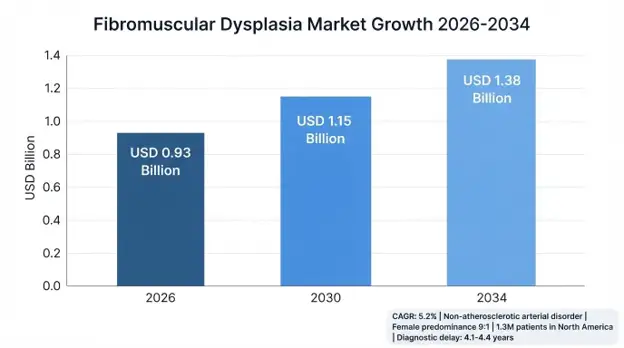
Fibromuscular dysplasia is a rare systemic vascular disorder where an idiopathic, non-inflammatory, non-atherosclerotic remodeling of medium-sized and small-sized arteries occurs in multiple vascular territories throughout, with various clinical signs ranging from incidental findings to life-threatening vascular events. It is a disease that almost exclusively targets women in all age groups, with a mean age at diagnosis of approximately 52 years and a strong female-to-male predominance in most studied populations (mean 9:1); it is a cause of 10–20% of secondary hypertension and a significant but underrecognized etiology of stroke, aneurysm, and vascular dissection in younger populations.
Pathophysiology is segmental arterial wall dysplasia, resulting in typical angiographic features such as medial fibroplasia with alternating stenotic webs and poststenotic dilatations, intimal fibroplasia (smooth tubular stenosis), and rare variants of perimedial and adventitial involvement, resulting in eventual hemodynamic compromise, thrombosis, aneurysm, and arterial dissection, which can cause catastrophic events like intracerebral hemorrhage, myocardial infarction, and acute arterial occlusion.
It includes a full diagnostic and therapeutic environment that features advanced imaging technologies such as duplex ultrasonography, computed tomography angiography, magnetic resonance angiography, and catheter-based angiography for disease detection and characterization, as well as a variety of therapeutic treatments, including both pharmacological management (such as antihypertensive therapy and antiplatelet drugs to manage hypertension and thrombotic risk) and invasive revascularization (including percutaneous transluminal angioplasty or surgical reconstruction for hemodynamically significant stenosis, aneurysm, and dissection). The market serves significant unmet needs in a diverse patient population, with estimates ranging from 3 to 5% of screened populations, affecting approximately 1.3 million people in North America alone, and with potentially substantial underdiagnosis due to the rarity of the condition and frequently non-specific presenting symptoms, which lead to a diagnostic delay of 4.1-4.4 years from the onset of symptoms.
| Report Coverage | Details |
|---|---|
| Base Year | 2025 |
| Base Year Value | USD 0.825 billion |
| Forecast Value | USD 1.38 billion |
| CAGR | 5.2% |
| Forecast Period | 2025-2034 |
| Historical Data | 2022-2025 |
| Largest Market | North America |
| Fastest Growing Market | Europe and Asia Pacific |
| Segments Covered | By Vascular Territory, Type, Disease Manifestation, Diagnostic Modality, Treatment Approach, End-User |
| Region Covered | North America, Europe, Asia Pacific, Middle East & Africa, Latin America |
| Countries Covered | US, Canada, Mexico, UK, Germany, France, Italy, Spain, Netherlands, China, Japan, India, Australia, South Korea, Brazil, Argentina, UAE, Saudi Arabia, South Africa |
| Key Market Playes | Mayo Clinic, Mount Sinai Health System, Cleveland Clinic, UK Vascular Society, European Society of Vascular Medicine, University of Michigan, Duke University Medical Center |
Get more details on this report - Request Free Sample
The marked increase in knowledge of the disease among healthcare professionals and their ability to diagnose it is one of the key drivers behind the development of the global market of fibromuscular dysplasia (FMD). Since symptoms of the disease, such as headaches, hypertension, and nervous system issues, resemble the symptoms of common diseases, there were serious problems with diagnosing the FMD in the past; in most cases, people were diagnosed with it with an average of more than four years after their first visit to the doctor. It has become much easier to detect the disease and identify patients due to more education of physicians, introduction of special FMD registries, and publication of guidelines for the disease.
The rise in popularity of vascular centers and the use of modern diagnostic techniques such as duplex ultrasonography, CT angiography, and MR angiography helped to improve the process of diagnosis of the disease. It has become easier to detect characteristic signs of the disease, such as resistant hypertension, vascular bruits, pulsatile tinnitus, and stroke, among young patients for general care physicians, cardiologists, neurologists, and vascular specialists.
FMD is a relatively common cause of secondary hypertension and cerebrovascular disease, providing many possibilities for early diagnosis and therapy. It has been established that FMD causes 10-20% of secondary hypertension cases and plays an important role in developing resistant hypertension among young patients often misdiagnosed with essential hypertension. Better awareness and more efficient vascular imaging technology allow the diagnosis of the condition in people who were not diagnosed with FMD before.
Another common manifestation of FMD is cerebrovascular disease, with the carotid and vertebral arteries involved in almost two-thirds of diagnosed cases. Patients often suffer from headaches, pulsatile tinnitus, transient ischemic attacks, ischemic stroke, and visual symptoms, showing the importance of the disease's effect on the nervous system. In addition, FMD leads to serious vascular complications such as arterial dissections and aneurysms of the renal and carotid arteries, causing hemorrhages and damage to the internal organs. The growing incidence of such complications increases the demand for specific diagnostics, monitoring, and treatment options and drives the steady market development.
The key limiting factor that limits fibromuscular dysplasia market growth relates to the relatively low number of patients affected by the condition compared to common cardiovascular and cerebrovascular conditions, which limits any economic incentive for developing and improving care facilities. While recently there have been claims that FMD is prevalent in 3-5% of patients who were tested, the condition is rarely diagnosed and affects approximately 1.3 million people in North America compared to 70 million hypertensive patients and 15 million stroke patients.
The low prevalence of FMD makes it difficult to recruit participants to clinical trials, fund research projects, and develop specialist knowledge. FMD specialist expertise is localized mostly in major academic medical institutions. The localization of expertise limits patient access to proper services and further hinders market growth and development.
A key market opportunity for the FMD market is the development of targeted therapies and disease-modifying therapies, considering developments in genetics and molecular science. Current management of FMD focuses mainly on symptom control and prevention of complications. Recent studies have shown that genetic predispositions, hormonal imbalance, smoking, and changes in the biology of the vascular smooth muscle can cause FMD. There are promising research findings indicating potential drug targets associated with the mutations of the ACTA2 gene, PDGF pathway, and renin-angiotensin-aldosterone system in patients with FMD. Novel therapies that include gene therapy, antisense oligonucleotides, and molecular therapy in prevention of arterial remodeling, aneurysms, and dissection can offer significant benefits in the treatment of FMD. Innovative therapies may help prevent the disease progress rather than manage its symptoms. Given the growing knowledge of the disease, there is an expectation that the development of targeted therapies will drive research and development activities in the market, generate high pricing power, and provide strong growth opportunities for the global FMD market.
An important opportunity in the FMD market is the rise of usage of comprehensive vascular imaging in recently diagnosed cases. The shift in clinical practices involves imaging of symptomatic arteries as well as all other arterial territories because of scientific data about patients suffering from FMD of kidneys being affected by cerebrovascular FMD without any symptoms. It makes it possible to diagnose aneurysms, dissections, and multi-vessel disease at early stages that allow intervening in time to prevent serious consequences such as strokes. It boosts the need for advanced imaging technologies such as CT angiography, MR angiography, duplex ultrasound, and 3D imaging systems. It provides more procedures for imaging, increases the utilization of vascular centers, and promotes better monitoring. With rising standardization of comprehensive imaging protocols among healthcare providers, there will be opportunities for growth in the diagnostic accuracy and treatment of FMD patients in favor of imaging equipment manufacturers and service providers.
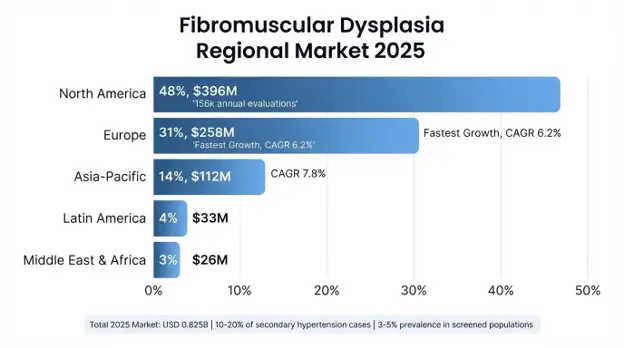
The North American region accounted for the major share in the global fibromuscular dysplasia (FMD) market in 2025 owing to advanced healthcare facilities, high awareness about the disease, and availability of specialized vascular centers. The North American region has the advantage of the FMD registry of the United States, which has helped in increasing knowledge about the disease, diagnosis, and treatment. The United States is a major contributor to the revenue generated in the regional market owing to widespread insurance coverage of imaging, interventions, and specialists' services.
Europe is the second largest market, with an estimate of USD 0.258 billion in 2025 and the fastest regional growth rate of 6.2% CAGR during the forecast period 2021 to 2034 due to the formation of European FMD registries, the developing of evidence-based guidelines for diagnosis and treatment of the disease through the European Society of Hypertension, and the setting up of FMD diagnosis centers in major hospitals of the region.
The European region has a universal healthcare system in many countries, providing full vascular diagnostic and intervention procedures irrespective of costs, research funding for studying FMD through European grants, and a multinational clinical trial network for studying FMD.
The Asia Pacific market constitutes a developing market, valued at USD 0.112 billion in 2025 and with a forecasted 7.8% CAGR up to 2034 on account of increasing healthcare infrastructure, an increasing number of imaging capabilities in major cities, and awareness among doctors about FMD from overseas medical education programs and patient advocacy efforts.
The China market accounts for 38% of market value in the region, on account of increased surveillance of vascular diseases due to large-scale epidemiological research, increased knowledge about secondary hypertension causes among Chinese doctors, and the establishment of hypertension specialist networks identifying FMD in the hypertensive population. Japan and South Korea have established healthcare infrastructure and medical imaging facilities that can diagnose FMD.
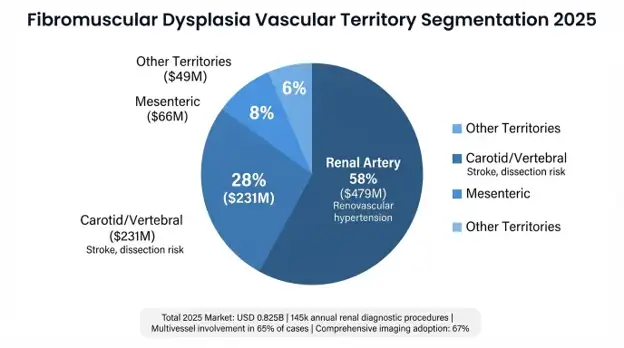
Renal Artery FMD is the most extensive vascular segment, occupying around 58% of the global market in 2025. The segment has gained such a significant market share because of high incidence and association of the condition with renovascular hypertension. Cerebrovascular FMD is one of the most rapidly growing segments due to increasing awareness about its relation to stroke, dissection, and aneurysms in young people. Mesenteric and coronary FMD are much less represented segments yet are still considered clinically important because of their relation to abdominal pain, ischemia, and acute coronary syndromes in people with no classic cardiovascular risk factors.
Medial fibroplasia is the most prevalent type of FMD, being responsible for more than 90% of all diagnosed cases in 2025. It displays a classical “string-of-beads” pattern on an angiogram and shows a good response to percutaneous transluminal angioplasty, thus being considered the typical phenotype of the disease. Intimal fibroplasia is responsible for approximately 7% of all cases and is distinguished by smooth arterial constriction, high rates of restenosis, and greater necessity of surgical revascularization. Perimedial and adventitial fibroplasia are rare forms of FMD (less than 1%), yet they still maintain their clinical significance because of peculiarities of the disease.
Medical management is the biggest treatment category within the fibromuscular dysplasia (FMD) industry, representing around 52% of the patient pool in 2025. It involves the control of hypertension through antihypertensive drugs like ACE inhibitors and ARBs in addition to antiplatelets. Percutaneous transluminal angioplasty (PTA) is the most favorable intervention, providing excellent technical success and blood pressure management. The technique is expected to be the fastest-growing segment. Surgical revascularization is a much smaller segment and used only in difficult cases of FMD such as branch renal artery disease, intimal fibroplasia, aneurysm reconstruction, or failed angioplasties.
Ultrasound imaging is the most frequently used technique for FMD diagnosis, which constitutes most of all procedures because of its availability, safety, and efficacy in early screening and further follow-up. CTA is the fast-growing market segment because of its high level of diagnostic accuracy, possibility to make three-dimensional images of blood vessels, and disease characterization. MRA has an equally high level of diagnostics without the need for radiation, so it can be used for long-term follow-up of the disease. Catheter-based angiography is the gold standard for diagnosis and used for treatment purposes mostly.
Hospitals and specialty medical centers are the biggest end-users in the FMD market owing to their sophisticated imaging technology, multidisciplinary vascular staff, and capability of handling complicated FMD cases. The rapidly growing end-user is the FMD Diagnostic Centers due to standardized diagnostic procedures, expertise of the clinical staff, and coordination of the care plan, which results in improved outcomes of the disease treatment. Ambulatory surgical facilities and vascular clinics make up an insignificant but an important part of the end-users as they perform outpatient vascular evaluation, imaging, and conservative treatment for stable FMD patients.
The global FMD market is characterized by high specialization and moderate fragmentation, as the competition in this segment is mainly driven by leading academic medical institutions and specialized vascular clinics, and not pharmaceutical companies. The competitive advantage for companies can be derived from their specialization in FMD diagnosis and vascular imaging techniques, multidisciplinary approach to patients, and conducting research. Leading clinics such as Mount Sinai Health System, Mayo Clinic, Cleveland Clinic, and Duke University Medical Center function as leading referral clinics, participating in the development of clinical guidelines and patient registry programs, conducting international studies, and setting up the trends of the global FMD market.
March 2026: The American Heart Association released an updated scientific statement regarding fibromuscular dysplasia by utilizing registry data that showed multivessel involvement in 65 percent of cases, advising comprehensive vascular imaging in all new diagnoses of FMD for better identification and prevention of cerebrovascular complications.
February 2026: The European Society of Hypertension set up an FMD working group that created guidelines for diagnosis and treatment procedures of FMD to achieve better consistency in treating this disease within the European healthcare system.
January 2026: Mayo Clinic FMD Registry increased the number of patients to 3,200, accompanied by an analysis published showing a 45% reduction in diagnostic delays due to systematic educational campaigns among providers and decision support tools used in the process.
December 2025: Duke University Medical Center launched a prospective multi-center study investigating biomarkers of FMD development and complication risk, recruiting 500 FMD patients for long-term follow-up to build risk stratification models for appropriate interventions and surveillance.
November 2025: Mount Sinai Health System organized a telemedicine consultation service for patients with FMD, making remote expert evaluation available to geographically scattered patients at 34 regional medical centers throughout North America.
You'll get the sample you asked for by email. Remember to check your spam folder as well. If you have any further questions or require additional assistance, feel free to let us know via-
+1 724 648 0810 +91 976 407 9503 sales@intellectualmarketinsights.com
22 Aug 2026
Intellectual Market Insights Research © 2026. All rights reserved.