Share this link via:

The global Fragile X syndrome market size was valued at USD 142.54 million in 2025 and is projected to reach USD 206.39 million by 2032, with continued expansion anticipated through 2034, growing at a compound annual growth rate of 5.43% during the forecast period (2026-2034).
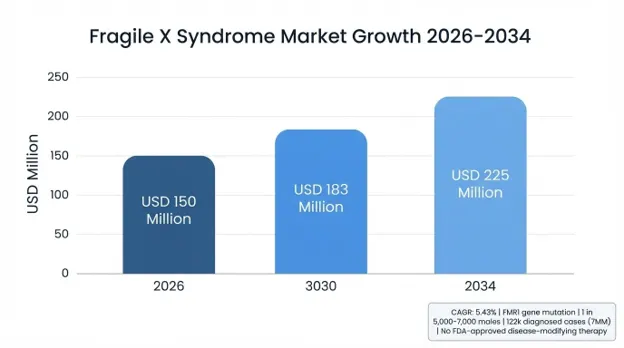
Opportunity to enter a market for therapeutic interventions to meet the unmet needs of the Fragile X syndrome patient population worldwide, including symptomatic pharmaceutical management, more targeted therapeutics in development, and emerging curative gene therapy.
Fragile X syndrome is the most frequent inherited syndrome associated with intellectual disability and developmental disorder and is caused by mutations in the FMR1 gene on the Xq27.3 chromosome. This genetic defect causes the FMR1 gene to be hypermethylated, to be silent, and to have much less or no fragile X mental retardation protein (FMRP). This protein dysfunction underlies the development of neurological impairments and abnormalities, such as the inability to synthesize proteins at synapses, instability and transport of RNA, and impaired neuronal connectivity that underlies cognitive and behavioral functions.
Fragile X syndrome presents with a variety of clinical features, such as learning disabilities (30-60% of boys and 16-20% of girls); behavioral issues including hyperactivity, impulsivity, anxiety, and aggression leading to difficulties in family and school relationships; autism spectrum disorder (46-60% of boys and 16-20% of girls); seizure disorders (10-20% of patients); sleep problems (50-80% of people); and sensory processing difficulties (enhanced sensitivity to environmental stimuli). Given the chronic progressive nature of behavioral symptoms, the multidisciplinary therapy necessary for the management of such symptoms, the significant burden to the health care system and the caregivers/families, and the absence of a disease-modifying therapy with curative intent, these impacts are significant and warrant therapeutic market development.
| Report Coverage | Details |
|---|---|
| Base Year | 2025 |
| Base Year Value | USD 142.54 Million |
| Forecast Value | USD 225.18 Million |
| CAGR | 5.43% |
| Forecast Period | 2025-2034 |
| Historical Data | 2022-2025 |
| Largest Market | North America |
| Fastest Growing Market | Asia Pacific |
| Segments Covered | By Product Type, Technology, Therapeutic Category, Clinical Application, End-User |
| Region Covered | North America, Europe, Asia Pacific, Middle East & Africa, Latin America |
| Countries Covered | US, Canada, Mexico, Germany, France, Italy, Spain, UK, China, Japan, India, Australia, South Korea, Brazil, Argentina, UAE, Saudi Arabia, South Africa |
| Key Market Playes | Zynerba Pharmaceuticals, Tetra Therapeutics, Neuren Pharmaceuticals, Marinus Pharmaceuticals, Roche (Genentech), Novartis, Healx, Acadia Pharmaceuticals |
Get more details on this report - Request Free Sample
The main structural factor contributing to the growth of the Fragile X syndrome market includes rising awareness of the prevalence of disease across the globe owing to increased diagnostic capabilities and increased clinical awareness among healthcare practitioners. Fragile X syndrome affects 1 in every 5,000-7,000 males and 1 in every 8,000-11,000 females across the globe. Recent findings indicate that the actual prevalence rate is much higher due to the presence of high rates of undiagnosed cases, especially among females with relatively milder symptoms that go unnoticed clinically. The seven major markets (the United States, Europe, and Japan) had a total of approximately 122,000 diagnosed prevalent cases of the disease in 2025.
Diagnostic delay continues to be an important obstacle to treatment initiation, as it has been found that 40% of families need to attend ten or more healthcare visits to receive a proper Fragile X syndrome diagnosis. Parents generally become aware of development delays when their children are 12 months old in the case of males and 16 months old in the case of females, although the average time between the first recognition of the development problems and receiving a proper diagnosis ranges from 20 to 26 months for the detection of development problems and 16 months after the diagnosis of developmental delays.
The absence of disease-specific therapies that target the pathophysiological mechanism associated with Fragile X syndrome, approved by the FDA, is one of the major factors driving the market. It has become imperative that any treatment does not target genetic aberration and focuses only on symptomatic treatment using pharmaceuticals that target behavior, psychiatric co-morbidities, and neurological complications. There is much need for new pharmaceutical products designed specifically for the treatment of fragile X syndrome.
Anxiety disorders in almost 96%, attention deficit hyperactivity disorder in around 84%, seizure disorders in 67%, sleep disorders in 70%, and aggression/behavioral dyscontrol in 56% of Fragile X syndrome patients necessitate treatment, which is currently pharmacological. The impact on the quality of life, academic performance, occupational opportunities, and family environment is severe due to the presence of these neuropsychiatric comorbidities in Fragile X syndrome patients. The business opportunity arises from addressing unmet medical needs by means of symptom-based therapeutic intervention for other neuropsychiatric disorders, innovative therapies for Fragile X syndrome, and gene therapy.
The extremely high failure rate of clinical trials for candidate drugs, especially those acting on the metabotropic glutamate receptors and other biological processes that get disrupted in this disease, is the most significant factor standing in the way of the development of the fragile X syndrome market. With their action to restore the balance between excitation and inhibition of neurotransmission, antagonists of metabotropic glutamate receptors, including fenobam and mavoglurant, have proven themselves highly promising in animal models. Still, despite having substantial theoretical rationale, clinical trials proved to be unable to demonstrate efficacy; the failure rate for investigational drugs in Phase II of clinical development is 89%, much higher than in other neurological and psychiatric disorders.
The diverse clinical phenotypes in Fragile X syndrome patients, the varied severity of behavioral disorders, inconsistent responses to symptomatic drugs, and changing pathophysiologic understanding make it very difficult to design clinical trials with appropriate statistical power. The use of behavioral parameters that have wide inter-observer differences, the high placebo effects in behavioral studies, which can be around 30-40%, and the problem of separating the specific symptoms of the disease from co-morbidity like autism spectrum disorder increase time and cost for development while decreasing chances for regulatory approval.
The development of gene therapy systems that would restore the functionality of the fragile X mental retardation protein using novel approaches like using adeno-associated viruses for the delivery of wild-type FMR1 genes, treating abnormal RNA splicing with ASOs, and reactivating the silenced FMR1 gene through demethylation using CRISPR systems represents an entirely novel market. These curative or disease-modifying approaches, which could potentially treat core symptoms of the disease with just one-time treatment, represent a paradigm shift from symptomatic treatments for life.
New preclinical data have provided proof of concept for several methods of gene therapy. Transduction of the FMR1 gene with AAV led to FMRP expression normalization in the tested animals, resulting in behavior correction, improved social interaction, normalized sleep pattern, and prevention of seizures. An antisense oligonucleotide therapy aimed at removing the abnormal 217-bp FMR1 mRNA isoforms could restore the formation of full-length FMR1 mRNA and FMRP expression in patient-derived cell lines. The CRISPR-mediated demethylation approach managed to reactivate the FMR1 gene fully, with FMRP expression sustained after transplantation into the mouse brain.
Opportunities within the gene therapy market include high pricing due to their curative nature and production costs ranging between USD 200,000-400,000 for each patient, that will lead to significant market value due to a small addressable population. There are currently 47 clinical gene therapies being developed against the Fragile X Syndrome with an estimated investment value of USD 2.8 billion.
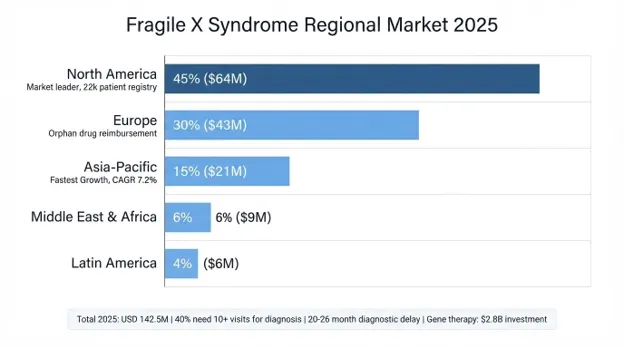
North America was the region with the highest market share, with USD 64.1 million in 2025, representing 45% of the total market value. This dominance is forecasted to be maintained till 2034, with a compounded annual growth rate of 5.8%. Presence of expertise in Fragile X Syndrome diagnosis and treatment, existence of patient registries like the National Fragile X Foundation, with over 22,000 patients enrolled, making it easy for conducting clinical trials, well-developed healthcare infrastructure with access to genetic testing facilities and specialists through leading academic medical centers, and presence of considerable pharmaceutical research investments in the U.S biopharmaceutical companies are clear signs of regional dominance.
The United States accounts for nearly 58% of Fragile X Syndrome cases that have been diagnosed in the developed markets, where the healthcare system facilitates diagnosis through molecular genetic testing, behavioral assessment, and neuropsychological evaluation. Medicare and other commercial insurances offer coverage of specific treatment options like behavioral therapy, speech therapy, occupational therapy, and drug therapy offer a platform to ensure that new treatments are adopted. The regulatory structure in place supports rapid innovation by way of orphan drugs designation, fast-track approval process, and breakthrough therapy designation of drugs.
The Asia Pacific market grew to be the fastest-growing regional market with a CAGR of 7.2% up until 2034, which is largely driven by the large population base, growth of health care infrastructure, advancements in genetic testing, and increased awareness of the condition amongst health care professionals. The potential of this region lies in the 1.8 billion people of reproductive age, who will benefit from the detection of Fragile X syndrome patients using newborn screening, carrier screening, and genetic counseling services.
China presents the largest market opportunity for the Asia Pacific, with Fragile X syndrome prevalence in diagnosed cases estimated at 38,000-50,000 patients, due to healthcare reform in the nation, increased access to genetic testing through government programs, and the creation of specialty clinics offering neurodevelopmental assessments in metropolitan cities. India offers fast market growth due to its huge base of children, increasing understanding about genetic diseases, increased access to health insurance through government schemes such as Ayushman Bharat that covers over 500 million people, and creation of high-volume specialty clinics offering neurodevelopmental services.
The Europe segment was valued at USD 42.8 million in 2025, accounting for 30% of the total market share, and is predicted to exhibit consistent growth till 2034. This is due to the existing infrastructure for diagnostics, full availability of genetic testing, healthcare systems that ensure multidisciplinary treatment methods, and effective reimbursement policy for orphan diseases through government healthcare systems and insurance mechanisms. Germany and the UK can be cited as key players in the region because of the existing rare disease research networks and pediatric neurodevelopmental expertise, along with full insurance coverage.
Symptomatic medications account for 68% of the market’s value, valued at approximately USD 96.9 million in 2025, which consists of conventional pharmacological options used to treat ADHD, anxiety, behavioral dyscontrol, and insomnia disorders as part of standard treatment practice. Targeted therapies include phosphodiesterase inhibitors, metformin treatment options, and cannabidiol and account for 22% of market shares, amounting to approximately USD 31.4 million in 2025 and showing annual growth of 12.8%, as clinical studies provide grounds for using mechanism-based treatment options. Gene therapies constitute 10% of market value, amounting to approximately USD 14.3 million in 2025.
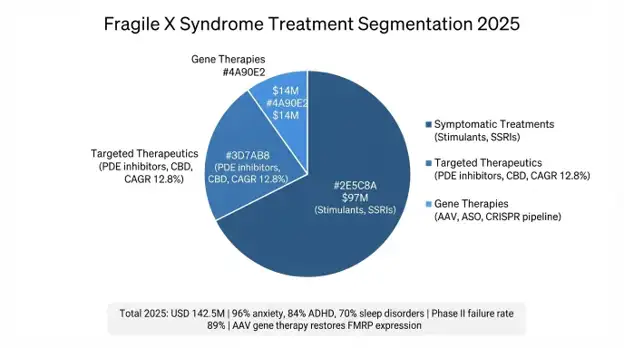
The stimulant medications comprising methylphenidate and amphetamine derivatives are the biggest therapeutic category of drugs, with a market share of 28%, treating symptoms of attention-deficit hyperactivity disorder experienced by 84% of people with Fragile X syndrome with an efficiency of about 70%. The selective serotonin reuptake inhibitors comprising sertraline have a market share of 24%, helping to manage the anxiety of about 96% of affected people using drugs. The emerging targeted therapeutics comprising phosphodiesterase-4D inhibitors and cannabidiol have a combined market share of 18%, experiencing rapid growth.
Hospitals and specialist clinics constitute 52% of market share, valued at approximately USD 74.1 million in 2025, offering diagnostic evaluation, prescription medicines, and multidisciplinary treatment coordination for difficult cases. Research centers and academic medical centers constitute 28% market share, including activities such as clinical trials, investigational drugs, and diagnostic tests. Home healthcare constitutes 12% of market share, offering behavior and occupation therapy and management of prescription medicines in a domestic setting. Diagnostic laboratories and genetic testing labs constitute 8% of market share, performing confirmatory genetic tests to diagnose Fragile X syndrome.
Fragile X Syndrome therapies represent a moderately fragmented market globally, where the top companies have a sustained competitive edge via their proprietary drugs in late clinical development, partnering with advocacy groups and research institutions, and designation of their products as orphan drugs, as well as being first movers in novel therapeutic areas. Competitive firms in this market are Zynerba Pharmaceuticals, developing Zygel (cannabidiol transdermal gel), which is in Phase III; Tetra Therapeutics, developing BPN14770 (phosphodiesterase-4D inhibitor) in Phase III; Neuren Pharmaceuticals, taking its experience in Rett syndrome to Fragile X therapy with trofinetide; Marinus Pharmaceuticals, working on ganaxolone (GABA steroid modulator); and research institutions, conducting gene therapy investigations.
March 2026: The company Tetra Therapeutics said that it had completed recruiting patients for the adult study known as EXPERIENCE-301 of zatolmilast (BPN14770). The results for efficacy and safety will be known in Q4 2026. The adolescent recruitment for the EXPERIENCE-204 study is at the final stage and should be completed by Q2 2027.
January 2026: Spinogenix Inc. has received fast-track designation from the FDA for its SPG601, which is a BK channel activator meant to correct synaptic dysfunction.
December 2025: Zygel’s Phase III trial has been boosted by Harmony Biosciences based on interim efficacy data showing statistically significant improvement in social avoidance and anxiety symptoms over placebo.
October 2025: Neuren Pharmaceuticals has commenced its cooperation with Acadia Pharmaceuticals to develop trofinetide for the treatment of fragile X syndrome due to their experience in working with the neurodevelopmental mechanisms related to Rett syndrome.
August 2025: Numerous research organizations have conducted trials involving investigational ASO treatments aimed at addressing the abnormal FMR1 mRNA splicing problem.
You'll get the sample you asked for by email. Remember to check your spam folder as well. If you have any further questions or require additional assistance, feel free to let us know via-
+1 724 648 0810 +91 976 407 9503 sales@intellectualmarketinsights.com
22 Aug 2026
Intellectual Market Insights Research © 2026. All rights reserved.