Share this link via:

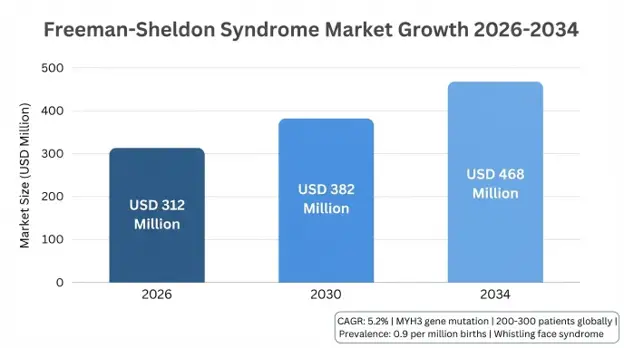
The global Freeman-Sheldon syndrome market is projected to reach USD 468 million by 2034, growing at a CAGR of 5.2% from 2026 to 2034, with the market reaching USD 312 million in 2026.
Freeman-Sheldon syndrome is also referred to as Freeman-Burian syndrome or whistling face syndrome and is an extremely rare congenital myopathic craniofacial condition that affects an estimated 200-300 people globally and has been documented to affect approximately 0.9 per one million live births. Although the number of patients with Freeman-Sheldon syndrome is small compared to some of the more common chronic diseases, it has significant commercial value due to the comprehensive nature of all of the required interventions, the long duration of treatment from infancy through adulthood, the specialized expertise required, and the premium price associated with the required coordinated multidisciplinary care protocols administered in craniofacial surgery centers and tertiary medical institutions.
Freeman-Sheldon syndrome is a genetically inherited form of developmental myopathy associated with a characteristic “whistling face” appearance with pursed lips, extremely small mouth opening (microstomia), deep nasolabial creases, H-shaped or V-shaped chin dimple (facial palsy), and extensive skeletal abnormalities of the limbs and spine. The disorder is caused by mutations in the embryonic myosin heavy chain MYH3 on the short (p) arm of chromosome 17 at band p13.1, which encodes proteins called myosins necessary to the creation of muscle fibers in the fetus. Changes in this gene prevent proper functioning of the myosin, resulting in continued muscle contractures and inadequate muscle relaxation during fetal development, which in turn leads to fixed joint deformities, muscle being replaced by fibrous tissue, and the characteristic dystonic appearance of multiple body systems.
It is a serious treatment challenge that demands multidisciplinary care that involves craniofacial surgery for reconstructing the face and managing airway issues, orthopedic surgery for correcting limb deformities, physical/occupational therapy for improving function and managing contractions, respiratory medicine for optimizing lung function, and continued medical monitoring for systemic complications such as restrictive lung disease, cardiac involvement, and gastrointestinal disorder. The market is not limited to medical products such as medicines but also includes the entire healthcare ecosystem, including diagnostic imaging, surgical equipment and implants, rehabilitation devices, fabrication of prosthetics, genetic counseling, extended disability support, and psychosocial care services to tackle the heavy burden that visible craniofacial deformities place on children's development and social integration.
| Report Coverage | Details |
|---|---|
| Base Year | 2026 |
| Base Year Value | USD 312 Million |
| Forecast Value | USD 468 Million |
| CAGR | 5.2% |
| Forecast Period | 2025-2034 |
| Historical Data | 2022-2025 |
| Largest Market | North America |
| Fastest Growing Market | Asia Pacific |
| Segments Covered | By Patient Presentation Type (Classic Type 1, Craniofacial Type 2, Mixed Type 3), By Management Approach (Surgical Intervention, Physical Rehabilitation, Combined Multidisciplinary Management), By Disease Severity (Mild, Moderate, Severe), By End-User (Craniofacial Centers, Orthopedic Specialty Clinics, Rehabilitation Facilities, Pediatric Hospitals), By Region (North America, Europe, Asia Pacific, Middle East & Africa, Latin America) |
| Region Covered | North America, Europe, Asia Pacific, Middle East & Africa, Latin America |
| Countries Covered | United States, Canada, Germany, UK, France, Japan, South Korea, Australia, Middle East & Africa countries, Latin American countries |
| Key Market Playes | Pfizer Inc., F. Hoffmann-La Roche Ltd., Novartis AG, Sarepta Therapeutics, Inc., Ultragenyx Pharmaceutical Inc., REGENXBIO Inc., Astellas Pharma Inc., BioMarin Pharmaceutical Inc., PTC Therapeutics, Inc., Orchard Therapeutics plc. |
Get more details on this report - Request Free Sample
Frequently, the expansion of the market for Freeman-Sheldon syndrome is a consequence of increased diagnostic awareness of pediatricians, obstetricians, and craniofacial specialists, which means that the syndrome is identified earlier and management is introduced in time periods of critical development. Historical underdiagnosis of FSS occurred due to its very rare nature, and many cases were incidental to other broader diagnoses of arthrogryposis multiplex congenita or mistaken for other different syndromes, such as Sheldon-Hall syndrome, which made access to the most effective multidisciplinary care and therapeutic interventions more difficult. The use of genetic testing based on sequencing of the MYH3 gene has ushered in a new era of diagnostic confirmation, allowing definitive diagnosis in phenotypically similar disease groups and allowing complete genetic counseling for affected families on recurrence risk and reproductive planning.
Early diagnosis allows for early referral to craniofacial surgery centers that can carry out specialized procedures when they would be most beneficial to the child's development, and there are known benefits of having comprehensive reconstruction before the entry years to school. The creation of international registries and patient advocacy groups such as Freeman-Sheldon Research Group has greatly improved the education and networking of physicians, expanding the availability of information on best management practices and providing a means for systematic collection of long-term outcomes.
Improvements in surgical instruments, monitoring systems, and anesthetic practice throughout the years have increasingly afforded an ever-greater number of treatment options for patients with Freeman-Sheldon syndrome who were previously deemed to be poor surgical candidates due to the extreme complexity of their airway anatomy and the difficulties of giving anesthesia. Highly specialized endoscopy equipment has made it possible to visualize distorted airway anatomy, and advanced airway devices have been developed that are appropriate for extreme mouth openings; alongside this, highly sophisticated intraoperative neuromonitoring has greatly improved surgical safety profiles. The peri-operative mortality rates have dramatically reduced in patients with Freeman-Sheldon syndrome who receive surgical reconstruction at specialized craniofacial centers with extensive experience in this rare disorder.
Rehabilitation technologies such as advanced bracing systems, which can use 3D printing capabilities to manufacture splints that are optimized for the individual hand and foot form and fit, and prosthetic designs for children that cater to developmental growth needs have enhanced functional outcomes. In a carefully selected group of patients where the risks of operative correction are unacceptable, the use of the Ponseti method modified for Freeman-Sheldon syndrome-related clubfoot has led to enhanced results with the use of special post-correction bracing protocols.
The global market for Freeman-Sheldon syndrome (FSS) is heavily constrained due to the very low prevalence rate of the syndrome, with no more than a few hundred diagnosed cases across the globe. Such a small number of patients lowers the business appeal of the market, thus making it less profitable to invest in drug development. Innovative drugs for FSS are few, and currently all treatment approaches are primarily aimed at alleviating the symptoms of the disease rather than modifying it. Another challenge that faces the market for FSS is late or wrong diagnosis, since the syndrome has several clinical features like other congenital musculoskeletal and craniofacial syndromes. Due to the lack of proper knowledge about FSS, patients are usually misdiagnosed and do not receive adequate medical treatment for years, further preventing the growth of the market. Limited access to genetic testing facilities is another problem of the FSS market, especially in developing countries.
The emergence of advanced genetic sequencing techniques and precision medicine represents a key growth prospect for the global Freeman-Sheldon syndrome (FSS) market. With the rising number of patients being tested with NGS, whole-exome sequencing, and prenatal genetic testing, the diagnosis of MYH3 gene mutation (the main genetic cause of FSS) has been significantly improved, resulting in earlier diagnosis and timely multidisciplinary treatment (orthopedic surgery, respiratory care, speech therapy, rehabilitation, and nutrition). Moreover, ongoing research in the fields of gene editing, RNA-based therapies, stem cell technologies, and regenerative medicine opens the perspective of developing drugs targeting genetic defects causing FSS. Over the course of the next 10 years, such developments can drastically change the current treatment paradigm for FSS patients. The growth in government funding in the field of rare diseases research, orphan drugs' incentives, and partnerships between academic and biotech companies can be seen as another driver of innovation in the FSS space. The development of the field of precision medicine and the development of personalized treatments and diagnostics are expected to increase the quality of patients' lives and bring commercial success to biopharmaceuticals.
The treatment of Freeman-Sheldon syndrome is also very difficult since the disease requires constant treatment using the help of orthopedic surgeons, pediatricians, neurologists, anesthesiologists, rehabilitators, speech therapists, respiration doctors, and genetic counseling. The treatment includes a series of operations aimed at the correction of skeleton problems, face problems, and joint contractures, followed by physical therapy, occupational therapy, and regular monitoring that allows maintaining the mobility of the patient. This type of treatment is additionally complicated by airway management difficulties and increased risks associated with anesthesia due to problems with the craniofacial structure of the patients, which increases the complexity of surgical procedures. All the factors mentioned significantly increase the cost of the treatment of the patients. In developing countries, there is a lack of specialized centers of health care, rehabilitation institutions, genetic testing, and specialized doctors, limiting access to treatment.
Management of specialists of various profiles and follow-up of patients may also bring some operational difficulties. In addition, there are no standard procedures of treatment, which, along with rareness of the disease, leads to inconsistency of patients' outcomes. Providing specialized treatment and affordable high-quality treatment is one of the biggest market entry barriers.
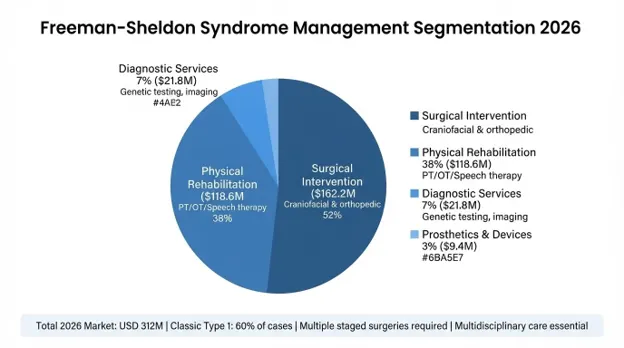
In the case of Freeman-Sheldon syndrome, the proportion of surgical treatment is roughly 52 percent of all treatment types, making this type of treatment the largest one in terms of therapeutic segmentation. It includes the correction of orthopedic deformities and craniofacial reconstruction, as well as airway surgery. Commisuroplasty, lip reconstruction, ptosis correction, tendon release, and joint contracture correction are commonly used in the process of treatment. Multiple staged operations are required because of the growth-related changes and the progression of the disease. Surgical treatment is the main treatment strategy for maximizing mobility, speech, swallowing, and overall functional independence of the patient.
Rehabilitation services are vital in improving functional outcomes and constitute 38% of the market for treatment of Freeman-Sheldon syndrome. Physical therapy, occupational therapy, and speech-language therapy have been included in this category in order to control joint contractures, increase mobility, improve hand functioning, and solve problems of speech and swallowing. Better clinical outcomes are associated with early initiation in infancy, usually delaying or reducing the need for surgery. Despite advancing physical limitations, the continued rehabilitation facilitates self-reliance in daily life tasks and preserves joint mobility and muscle flexibility. Rehabilitation forms an important component of the all-inclusive management of Freeman-Sheldon syndrome because continued treatment, exercises, and caregiver education remain necessary in adult life to avoid contracture progression and maintain functional capacity.
Diagnostic services, such as genetic screening; imaging studies that evaluate the structure of the joints, chest wall mechanics, and spine abnormality; pulmonary function studies; and cardiac evaluation account for approximately 7% of the market value. Diagnostic services help in identifying the normal function of an individual and highlight problems that require intervention and determine the course of action. Serial imaging and pulmonary function studies during childhood and adolescent years may help in preventing restrictive physiology.
Approximately 3% of the market value is made up of custom prosthetic limbs and special assistive devices. Prosthetic limbs should be able to take care of severe foot deformities since surgery is not possible or desirable in such cases. The replacement of prosthetic limbs should occur after every 18 to 24 months during the growing years and every year in the case of adolescents because of pediatric prosthetic needs. With the use of advanced technology and three-dimensional printing, it is possible to create personalized prosthetic limbs according to the body structure of patients.
Type 1 (Classic Form) has the highest proportion among all the Freeman Sheldon syndrome market segments and makes up around 60% of all cases. This form is distinguished by specific craniofacial anomalies along with contractures of various joints of the hands, feet, spine, hips, and shoulder blades. The patients must go through multiple correction surgeries and need intensive rehabilitation because of progressive musculoskeletal, respiratory, and gastrointestinal issues. Type 2 (Craniofacial Dominant Type) accounts for about 25% of all cases and is typified by the presence of predominantly craniofacial deformities with mild limb deformities; hence, its treatment becomes less complicated and more favorable. Type 3 (Intermediate Type) comprises the final 15% of the section and exhibits moderately severe craniofacial deformities and contractures.
The pulmonary complications are by far the biggest and the most important part of clinical manifestation in the Freeman Sheldon syndrome market, given that they greatly affect morbidity and have a need for health care in the long run. Spinal deformities, restricted movement of the chest wall, and craniofacial abnormalities often cause restrictive lung disease that calls for respiratory monitoring, oxygen therapy, and pulmonary treatment for a long period of time. The second type of manifestation is Gastrointestinal and Swallowing Complications, including feeding problems, the risk of aspiration, gastroesophageal reflux, and undernutrition, all of which call for nutritional intervention, speech therapy, and sometimes even tube feeding when children are very young. Musculoskeletal and orthopedic complications, like progressive joint contractures and spinal deformities, imply orthopedic monitoring and surgical correction.
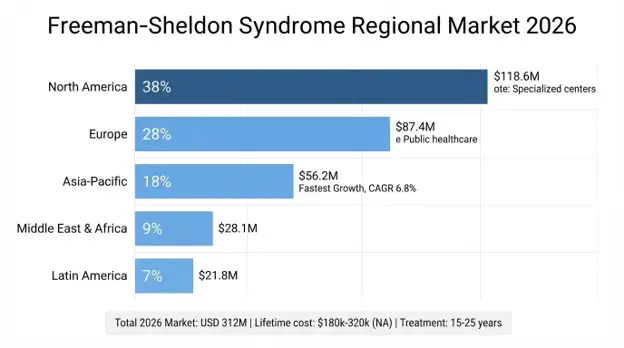
The Freeman-Sheldon syndrome treatment management market is led by North America with a value share of about 38% because of the presence of highly sophisticated infrastructure in terms of craniofacial surgery, good insurance that will cover the expensive multidisciplinary treatment process, and expertise available at academic centers. The United States is home to the Freeman-Sheldon Research Group and various specialized craniofacial treatment centers that have handled such cases in the past, making it the best in terms of treating this condition in the world. Lifetime management costs in North America range between USD 180,000 and USD 320,000.
Europe accounts for roughly 28% of the world’s market value, while specialized centers in Germany, the UK, France, and some other developed countries offer complete Freeman-Sheldon syndrome care. Multidisciplinary care is often facilitated in Europe by public financing mechanisms; innovative treatments can be somewhat less prevalent compared to North American centers. The lifetime cost of treatment in Europe is estimated at between USD 140,000 and USD 240,000.
The Asia Pacific region shows the highest growth rate of around 6.8% per year till 2034 due to the development of the healthcare sector in advanced Asian countries like Japan, South Korea, and Australia; increasing referrals of patients for medical tourism; and the establishment of expertise in performing craniofacial surgeries in prominent Asian medical facilities. The absolute market size is quite small, approximately 18% of the global total, owing to low patient recognition rates and fewer numbers of craniofacial specialty centers in poor regions. The Middle East & Africa and Latin American regions together account for about 16% of the global market size, owing to inadequate facilities and lack of funds for comprehensive treatment.
Craniofacial specialty centers as well as medical educational institutions own about 52% of the Freeman-Sheldon Syndrome management market, offering a full scope of surgical experience and multidisciplinary cooperation. These specialized centers are often functioning on the regional or even national level as referral centers for the geographically distant patients and centers of excellence in the management of Freeman-Sheldon Syndrome.
Pediatric hospitals and orthopedic specialty centers make up about 28% of market share, offering rehabilitative treatments, orthopedic procedures, and continuous medical management of Freeman-Sheldon Syndrome patients. Rehabilitation centers and outpatient clinics comprise about 14% of market share, offering physical and occupational therapy programs, manufacture of prostheses, and assistance devices.
The market for Freeman-Sheldon syndrome is a low-concentration one owing to the unique rarity of the disorder and the scarcity of centers that possess the clinical know-how to offer the best treatment for patients suffering from it. Academic centers specializing in craniofacial problems enjoy competitive advantages owing to their cumulative experience, referral networks, and research. The prominent craniofacial surgical centers around the world include centers located in North America, Europe, and Australia with specialist programs for the treatment of Freeman-Sheldon syndrome. Competitive advantage stems from clinical outcomes, evidence of functional success, multidisciplinary cooperation, support services, and research.
You'll get the sample you asked for by email. Remember to check your spam folder as well. If you have any further questions or require additional assistance, feel free to let us know via-
+1 724 648 0810 +91 976 407 9503 sales@intellectualmarketinsights.com
22 Aug 2026
Intellectual Market Insights Research © 2026. All rights reserved.